
Top Indicators Your Mid-Market Sales Team Has Outgrown Its Toolset
Your sales team is working harder than ever, but quota attainment keeps slipping. Reps toggle between six different tools before sending a single email. RevOps spends more time reconciling data than generating insights. These aren't execution problems. They're signals that your sales tech stack has hit its ceiling.
Mid-market teams face a specific inflection point: they've grown past the point where point solutions work, but haven't yet consolidated into a unified GTM platform. Identifying that moment early is the difference between a smooth scale-up and a painful, expensive overhaul.

Research Less, Close More With Apollo
Tired of burning hours tracking down emails and phone numbers that bounce? Apollo delivers verified contact data so your team spends time selling, not searching. Join 600K+ companies building pipeline faster.
Start Free with Apollo →Key Takeaways
- Quota attainment is at a multi-year low industrywide, and fragmented toolsets are a primary contributing factor.
- When sales plays can't be embedded in CRM workflows, the stack is structurally broken, not just inconvenient.
- Data quality failures block AI initiatives before they start, making clean, unified data a prerequisite for scale.
- RevOps leaders lose disproportionate time managing integrations instead of driving revenue strategy.
- Consolidating to a unified GTM platform is now a mainstream move, not a nice-to-have.
What Are the Top Indicators a Mid-Market Sales Team Has Outgrown Its Toolset?
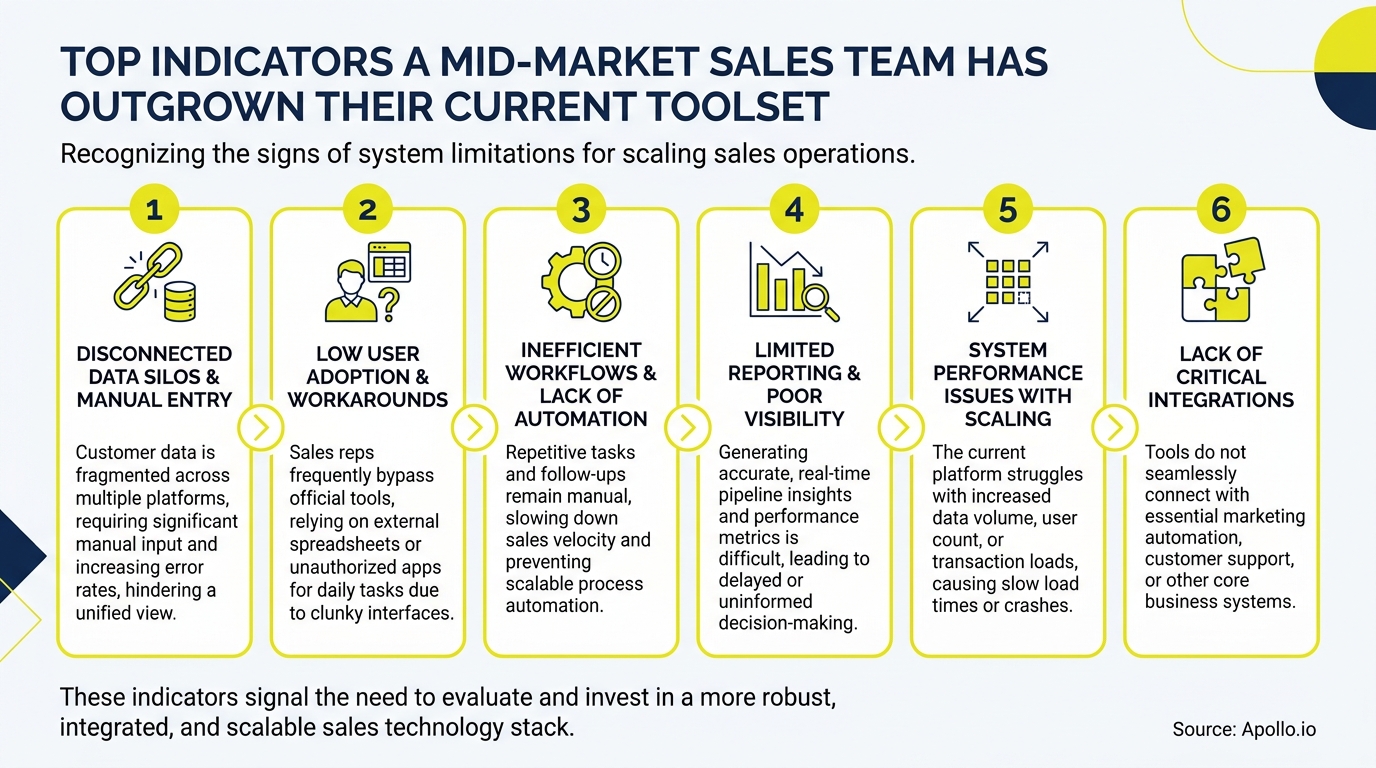
A mid-market sales team has outgrown its toolset when the tools create more coordination work than selling time, when data lives in silos that can't support forecasting or AI, and when reps are toggling between systems instead of executing plays. These are structural failures, not adoption problems. According to Bain & Company, 70% of companies struggle to effectively integrate their sales plays into revenue technology tools, limiting their ability to achieve expected growth gains. That statistic describes a stack that no longer fits the operating model.
The clearest warning signs fall into four categories: performance decline, workflow friction, data dysfunction, and AI readiness failure. Use the table below as a quick diagnostic.
| Indicator Category | Observable Signal | Severity |
|---|---|---|
| Performance | Quota attainment declining for 2+ consecutive quarters | High |
| Performance | Win rates falling while quotas increase | High |
| Workflow Friction | Reps use 5+ tools in a single prospecting workflow | High |
| Workflow Friction | Sales plays exist in decks, not in CRM stages | High |
| Data Dysfunction | CRM data is incomplete or unreliable for forecasting | Critical |
| Data Dysfunction | RevOps spends majority of time on data reconciliation | High |
| AI Readiness | AI tools were purchased but deliver no measurable output | Critical |
| AI Readiness | No unified data layer across engagement and CRM | Critical |
Why Is Declining Quota Attainment a Stack Problem?
Declining quota attainment often signals that the toolset can no longer support the volume or complexity of the team's current selling motion. Research from Everstage shows that only 28% of sales representatives hit their annual quota, the lowest figure in six years. When win rates fall alongside rising targets, the problem rarely sits with individual reps. It sits with the infrastructure they're working inside.
According to data cited by Sailes, average win rates dropped from 23% in 2022 to 19% in 2024, while sales executives faced an average 7.5% increase in quota. Teams operating on fragmented stacks absorb that pressure without the systems to respond to it. Reps spend time on tool administration instead of active selling, and managers lack the unified visibility to course-correct in time.
Struggling to keep your pipeline healthy across disconnected tools? Build and manage your pipeline in one place with Apollo.
How Does Data Dysfunction Signal an Outgrown Stack?
Data dysfunction is the most reliable leading indicator that a stack has been outgrown. When contact data is incomplete, CRM records are stale, and engagement data lives in a separate tool from opportunity data, the entire GTM motion degrades. Research from Nektar.ai found that 45% of sellers report incomplete data as their biggest challenge, with unreliable data persisting in core CRM systems.
For mid-market RevOps leaders, this creates a compounding problem. Forecasts are unreliable because pipeline data is manually entered and inconsistently maintained.
AI tools purchased to automate prospecting or scoring can't function without a clean, unified data layer. The result: expensive technology that produces no measurable output, and a RevOps team trapped in data maintenance mode instead of strategy mode.
This is a structural ceiling, not a training issue.
Turn Funnel Guesswork Into Pipeline Wins
Tired of watching quality leads stall before they ever reach your pipeline? Apollo surfaces in-market buyers with precision targeting so your team stops chasing and starts closing. Nearly 100K paying customers trust Apollo to forecast with confidence.
Start Free with Apollo →What Are the Signs RevOps Teams Have Hit the Integration Ceiling?
RevOps teams have hit the integration ceiling when more than a third of their capacity goes to maintaining integrations rather than improving revenue operations. Mid-market firms frequently operate stacks of six or more tools, many of which are not fully integrated or adopted, creating persistent operational bottlenecks as noted by Fullfunnel. The integration tax compounds with every new tool added.
Specific RevOps warning signs include:
- CRM integration failures cited as a top reason for project underperformance (lack of integration with other tools is a leading cause of CRM project failures, per SLT Creative)
- Sales plays documented in slides or wikis but not embedded in CRM workflow stages
- Separate tools for prospecting, sequencing, calling, and forecasting with no shared data model
- Manual exports required to get data from engagement tools into CRM
- No single source of truth for rep activity, pipeline health, or deal stage
The consolidation trend is now mainstream: vendor messaging across the industry has converged on unified AI and RevOps platforms as the 2026 default. This shift reflects a real operational need, not just a marketing cycle.

How Do SDRs and AEs Know Their Tools Are Holding Them Back?
SDRs and AEs know their tools are holding them back when they spend more time managing their stack than executing outreach or advancing deals. For SDRs, the clearest signal is spending significant time each day switching between a prospecting database, a sequencing tool, a dialer, and a CRM, with no single workspace that connects all four.
For AEs, it shows up as incomplete pre-call intelligence, manual note-taking with no conversation capture, and deal stages that don't reflect actual buyer behavior.
These are not workflow preference issues. They reflect a stack that was built for a smaller team or simpler motion and never scaled. Sales productivity breaks down when reps must act as their own integration layer between disconnected tools. The administrative overhead compounds daily, and the reps who feel it most acutely are often the ones closest to quota pressure.
Spending too much rep time on manual outreach and tool-switching? Run multi-channel sequences from one workspace with Apollo.
What Does an Outgrown Stack Look Like for AI Readiness?
An outgrown stack blocks AI adoption before it begins. AI tools require a clean, unified data foundation to generate reliable outputs.
When engagement data sits in one tool, contact data in another, and call recordings in a third, AI has no coherent input to work from. The result is AI purchases that produce no measurable lift, which mid-market teams increasingly experience as a credibility problem with leadership.
The agentic AI era raises the stakes further. Platforms like Salesforce's Agentforce and Microsoft's 365 Copilot agents are designed to execute workflows autonomously, but only when the underlying data is governed, accessible, and unified.
Teams still operating fragmented point-solution stacks cannot unlock agentic workflows regardless of which AI tools they purchase. Governance, permissions, and a unified data model are prerequisites, not features.
This is the new definition of having outgrown your stack: your AI ambitions exceed your data infrastructure.
For teams evaluating their sales intelligence tools, the right question is no longer just "does this tool do X?" It's "does this platform give us a unified data layer that supports AI execution at scale?"
What Is the 90-Day Path from Outgrown Stack to Unified GTM Platform?
The 90-day path from fragmented stack to unified platform follows three phases: audit, consolidate, and instrument. Each phase has a clear owner and success metric.
| Phase | Timeframe | Owner | Key Actions | Success Metric |
|---|---|---|---|---|
| Audit | Days 1–30 | RevOps | Map all active tools, integration points, and data gaps; score stack against diagnostic indicators above | Stack audit complete; redundancies identified |
| Consolidate | Days 31–60 | RevOps + Sales Leadership | Select unified platform; migrate data; sunset redundant tools; embed plays in CRM workflow stages | Single workspace live for SDRs and AEs; plays in CRM |
| Instrument | Days 61–90 | RevOps + Enablement | Define rep activity benchmarks; activate AI features; set governance and data hygiene standards | Forecast reliability improves; AI outputs measurable |
Teams that consolidate report meaningful outcomes. "We reduced the complexity of three tools into one," noted Collin Stewart at Predictable Revenue. "Having everything in one system was a game changer," said the team at Cyera. The operational shift is real: fewer integrations to maintain, one data model to govern, and reps working from a single workspace. Building a sales tech stack that scales revenue starts with recognizing when the current one has stopped scaling.

What Should Mid-Market Teams Do When They Recognize These Signals?
Mid-market teams that recognize these signals should act on them as operational risk, not as a future planning item. The longer a fragmented stack persists, the more data debt accumulates, the more AI potential is blocked, and the harder the eventual migration becomes.
The diagnostic indicators in this article are measurable: quota trends, win rates, RevOps capacity allocation, CRM data completeness, and AI output. Run the audit in 30 days and make the consolidation decision with data.
Apollo gives B2B GTM teams a unified platform covering prospecting, multi-channel engagement, conversation intelligence, and deal management in one workspace. Trusted by nearly 100K paying customers including Anthropic, Smartling, and Redis, Apollo consolidates the fragmented stack that holds mid-market teams back. "We cut our costs in half," said the team at Census. Explore what enterprise sales solutions look like when everything runs from one platform, and see how Apollo's unified GTM platform supports teams from mid-market through enterprise.
Start a Trial and see how Apollo consolidates your stack into one workspace for prospecting, engagement, and pipeline management.
Prove Pipeline ROI Before Next Quarter
ROI pressure killing your tool budget approval? Apollo delivers measurable pipeline impact your leadership can see — faster. Teams like Built-In achieved +10% win rates and +10% ACV with Apollo.
Start Free with Apollo →Don't miss these
Sales
Inbound vs Outbound Marketing: Which Strategy Wins?
Sales
What Is a Sales Funnel? The Non-Linear Revenue Framework for 2026
Sales
What Is a Go-to-Market Strategy? The 2026 GTM Playbook
See Apollo in action
We'd love to show how Apollo can help you sell better.
By submitting this form, you will receive information, tips, and promotions from Apollo. To learn more, see our Privacy Statement.
4.7/5 based on 9,690 reviews
