
What Are the Most Common GTM Tool Consolidation Mistakes Mid-Market Companies Make?
Most mid-market GTM consolidation efforts fail not because teams chose the wrong platform, but because they treated consolidation as a procurement project instead of a change-management program. The result: stacks stay bloated, integrations break, and reps lose time that should go to selling. If you're evaluating your GTM tools or planning a rationalization effort, knowing these mistakes upfront saves months of rework.

Research Less, Pipeline More With Apollo
Tired of your reps burning hours on manual research instead of selling? Apollo surfaces verified contacts instantly, so your team spends time closing — not hunting. Join 600K+ companies building pipeline faster.
Start Free with Apollo →Key Takeaways
- GTM tool consolidation most often fails because teams cut tools without first fixing their data model or workflow design.
- Mid-market companies are uniquely prone to team-level shadow purchasing that undoes platform-level consolidation.
- Consolidation without enablement investment leads to low adoption on the new platform and continued use of legacy tools.
- RevOps leaders who treat consolidation as ongoing governance, not a one-time project, achieve lasting results.
- A unified GTM platform eliminates integration debt and gives every team, from SDRs to AEs to RevOps, one source of truth.
Why Do Mid-Market GTM Stacks Keep Growing Despite Consolidation Pressure?
Mid-market stacks keep growing because consolidation efforts address platform licenses while ignoring team-level purchasing behavior. According to Martech.org, more than half of GTM teams (53%) identify technology as the primary barrier to alignment, with only 30% believing their existing tech stack actually facilitates it. Yet tool counts continue to climb.
The pattern is predictable: a RevOps leader consolidates the core stack, but individual teams quietly add point solutions to fill gaps. Research from Netguru shows that a survey of 720 sales reps revealed they spend almost 65% of their work time on activities other than selling, largely due to disconnected systems that undermine data integration. Consolidation that doesn't address the root workflow gaps simply shifts where the sprawl lives.
Three structural causes drive this cycle:
- No intake governance: Any team member can expense a new SaaS tool without a capability review.
- Platform-level thinking: Leaders consolidate contracts but don't sunset the underlying use cases that spawned the old tools.
- Integration debt accumulation: Each new tool creates a new data sync requirement, compounding the problem over time.
What Are the Six Most Common GTM Tool Consolidation Mistakes?
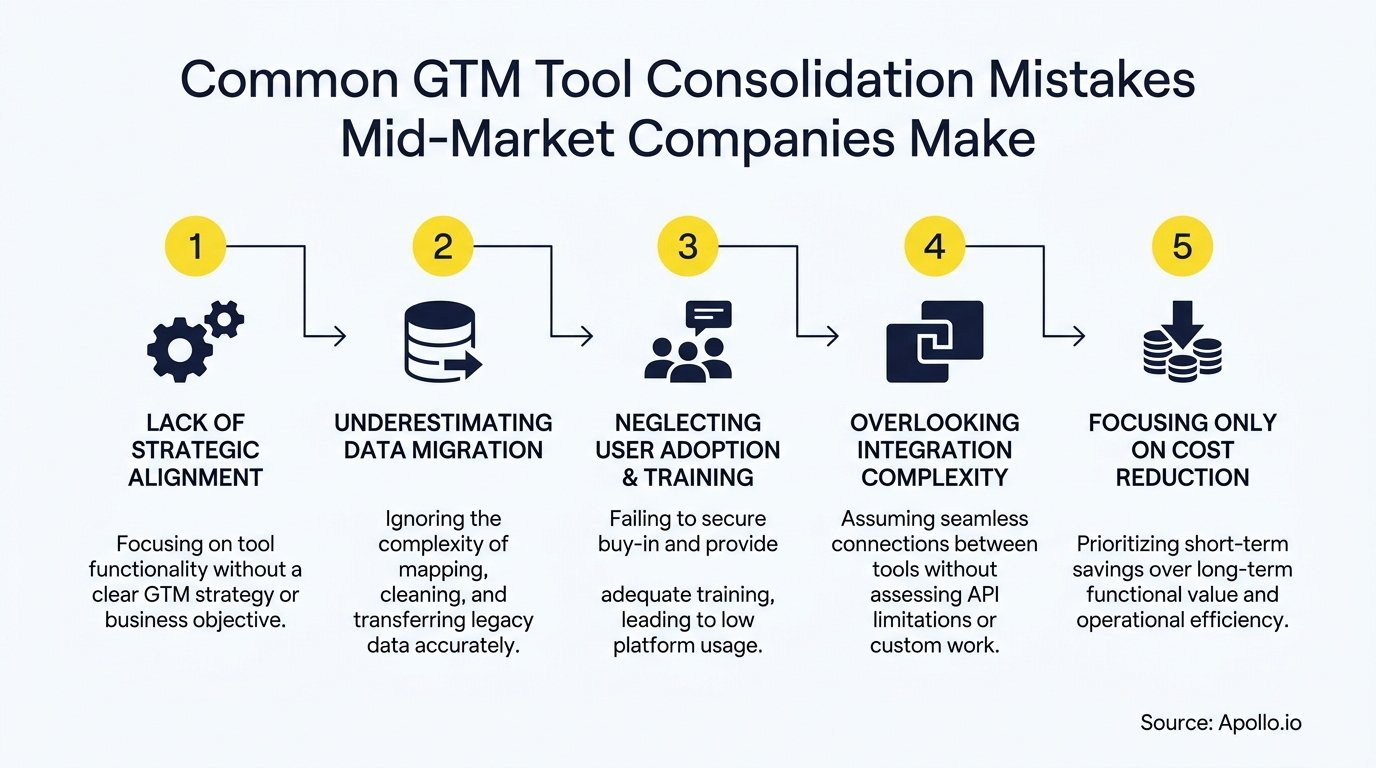
The most common GTM tool consolidation mistakes mid-market companies make fall into six repeating patterns, each tied to a specific governance or process failure.
| Mistake | Root Cause | Consequence |
|---|---|---|
| Cutting tools before fixing the data model | Procurement-first thinking | Broken reporting, lost pipeline attribution |
| Treating consolidation as a one-time project | No ongoing governance charter | Sprawl returns within 6-12 months |
| Ignoring team-level shadow purchasing | No intake gate or approval process | Platform consolidation undone by team additions |
| Under-investing in enablement | Assuming a better platform = automatic adoption | Low utilization, reps revert to old tools |
| Skipping cross-functional alignment | Marketing consolidates without Finance or IT buy-in | Budget conflicts, delayed rollouts |
| Automating broken processes | Platform migration before workflow redesign | Faster execution of flawed GTM motions |
Data from CX Today reinforces the scale of this problem: Salesforce's 2026 research indicates that sales teams use an average of eight tools, with 42% of reps reporting tool overload as a problem. Consolidation that doesn't reduce cognitive load for reps fails the people it was meant to help.
Struggling to manage pipeline across disconnected tools? See how Apollo unifies your pipeline in one workspace.

How Do RevOps Leaders Build a Continuous Governance Model?
RevOps leaders prevent consolidation drift by treating tool governance as an ongoing operating rhythm, not a one-time initiative. The goal is a living program with clear ownership, intake gates, and deprecation SLAs.
Core governance artifacts every mid-market GTM team needs:
- Tool intake gate: A simple request form requiring capability justification, integration assessment, and owner assignment before any new tool is approved.
- Deprecation SLA: A defined timeline (typically 30-60-90 days) for sunsetting a replaced tool after migration, preventing dual-running costs.
- RACI for data ownership: Clear accountability for each data object in the GTM stack (contacts, accounts, opportunities) to prevent data quality decay.
- Quarterly stack review: A recurring ritual where RevOps reviews utilization, integration health, and tool ROI against a scorecard.
For B2B marketing tool decisions, this governance model also ensures marketing doesn't rebuild the same capabilities RevOps already consolidated in the sales stack.
Turn Funnel Guesswork Into Pipeline Confidence
Tired of watching marketing leads stall before they ever reach your pipeline? Apollo surfaces high-intent prospects and keeps your funnel moving with verified contacts that actually convert. Join 600K+ companies forecasting with confidence.
Start Free with Apollo →How Should RevOps Teams Build the CFO Case for Consolidation?
RevOps teams build a CFO-ready consolidation case by framing it around total cost of ownership (TCO), not just license savings. CFOs approve consolidation when they see concrete payback scenarios tied to revenue risk reduction.
TCO components to include in your model:
- License costs: active subscriptions across all GTM tools, including team-level shadow IT
- Integration maintenance: engineering hours spent maintaining data syncs between tools
- Enablement costs: onboarding and ongoing training across multiple platforms
- Revenue leakage: pipeline lost to attribution gaps and missed follow-up from data inconsistencies
The revenue leakage line is often the most persuasive. A Hidden Revenue Execution Crisis report found that for a typical B2B SaaS company, execution gaps result in 10-15% of potential revenue lost, with mid-market SaaS companies potentially losing 15-25% of their annual revenue due to these issues. Framing consolidation as revenue recovery, not cost reduction, changes the conversation with finance.
When Census consolidated their GTM stack with Apollo, the outcome was direct: "We cut our costs in half." That's the CFO language that moves consolidation from backlog to priority.
How Do SDRs and AEs Lose Productivity During Poorly Managed Consolidation?
SDRs and AEs lose productivity during consolidation when migration timelines extend and they're forced to operate in two systems simultaneously. This dual-running period is where pipeline coverage drops and adoption stalls permanently.
Common rep-level failure modes during consolidation:
- SDRs revert to legacy sequencing tools when the new platform hasn't been configured to match their existing workflows.
- AEs lose deal context when CRM data is migrated incompletely, particularly custom fields and activity history.
- Sales managers lose visibility into team performance when reporting breaks during the transition window.
The fix is a sequenced migration plan: configure and validate the new platform fully before sunsetting the old one, and assign a dedicated owner for each team's workflow migration. Reps need to see their exact workflow replicated in the new tool before they'll commit to it.
For teams using sales intelligence tools, consolidating data, sequencing, and reporting into one platform removes the context-switching that kills rep productivity during and after migrations.
Spending too much time managing disconnected outreach tools? Automate your sequences with Apollo's multi-channel engagement platform.
What Does a Successful Mid-Market GTM Consolidation Look Like?
Successful mid-market GTM consolidation follows a process-before-platform sequence: define the target workflow and data model first, then select and migrate to a unified platform. Teams that invert this order automate broken processes and amplify existing problems.
A practical 4-phase consolidation sequence:
- Audit: Map every active GTM tool, its owner, utilization rate, and integration dependencies.
- Design: Define the target data model, workflow, and reporting structure independent of any specific tool.
- Migrate: Configure the unified platform to match the designed workflow, validate with a pilot team, then migrate in phases.
- Govern: Activate intake gates, deprecation SLAs, and quarterly reviews to prevent re-sprawl.
Approximately 90% of B2B teams face attribution challenges due to fragmented data and siloed systems, according to Heinz Marketing. The teams that close this gap do so by establishing a single source of truth for GTM data before migrating any workflows. Cyera's experience captures this well: "Having everything in one system was a game changer."
Predictable Revenue reached the same conclusion after consolidating with Apollo: "We reduced the complexity of three tools into one." That simplicity is what enables consistent demand gen metrics and reliable pipeline forecasting.

How Do You Avoid GTM Consolidation Mistakes in 2026?
Avoiding the most common GTM tool consolidation mistakes in 2026 requires treating consolidation as a continuous governance program, not a one-time project. The teams that get it right combine clear ownership, intake discipline, and a unified platform that gives every role, from SDRs to RevOps to sales leaders, one workspace.
The checklist that separates successful consolidations from failed ones:
- Fix your data model before selecting a new platform
- Assign a named owner for every tool and data object
- Build and enforce an intake gate for all new tool requests
- Define deprecation SLAs before migration begins, not after
- Invest in enablement proportional to the scope of change
- Run quarterly governance reviews to catch re-sprawl early
Apollo is built for this consolidation outcome. It combines sales intelligence, multi-channel engagement, sales automation, and pipeline management in a single platform trusted by nearly 100K paying customers across 600K+ companies. Whether you're a RevOps leader rationalizing a fragmented stack or a founder building your first scalable GTM motion, Apollo removes the integration debt that stalls consolidation programs.
Ready to consolidate your GTM stack and stop paying for tools your team doesn't use? Start a free trial with Apollo and see how one unified platform replaces the sprawl.
Prove Pipeline ROI With Apollo
ROI pressure killing your tool budget? Apollo delivers measurable pipeline impact fast — so you can walk into any budget review with numbers that stick. Join 600K+ companies justifying every dollar spent.
Start Free with Apollo →Don't miss these
Sales
Inbound vs Outbound Marketing: Which Strategy Wins?
Sales
What Is a Sales Funnel? The Non-Linear Revenue Framework for 2026
Sales
What Is a Go-to-Market Strategy? The 2026 GTM Playbook
See Apollo in action
We'd love to show how Apollo can help you sell better.
By submitting this form, you will receive information, tips, and promotions from Apollo. To learn more, see our Privacy Statement.
4.7/5 based on 9,690 reviews
