
What Are the Limitations of Current AI SDR Tools in 2026?
AI SDR tools promise hands-free pipeline. The reality is more complicated. Most deployments hit hard ceilings in data quality, deliverability, and personalization depth — problems that copy generation alone cannot fix. Understanding these constraints is the difference between a productive AI outbound motion and a domain reputation disaster. Tools like Apollo's AI Sales Assistant are designed to address these gaps by grounding AI outputs in real account signals and verified contact data, rather than generating generic outreach at scale.
If you're evaluating sales intelligence tools or deciding how to augment your SDR team with AI, this breakdown covers the core limitations and how to work around them in 2026.

Research Less, Close More With Apollo
Tired of burning hours verifying contact info instead of selling? Apollo delivers accurate business contacts instantly, so your team spends time closing — not chasing. Join 600K+ companies building pipeline faster.
Start Free with Apollo →Key Takeaways
- Data decay is the root cause of most AI SDR failures — stale contact data makes personalization structurally unreliable.
- Deliverability is now a systems problem: authentication, complaint rates, and domain hygiene gate whether AI-generated emails get seen at all.
- Superficial personalization is detectable — both by buyers and by mailbox provider spam filters increasingly using AI signals.
- Human SDRs still outperform AI in complex qualification and high-value deal scenarios.
- The winning model in 2026 is hybrid: AI handles research, drafting, and sequencing; humans handle nuance, objections, and strategy.
What Are the Core Limitations of AI SDR Tools?
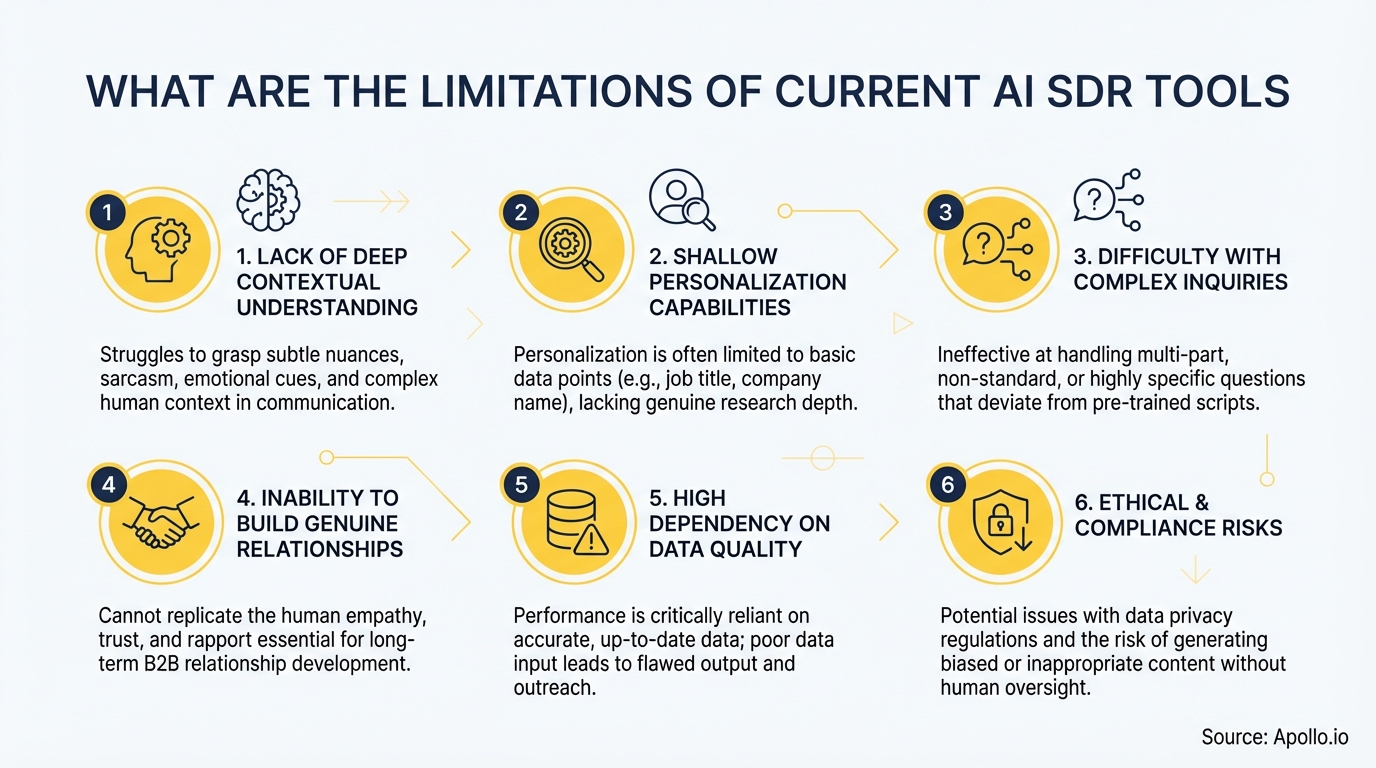
The core limitations of current AI SDR tools fall into four categories: data quality, personalization depth, deliverability infrastructure, and qualification accuracy. These are not software bugs — they are structural constraints that affect every autonomous outbound system.
| Limitation | Root Cause | Practical Impact |
|---|---|---|
| Data decay | B2B contact data changes rapidly | Bounces, misdirected outreach, wasted credits |
| Generic personalization | AI not grounded in real account context | Low reply rates, brand damage |
| Deliverability failure | Volume without authentication | Domain blacklisting, spam filtering |
| Qualification gaps | AI cannot read nuanced buying signals | Meetings that don't convert to pipeline |
| Governance deficit | Adoption outpaces policy | Compliance exposure, inconsistent messaging |
Why Does Data Quality Break AI SDR Performance?
Data quality is the single biggest constraint on AI SDR effectiveness. According to Eubrics, 60% of sales leaders identify poor data quality as their top AI adoption challenge. When the underlying contact records are stale, incomplete, or inconsistent, every downstream AI output — targeting, personalization, routing — degrades.
Research from Koncert confirms that B2B sales data is frequently incomplete and spread across multiple systems, leading to unreliable AI predictions. An AI SDR hitting a list of decayed contacts doesn't just waste send capacity — it actively damages sender reputation through increased bounces and spam complaints.
Tired of outreach bouncing on stale data? Apollo's data enrichment keeps your contact records verified and current across 230M+ business contacts.

Why Is AI Personalization Often Superficial?
AI personalization is superficial when it substitutes variable insertion (name, company, title) for genuine relevance grounded in account context. As noted by Sailes, many AI SDR solutions offer personalization that is superficial, resulting in mass, low-quality outreach that fails to convert effectively. Buyers recognize it — and so do spam filters.
The 2026 deliverability reality makes this worse: mailbox providers now use AI signals to detect outreach that looks personalized but behaves like automation. Generic LLM-written patterns are increasingly identifiable at scale.
The differentiator is not copy quality — it is signal quality: timely intent data, job change triggers, funding events, and real firmographic context used to ground every message.
This is why configuring Apollo's AI Content Center with your value proposition, ICP pain points, and differentiators matters. AI outputs grounded in your specific GTM context outperform generic LLM drafts on both reply rates and inbox placement.
Turn Funnel Gaps Into Pipeline Gold
Tired of watching marketing leads stall before they ever reach your pipeline? Apollo surfaces in-market buyers with real-time signals so your team reaches the right prospect at right moment. 600K+ companies trust Apollo to forecast with confidence.
Schedule a Demo →How Do Deliverability Constraints Limit AI SDR Scale?
Deliverability is the hard ceiling that caps AI SDR ROI at volume. In May 2025, Microsoft began enforcing bulk sender requirements (SPF/DKIM/DMARC) for Outlook, Hotmail, and Live traffic — raising the infrastructure bar for any team running automated sequences.
Authentication failures now block outreach before personalization even matters.
Even with proper authentication, complaint rates determine long-term sender health. Teams running high-volume AI sequences without precise targeting face compounding reputation damage that limits future deliverability across their entire domain.
This is a systems problem, not a copywriting problem — and it requires data hygiene, suppression list management, and engagement monitoring as prerequisites to scale.
How Do SDRs and AEs Lose When AI Qualification Falls Short?
SDRs and AEs lose pipeline quality when AI handles qualification in complex deal scenarios without human oversight. Research from Isometrik found that human SDRs hold an advantage in complex qualification accuracy of 25-30% over AI SDRs. In enterprise deals with multiple stakeholders, buying committee dynamics, and non-obvious objections, AI tools cannot yet replicate the judgment a skilled rep applies in real time.
For Account Executives managing high-value deals, AI-booked meetings that skip proper qualification create downstream friction: misaligned discovery calls, wasted demo capacity, and inflated pipeline that doesn't close. The fix is a hybrid model — AI handles research, list building, and initial sequencing; SDRs and AEs own qualification nuance and account strategy.
Apollo's AI Research and Scores features support this model by surfacing account-level signals and ICP fit scores that help reps prioritize which accounts warrant human attention — rather than treating all AI-generated prospects as equally qualified. As Ian Kistner, Head of Sales Development at Crusoe, put it: "We're using Apollo's AI Assistant to score and tier accounts, which makes it much easier to prioritize outbound in a quickly expanding market."

What Governance Gaps Create Risk for RevOps and Sales Leaders?
Governance gaps emerge when AI SDR adoption outpaces policy. A 2025 survey cited by Intersight found 48% of sales enablement leaders found adoption challenging even with AI tools in place, primarily due to lack of training and unclear implementation frameworks. RevOps leaders face compounding risks: AI-generated messaging that contradicts approved claims, audit trails that don't exist, and agentic tools with CRM write access operating without guardrails.
As AI SDR tools become more interconnected — accessing CRMs, enrichment vendors, mailboxes, and meeting schedulers — enterprises increasingly require audit logs, approval workflows, and security controls. Tools without these features create compliance exposure that grows with adoption.
Before scaling any AI outbound motion, RevOps teams should establish approved messaging libraries, claim substantiation standards, and suppression list enforcement as non-negotiable prerequisites.
Spending time stitching together point tools with no central governance? Apollo's AI sales automation consolidates prospecting, sequencing, and enrichment in one governed workspace — so your team has one system to audit, not five.
What Is the Right Model for AI SDR Tools in 2026?
The right model for AI SDR tools in 2026 is a copilot framework, not an autopilot framework. Fully autonomous AI SDR deployments have largely given way to hybrid workflows where AI handles the research, drafting, and sequencing workload while humans retain ownership of qualification, objection handling, and account strategy.
This matches both the current capability ceiling of AI tools and the preferences of B2B buyers, who increasingly value relevance and timing over volume.
Apollo's AI Sales Assistant is built for this model. It runs end-to-end GTM workflows — from web-powered list building and Outbound Copilot sequencing to pre-meeting research and conversation intelligence — with human approval gates built in. Tory Kindlick, Head of Revenue Ops at RapidSOS, described it this way: "Work that would've taken me hours was done before I even got off the train." That's the promise of AI assistance done right: faster execution, not replaced judgment.
For a deeper look at how leading teams are structuring their sales automation and lead generation tools, those resources cover the practical frameworks that separate performant AI-assisted outbound from the spray-and-pray deployments that damage pipeline and reputation alike.
Start Building Smarter AI Outbound
The limitations of current AI SDR tools are real — but they are manageable when you address the root constraints: verified data, signal-grounded personalization, deliverability infrastructure, and human-in-the-loop qualification. Teams that treat AI as a copilot rather than a replacement consistently outperform those chasing fully autonomous outbound.
Apollo gives B2B GTM teams the data quality, AI research, and workflow governance to run AI-assisted outbound that actually converts. Start Prospecting and see how a unified platform closes the gaps that point-tool AI SDRs leave open.
Prove Pipeline ROI With Apollo
ROI pressure killing your tool budget? Apollo delivers measurable pipeline impact from day one — so justifying the investment is easy. Leadium 3x'd annual revenue. Your board meeting just got a lot simpler.
Start Free with Apollo →Don't miss these
Sales
Inbound vs Outbound Marketing: Which Strategy Wins?
Sales
What Is a Sales Funnel? The Non-Linear Revenue Framework for 2026
Sales
What Is a Go-to-Market Strategy? The 2026 GTM Playbook
See Apollo in action
We'd love to show how Apollo can help you sell better.
By submitting this form, you will receive information, tips, and promotions from Apollo. To learn more, see our Privacy Statement.
4.7/5 based on 9,690 reviews
