
Early Signals Your GTM Team Is Ready for Automated Motion
Most GTM teams don't lack ambition around automation. They lack clarity on when they're actually ready for it. Jumping to automated workflows before the prerequisites are in place wastes budget and creates more chaos than it solves. The good news: the signals are measurable, and they show up before your team hits a wall.
Whether you're an SDR manager watching reps burn hours on manual research, a RevOps leader drowning in pipeline reporting disagreements, or a founder trying to scale outbound without adding headcount, knowing the readiness signals helps you move faster and smarter. Pairing those signals with the right sales intelligence tools is what separates teams that automate effectively from those that just add tech debt.

Scale Your Team Without the Chaos
Tired of inconsistent processes slowing your reps down? Apollo standardizes your outreach playbooks so every SDR hits the ground running. Join 600K+ companies building predictable pipeline from day one.
Start Free with Apollo →Key Takeaways
- GTM automation readiness is visible before you hit capacity limits. Specific operational pain points, not just growth pressure, are the clearest early signals.
- Verification burden (more time validating AI outputs than creating) is a tipping point that signals your team needs structured workflow automation, not more AI tools.
- Data quality and documented SOPs are non-negotiable prerequisites. Automating a broken process just breaks it faster.
- Four out of five GTM leaders feel urgency to demonstrate ROI from AI, and 92% plan increased investment over the next three years. Your competitors are moving.
- The highest-value first automation wins are in prospecting, lead routing, and outreach sequences, not content creation.
What Are the Early Signals That a GTM Team Is Ready to Move Toward a More Automated Motion?
A GTM team is ready to automate when it can identify specific, recurring friction points that automation can directly address. As Skaled puts it: "GTM teams are ready when they identify specific friction points in their motion that automation can address." Vague discomfort with manual work is not a readiness signal. Documented bottlenecks with measurable cycle-time impact are.
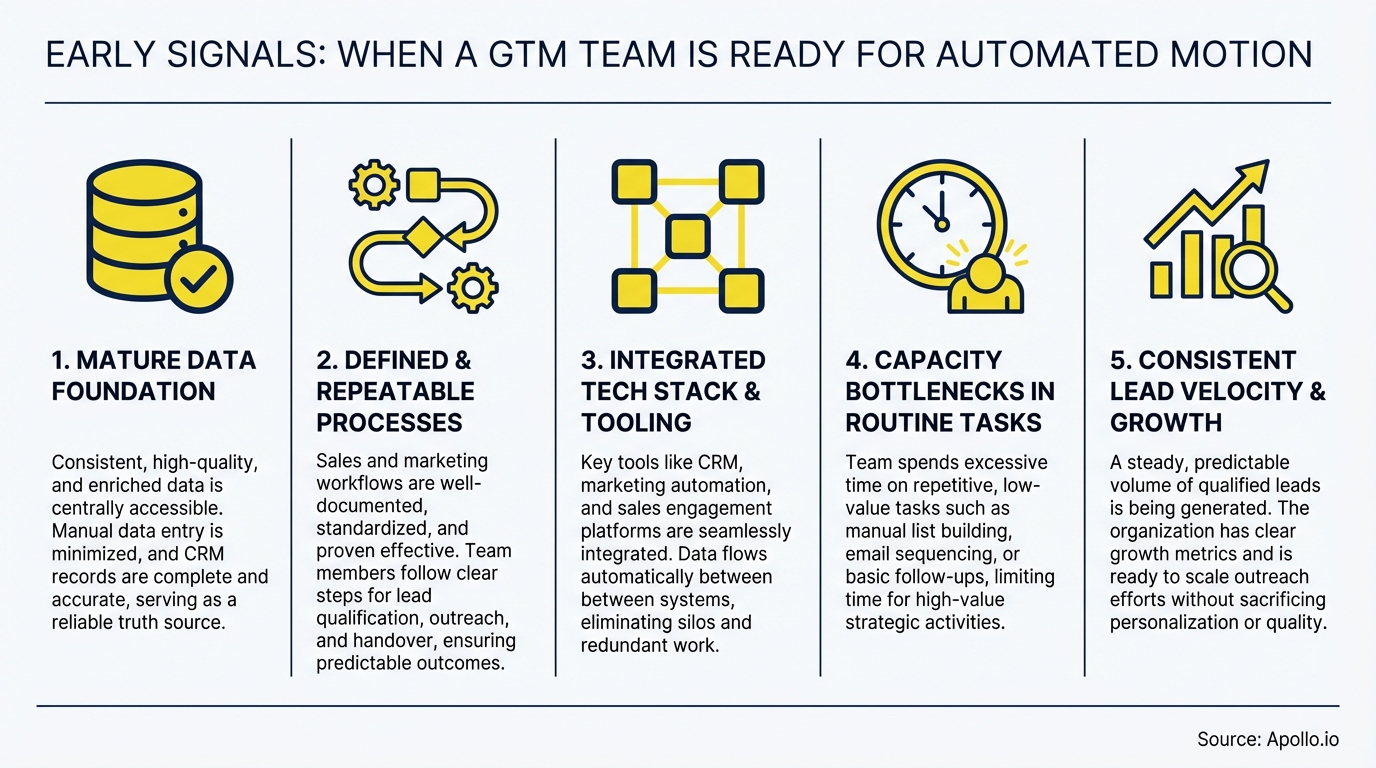
The five clearest early signals to look for:
- Reps are spending more time on research and data entry than on selling. SDRs manually building prospect lists, updating CRM fields, or personalizing emails one by one are doing work that automation handles reliably.
- Pipeline reporting disagreements between Sales, Marketing, and Finance. According to ColdICP, pipeline reporting conflicts across departments are a leading indicator that teams are ready for RevOps-enabling automation.
- You've hit the verification burden tipping point. When your team spends more time checking AI-generated outputs than it saves generating them, structured workflow automation (not just more AI prompting) is the answer.
- AI is used tactically but inconsistently. Individual reps using AI for drafting or ideation without a repeatable process signals readiness for governance and automation infrastructure.
- Headcount requests keep coming but conversion rates aren't moving. If adding reps hasn't improved pipeline efficiency, the problem is process, not people.
How Do RevOps Leaders Know When Data Is Ready to Support Automation?
Data quality is the single biggest prerequisite for reliable GTM automation. Automating against inconsistent, duplicate, or incomplete CRM data produces confident wrong answers at scale.
RevOps leaders should verify these conditions before enabling automated workflows:
- Lifecycle stage definitions are standardized and agreed upon across Sales and Marketing
- Lead routing rules are documented, not tribal knowledge
- Contact and account records have consistent field completion above a defined threshold
- Attribution model is agreed upon (even if imperfect)
- A single source of truth exists for pipeline data
Tool consolidation accelerates this. Teams still managing five or six disconnected point solutions create integration debt that makes data hygiene nearly impossible to maintain. As one Cyera team member noted, "Having everything in one system was a game changer." Struggling to keep contact data clean across multiple tools? Apollo's data enrichment keeps your CRM accurate automatically.
What Is the GTM Automation Readiness Scorecard?
A readiness scorecard translates qualitative signals into a go/no-go decision framework. Score your team across five dimensions, each on a 1-5 scale.
| Dimension | Score 1 (Not Ready) | Score 3 (Partially Ready) | Score 5 (Ready) |
|---|---|---|---|
| Data Quality | No standardization, high duplicate rate | Some standards, inconsistent adoption | Defined fields, enforced hygiene, single source of truth |
| Process Documentation | Tribal knowledge only | Some SOPs exist, not enforced | Documented, audited, and followed SOPs for core motions |
| AI Adoption Maturity | No AI use | Tactical/individual AI use without governance | Repeatable AI workflows with QA checkpoints |
| Signal Identification | Cannot name trusted intent signals | Some signals tracked, not correlated to outcomes | 10+ signals mapped to pipeline or revenue impact |
| Cross-Team Alignment | Siloed KPIs, reporting disagreements | Shared goals in theory, not in practice | Shared revenue goals, unified reporting |
Scoring: 18-25 = ready to automate core motions. 10-17 = fix prerequisites first. Below 10 = invest in RevOps fundamentals before any automation spend.
Turn Funnel Guesswork Into Pipeline Clarity
Pipeline forecasting a guessing game because leads stall before they ever become opportunities? Apollo surfaces high-intent prospects and signals that move deals forward. Nearly 100K paying customers stopped guessing and started closing.
Schedule a Demo →What Should SDRs and AEs Automate First?
The highest-value first automation wins for SDRs and AEs are in prospecting research, lead routing, and multi-channel outreach sequences, not in content creation or reporting.
A data-driven perspective from Demandbase reinforces this: high-performing GTM teams have shifted focus from AI for productivity tasks like content writing to AI that drives pipeline and conversion outcomes. That's where the ROI is.
Prioritized first-wins by role:
- SDRs: Automated prospect list building with intent signals, sequence enrollment triggers, follow-up task creation after call dispositions
- AEs: Pre-meeting research summaries, deal stage progression alerts, renewal risk scoring
- Marketing: Lead scoring updates based on behavioral signals, inbound routing by ICP fit, nurture sequence triggers
- RevOps: CRM field enrichment, duplicate merging, pipeline hygiene alerts
Explore the best B2B marketing tools for 2026 to see which platforms support these automation use cases natively.
Spending hours building prospect lists manually? Apollo automates your multi-channel sequences so reps focus on conversations, not admin.

How Do You Build the Business Case for GTM Automation?
The business case for GTM automation is strongest when it connects to revenue outcomes, not just efficiency gains. According to SignalFire, four out of five GTM leaders express urgency to demonstrate ROI from AI, and 92% plan increased investment over the next three years.
A CFO-aligned ROI framework should include:
- Baseline metrics: Current cost per qualified lead, average cycle time from MQL to SQL, rework rate on outreach sequences
- Throughput delta: How many more qualified conversations can the same team generate with automation in the prospecting workflow?
- Pipeline impact: Tie automation investment to pipeline contribution, not just time saved
- Tech stack consolidation savings: Replacing three or four tools with a unified platform is a real cost reduction. As Census reported, "We cut our costs in half" after consolidating.
Teams using outbound sales software that unifies prospecting, enrichment, and engagement in one place reduce both the cost and complexity of building this ROI case.
What Governance Controls Does a GTM Team Need Before Automating?
Governance is the prerequisite most teams skip and the reason most automation projects underperform. As AI moves from "AI suggests" to "AI does" across the revenue funnel, permissioning, auditability, and clear boundaries on what automation can trigger become critical.
Minimum governance requirements before scaling automated GTM motions:
- Defined approval workflows for any automation that contacts prospects or customers
- QA checkpoints: who reviews AI-generated outputs before they go live?
- Escalation paths: which signals trigger human review instead of automated action?
- Audit logs: can you trace every automated action back to its trigger and rule?
- Brand and compliance controls: are there guardrails on messaging, frequency, and channel?
According to Captivate Talent, 62% of companies choose to re-skill employees rather than reduce headcount when automating, which means governance also includes defining how human roles evolve alongside automated workflows.
For teams building outbound programs, reviewing lead generation examples that combine automation with human oversight can inform governance design.

Is Your GTM Team Ready to Automate? Start Here
The clearest signal that a GTM team is ready to automate is not a technology decision. It's an operational one: you have documented friction points, clean enough data, aligned definitions, and at least some AI already in use.
That foundation is what makes automation produce pipeline, not just activity.
Teams that move too early create noise. Teams that wait too long cede ground to competitors already running automated motions at scale.
The readiness scorecard in this article gives you a concrete starting point.
Apollo brings prospecting, enrichment, engagement, and AI automation into one unified platform, so you consolidate your tech stack instead of adding to it. "We reduced the complexity of three tools into one," noted the team at Predictable Revenue.
Start Your Free Trial and see how Apollo's unified GTM platform helps your team move from manual to automated without adding complexity.
Prove Pipeline ROI Before Next QBR
ROI pressure killing your tool budget before it even gets approved? Apollo delivers measurable pipeline impact from day one. Leadium 3x'd annual revenue — see your numbers move fast.
Schedule a Demo →Don't miss these
Sales
Inbound vs Outbound Marketing: Which Strategy Wins?
Sales
What Is a Sales Funnel? The Non-Linear Revenue Framework for 2026
Sales
What Is a Go-to-Market Strategy? The 2026 GTM Playbook
See Apollo in action
We'd love to show how Apollo can help you sell better.
By submitting this form, you will receive information, tips, and promotions from Apollo. To learn more, see our Privacy Statement.
4.7/5 based on 9,690 reviews
