
What Are Sales Metrics? The Complete 2026 Guide for B2B GTM Teams
Sales metrics are the quantitative measurements that tell you whether your revenue engine is working. They cover every stage of the funnel, from first touch to closed-won, and give sales leaders, RevOps teams, and individual reps the data they need to make decisions, forecast accurately, and hit quota.
Without the right metrics, you're managing by instinct instead of evidence.
The challenge in 2026 is not a shortage of data. It's knowing which metrics actually predict revenue versus which ones just look good in a slide deck. If you're also building out your demand gen metrics framework, understanding how sales metrics connect to pipeline is essential for aligning your full GTM motion.

Apollo Turns Research Hours Into Pipeline
Tired of your reps burning the day on manual research instead of closing deals? Apollo delivers verified contacts instantly, so your team spends time selling. Nearly 100K paying customers scaled pipeline without scaling headcount.
Start Free with Apollo →Key Takeaways
- Sales metrics are quantitative measures that track performance across every stage of the revenue funnel, from prospecting through close.
- Surface metrics like email opens and dials tell you about activity, not outcomes. Down-funnel metrics like stage conversion rate and deal slippage predict revenue.
- RevOps teams must establish shared metric definitions across CRM and analytics tools, or AI-assisted reporting will surface inconsistent results.
- According to Kondo, sales cycles lengthened to 6.5 months in 2023, up from 4.9 months in 2019, making pipeline quality metrics more critical than ever.
- The most trustworthy sales metric framework combines leading indicators (pipeline coverage, conversion rates) with lagging indicators (revenue, win rate, quota attainment).
What Are Sales Metrics and Why Do They Matter?
Sales metrics are standardized data points that measure the health, efficiency, and output of a sales process. They answer questions like: Are we generating enough pipeline?
Are deals progressing? Where are we losing revenue?
They are distinct from vanity metrics, which measure activity without linking it to outcomes.
Sales metrics matter because they create accountability and predictability. A rep who books 20 meetings a month but closes none is not performing, and metrics expose that gap. For revenue leaders, they are the basis for forecasting, coaching, and resource allocation. For B2B marketing teams, they are the bridge between campaign investment and revenue impact.
| Metric Type | What It Measures | Example |
|---|---|---|
| Activity Metrics | Rep effort and output | Calls made, emails sent |
| Pipeline Metrics | Funnel health and progression | Pipeline coverage, stage conversion rate |
| Revenue Metrics | Business outcomes | Win rate, ARR, quota attainment |
| Efficiency Metrics | Cost and speed of selling | Sales cycle length, CAC |
Why Do Surface Metrics Fail to Drive Revenue Decisions?
Surface metrics measure activity, not advancement. Tracking dials, email sends, and meeting bookings tells you reps are busy.
It does not tell you whether the pipeline is healthy or whether the quarter is at risk. Most teams over-index on these because they are easy to collect and easy to report.
The shift happening right now in B2B sales is from activity metrics to buyer-signal metrics: stage conversion rates, time-in-stage, multi-threading depth, meeting-to-next-step rate, and deal slippage. These metrics measure whether deals are actually moving.
Deal slippage rate in particular has become a leading indicator for missed quarters, because it surfaces pipeline integrity problems weeks before a forecast miss shows up.
- Dials and emails sent: Activity. Useful for coaching cadence, not for forecasting.
- Meeting booked rate: Better, but still a leading activity signal.
- Stage conversion rate: A genuine pipeline health signal.
- Deal slippage rate: A forecast risk signal and one of the most actionable metrics a sales leader can track.
Turn Funnel Guesswork Into Real Pipeline
Pipeline forecasting a guessing game because your leads never convert? Apollo surfaces high-intent prospects at the right moment, so your team pursues opportunities that actually close. Nearly 100K paying customers stopped guessing and started growing.
Start Free with Apollo →What Are the Core Sales Metrics Every B2B Team Should Track?
The right sales metrics framework covers four layers: pipeline generation, pipeline progression, revenue outcomes, and efficiency. Each layer answers a different question about your business.
| Metric | Formula / Definition | Why It Matters |
|---|---|---|
| Pipeline Coverage Ratio | Total pipeline value / Quota | Forecasting buffer and capacity signal |
| MQL to SQL Conversion Rate | SQLs created / MQLs received | Marketing-sales alignment quality |
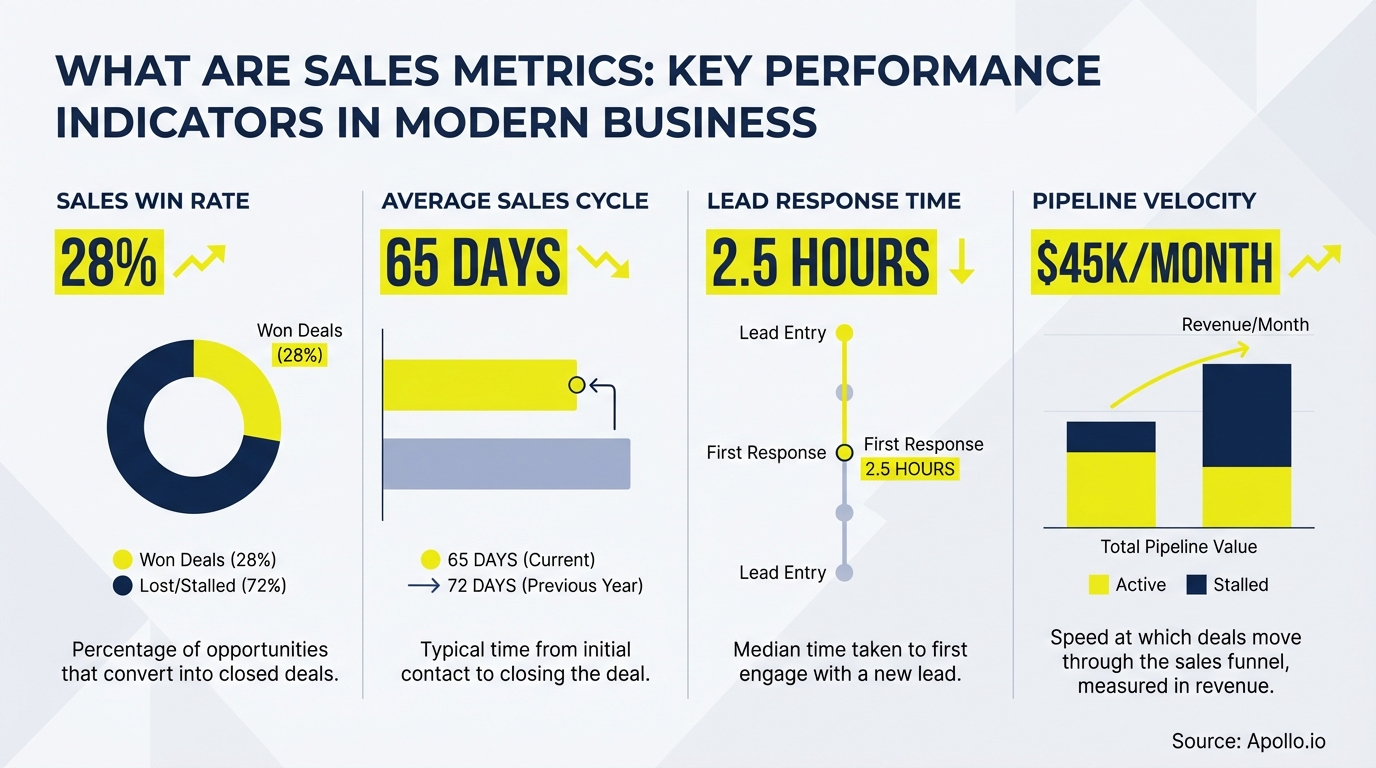
| Win Rate | Closed-won / Total opportunities | Sales effectiveness and ICP fit |
| Average Sales Cycle Length | Days from opportunity created to close | Efficiency and buyer friction |
| Quota Attainment | Revenue closed / Quota target | Team performance benchmark |
| Deal Slippage Rate | Deals pushed past close date / Total forecast | Forecast accuracy and deal health |
| Customer Acquisition Cost (CAC) | Total sales + marketing spend / New customers | Revenue efficiency and payback period |
| LTV:CAC Ratio | Customer lifetime value / CAC | Long-term unit economics |
Sales cycle length is a metric that deserves close attention right now. Research from Rachel A. Krug found that the average B2B sales process in 2024 was approximately 25% longer than five years prior. Longer cycles compress forecast accuracy and demand more disciplined pipeline management. Pair sales cycle tracking with your sales funnel analysis to identify where deals are stalling.
Struggling to see which deals are progressing and which are stalling? Get complete pipeline visibility with Apollo's deal management tools.

How Do RevOps Leaders Build a Metrics Governance Framework?
Metrics governance is the practice of establishing shared definitions, data ownership, and audit rules for every metric your GTM team uses. Without it, your CRM reports one win rate, your BI tool reports another, and leadership debates the numbers instead of acting on them.
This is not a theoretical problem. As AI assistants are embedded into CRM and analytics workflows, inconsistent definitions break automation outputs.
If your system defines an SQL differently in HubSpot than in your data warehouse, AI-generated forecasts will be unreliable. RevOps teams are now formalizing metric dictionaries as a core GTM capability, not an afterthought.
A practical governance blueprint:
- Define every key metric in writing. MQL, SQL, opportunity, pipeline, churn, and win rate must have a single agreed definition stored in a shared document.
- Assign data ownership. Each metric should have one team (usually RevOps) responsible for its accuracy and consistency.
- Establish a single source of truth. Your CRM is the system of record. All reports should pull from it, not from spreadsheets.
- Run quarterly metric audits. Check for definition drift, CRM hygiene issues, and reporting inconsistencies before they compound.
This is especially critical for teams scaling their B2B SaaS sales funnel, where stage definitions directly drive forecasting accuracy and commission calculations.
How Do SDRs and AEs Use Sales Metrics to Hit Quota?
SDRs and AEs interact with sales metrics differently, but both roles depend on them to self-correct before a bad week becomes a bad quarter.
For SDRs, the most actionable metrics are connect rate, meeting-to-next-step rate, and MQL-to-SQL conversion. These tell an SDR whether their targeting is accurate, their messaging is resonating, and their handoffs are producing qualified pipeline. An SDR with a high meeting-booked rate but low SQL conversion rate has a qualification problem, not a prospecting problem.
For Account Executives, the critical metrics are stage conversion rate, deal slippage, average deal size, and win rate by segment. AEs who track time-in-stage can identify at-risk deals before they slip. Those who monitor win rate by ICP tier can prioritize their pipeline toward the accounts most likely to close. For AEs managing complex deals, understanding high-ticket sales metrics like multi-threading depth and stakeholder engagement is especially important.
Want to build more qualified pipeline from the start? Build a stronger pipeline with Apollo's lead qualification and prospecting tools.

How Do Sales Metrics Connect to Marketing and Demand Gen?
Sales metrics and marketing metrics are not separate scorecards. They are different views of the same revenue system.
The connection point is pipeline: marketing is responsible for generating qualified pipeline, and sales is responsible for converting it.
The MQL-to-SQL conversion rate is the primary handoff metric. A low conversion rate signals either poor lead quality from marketing or poor qualification from SDRs.
Both teams need to own the number together. Beyond that, metrics like pipeline influenced, win rate by lead source, and CAC by channel tie marketing investment directly to sales outcomes.
Data from BookYourData projects that 80% of B2B sales interactions will occur through digital channels, which means the metrics used to track buyer engagement, web visits, email engagement, and digital content interaction, are increasingly predictive of pipeline quality. Marketing and sales teams that share a unified view of these signals will outperform those that don't. For a deeper look at how to connect these signals to revenue, see the guide on KPIs, attribution, CAC, and marketing ROI.
Start Measuring What Actually Moves Revenue
Sales metrics are only valuable when they are defined consistently, tracked in a single system, and connected to outcomes that matter to the business. Activity metrics have their place, but the teams winning in 2026 are the ones tracking pipeline progression, deal slippage, stage conversion, and win rate by ICP tier.
Apollo gives GTM teams one workspace to prospect, engage, manage pipeline, and measure performance without juggling five separate tools. As Cyera put it, "Having everything in one system was a game changer." If you are ready to align your metrics to revenue and cut your tech stack at the same time, start with Apollo.
Start Your Free Trial and see how Apollo's unified platform helps your team track, improve, and act on the sales metrics that drive revenue.
Prove Pipeline ROI With Apollo
ROI pressure killing your next budget approval? Apollo delivers measurable pipeline impact from day one, so you walk into every review with hard numbers. Leadium 3x'd their annual revenue — your proof starts now.
Start Free with Apollo →Don't miss these
Sales
Inbound vs Outbound Marketing: Which Strategy Wins?
Sales
What Is a Sales Funnel? The Non-Linear Revenue Framework for 2026
Sales
What Is a Go-to-Market Strategy? The 2026 GTM Playbook
See Apollo in action
We'd love to show how Apollo can help you sell better.
By submitting this form, you will receive information, tips, and promotions from Apollo. To learn more, see our Privacy Statement.
4.7/5 based on 9,690 reviews
