
A/B Testing Best Practices for Improving Email Content
Most B2B email A/B tests are structured wrong. Teams swap subject lines, declare a winner based on open rate, and repeat the cycle without building any real knowledge. The result: incremental tweaks that never move pipeline. According to Dyspatch, marketers who frequently A/B test emails achieve an 86% higher email ROI (approximately 42:1) compared to those who never test (23:1). That gap exists because consistent testers treat A/B testing as a repeatable learning system, not a one-off experiment. This guide covers the best practices for writing sales emails and testing them in ways that compound over time.

Research Less, Close More With Apollo
Tired of your reps burning hours on manual lead research instead of selling? Apollo surfaces verified contacts instantly so your team spends time closing, not digging. Join 600K+ companies building pipeline faster.
Start Free with Apollo →Key Takeaways
- Test one variable at a time with a clear hypothesis — otherwise you cannot attribute results to a specific change.
- Limit tests to engaged segments (opened in the past 90 days) to keep signal clean and protect sender reputation.
- For B2B, the highest-value tests are message-market-fit changes — problem framing, proof points, and risk reduction — not cosmetic tweaks.
- Measure downstream outcomes (replies, meetings booked, pipeline created) in addition to opens and clicks.
- Track deliverability signals — spam complaints, unsubscribes, inbox placement — as part of every test, not as an afterthought.
What Is Email A/B Testing and Why Does It Matter for B2B?
Email A/B testing is the practice of sending two versions of an email to randomized audience segments, measuring the difference in a defined outcome, and applying the winning insight to future sends. For B2B GTM teams, it is the fastest way to close the gap between what you assume resonates and what actually drives action. As Salesforce notes, every test should start with a clearly defined goal — such as a 5% improvement in open rate or a measurable lift in reply rate — before a single variant is written.
The stakes are real. B2B buyers are moving faster: buying cycles shortened from 11.3 months to 10.1 months in 2025, and 94% of buyers had already shortlisted vendors before engaging a seller.
Every email your team sends is competing for a narrow window of influence. Systematic testing is how you make each send count.
What Should SDRs and Marketers Actually Test in Email Content?
The highest-value email content tests focus on message-market-fit, not cosmetic changes. Most guides stop at subject lines and send times.
B2B teams should go deeper, testing how the message frames the buyer's problem, demonstrates proof, and reduces perceived risk.
| Funnel Stage | Test Variable | Example Variants |
|---|---|---|
| Top of funnel | Problem framing | "Most SDRs waste 2 hours a day on research" vs. "Your team is working harder than they need to" |
| Mid-funnel | Proof type | Customer quote vs. specific outcome stat vs. named case study reference |
| Late-stage | Risk reduction | "No setup fee" vs. "Cancel anytime" vs. "Results in 30 days or we'll help you troubleshoot" |
| All stages | CTA wording | "Book a 15-minute call" vs. "See a quick demo" vs. "Get the framework" |
| All stages | Personalization depth | First name only vs. role-specific pain point vs. industry-specific use case |
For SDRs building outbound sequences, the most impactful test is often how you open the email — whether you lead with the prospect's pain, a shared context, or a specific outcome. Pair this with guidance on email personalization for sales to build variants that go beyond merge tags.
Spending hours crafting variants manually? Apollo's multi-channel sales engagement platform lets you build, test, and automate sequences in one workspace — without stitching together separate tools.
What Is the Statistically Safe Way to Run an Email A/B Test?
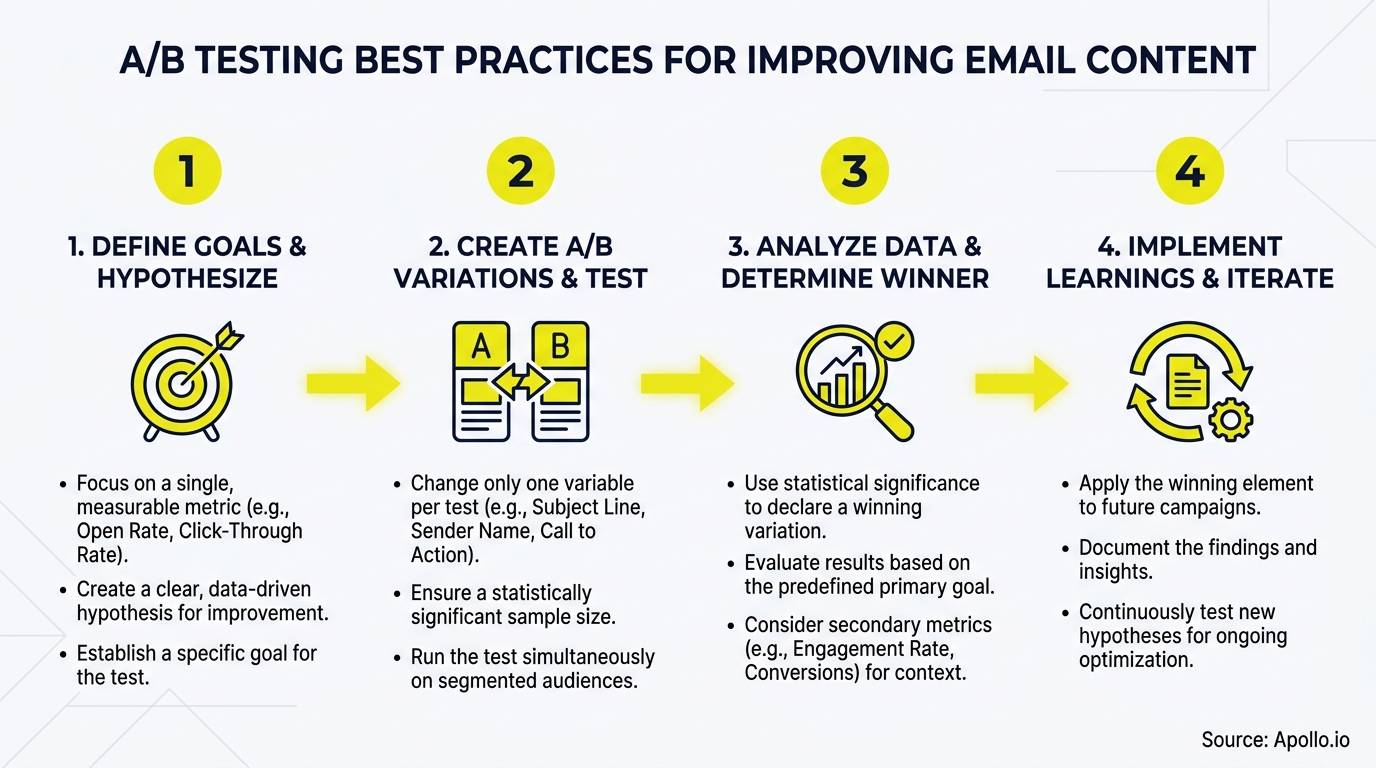
A statistically safe email A/B test requires one changed variable, randomized audience splits, a sufficient sample size, and enough time for results to stabilize. Skipping any of these steps produces misleading results. As 2x.marketing emphasizes, isolating one variable per test is the foundational rule — otherwise you cannot attribute outcomes to a specific change.
A Reddit user shared a firsthand perspectivethat cuts through generic list-hygiene advice: "The cleanest A/B tests I've run were on active segments only — people who'd opened at least once in the past 90 days or so. A valid address that hasn't opened in 18 months muddies your signal almost as much as a dead inbox does." This is a concrete guardrail most guides omit.
Use this pre-send checklist before every test:
- One variable only: Subject line, CTA, body copy angle, or send time — never two at once.
- Minimum sample size: Aim for at least 1,000 recipients per variant for directional data; 5,000+ per variant for statistical confidence.
- Randomized split: Use your platform's built-in random assignment, not manual list segmentation.
- Engaged segment only: Filter to contacts who engaged within the past 90 days.
- Run time: Allow at least 48–72 hours before reading results, longer for low-volume lists.
- Confidence threshold: Do not declare a winner below 90% statistical confidence.
- Document the hypothesis: Write down what you expect to happen and why, before you send.
Apollo Turns Funnel Chaos Into Pipeline Clarity
Marketing leads stalling before they ever reach sales. Apollo surfaces high-intent prospects and delivers real-time pipeline visibility so your team acts on opportunity—not guesswork. Nearly 100K paying customers trust Apollo to forecast with confidence.
Start Free with Apollo →What Metrics Matter Beyond Opens?
For B2B email A/B testing, open rate is a starting point, not a success metric. The metrics that matter are downstream: reply rate, click-to-open rate (CTOR), meetings booked, and pipeline influenced. According to Charle Agency, A/B tested emails can achieve 49% higher open rates and 135% higher click rates — but even those gains only matter if clicks convert to conversations.
For B2B services emails, Popupsmart reports an average CTOR of 11.35%, with strong programs exceeding 21.78%. Use CTOR — not raw click rate — to evaluate content quality, since it controls for the number of people who actually saw the email body.
Build a measurement framework that covers three layers:
- Engagement signals: Open rate, CTOR, reply rate
- Pipeline signals: Meetings booked, opportunities created, content-assisted revenue
- Negative signals: Unsubscribes, spam complaints, bounces (see the next section)
RevOps leaders can tie this directly to their CRM by tagging test variants as campaign properties, then tracking opportunity creation and deal velocity by variant. This turns email testing into a revenue input, not just a marketing metric.

How Do Deliverability Guardrails Protect Your A/B Tests?
Deliverability is a testing dimension, not just an infrastructure concern. Your "winning" variant based on open rate may simultaneously be generating higher spam complaints — a signal that damages sender reputation over time.
Google's sender guidelines require bulk senders to keep spam rates below 0.3%, with the expectation of staying well below 0.1%. That means every test needs a negative-signals dashboard running alongside standard metrics.
Set these stop conditions before you send:
- Pause the variant if spam complaint rate exceeds 0.08% mid-test.
- Flag any variant with unsubscribe rate more than 2x your list average.
- Monitor inbox placement rate — not just delivery rate — using seed testing or inbox placement tools.
- Check that DMARC, SPF, and DKIM authentication are active. Data from Digital Applied shows authenticated domains average a 34.2% open rate, underlining that authentication is table stakes before any content test.
For more on protecting sender reputation while scaling outreach, see how to improve email deliverability in 5 steps and bulk email best practices.
How Should SDRs and Marketers Build a Compounding Test Library?
The teams that get the most from A/B testing treat each test as a building block, not a standalone event. A Reddit user shared a firsthand perspectiveillustrating exactly this: "Just changing how clearly the offer was worded lifted conversions by about 50%. Then, personalizing the copy for a specific audience segment brought another +75%. Adding incentives and urgency doubled conversions again. Each test built on the previous one — and the biggest insights came after the first round."
Structuring a test library also prepares your program for AI-assisted optimization. Agentic AI systems can run continuous experiments and roll winners forward — but only if they are optimizing against proven hypotheses, not random variants.
Build your library now so future automation has a foundation to work from.
For each completed test, log:
- Hypothesis tested
- Segment and sample size
- Variable changed
- Winner and confidence level
- Downstream outcome (replies, meetings, pipeline)
- Next hypothesis informed by this result
Also consider testing send time and day as a variable — timing interacts with content in ways that can shift reply rates independently of copy quality.
Struggling to connect your email testing to actual pipeline? Apollo's pipeline tools give SDRs, AEs, and RevOps teams a unified view of which outreach variants are generating qualified opportunities — without managing five separate platforms.

Start Turning Email Tests into Pipeline
The best email A/B testing programs share three traits: they test one meaningful variable at a time, measure outcomes past the inbox, and treat each test as the foundation for the next. For B2B GTM teams — whether you are an SDR building sequences, a marketer optimizing nurture campaigns, or a RevOps leader tracking content ROI — this approach converts email from a volume play into a precision instrument.
Pair your testing discipline with strong subject line strategy by reviewing the best email subject lines for sales and cold email subject lines that boost open rates. Then run your winning variants through Apollo's engagement platform to reach verified contacts at scale.
Start a free trial with Apollo and test your best email variants against a database of 230M+ verified business contacts — all from one platform.
Prove Pipeline ROI From Day One
Budget approval stuck on unclear metrics? Apollo delivers measurable pipeline impact fast—so you walk into every renewal conversation with hard numbers. Nearly 100K paying customers justified the investment.
Start Free with Apollo →Don't miss these
Sales
Inbound vs Outbound Marketing: Which Strategy Wins?
Sales
What Is a Sales Funnel? The Non-Linear Revenue Framework for 2026
Sales
What Is a Go-to-Market Strategy? The 2026 GTM Playbook
See Apollo in action
We'd love to show how Apollo can help you sell better.
By submitting this form, you will receive information, tips, and promotions from Apollo. To learn more, see our Privacy Statement.
4.7/5 based on 9,690 reviews
