
Signal-Based Selling: The Complete 2026 Framework for Revenue Teams
Stricter inbox enforcement killed high-volume outbound in 2025. Teams that survived shifted from spray-and-pray to precision targeting based on real buyer signals.
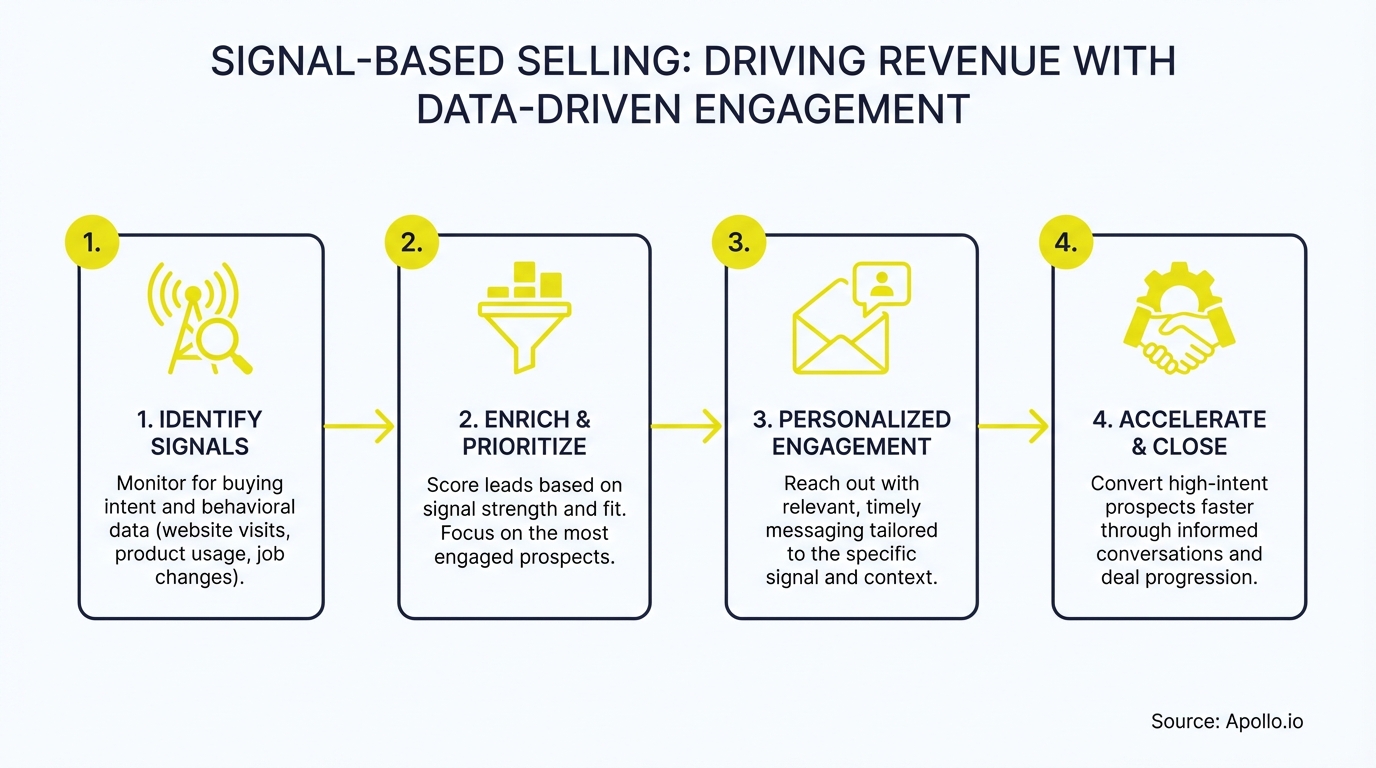
Signal-based selling transforms how revenue teams prioritize accounts, time outreach, and measure outcomes. This framework is central to the modern GTM Engineer role, where strategy meets execution velocity.
According to Span Global Services, 99% of businesses have reported an increase in sales or ROI after implementing intent data in their strategies. Yet only a quarter of B2B companies currently leverage these tools.
The gap between potential and adoption creates a competitive advantage for teams that operationalize signals correctly.

Stop Manual Research - Apollo Finds Contacts Fast
Tired of reps spending 4+ hours daily hunting for contact info? Apollo delivers 224M verified contacts with 96% email accuracy. Join 550K+ companies closing deals faster.
Start Free with Apollo →Key Takeaways
- Signal-based selling prioritizes accounts showing genuine buying intent through multi-source data validation
- Modern teams layer individual and group-level signals to reduce false positives and route the right plays
- Speed-to-signal is becoming the new speed-to-lead, with top teams operating on 30-minute SLAs
- Deliverability enforcement makes signal-triggered outreach a risk-management requirement, not just a growth tactic
- Agentic AI is shifting signal-based selling from insights to automated execution
What Is Signal-Based Selling?
Signal-based selling is a revenue methodology that prioritizes accounts and triggers outreach based on verified buyer intent signals rather than static lists or demographic criteria.
Instead of contacting every company in your total addressable market, you engage accounts demonstrating active buying behavior through research activity, technology changes, funding events, or engagement with your content.
Research from Landbase shows that while 96% of B2B marketers report success with intent data, only 25% of B2B companies currently leverage these tools. This adoption gap creates a window for early movers.
The methodology shifts sales from interruption-based prospecting to response-based engagement. You're reaching out when buyers are already in-market, not hoping to create urgency through cold outreach.
Why Does Signal-Based Selling Matter In 2026?
The B2B buying journey compressed dramatically between 2024 and 2025. Average cycle length fell from 11.3 months to 10.1 months, while the point of first contact moved earlier from 69% of the journey to 61%.
Buyers now make decisions faster but engage sellers earlier. The first vendor contacted still wins roughly 80% of deals, and 95% of the time the winning vendor was already on the Day One shortlist.
This creates a premium on early-stage in-market detection. Sales teams that identify buying signals six to seven weeks earlier gain a structural advantage over competitors relying on inbound or static outbound motions.
Deliverability enforcement accelerated this shift. Stricter bulk-sender requirements from major inbox providers now penalize untargeted volume and reward signal-timed relevance.
Teams sending fewer, higher-relevance messages keep complaint rates low and deliverability high. Signal-based selling became a compliance strategy, not just a conversion optimization tactic.
What Are The Core Signal Types?
Signal-based selling relies on three distinct data layers. Each provides different insights into buyer intent and readiness.
What Are First-Party Signals?
First-party signals come from your own systems and customer interactions. These include website behavior, product usage patterns, CRM engagement history, and support ticket trends.
Website visitor tracking reveals which accounts are researching specific capabilities or pricing pages. Product usage data shows expansion opportunities based on feature adoption or nearing usage limits.
These signals carry the highest confidence because they're based on direct interaction with your brand. However, they only capture accounts already aware of your solution.
What Are Second-Party Signals?
Second-party signals originate from sales intelligence databases and verified contact repositories. These include job changes, technology installations, company growth indicators, and department expansions.
Hiring patterns signal strategic priorities. A company adding five sales engineers likely plans to scale technical selling, creating opportunity for sales enablement or revenue operations tools.
Technology stack changes indicate budget allocation and vendor consolidation efforts. New funding rounds suggest expansion budgets and willingness to invest in growth infrastructure.
What Are Third-Party Signals?
Third-party signals come from intent data providers, review sites, and content consumption networks. These track research behavior across the broader web, not just your properties.
Intent data reveals which accounts are researching your product category, even if they haven't visited your site yet. Review site activity shows active vendor evaluation and comparison shopping.
Data from BookYourData indicates that by 2025, 80% of B2B sales interactions between suppliers and buyers are expected to occur through digital channels. This digital-first environment creates abundant third-party signal opportunities.
However, adoption remains uneven. Only 30% of marketers use third-party intent data, and just 12% of users find it useful, often due to poor signal quality or integration challenges.
How Do Individual Signals Differ From Group-Level Signals?
Individual signals track single-person behavior like email opens, content downloads, or webinar attendance. Group-level signals aggregate behavior across buying committee members to indicate account-level intent.
Most revenue teams collect significantly more individual signals than group signals. The average ratio is 5.4 individual-level signals collected versus 1.5 group-level signals.
Individual signals help personalize outreach but can create false positives. One person downloading a whitepaper doesn't mean their company is ready to buy.
Group-level signals provide stronger intent validation. When three different people from the same account visit your pricing page, attend a webinar, and engage on social, the account is demonstrably in-market.
Modern signal-based selling requires both. Individual signals determine who to contact and what message resonates, while group signals determine which accounts to prioritize and when to engage.
What Is The Signal-Based Selling Operating Model?
Effective signal-based selling requires a structured operating model from signal capture through revenue attribution. This is where most implementations fail: they collect signals but lack the workflows to act on them systematically.
The operating model spans five phases. Each requires specific tools, team alignment, and measurement frameworks.
| Phase | Timeline | Key Activities | Owner |
|---|---|---|---|
| Signal Discovery | Ongoing | Integrate data sources, configure tracking, establish signal taxonomy | RevOps / GTM Engineer |
| Signal Scoring | Daily | Weight signals by type, validate confidence thresholds, combine individual + group data | RevOps / Sales Operations |
| Signal Routing | Real-time | Assign to SDR/AE/CS based on score and account stage, trigger playbooks | Sales Operations |
| Signal Execution | 30-min SLA | Personalized outreach, content delivery, multi-channel sequences | SDR / AE |
| Signal Optimization | Monthly | Measure conversion by signal type, adjust scoring weights, refine playbooks | Sales Leadership / RevOps |
Speed-to-signal emerged as the critical operational metric in 2026. Top-performing teams route signals to the right rep and trigger the appropriate play within 30 minutes of detection.
This requires automation at every phase except final message approval. Manual triage, scoring, and routing introduce delays that erode signal freshness and conversion rates.
How Do SDRs Use Signals Differently Than AEs?
SDRs use signals to prioritize outbound prospecting and personalize initial outreach. They focus on early-stage signals like content consumption, technology research, and competitor comparison activity.
An SDR might trigger outreach when an account visits three pricing-related pages in one session, downloads a competitive comparison guide, or engages with category-education content.
AEs use signals to time expansion conversations and identify upsell opportunities. They monitor product usage patterns, support ticket themes, and stakeholder job changes within existing accounts.
When a customer's usage approaches plan limits or a new VP joins who previously bought your solution at another company, the AE has a signal-based reason to reach out with relevant expansion opportunities.
Customer Success teams use signals to predict churn risk and intervention opportunities. Declining login frequency, unused features, and increasing support tickets all signal accounts needing proactive engagement.
What Tools Do GTM Engineers Use To Operationalize Signals?
Modern GTM Engineers build signal-based selling systems using integrated platforms rather than stitching together multiple point solutions.
The traditional approach required separate tools for intent data, website tracking, data enrichment, scoring, routing, and execution. This created integration overhead, data inconsistency, and delayed signal-to-action workflows.
Need to consolidate your signal sources and automate routing? Explore Apollo's unified sales engagement platform to capture, score, and act on signals in one workspace.
Apollo's perspective is that the best GTM Engineer isn't someone who builds elaborate integrations between 14 different tools. They're a revenue strategist who deploys elegant systems at high velocity.
That's why Apollo's GTM Engineering (GTME) Program focuses on collapsing the typical tech stack fragmentation into one unified workflow, helping teams move from signal detection to revenue execution without integration babysitting.
How Do You Prevent Signal Fatigue And False Positives?
The biggest risk in signal-based selling is overwhelming reps with low-quality alerts or triggering outreach based on false intent signals.
Signal fatigue occurs when systems surface too many signals without proper filtering or prioritization. Reps ignore alerts because most don't convert, defeating the purpose of the system.
False positives happen when individual signals get misinterpreted as account-level intent. One person from a large enterprise downloading a guide doesn't mean the company is evaluating vendors.
Multi-signal validation solves both problems. Require at least two independent signals from different sources before triggering high-priority routing or automated sequences.
For example, combine website visit data with intent topic research and a recent job posting for a related role. This triangulation increases confidence that the signal represents genuine buying interest.
Confidence scoring helps teams differentiate between "maybe interested" and "definitely in-market" accounts. Assign point values to each signal type based on historical conversion correlation.
Track false-positive rates by signal source and adjust scoring weights monthly. If third-party intent from a specific provider consistently shows low conversion, reduce its weight or remove it entirely.

What Is The Pre-Contact Content Strategy For Signal-Based Selling?
Most teams think about signals as outreach triggers. Advanced teams use signals to orchestrate pre-contact content that influences buying decisions before sales ever makes contact.
Research shows buyers complete 61% of their journey before engaging with vendors in 2025. This pre-contact window represents the highest-leverage opportunity to shape vendor perception and evaluation criteria.
Signal-based content orchestration maps detected signals to specific content assets delivered through paid ads, organic content, and account-based experiences.
When an account shows early-stage research signals, serve educational content that frames the problem and establishes your category point of view. When signals indicate active vendor comparison, serve differentiation content and customer proof.
This requires an editorial calendar mapped to signal stages rather than traditional funnel stages. Content gets triggered by what accounts do, not where they sit in your CRM.
Find Buyers Ready To Act With Apollo
Running out of qualified leads while competitors fill their pipeline. Apollo delivers 224M verified contacts with buyer intent signals. Join 550K+ companies turning prospect research into revenue.
Start Free with Apollo →| Signal Stage | Timeline to Contact | Content Type | Delivery Channel |
|---|---|---|---|
| Problem Awareness | Week -7 to -5 | Category education, industry research, problem frameworks | Organic search, paid social, retargeting |
| Solution Research | Week -5 to -3 | Solution guides, capability comparisons, implementation frameworks | Paid search, retargeting, email nurture |
| Vendor Evaluation | Week -3 to -1 | Case studies, ROI calculators, competitive differentiation | Account-based ads, personalized landing pages, sales outreach prep |
| Decision Imminent | Week -1 to 0 | Customer testimonials, implementation support, risk mitigation | Direct mail, executive outreach, SDR sequences |
This approach requires coordination between marketing, sales, and revenue operations. Signals detected by marketing inform content delivery, while sales uses the same signals to time outreach.
How Do You Measure Signal-Based Selling Performance?
Traditional funnel metrics don't capture signal-based selling effectiveness. You need measurements that connect signals to pipeline and revenue outcomes.
Signal-to-meeting rate measures how often a detected signal converts to a booked conversation. Track this by signal type to identify which sources drive actual meetings versus noise.
Signal-to-opportunity rate shows how many signals generate qualified pipeline. This metric reveals whether your scoring model accurately identifies in-market accounts.
Time from signal detection to first touch measures operational speed. Top teams achieve sub-30-minute response times on high-priority signals through automated routing and playbook triggers.
Signal source ROI compares the cost of each data source against the pipeline it generates. This helps teams optimize vendor spend and eliminate low-performing signal providers.
Using intent data can improve conversion rates by up to 70% when paired with targeted messaging and timely follow-ups, according to Constantine Eghebi. However, this requires proper integration and execution discipline.
Correlation analysis identifies which signals predict closed-won deals. Calculate r-values between each signal type and revenue outcomes, then adjust scoring weights accordingly.
Signals with r-values above 0.7 should receive increased weight. Signals below 0.5 should be reduced or removed from scoring models entirely.
What Role Does AI Play In Signal-Based Selling?
AI is shifting signal-based selling from insights to autonomous execution. Platforms now detect signals, score accounts, personalize messages, and trigger sequences without manual intervention.
Recent analysis from Forrester indicates revenue enablement platforms are hitting an inflection point driven by agentic AI. Sales tech is moving from surfacing signals to taking action on signals through next-best-action recommendations and automated follow-ups.
This changes the SDR role from list-building and research to exception-handling and high-value conversations. AI handles signal monitoring, account prioritization, and initial personalization.
Human reps focus on reviewing AI-generated messaging for top-scored accounts, conducting actual conversations, and providing feedback that trains the system.
The human-in-the-loop workflow maintains quality while achieving scale. AI researches everything, humans review top-priority outputs, and approved content enters automated sequences.
Struggling to act on signals fast enough? Explore Apollo's AI-powered automation to detect, score, and engage signal-based accounts at machine speed with human oversight.
How Do You Build Signal Governance And Team Trust?
Many signal-based selling programs fail not from poor technology but from lack of team trust in signal quality and system recommendations.
Reps ignore signals when they've experienced too many false positives or when the system recommends outreach to obviously unqualified accounts.
Signal governance establishes clear standards for data quality, confidence thresholds, and human override authority. This builds team confidence in system recommendations.
Create a signal validation rubric that defines minimum requirements before triggering outreach. Require multiple independent signals, minimum account score, and ICP fit confirmation.
Implement feedback loops where reps can flag false positives and low-quality signals. Use this data to refine scoring models and filter out unreliable sources.
Run regular calibration sessions where sales leadership reviews signal-triggered opportunities and validates that routing and prioritization logic matches strategic priorities.
Transparency matters. Show teams which signals contributed to an account's score and why the system recommended specific actions. This builds understanding and trust in AI-driven recommendations.

What Are Common Signal-Based Selling Mistakes?
The most common mistake is treating signal-based selling as a data problem rather than an operating model problem. Teams invest in intent data but lack the workflows to act on it systematically.
Another frequent error is over-relying on single signal sources. No single data provider offers complete market coverage or perfect accuracy. Multi-source validation reduces false positives.
Teams often fail to differentiate between individual and group-level signals, triggering high-priority plays based on single-person behavior rather than account-level intent.
Many organizations lack clear signal-to-action SLAs. Signals lose value quickly, but without defined response time expectations, routing and execution lag reduces conversion rates.
Finally, teams measure activity metrics like signals detected or outreach triggered rather than outcome metrics like signal-to-pipeline conversion or signal source ROI.
How Does Signal-Based Selling Integrate With Existing GTM Motions?
Signal-based selling enhances rather than replaces existing go-to-market strategies. It improves targeting for outbound, prioritization for inbound, and timing for account-based marketing.
For outbound teams, signals transform cold prospecting into warm outreach. Instead of contacting every account in your TAM, you engage accounts demonstrating active research behavior.
For inbound teams, signals provide context about what prospects researched before converting. This enables more relevant follow-up and faster qualification.
For account-based marketing programs, signals determine which target accounts to activate with paid campaigns and when to increase spend based on engagement signals.
The modern GTM tech stack integrates signal sources with execution platforms to create closed-loop workflows from detection through revenue attribution.
This integration is exactly what separates effective GTM Engineers from teams still duct-taping point solutions together. The role demands both strategic thinking and operational execution at high velocity.
Frequently Asked Questions
What Is The Difference Between Intent Data And Signals?
Intent data is one type of signal among many. Signals include intent data plus first-party website behavior, product usage, technology changes, hiring patterns, funding events, and engagement activity.
Intent data specifically tracks research behavior across third-party content networks. Signals encompass any indicator of buying interest or account readiness regardless of source.
How Many Signals Should Trigger Outreach?
Most high-performing teams require at least two independent signals from different sources before triggering automated outreach. Single signals generate too many false positives.
For high-priority plays like executive outreach or custom content creation, require three or more signals including at least one group-level indicator.
Can Small Teams Implement Signal-Based Selling?
Signal-based selling provides even greater leverage for small teams with limited capacity. Automated signal detection and routing help small sales teams focus efforts on genuinely in-market accounts.
Start with first-party signals from your website and CRM, then layer in database signals and intent data as budget allows. Even basic signal filtering improves outbound efficiency.
How Long Does It Take To See Results From Signal-Based Selling?
Teams typically see improved meeting booking rates within the first month of implementation. Pipeline impact becomes visible in 60 to 90 days depending on your sales cycle length.
The key is starting with proper signal scoring and routing infrastructure rather than just collecting data. System design determines speed to value.
What Happens When Multiple Reps Get The Same Signal?
Clear routing rules prevent signal conflicts. Assign accounts to specific reps based on territory, account ownership, or lead routing logic before signals trigger actions.
For unowned accounts, implement round-robin assignment or skill-based routing. The system should assign the account to one rep when the signal is detected, not send the same alert to multiple people.
Signal-based selling represents the future of B2B revenue operations. Teams that operationalize signals systematically gain structural advantages in a market where buyers complete most of their journey before engaging vendors.
The methodology requires investment in data sources, scoring infrastructure, and execution workflows. However, the alternative is continuing to interrupt prospects with untargeted outreach that damages deliverability and wastes rep capacity.
Prove ROI Fast With Apollo's Measurable Impact
Budget approval stuck on unclear metrics? Apollo delivers trackable pipeline growth with 96% email accuracy. Built-In increased win rates 10% and ACV 10% using Apollo's signals.
Start Free with Apollo →Ready to transform your signal detection into systematic revenue execution? Start Your Free Trial with Apollo's comprehensive platform and experience unified signal capture, intelligent scoring, and automated engagement in one solution.
Don't miss these
Sales
Inbound vs Outbound Marketing: Which Strategy Wins?
Sales
What Is a Sales Funnel? The Non-Linear Revenue Framework for 2026
Sales
What Is a Go-to-Market Strategy? The 2026 GTM Playbook
See Apollo in action
We'd love to show how Apollo can help you sell better.
By submitting this form, you will receive information, tips, and promotions from Apollo. To learn more, see our Privacy Statement.
4.7/5 based on 9,690 reviews
