
How to Sell Outbound Lead Generation Services to Clients
AI can write a thousand cold emails before lunch, so why are companies still paying agencies real money for outbound lead gen? Because sending emails was never the hard part.
Winning trust from a 13-person buying committee, protecting a client's domain reputation, and delivering pipeline that actually closes, that's the job clients pay for in 2026.
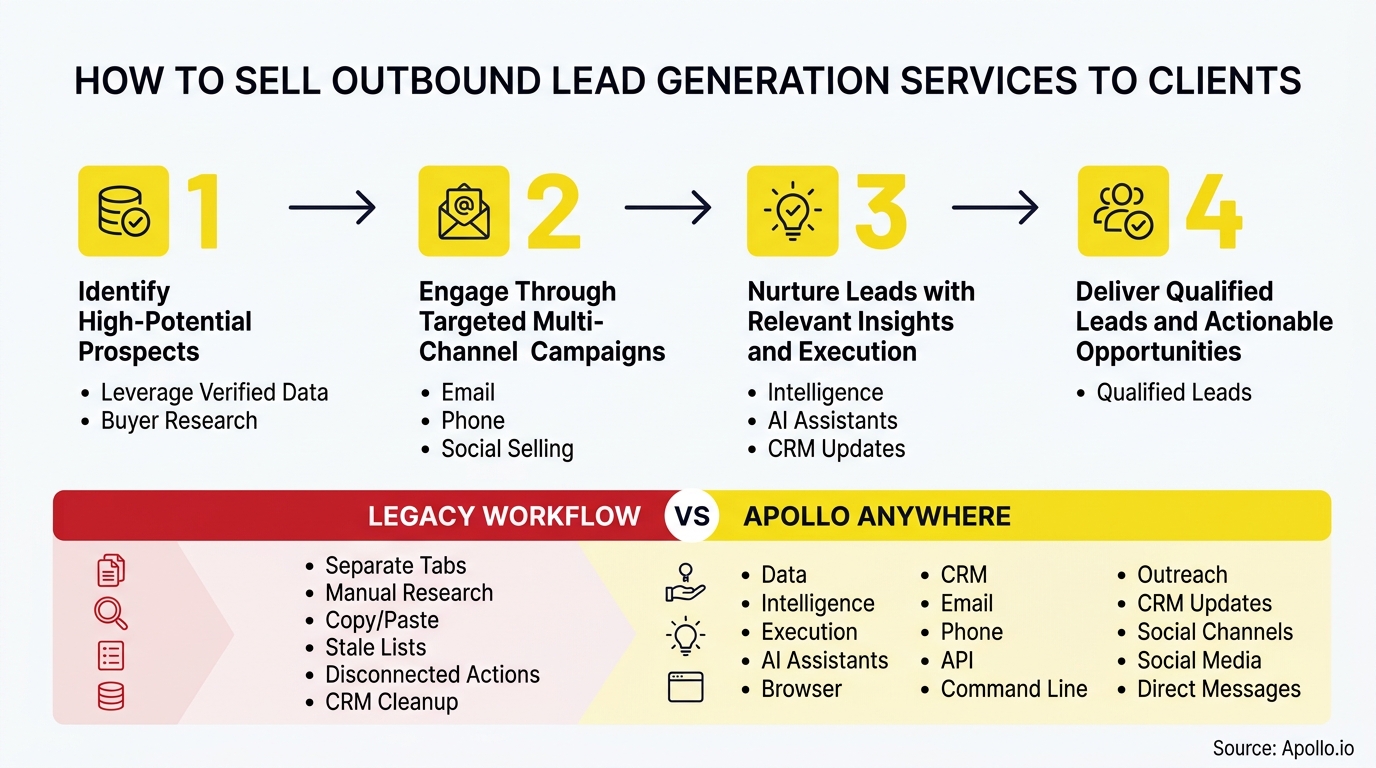
This guide shows you how to package, price, and sell outbound lead generation as a verified pipeline system, not a volume play. You'll get a positioning framework, an ICP filter, a buying-group campaign model, a deliverability SOP, and an economics calculator that proves your value against an in-house SDR hire. For the prospecting mechanics underneath the offer, see this outbound prospecting guide.

Skip The Research, Apollo Finds Contacts Fast
Spending hours chasing down emails and phone numbers that turn out wrong? Apollo verifies contact data instantly with 98% email accuracy, so reps sell instead of searching. Get straight to qualified conversations.
Start Free with Apollo →Key Takeaways
- Clients buy qualified pipeline and revenue outcomes, not lead volume or email counts, so build your offer and pricing around meetings held and opportunities created.
- Multi-threading a full buying committee outperforms single-contact appointment setting because most B2B deals involve many stakeholders and multiple departments.
- Deliverability and sender reputation are now core service deliverables. Google enforces strict spam-rate and authentication requirements for high-volume senders.
- An outsourced outbound engine typically costs less than a fully loaded in-house SDR hire once salary, tools, and management time are included.
- Tool consolidation is a real selling point for agencies too. Fewer platforms means faster onboarding, cleaner attribution, and better margins per client.
How Do You Position An Outbound Lead Gen Service To Clients?
You position an outbound lead gen service by selling qualified pipeline and revenue capacity, not raw contact volume. Roughly 70% of B2B marketers increased lead-generation budgets, according to a 2024 professional networks and Ipsos benchmark cited in industry research, yet 37% named building a high-quality pipeline their top priority, not list size.
Lead with that distinction in every pitch.
Frame your service around three outcomes: qualified meetings booked, opportunities created, and capacity returned to the client's sales team. Sales reps spend the majority of their week on non-selling work, according to Salesforce's 2024 survey of 5,500 sales professionals, which also found most reps missed the prior year's quota.
Your pitch should quantify how many selling hours you give back, not how many emails you send.
Anchor your positioning statement in a simple template: "We help [ICP] generate [outcome] by running [channel mix] campaigns backed by [data + compliance layer], so your reps spend time closing, not prospecting." Reference data-driven prospecting strategies to show clients your targeting is systematic, not spray-and-pray.
How Do You Choose The Right ICP Before Building A Campaign?
You choose the right ICP by filtering for firmographic fit, buying signals, and a realistic path to a qualified conversation. Skipping this step is the fastest way to burn a client's domain reputation on unqualified sends.
Signal-based targeting is replacing static list-building. Providers like Unify and professional networks are productizing signal detection (hiring changes, funding events, website activity, intent data) because clients now expect a "why this buyer, why now" rationale behind every send, not just a title and company size match.
- Firmographic fit: industry, employee count, revenue band, tech stack
- Signal fit: recent funding, leadership hires, product launches, hiring surges
- Buying-committee fit: can you identify at least 5-8 stakeholders per account, not just one contact
- Reachability fit: verified email and phone coverage for the roles you need to reach
Struggling to find qualified leads that fit all four filters? Search Apollo's 240M+ contacts with 65+ filters to build ICP lists in minutes instead of days. This also strengthens your sales prospecting list before a single email goes out.
How Do You Design Campaigns For Multi-Threaded Buying Groups?
You design multi-threaded campaigns by mapping every stakeholder in the buying group and sequencing role-specific messages instead of chasing one contact. Forrester reported in December 2024 that an average of 13 people participate in a B2B buying decision, 89% of purchases involve at least two departments, and 86% of purchases stall, according to Forrester's State of Business Buying research. Single-contact appointment setting simply can't move a deal that size.
Build a stakeholder map for each target account: economic buyer, champion, technical evaluator, end user, and procurement. Write distinct messaging for each role that addresses their specific stake in the problem, then sequence outreach so multiple contacts hear a consistent narrative within the same week.
Channel mix matters here too. Companies using at least three outreach channels (email, social, and phone) achieve a measurably higher conversion rate than single-channel teams, according to Martal's enterprise lead generation research. Combine that channel mix with content: short-form video and customer proof build the familiarity that gets your client on the buyer's shortlist before a rep ever reaches out.

What Should A Deliverability And Compliance SOP Include?
A deliverability SOP protects your client's sender reputation by enforcing authentication, list hygiene, and spam-rate thresholds before you launch a single sequence. Since February 2024, Google has required senders delivering more than 5,000 daily messages to Gmail to implement SPF, DKIM, and DMARC, support one-click unsubscribe, and stay under a 0.3% spam-complaint rate, per Google's sender guidelines, which recommends staying under 0.1%.
Build this into your onboarding checklist, not an afterthought:
- Verify SPF, DKIM, and DMARC records on every sending domain before go-live
- Use domain warmup schedules and sending-volume caps for new domains or mailboxes
- Monitor spam-complaint rate weekly and pause sequences that approach 0.2%
- Verify email and phone data at the point of list-building, not after bounces spike
- Document data sources and CRM-access permissions for every client, since sales teams increasingly ask vendors detailed questions about data security and governance
Tired of dirty data tanking your deliverability scores? Start free with Apollo's data enrichment to verify contacts before every send.
See Every Deal Stage Before It Slips
Forecasting off gut feel because deal stages live in five different tabs? Apollo surfaces buyer intent and engagement signals in real time, so you spot stalled deals before they go cold. Built-In improved win rates using Apollo's scoring and signals.
Schedule a Demo →How Do SDRs And Agencies Set Acceptance Criteria For Qualified Leads?
SDRs and agencies set acceptance criteria by defining, in writing, exactly what makes a lead "qualified" before the campaign launches, not after the client disputes an invoice. This single document prevents most billing disputes in outsourced lead gen.
Your acceptance criteria should specify: minimum stakeholder seniority, confirmed budget or authority signal, a scheduled and attended meeting (not just booked), and a defined handoff window to the client's Account Executive. For SDRs managing high sequence volume, tightening this definition upfront also protects your team's quota credibility with the client.
Put this in the contract as a Service Level Agreement: leads that don't meet criteria within 48 hours get replaced free, not billed. This single clause resolves most disputes before they start and signals to the client you're confident in your qualification process. Reference proven lead nurturing strategies for handling leads that qualify but aren't sales-ready yet.
How Do You Price An Outbound Lead Gen Retainer?
You price an outbound lead gen retainer using one of three models: flat monthly retainer, per-qualified-meeting, or hybrid (base retainer plus performance bonus). Most agencies land on hybrid pricing because it balances predictable revenue for you with performance incentive for the client.
| Pricing Model | How It Works | Best For |
|---|---|---|
| Flat Retainer | Fixed monthly fee for a defined volume of activity (calls, emails, accounts worked) | New clients, pilot programs, complex ICPs |
| Per-Qualified-Meeting | Client pays only for meetings that meet acceptance criteria | Clients wanting performance-based risk sharing |
| Hybrid | Lower base retainer plus bonus per qualified meeting or opportunity | Long-term partnerships, scaling accounts |
The global lead generation outsourcing market is valued at an estimated $4.2 billion in 2026, projected to grow to $7.6 billion by 2033, according to Martal's market analysis, a signal that budget for this model keeps expanding even as DIY tools improve.
Is Outsourced Outbound Cheaper Than Hiring An In-House SDR?
Outsourced outbound is typically cheaper than a full-time in-house SDR once you account for salary, taxes, tools, and management overhead. According to Outbound Sales Pro's cost analysis, a fully loaded in-house SDR costs between $9,800 and $14,200 per month when you include salary, taxes, tech stack, and management time.
Use this simple calculator framework in your sales conversations:
- In-house cost: base salary + payroll tax + benefits + tech stack (data, engagement, dialer) + manager time allocated to coaching
- Outsourced cost: your retainer or per-meeting fee, all-inclusive of data, tools, and management
- Ramp time: in-house hires typically need 60-90 days to reach full productivity; outsourced teams with existing infrastructure ramp faster
For Founders and Revenue Leaders comparing options, this framework turns an abstract "should we outsource" question into a concrete monthly cost comparison they can bring to their CFO.
How Can SDRs And RevOps Leaders Scale Outbound Without Adding Headcount?
SDRs and RevOps leaders scale outbound without adding headcount by consolidating data, sequencing, and reporting into one platform instead of stitching together separate tools for each function. Managing five or six disconnected tools eats the exact selling time you're trying to give back to clients.
For agencies running multiple client accounts, tool sprawl compounds fast: one platform for data, another for sequences, a third for call intelligence, a fourth for reporting. That's real overhead multiplied across every client you serve. Collin Stewart of Predictable Revenue put it simply: "We reduced the complexity of three tools into one."
Spending hours stitching together manual outreach across disconnected platforms? Automate your sequences with Apollo's multi-channel platform and run data, outreach, and reporting from one workspace. For Account Executives inheriting these meetings, pre-meeting intelligence pulled from the same system means faster deal qualification and fewer dropped handoffs.
What Should A Launch-To-Revenue Reporting Scorecard Track?
A launch-to-revenue scorecard tracks the full funnel from first send to closed revenue, not just activity metrics like emails sent or calls dialed. Clients renew agencies that can show a clear line from campaign activity to pipeline dollars.
- Activity: accounts worked, contacts reached, sequences completed
- Engagement: reply rate, meeting-booked rate, show rate
- Qualification: meetings meeting acceptance criteria, opportunities created
- Revenue: pipeline value generated, closed-won attributed to the campaign
Report this monthly in a format the client can forward to their own leadership. Tie every metric back to the qualified-pipeline promise you made in your original pitch, and use deal management tools to keep pipeline visibility transparent for both sides.
Ready To Build A Sellable Outbound Lead Gen Offer?
Selling outbound lead gen in 2026 means selling verified pipeline, multi-threaded account strategy, and airtight deliverability, not inbox volume. Clients have more DIY prospecting options than ever, so your differentiation has to be judgment, process, and proof, not just execution.
Build your offer around the framework above: tight ICP filters, buying-group campaigns, a documented compliance SOP, clear acceptance criteria, and a pricing model that reflects real value delivered. Apollo brings B2B data, sales engagement, and AI-powered execution together in one connected go-to-market system, so agencies and internal teams don't have to stitch together separate vendors for research, outreach, and reporting. Explore the sales intelligence and lead database built for exactly this kind of work.
Start Your Free Trial:Start Your Free Trial

Frequently Asked Questions About Selling Outbound Lead Gen
How Much Should Agencies Charge For Outbound Lead Generation?
Pricing depends on the deliverable you're guaranteeing, not the number of emails sent. Agencies typically anchor pricing to qualified meetings booked or sales-accepted leads delivered, then layer in a base retainer that covers list building, copywriting, and campaign management.
A performance component tied to accepted-lead volume protects your margin while giving clients a clear reason to renew.
What Makes A Lead "Qualified" In An Outbound Contract?
A qualified lead is one that meets the acceptance criteria both parties defined in writing before the campaign started, typically firmographic fit, a confirmed pain point, and a named decision-maker or influencer on the call. Vague definitions like "interested prospect" create disputes at invoice time.
Document criteria in the SOW and reconcile every disputed lead against that checklist, not a subjective read of the call.
Can Small Agencies Compete With In-House SDR Teams?
Yes, small agencies compete by offering specialized ICP research, faster ramp time, and proof of results across multiple clients instead of one company's learning curve. Clients hire agencies to skip the hiring, training, and tooling overhead of building an SDR function from scratch.
An agency that shows up with a documented process, live dashboards, and case studies can out-position an unproven internal hire even at a comparable price point.
What Tools Do Agencies Need To Run Outbound Campaigns At Scale?
Agencies need a verified contact database, a sequencing platform for multi-channel outreach, deliverability monitoring, and a reporting layer clients can access directly. Consolidating these functions into a single workspace, rather than stitching together separate point tools, cuts the operational overhead of managing multiple logins and reconciling data across systems.
This is the efficiency gap that determines whether an agency can profitably run five accounts or fifty.
Apollo Turns New Reps Into Quota Hitters Fast
New reps taking months to ramp while your pipeline goals don't wait? Apollo gives every rep the same verified data, sequences, and playbooks from day one, no tribal knowledge required. Prove the ROI with pipeline built in weeks, not quarters.
Start Free with Apollo →Don't miss these
Sales
Inbound vs Outbound Marketing: Which Strategy Wins?
Sales
What Is a Sales Funnel? The Non-Linear Revenue Framework for 2026
Sales
What Is a Go-to-Market Strategy? The 2026 GTM Playbook
See Apollo in action
We'd love to show how Apollo can help you sell better.
By submitting this form, you will receive information, tips, and promotions from Apollo. To learn more, see our Privacy Statement.
4.7/5 based on 9,690 reviews
