
What Is a Sales Tech Stack? Tools, Layers, and How to Build One in 2026
Your sales tech stack is the collection of software tools your team uses to find prospects, engage buyers, manage pipeline, and close deals. In 2026, building the right stack is less about adding tools and more about ruthlessly cutting the ones that create friction. According to Salesforce, sales reps spend only 28% of their time actively selling — the other 72% goes to administrative work that a well-designed stack should eliminate.
The best sales tech stack playbooks focus on consolidation: fewer tools, deeper integrations, and a clear data layer that feeds every workflow from prospecting through close.

Build Pipeline, Not Spreadsheets
Tired of your reps burning hours on manual research instead of closing deals? Apollo surfaces verified contacts instantly so your team sells more and researches less. Join 550K+ companies turning prospecting into pipeline.
Start Free with Apollo →Key Takeaways
- The average B2B sales rep uses 14 different tools daily — tool overload directly reduces selling time and quota attainment.
- A modern sales tech stack has five core layers: data, engagement, CRM, intelligence, and automation.
- Stack consolidation is the top priority in 2026: unified platforms reduce cost, improve data quality, and increase rep adoption.
- SDRs, AEs, and RevOps each need different views of the stack — build for all three or adoption suffers.
- AI governance is now a stack requirement, not a feature — teams must control how AI agents access data and take action.
What Is a Sales Tech Stack?
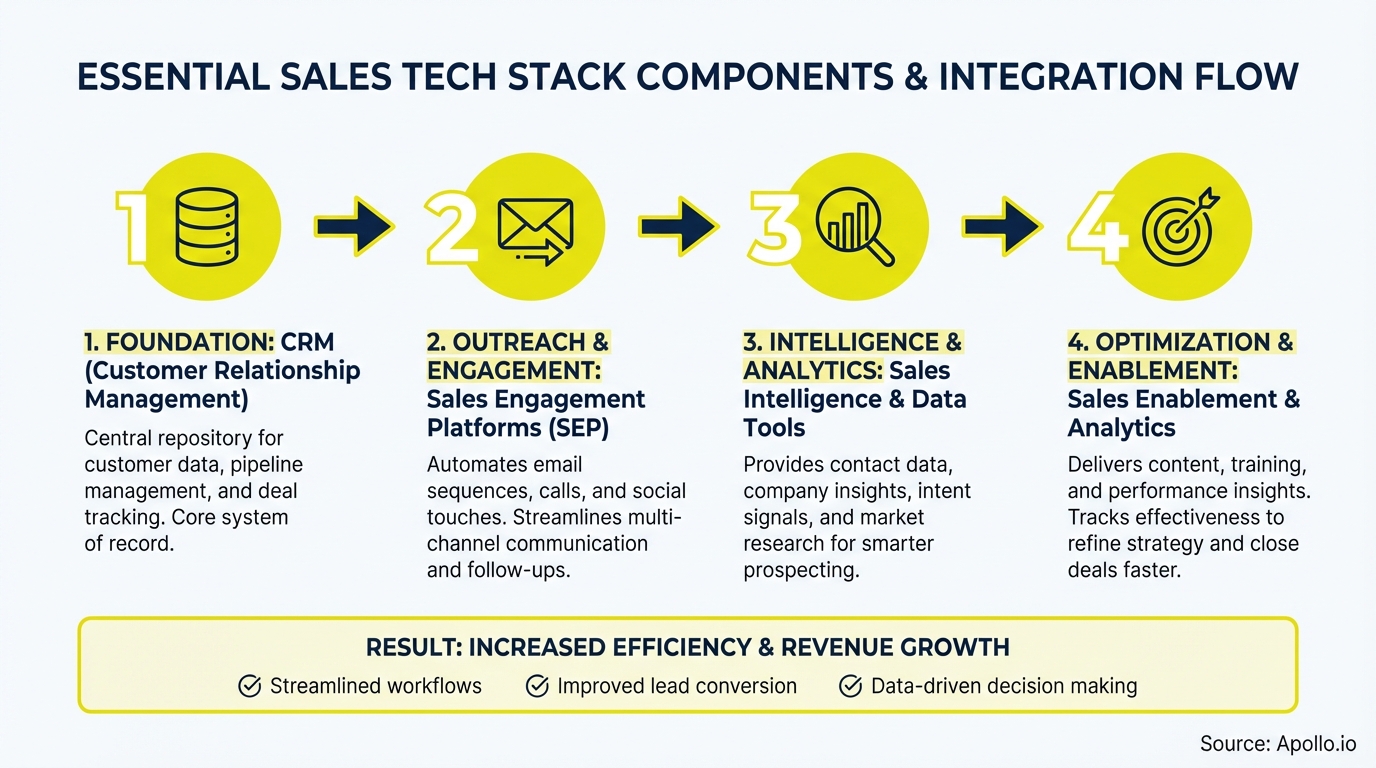
A sales tech stack is the integrated set of tools that enables a revenue team to execute its go-to-market motion — from identifying ideal customers to closing and expanding them. It is not a single platform.
It is a system of interconnected layers, each solving a specific part of the sales process.
A well-built stack reduces manual work, ensures consistent messaging, and gives leadership visibility into pipeline health. A poorly built stack does the opposite: it creates data silos, slows reps down, and makes attribution impossible.
| Stack Layer | Function | Example Tools |
|---|---|---|
| Data & Intelligence | Contact discovery, enrichment, intent signals | Apollo, ZoomInfo |
| CRM | Pipeline tracking, opportunity management | Salesforce, HubSpot |
| Sales Engagement | Sequences, email, calls, social outreach | Apollo, Outreach |
| Conversation Intelligence | Call recording, coaching, deal insights | Gong, Apollo Conversations |
| Automation & Workflow | Task routing, AI agents, process triggers | Apollo Workflows, Zapier |
Why Is Tool Overload Killing Sales Productivity?
More tools rarely means more revenue. Research from Kondo shows that the average sales team uses 10 different tools in their sales process, and 66% of sales representatives feel overwhelmed by the number of tools they must navigate daily. Context-switching between disconnected platforms fragments attention and creates data gaps that hurt forecasting.
A Salesforce study cited by Brixon Group found that the average B2B sales rep uses 14 different tools daily — a number that correlates directly with lower selling time and higher administrative burden.
The fix is consolidation. Platforms that combine data, engagement, and intelligence in one workspace eliminate the switching cost and give RevOps a single source of truth. As Collin Stewart at Predictable Revenue put it: "We reduced the complexity of three tools into one" — a shift that cut their stack costs significantly.
Spending too much time on manual outreach? Automate your sequences with Apollo's multi-channel engagement platform and give your reps more time to actually sell.

How Do SDRs and RevOps Leaders Use the Stack Differently?
SDRs and RevOps operate in the same stack but need fundamentally different things from it. Aligning your tool configuration to each role drives adoption and output.
For SDRs and BDRs:
- Fast access to verified contact data with intent signals
- Automated multi-channel sequences (email, phone, social)
- One-click meeting booking tied to CRM activity
- Clear task queues with no manual data entry
For RevOps leaders:
- Clean, enriched CRM data with no duplicates
- Attribution reporting from first touch to closed-won
- Workflow automation that routes leads without manual handoffs
- Fewer integrations to maintain and audit
For Account Executives managing active deals, the stack needs deal management visibility — stage progression, stakeholder mapping, and next-step tracking in one place. Apollo's deal management tools give AEs that pipeline clarity without switching to a separate system.
Turn Funnel Guesswork Into Closed Deals
Tired of watching quality leads stall before they ever reach your pipeline? Apollo surfaces in-market buyers with precision so your team acts on real signals, not gut instinct. Join 550K+ companies forecasting with confidence.
Schedule a Demo →What Does a Modern Sales Tech Stack Look Like in 2026?
The 2026 stack is converging around AI-native, consolidated platforms. Vendors like Salesforce are embedding AI agents (Agentforce) directly into their CRM and workflow layers.
The shift from point solutions to unified platforms is accelerating — driven by cost pressure, data quality demands, and the need to govern AI actions at scale.
Key characteristics of a 2026-ready stack:
- Unified data layer: Enrichment, verification, and intent signals flow into CRM automatically — no manual imports.
- AI governance controls: Teams define what AI agents can and cannot do. Audit logs, permission scopes, and human-in-the-loop checkpoints are standard.
- Rep-free buyer enablement: Self-serve content hubs, ROI calculators, and interactive demos support buyers who prefer to research independently.
- Attribution from content to close: Every touchpoint — email open, demo view, call recording — maps to pipeline influence in the CRM.
Security is also now a stack design criterion. Interconnected tools with broad OAuth permissions create risk.
Evaluating third-party app integrations for token scope, data access, and incident response policies is part of responsible stack governance in 2026.
How Do You Build a Sales Tech Stack That Scales?
Building a scalable stack means starting with outcomes, not features. Define what each stage of your sales process needs to produce, then select tools that deliver those outcomes with minimal overlap.
Five-step build framework:
- Audit current tools: Map every tool to a specific workflow. Cut anything without clear ownership or measurable impact.
- Anchor on CRM: Every other tool should push data to and pull data from your CRM. No CRM integration, no adoption.
- Consolidate data and engagement: Use one platform for contact discovery, enrichment, and outreach sequences where possible.
- Add intelligence last: Conversation intelligence, forecasting, and analytics tools only add value if the data feeding them is clean.
- Govern AI actions explicitly: Define which workflows use AI automation, set approval gates for high-stakes actions, and review outputs regularly.
Struggling to find the right contacts to fill your pipeline? Search Apollo's 224M verified contacts with 65+ filters to target your exact ICP without adding another data tool to your stack.
For a deeper build guide, see how modern teams scale revenue with the right stack architecture. If you want to see what stack consolidation looks like in practice, Census replaced their entire sales tech stack with Apollo and cut costs in half.
How Does AI Change the Sales Tech Stack in 2026?
AI is no longer a feature inside tools — it is becoming a first-class component of the stack itself. AI agents can now prospect, draft outreach, update CRM records, and flag deal risks without rep intervention. Gartner predicts that 60% of B2B seller work will be executed by generative AI technologies by 2028, up from less than 5% in 2023.
This creates two priorities for stack builders:
- Data quality: AI outputs are only as reliable as the data they act on. Enrichment and verification must happen upstream of every AI workflow.
- Governance: AI agents need defined boundaries. What actions can they take autonomously? What requires human approval? These are now stack design decisions, not IT afterthoughts.
Teams that explore which AI sales tools actually drive results consistently find that embedded AI (within a unified platform) outperforms bolted-on AI tools that lack context from the rest of the stack. Explore how sales automation works inside Apollo to see how AI and workflow automation combine in one system.

Build a Leaner, Smarter Sales Tech Stack with Apollo
The best sales tech stack in 2026 is not the biggest one. It is the most integrated one — where data flows cleanly, reps spend time selling, and revenue leaders have full visibility from first touch to closed deal.
Apollo consolidates data enrichment, contact search, multi-channel engagement, AI automation, deal management, and conversation intelligence in one platform. Customers like Cyera report that "having everything in one system was a game changer" — and Census cut their costs in half by replacing fragmented point solutions with Apollo.
Whether you are an SDR building outbound sequences, a RevOps leader rationalizing your stack, or a founder trying to compete without enterprise budgets, Apollo gives you the tools to move faster with less overhead.
Try Apollo Free and see how much of your current stack you can consolidate into one platform.
Prove Pipeline ROI With Apollo
ROI pressure making budget approvals impossible? Apollo delivers measurable pipeline impact so you can justify every dollar spent. Leadium 3x'd their annual revenue — your CFO will notice.
Start Free with Apollo →Don't miss these
Sales
Inbound vs Outbound Marketing: Which Strategy Wins?
Sales
What Is a Sales Funnel? The Non-Linear Revenue Framework for 2026
Sales
What Is a Go-to-Market Strategy? The 2026 GTM Playbook
See Apollo in action
We'd love to show how Apollo can help you sell better.
By submitting this form, you will receive information, tips, and promotions from Apollo. To learn more, see our Privacy Statement.
4.7/5 based on 9,690 reviews
