
Sales Reporting Software: How to Transform Data Into Revenue Growth
Sales leaders in 2026 face a critical challenge: turning mountains of sales data into actionable insights that actually drive revenue. Manual reporting steals hours from selling time, while disconnected tools create data silos that hide pipeline risks until it's too late. Sales analytics platforms that integrate with your entire tech stack are now essential for teams that want to forecast accurately and coach effectively.

Apollo Finds Contacts In Seconds, Not Hours
Tired of spending 4+ hours daily hunting for contact info? Apollo delivers 224M verified contacts with 96% email accuracy. Join 550K+ companies who eliminated manual research.
Start Free with Apollo →Key Takeaways
- Sales reporting software transforms raw CRM data into visual dashboards that reveal pipeline health, rep performance, and revenue forecasts in real time
- AI-powered reporting tools cut report generation time by 75% while surfacing hidden trends that manual analysis misses
- Integrated platforms consolidate data from multiple sources, eliminating the need for separate analytics tools and reducing tech stack costs
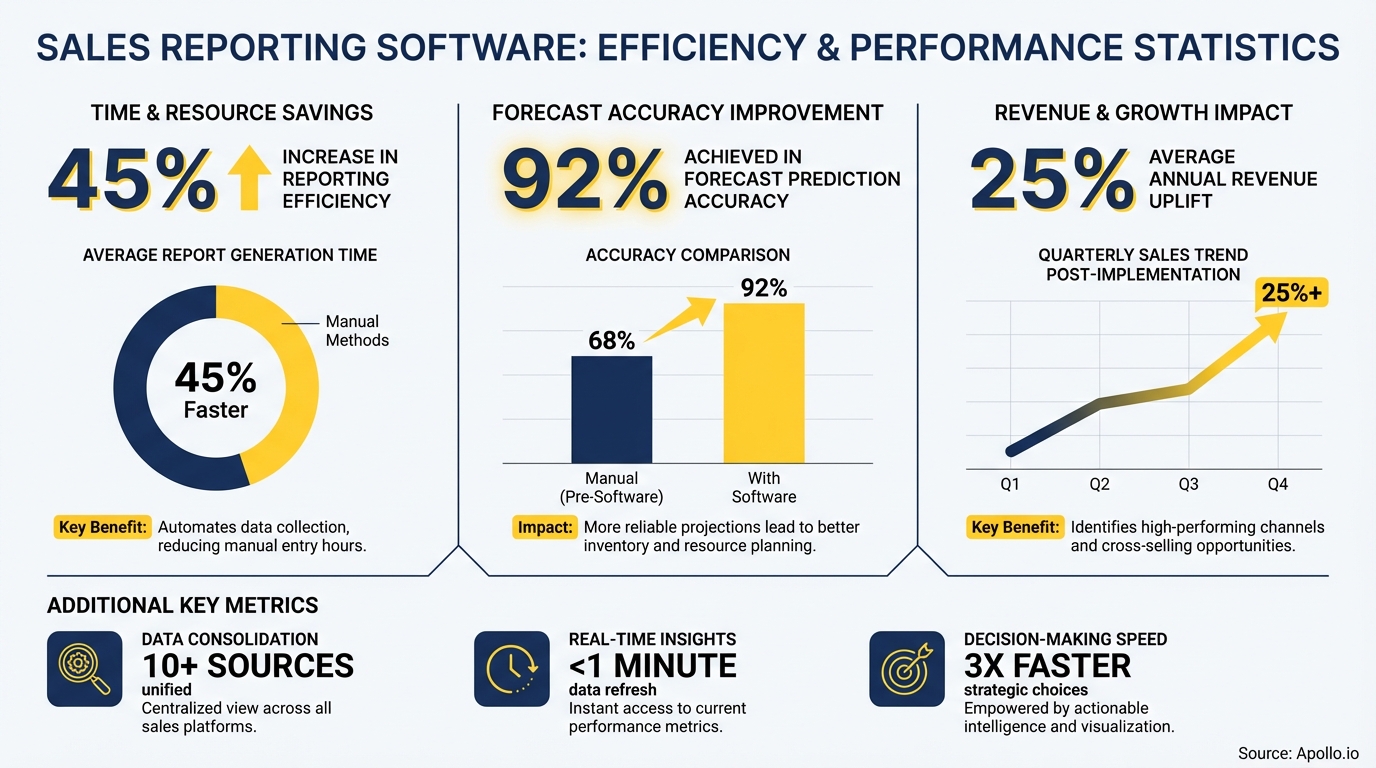
- RevOps teams using modern reporting software achieve 30-40% faster month-end close processes and more accurate forecasting
- The ROI payback period for sales reporting software averages 3-6 months through improved quota attainment and reduced administrative overhead
What Is Sales Reporting Software?
Sales reporting software is a platform that aggregates data from CRM systems, marketing automation tools, and other sales technologies to create visual reports and dashboards. It tracks metrics like pipeline velocity, win rates, quota attainment, and revenue forecasts.
The software automates data collection and analysis that would otherwise require hours of manual spreadsheet work.
Modern sales reporting tools connect to your entire go-to-market stack. They pull data from your CRM, email platforms, call recording systems, and deal management software to create a single source of truth. According to Gartner, the CRM digital commerce software market is projected to grow at a five-year CAGR of 16% through 2027, reaching $21.7 billion as B2B organizations prioritize unified data platforms.
Sales reporting software is not just a dashboard builder. It includes forecasting engines, anomaly detection, and prescriptive analytics that tell you what actions to take, not just what happened last quarter.
Why Do Sales Leaders Need Reporting Software in 2026?
Sales leaders need reporting software because manual reporting processes can't scale with modern sales complexity. Teams using 5-10 different sales tools generate data across multiple systems.
Consolidating this information manually takes RevOps analysts 10-15 hours per week, time that could be spent on strategic initiatives instead of data wrangling.
Tired of pulling reports from multiple systems? Unify your sales data in Apollo's all-in-one platform and eliminate tool sprawl.
Research by Gartner shows that 92% of businesses are investing in AI-powered software in 2024, recognizing that AI can surface insights human analysts miss. Sales reporting software with AI capabilities identifies at-risk deals, recommends next-best actions, and forecasts revenue with 85-90% accuracy.

For Sales Leaders managing distributed teams, real-time visibility into pipeline health and rep activity is non-negotiable. Modern reporting software provides instant answers to questions like "Which deals are stalled?" and "Who needs coaching this week?" without requiring analysts to build custom reports.
What ROI Can Sales Teams Expect?
Sales teams implementing reporting software typically see measurable ROI within 3-6 months through three primary drivers: increased quota attainment, reduced administrative time, and improved forecast accuracy. Organizations report 15-25% improvements in win rates when reps have access to real-time competitive intelligence and deal insights.
Tool consolidation delivers significant cost savings. Teams replacing separate analytics, forecasting, and BI tools with an integrated platform like Apollo's unified sales stack cut software costs by 40-60%. As one customer shared: "We cut our costs in half" (Census).
Turn Forecast Chaos Into Revenue Certainty
Pipeline forecasting a guessing game? Apollo reveals real-time deal intelligence and buying signals so you stop missing numbers. Built-In increased win rates 10% with Apollo's scoring.
Start Free with Apollo →How Does Sales Reporting Software Work?
Sales reporting software works by connecting to your CRM and other sales tools through native integrations or APIs.
It extracts data on deals, activities, contacts, and revenue, then processes this information using pre-built reporting templates or custom report builders.
The software refreshes data automatically, from hourly to real-time depending on your configuration.
The reporting engine applies business logic to raw data. It calculates metrics like average deal size, sales cycle length, and conversion rates by stage.
AI-powered platforms go further, using machine learning models to score deal health, predict close dates, and identify patterns across won and lost opportunities.
Users access insights through interactive dashboards that allow filtering by time period, team, product, or territory. Sales Leaders can drill down from executive-level pipeline views to individual rep performance with one click.
Mobile apps ensure field reps have access to critical data before customer meetings.
What Data Sources Does It Integrate?
Modern sales reporting software integrates with 20-50+ data sources to create comprehensive analytics. Core integrations include Salesforce, HubSpot, Microsoft Dynamics, and other major CRMs. Additional connections pull data from email platforms (Gmail, Outlook), conversation intelligence tools, marketing automation systems, and customer success platforms.

All-in-one platforms eliminate integration complexity entirely. Apollo combines prospecting, engagement, and reporting in one workspace, avoiding the data sync issues that plague multi-tool stacks. "Having everything in one system was a game changer" (Cyera).
How Do RevOps Teams Choose the Right Reporting Platform?
RevOps teams evaluating sales reporting software should prioritize three capabilities: data integration breadth, customization flexibility, and AI-powered insights. Start by mapping your current tech stack and identifying which data sources must connect to your reporting platform.
Platforms that can't integrate with your core systems create blind spots in your analytics.
Customization determines whether the platform adapts to your sales process or forces you to change how you work. Look for solutions offering custom fields, calculated metrics, and flexible report builders.
Pre-built templates accelerate time-to-value, but you need the ability to create reports matching your unique business model.
Security and compliance matter for teams handling sensitive customer data. Verify that platforms offer role-based access controls, data encryption, and audit logs.
For regulated industries, confirm the vendor maintains SOC 2, GDPR, and other relevant certifications.
What Features Matter Most for Account Executives?
Account Executives need reporting features that help them close deals faster, not just track what happened last quarter. Deal-level insights showing engagement history, stakeholder maps, and competitive intelligence prove most valuable.
AEs report that platforms surfacing "next best action" recommendations based on similar won deals increase their close rates by 20-30%.
Mobile access is critical for field sellers who need pipeline data before customer meetings. Real-time notifications about deal activity, such as when a champion views a proposal or a decision-maker engages with content, enable timely follow-up that moves deals forward.
What Are the Implementation Best Practices?
Successful implementations start with clean data. Audit your CRM for duplicate records, incomplete fields, and inconsistent naming conventions before connecting reporting software.
Garbage in, garbage out applies doubly to analytics platforms that amplify data quality issues across your entire organization.
Struggling with dirty contact data? Apollo enriches and verifies 224M+ business contacts automatically, ensuring your reports reflect reality.
Define your key metrics before building dashboards. Sales Leaders should align with finance and marketing on definitions for pipeline, qualified opportunities, and revenue recognition.
Misaligned metrics create confusion and erode trust in your reporting.
Roll out reporting software in phases. Start with executive dashboards and core pipeline reports, then expand to rep-level analytics and AI-powered insights.
This approach allows teams to adopt gradually while RevOps validates data accuracy at each stage.
How Long Does Implementation Take?
Implementation timelines range from 2 weeks for simple CRM integrations to 3-6 months for enterprise deployments with complex data migration requirements. Cloud-based platforms with pre-built CRM connectors typically go live within 30 days.
Custom integrations, historical data migration, and advanced AI model training extend timelines.
Platforms designed as all-in-one solutions reduce implementation complexity. Teams using integrated AI GTM systems avoid multi-system data mapping and can start generating insights within days instead of months.
What AI Capabilities Should You Expect in 2026?
AI-powered sales reporting software in 2026 offers three core capabilities: predictive forecasting, deal health scoring, and automated insight generation. Predictive forecasting uses historical data and current pipeline signals to project revenue with 85-95% accuracy.
The AI identifies patterns humans miss, such as how email response times correlate with close probability.
Deal health scoring analyzes dozens of signals to flag at-risk opportunities. The AI considers engagement frequency, stakeholder coverage, competitive presence, and progression velocity.
Sales Leaders receive alerts when high-value deals show warning signs, enabling proactive coaching before opportunities slip away.
Automated insight generation eliminates manual report analysis. The AI surfaces anomalies, trends, and opportunities in plain language: "Enterprise deals are taking 30% longer to close this quarter" or "Deals with 3+ stakeholders engaged have 2.5x higher win rates." This capability saves RevOps teams 10-15 hours per week on report interpretation.
Conclusion: Build Your Revenue Engine on Unified Data
Sales reporting software transforms how revenue teams operate in 2026. The right platform consolidates data from across your tech stack, delivers AI-powered insights, and gives every role from SDRs to Sales Leaders the visibility they need to hit targets.
Organizations implementing modern reporting solutions report 15-25% quota attainment improvements and 40-60% reductions in software costs through tool consolidation.
The key is choosing a platform that integrates deeply with your existing systems or, better yet, replaces multiple tools entirely. "We reduced the complexity of three tools into one" (Predictable Revenue). For teams serious about revenue growth, unified platforms that combine prospecting, engagement, and analytics in one workspace eliminate data silos while cutting costs.
Ready to cut your tech stack and unify your sales data? Start your free Apollo trial and see how 2M+ users leverage all-in-one sales intelligence to drive predictable revenue growth.
Prove Apollo's ROI In Your First 30 Days
Budget approval stuck on unclear metrics? Apollo tracks every touchpoint from first contact to closed deal. Built-In increased win rates 10% and ACV 10% with measurable pipeline impact.
Start Free with Apollo →Don't miss these
Sales
Inbound vs Outbound Marketing: Which Strategy Wins?
Sales
What Is a Sales Funnel? The Non-Linear Revenue Framework for 2026
Sales
What Is a Go-to-Market Strategy? The 2026 GTM Playbook
See Apollo in action
We'd love to show how Apollo can help you sell better.
By submitting this form, you will receive information, tips, and promotions from Apollo. To learn more, see our Privacy Statement.
4.7/5 based on 9,690 reviews
