
Sales Programs: Definition, Benefits, and Best Practices
Sales programs are evolving faster than ever. By 2026, the gap between teams using data-driven frameworks and those relying on intuition has become a competitive chasm. Modern B2B sales organizations need structured programs that blend technology, process, and human expertise to consistently hit revenue targets.

Skip Manual Research - Apollo Finds Contacts Fast
Tired of spending 4+ hours daily hunting for contact info? Apollo delivers 224M verified contacts with 96% email accuracy. Join 550K+ companies hitting quota faster.
Start Free with Apollo →Key Takeaways
- Sales programs combine training, processes, tools, and metrics to drive predictable revenue growth
- Data-driven programs outperform intuition-based approaches by integrating analytics across the entire sales cycle
- Effective programs balance digital self-service with personalized human interaction throughout the buyer journey
- Successful implementation requires alignment between marketing content, sales execution, and customer engagement triggers
- Modern platforms consolidate multiple tools into unified workspaces, cutting costs and complexity
What Are Sales Programs?
Sales programs are structured frameworks that combine training, technology, processes, and performance metrics to drive consistent revenue results. They provide repeatable systems for prospecting, engaging buyers, advancing deals, and closing business across your entire sales organization.
According to Gartner research, 60% of B2B sales organizations have already transitioned from experience-based selling to data-driven programs that integrate processes, applications, data, and analytics into unified operational practices.
Modern sales programs go beyond traditional training. They orchestrate how your team identifies prospects, sequences outreach, manages conversations, and forecasts revenue.
For Sales Leaders managing distributed teams, programs create the consistency needed to scale performance across reps with different experience levels.
Why Do Sales Programs Matter in 2026?
Sales programs matter because buyer behavior has fundamentally shifted. Research by Gartner shows 61% of B2B buyers now prefer digital self-service over direct sales interactions. Your program must orchestrate when and how human sellers add value.
Without structured programs, teams face:
- Inconsistent messaging that confuses buyers
- Wasted time on low-fit prospects
- Manual processes that limit scalability
- Disconnected tools creating data silos
- Unpredictable pipeline and forecasting
Struggling to find qualified leads? Search Apollo's 224M+ contacts with 65+ filters to build targeted prospect lists.
What Are the Core Components of Effective Sales Programs?
Effective sales programs integrate five core components that work together as a unified system. Each component supports the others, creating compounding performance gains across your revenue organization.
| Component | Purpose | Key Elements |
|---|---|---|
| Data Foundation | Accurate targeting and intelligence | Contact database, enrichment, verification, intent signals |
| Engagement Framework | Multi-channel buyer interaction | Email sequences, calls, social outreach, meeting coordination |
| Content System | Relevant messaging at each stage | Pitch decks, case studies, ROI calculators, email templates |
| Process Playbooks | Repeatable execution steps | Qualification criteria, objection handling, negotiation frameworks |
| Performance Metrics | Visibility and optimization | Activity tracking, conversion rates, pipeline coverage, win rates |
RevOps leaders building sales development programs report that tool consolidation dramatically reduces complexity. Census cut their costs in half by moving to a unified platform. Cyera found that having everything in one system was a game changer for their team.
Turn Forecast Chaos Into Revenue Certainty
missing pipeline visibility and for? Apollo delivers real-time deal intelligence and buying signals so you always know what's closing. Built-In increased win rates 10% with Apollo's scoring.
Start Free with Apollo →How Do SDRs Use Sales Programs to Book More Meetings?
SDRs use sales programs to systematically identify high-fit prospects, execute multi-channel sequences, and convert outreach into qualified meetings. Programs eliminate guesswork by providing proven frameworks for prospecting, messaging, and follow-up cadences.
Modern SDR programs include:

- Ideal customer profile filters for precise targeting
- Automated sequences mixing email, calls, and social touches
- Personalization templates that scale across hundreds of prospects
- Real-time notifications for prospect engagement signals
- Meeting booking tools that eliminate scheduling friction
SDRs using structured programs spend less time on manual research and more time on actual conversations. They leverage AI sales tools to automate repetitive tasks while maintaining personalization at scale.
How Should Sales Leaders Build Data-Driven Programs?
Sales Leaders build data-driven programs by establishing clear metrics, integrating analytics across the sales cycle, and creating feedback loops that optimize performance. Start with baseline measurements, implement tracking systems, and iterate based on results.
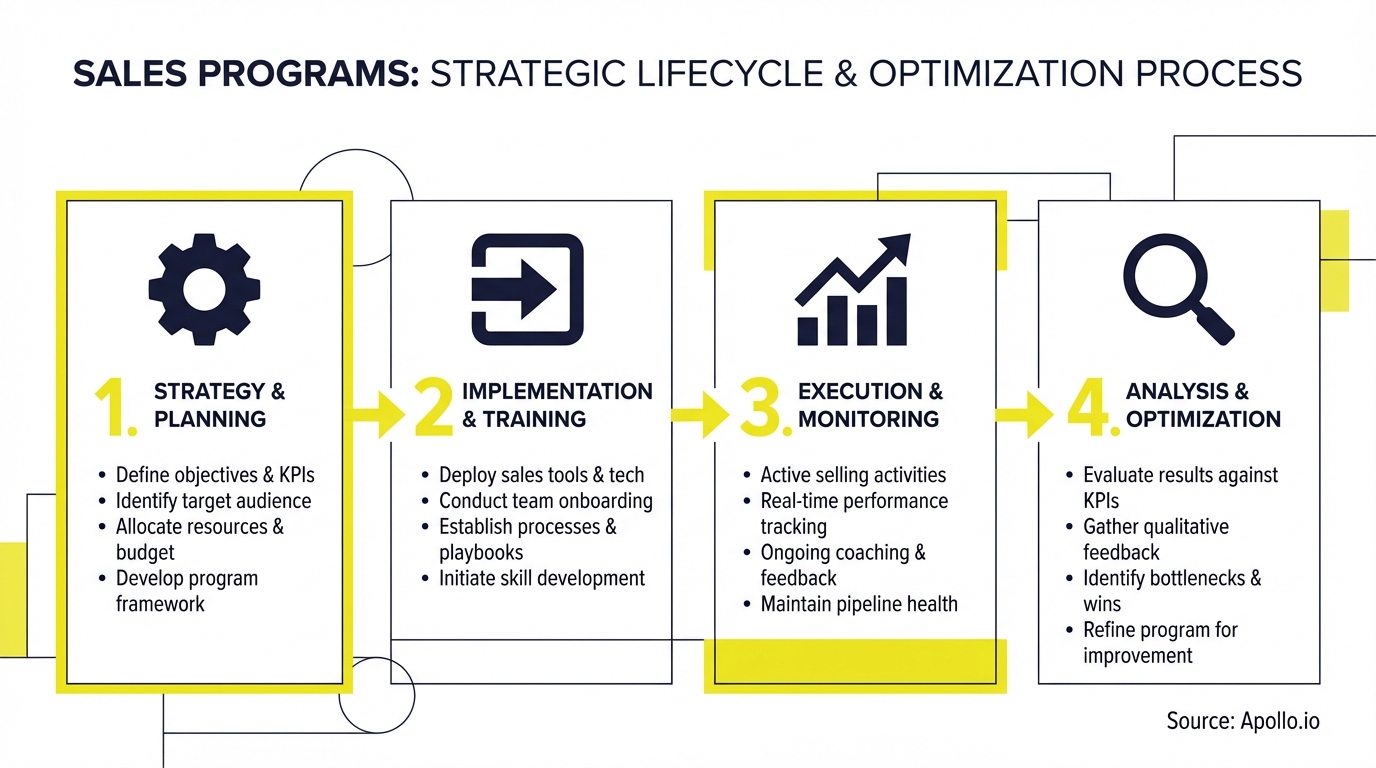
Implementation steps:
- Define success metrics: Conversion rates by stage, average deal size, sales cycle length, win rate by segment
- Audit current state: Identify gaps in data quality, process consistency, and tool utilization
- Select unified platform: Consolidate prospecting, engagement, and analytics into one workspace
- Build playbooks: Document proven sequences, messaging, and qualification frameworks
- Enable the team: Train on new processes with clear examples and practice scenarios
- Monitor and optimize: Weekly pipeline reviews, monthly performance analysis, quarterly program updates
Predictable Revenue reduced the complexity of three tools into one by consolidating their tech stack. For Founders competing with better-funded competitors, unified sales platforms level the playing field without enterprise budgets.
What Role Does Human Interaction Play in Modern Sales Programs?
Human interaction remains critical in modern sales programs despite increased automation. Gartner predicts that by 2030, 75% of B2B buyers will prefer sales experiences prioritizing human interaction over AI-driven engagements.
Effective programs orchestrate when automation handles routine tasks and when sellers add strategic value. AEs managing complex deals use programs to:
- Automate meeting scheduling and follow-up emails
- Surface pre-meeting intelligence on prospect challenges
- Focus human time on consultative discovery and objection handling
- Personalize proposals using data-backed insights
- Build relationships through strategic check-ins at key milestones
The balance matters. Programs should eliminate busywork so sellers spend more time on high-value human interactions. Account Executives using proven sales frameworks combine automation efficiency with relationship-building expertise.
Spending hours on manual outreach? Automate your sequences with Apollo's multi-channel platform while maintaining personalization.
How Do You Measure Sales Program ROI?
You measure sales program ROI by tracking revenue impact, efficiency gains, and cost savings across your sales organization. Compare pre-program and post-program performance using pipeline velocity, win rates, and quota attainment as primary indicators.

Key measurement framework:
- Revenue metrics: Pipeline generated, deals closed, average contract value, customer lifetime value
- Efficiency metrics: Time to first meeting, sales cycle length, activities per closed deal
- Cost metrics: Cost per lead, cost per acquisition, tool consolidation savings
- Team metrics: Ramp time for new hires, quota attainment percentage, rep retention rates
Research by McKinsey found that 57% of sellers don't fully utilize marketing content because it feels generic. Programs that align content with sales needs show measurable improvements in conversion rates and deal velocity.
CEOs evaluating program investments should track how consolidation reduces vendor costs while improving results. Teams using unified deal management platforms report cleaner forecasts and better pipeline visibility.
Start Building Your Sales Program in 2026
Sales programs aren't optional anymore. They're the difference between teams that scale predictably and teams that struggle with inconsistent results.
The best programs combine data-driven frameworks with human expertise, balancing automation efficiency with personalized buyer engagement.
Begin by auditing your current state. Map your existing processes, identify tool overlaps, and measure baseline performance.
Then build incrementally: start with prospecting and outreach, add conversation intelligence, layer in analytics, and refine based on results.
Modern platforms eliminate the need to stitch together separate tools for prospecting, engagement, and pipeline management. Apollo consolidates data, sequences, and analytics into one workspace, helping teams like yours cut costs while improving outcomes.
Ready to build a program that drives predictable revenue? Request a Demo to see how Apollo helps sales teams execute data-driven programs at scale.
Prove Apollo's ROI In Your First 30 Days
Budget approval stuck on unclear metrics? Apollo delivers measurable pipeline impact from day one—Built-In increased win rates 10% and ACV 10% with Apollo's intelligence. Start tracking ROI immediately.
Start Free with Apollo →Don't miss these
Sales
Inbound vs Outbound Marketing: Which Strategy Wins?
Sales
What Is a Sales Funnel? The Non-Linear Revenue Framework for 2026
Sales
What Is a Go-to-Market Strategy? The 2026 GTM Playbook
See Apollo in action
We'd love to show how Apollo can help you sell better.
By submitting this form, you will receive information, tips, and promotions from Apollo. To learn more, see our Privacy Statement.
4.7/5 based on 9,690 reviews
