
Sales Process Optimization: How to Build a Hybrid Selling Engine in 2026
Sales process optimization in 2026 means more than tweaking your funnel. It means building a hybrid selling engine that combines AI-driven automation with strategic human touchpoints across multiple channels. Research by Gartner shows that 75% of B2B sales organizations now augment traditional playbooks with AI-guided selling solutions. The teams winning in 2026 are those who balance automation efficiency with personalized buyer engagement.
This article shows you how to optimize your sales process using proven frameworks, real case studies, and practical implementation strategies that deliver measurable ROI.

Apollo Eliminates 4+ Hours Of Daily Research
Tired of spending 4+ hours daily hunting for contact info? Apollo delivers 224M verified contacts with 96% email accuracy instantly. Join 550K+ companies who stopped wasting time and started closing deals.
Start Free with Apollo →Key Takeaways
- Sales process optimization combines AI automation with human touchpoints across up to ten buyer channels
- Data-driven selling improves win rates and shortens sales cycles by focusing reps on high-intent prospects
- Modern teams consolidate 3-5 tools into unified platforms, cutting costs while improving pipeline visibility
- SDRs and AEs using AI-guided workflows report booking 46% more meetings and closing deals faster
- Hybrid selling strategies balance digital self-service with strategic rep engagement for complex deals
What Is Sales Process Optimization?
Sales process optimization is the systematic improvement of your sales workflow to increase efficiency, reduce friction, and accelerate revenue growth. It involves analyzing each stage of your B2B sales process, identifying bottlenecks, and implementing data-driven changes that help reps close more deals faster.
Modern optimization goes beyond pipeline management. It integrates AI automation, multi-channel engagement, and real-time analytics to guide reps toward the highest-value activities. According to Gartner, 60% of B2B sales organizations have transitioned from experience-based selling to data-driven selling by integrating processes, applications, and analytics into a unified practice.
Why Does Sales Process Optimization Matter in 2026?
Buyer expectations have fundamentally shifted. Data from McKinsey indicates that B2B buyers now use up to ten channels during any purchase, including digital self-service, rep-assisted touchpoints, and social platforms. Teams that optimize for this hybrid reality win deals faster and at higher margins.

Unoptimized processes create three critical problems:
- Wasted rep time: SDRs spend hours on manual research and data entry instead of selling
- Inconsistent buyer experiences: Prospects receive different messages across channels, creating confusion
- Poor pipeline visibility: Sales leaders lack real-time insights into deal health and forecast accuracy
Optimization solves these problems by standardizing workflows, automating repetitive tasks, and giving teams a single source of truth for prospect data and engagement history.
How Do Sales Leaders Optimize Their Processes?
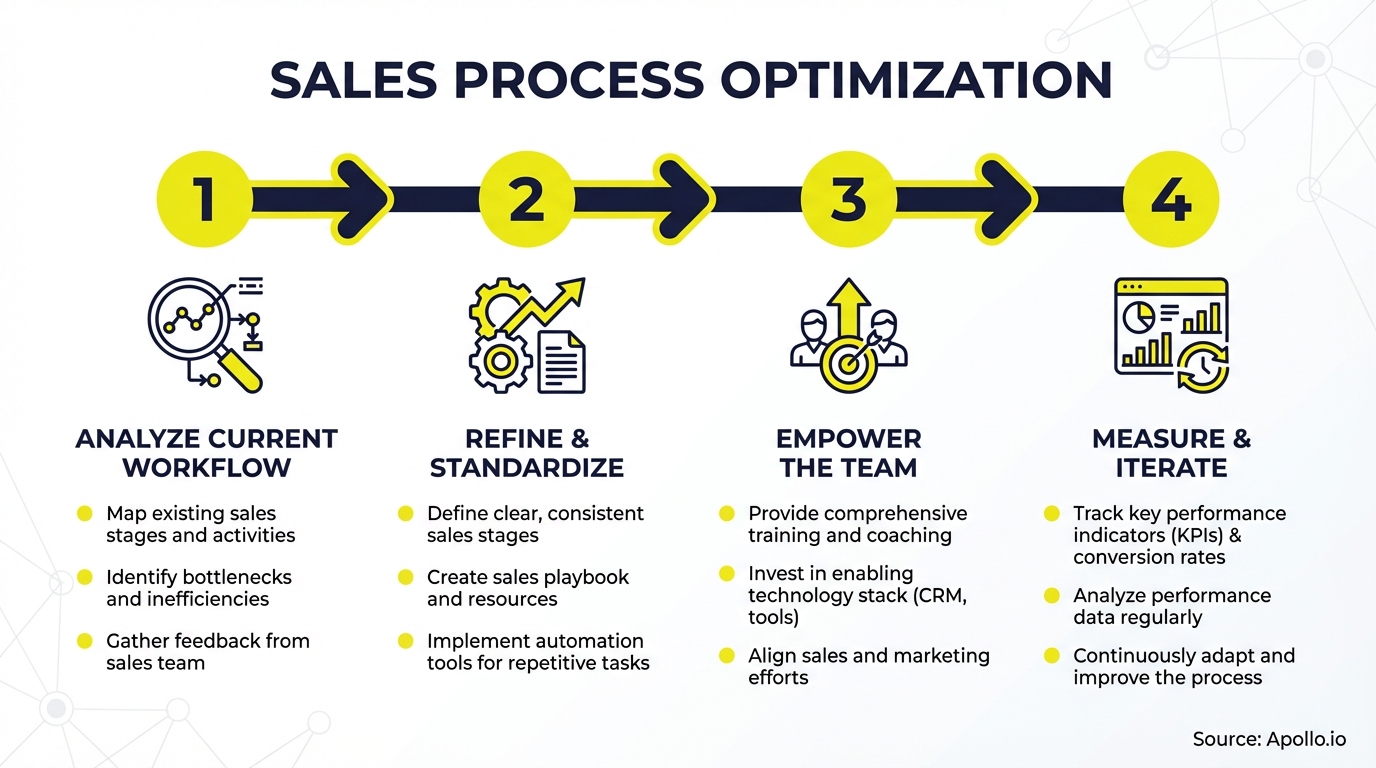
Sales leaders optimize processes by mapping the current state, identifying high-impact improvement areas, and implementing changes systematically. Start with pipeline analysis to find where deals stall or drop off.
Struggling to track where deals get stuck? Get complete pipeline visibility with Apollo's deal management platform.
The optimization framework includes four core components:
| Component | Focus Area | Key Metrics |
|---|---|---|
| Data Quality | Contact accuracy, enrichment, verification | 96% email accuracy, reduced bounce rates |
| Workflow Automation | Sequences, follow-ups, task routing | Time saved per rep, activities per day |
| Channel Orchestration | Email, phone, social coordination | Response rates, meeting bookings |
| AI-Guided Actions | Next-best-action recommendations | Win rate improvement, cycle time reduction |
RevOps leaders report the biggest gains come from consolidating fragmented tech stacks. As one customer noted: "We reduced the complexity of three tools into one" (Predictable Revenue).
This consolidation improves data flow and gives teams one workspace for everything.
Turn Forecast Guesswork Into Revenue Certainty
Can't trust your pipeline because deal stages are outdated. Apollo tracks prospect engagement in real-time so you forecast with confidence. Built-In increased win rates 10% with accurate visibility.
Start Free with Apollo →How Do SDRs Book More Meetings with Optimized Processes?
SDRs book more meetings by focusing on high-intent prospects and automating low-value tasks. Optimized workflows give SDRs pre-researched accounts, AI-generated messaging, and automated follow-up sequences that keep prospects engaged without manual effort.
Teams using AI sales tools report 46% more meetings booked. The difference comes from three process improvements:
- Intelligent prospecting: AI identifies buyers showing intent signals and prioritizes outreach accordingly
- Personalized at scale: Dynamic messaging adapts to prospect role, industry, and engagement history
- Multi-channel sequencing: Coordinated touchpoints across email, phone, and social platforms increase response rates
For SDRs managing large prospect lists, automation handles routine follow-ups while they focus on conversations with engaged buyers. This balance between automation and human interaction is what drives booking rates higher.

What Role Does AI Play in Process Optimization?
AI plays a central role by analyzing sales data to recommend next-best actions, automating repetitive tasks, and personalizing outreach at scale. Modern AI sales automation platforms process millions of data points to guide reps toward activities that historically drive results.
Spending hours researching prospects manually? Search Apollo's 224M+ contacts with 65+ filters for instant targeting.
AI optimization delivers value across the entire sales cycle:
| Sales Stage | AI Application | Impact |
|---|---|---|
| Prospecting | Intent signal detection, account prioritization | Focus on high-conversion targets |
| Outreach | Message generation, send-time optimization | Higher response and booking rates |
| Discovery | Pre-call research, talking point generation | More productive conversations |
| Negotiation | Deal risk scoring, next-step recommendations | Faster closes, reduced slippage |
Account Executives using AI-powered sales development workflows report 35% increases in bookings. The technology handles data analysis and pattern recognition while reps focus on relationship building and strategic selling.
How Do Modern Teams Balance Automation with Human Touch?
Modern teams balance automation with human touch by automating transactional interactions while reserving rep involvement for high-value, complex conversations. Research shows that while 61% of B2B buyers prefer rep-free experiences for simple transactions, 75% still want human interaction for strategic decisions by 2030.
The hybrid approach works like this: automation handles data enrichment, initial outreach, follow-up reminders, and scheduling. Reps engage when prospects show buying signals, ask complex questions, or reach decision stages.
This division maximizes efficiency without sacrificing relationship quality.
Sales leaders building optimized processes create clear rules for when automation hands off to human reps. Triggers include reply engagement, meeting requests, pricing questions, or deals exceeding certain thresholds.
This systematic approach ensures prospects get the right experience at the right time.
Start Optimizing Your Sales Process Today
Sales process optimization in 2026 requires balancing AI-driven efficiency with strategic human engagement across multiple buyer channels. The teams winning today are those who consolidate fragmented tech stacks, implement data-driven workflows, and give reps the tools to focus on high-value activities.
Start by auditing your current process to identify bottlenecks. Map where deals stall, where reps waste time on manual tasks, and where buyer engagement drops off.
Then implement systematic improvements: clean your data, automate repetitive workflows, and add AI-guided actions that help reps prioritize effectively.
Ready to optimize your sales process? Start Your Free Trial and see how Apollo's unified platform helps teams consolidate tools, automate workflows, and close more deals faster.
Prove Apollo's ROI In Your First 30 Days
Budget approval stuck on unclear metrics? Apollo tracks every touchpoint from prospect to close so you quantify pipeline impact instantly. Built-In increased win rates 10% with measurable visibility.
Start Free with Apollo →Don't miss these
Sales
Inbound vs Outbound Marketing: Which Strategy Wins?
Sales
What Is a Sales Funnel? The Non-Linear Revenue Framework for 2026
Sales
What Is a Go-to-Market Strategy? The 2026 GTM Playbook
See Apollo in action
We'd love to show how Apollo can help you sell better.
By submitting this form, you will receive information, tips, and promotions from Apollo. To learn more, see our Privacy Statement.
4.7/5 based on 9,690 reviews
