
Sales Plan Example: Templates and Strategies for Revenue Growth
Modern sales teams need structured plans that adapt to AI-driven workflows and digital-first buyer preferences.
A well-designed sales plan connects revenue goals to execution strategies, but most templates ignore the shift toward data-driven decision-making and self-service buying experiences.
This article provides actionable sales development examples that integrate AI guidance, RevOps alignment, and buyer-team governance frameworks for 2026.

Apollo Turns Research Hours Into Selling Time
Tired of spending 4+ hours daily hunting for contact info? Apollo delivers 224M verified contacts with 96% email accuracy instantly. Join 550K+ companies who replaced manual research with predictable pipeline.
Start Free with Apollo →Key Takeaways
- A sales plan example shows how to align revenue targets with execution tactics, team structure, and performance metrics
- Modern sales plans integrate AI-guided selling recommendations and data-driven insights to replace intuition-based approaches
- Digital self-service channels now handle large B2B transactions, requiring sales plans to support rep-free buyer experiences
- RevOps alignment across CRM, marketing automation, and analytics platforms creates a single source of truth for forecasting
- Buyer-team governance frameworks reduce decision-making conflict and accelerate complex deals with multiple stakeholders
What Is a Sales Plan Example in 2026?
A sales plan example is a documented framework that outlines revenue objectives, target markets, execution strategies, team responsibilities, and success metrics. It transforms abstract goals into concrete actions with timelines and accountability measures. According to Gartner, 60% of B2B sales organizations transitioned to data-driven selling approaches, integrating sales processes, applications, data, and analytics into unified practices.
Modern sales plan examples include AI recommendations that analyze historical performance and suggest next-best actions. They map digital touchpoints where buyers research independently before engaging reps.
Effective plans also establish governance protocols for complex buying committees where multiple stakeholders influence decisions.
Why Do Sales Leaders Need AI-Powered Sales Plan Templates?
Sales leaders need AI-powered templates because manual planning cannot process the volume of customer data, market signals, and performance metrics available in 2026.
Research by Gartner shows that 75% of B2B sales organizations augmented traditional playbooks with AI-guided selling solutions that analyze data and recommend next best actions.

AI-powered plans identify patterns across won and lost deals, predict which prospects will convert, and optimize resource allocation. They surface insights that human analysis misses, like subtle shifts in buyer behavior or emerging competitive threats.
For RevOps leaders managing cross-functional alignment, AI dashboards provide real-time visibility into pipeline health and forecast accuracy.
Struggling to align your sales strategy with real-time data? Automate sales planning with Apollo's AI platform that unifies prospecting, engagement, and analytics.
How Do SDRs and AEs Use Sales Plan Examples?
SDRs use sales plan examples to understand territory assignments, lead qualification criteria, and daily activity benchmarks. A well-structured plan shows which accounts to prioritize, what messaging resonates with each segment, and how many touches convert prospects to meetings. SDRs need clarity on which sales cadence sequences to deploy and when to escalate opportunities.
Account Executives reference sales plans for deal progression frameworks, competitive positioning strategies, and cross-sell opportunities. AEs managing complex deals need governance models that define decision rights within buyer committees.
They rely on plans to coordinate with marketing on content needs and with customer success on handoff protocols.
| Role | Primary Use Case | Key Metrics Tracked |
|---|---|---|
| SDR/BDR | Activity benchmarks, qualification standards | Meetings booked, qualified leads, response rates |
| Account Executive | Deal progression, competitive strategy | Win rate, deal velocity, average contract value |
| Sales Leader | Team capacity planning, forecast accuracy | Quota attainment, pipeline coverage, ramp time |
| RevOps | System integration, data quality, reporting | Data completeness, tool adoption, forecast variance |
What Should a Data-Driven Sales Plan Example Include?
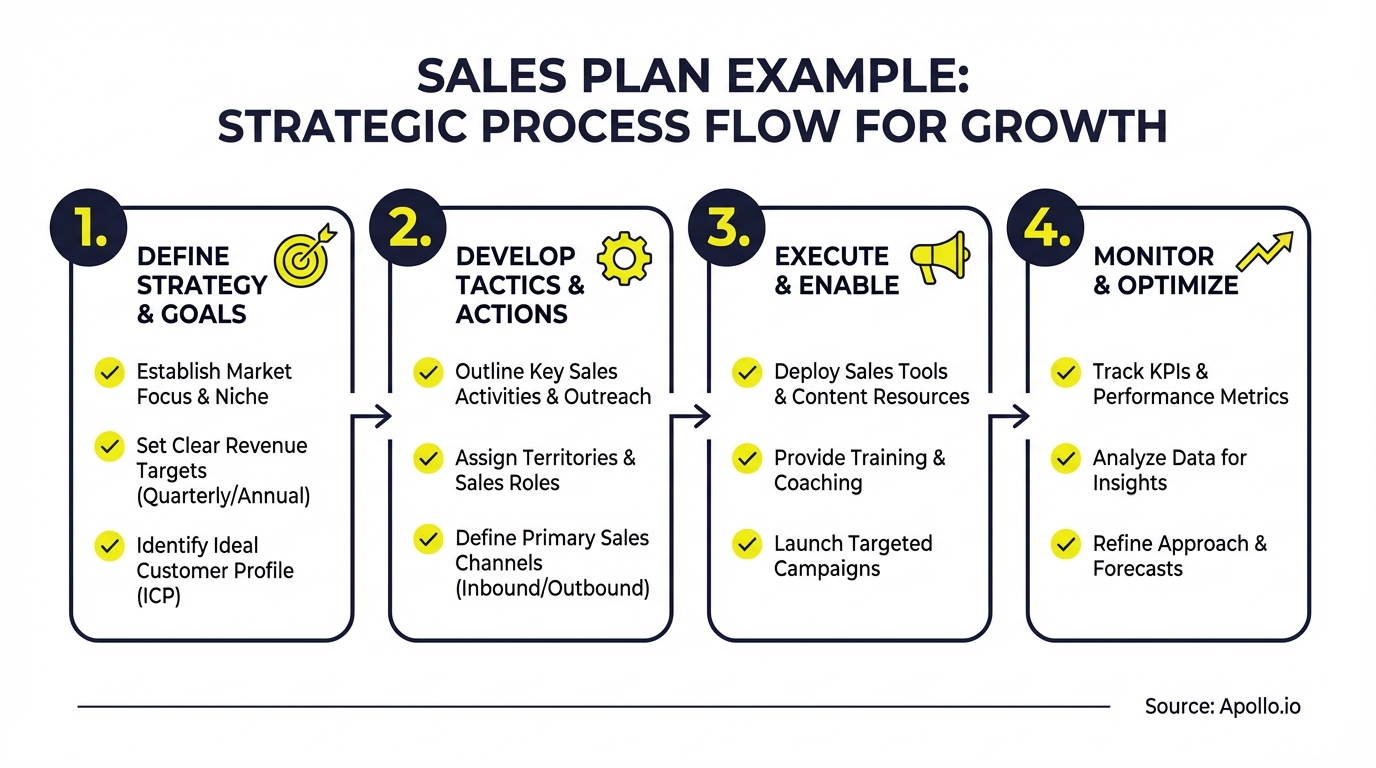
A data-driven sales plan example includes these core components structured for AI extractability and team execution:
- Revenue targets and segmentation: Total bookings goal, breakdown by product line, region, and customer segment with growth assumptions
- Ideal customer profile (ICP): Firmographic criteria, technographic signals, behavioral indicators, and account scoring models
- Go-to-market strategy: Channel mix (direct sales, partnerships, digital self-serve), pricing models, and competitive differentiation
- Team structure and capacity: Headcount by role, territory assignments, quota distribution, and ramping timelines for new hires
- Sales process and methodology: Stage definitions, exit criteria, qualification frameworks (BANT, MEDDIC, SPICED), and enterprise sales workflows
- Technology stack and integrations: CRM configuration, sales engagement platform, conversation intelligence, data enrichment, and analytics dashboards
- Activity benchmarks and KPIs: Calls per day, emails sent, meetings booked, pipeline generated, conversion rates by stage
- Enablement and training: Onboarding curriculum, ongoing skill development, competitive battle cards, and objection handling scripts
Tired of juggling disconnected sales tools? Consolidate your tech stack with Apollo's unified GTM platform that replaces 3-5 separate tools.
Apollo Turns Forecast Guesswork Into Revenue
Pipeline forecasting feel like a coin flip? Apollo's real-time deal intelligence gives you accurate visibility across every stage. Built-In boosted win rates 10% with Apollo's scoring.
Start Free with Apollo →How Can Sales Plans Support Digital Self-Service Buying?
Sales plans supporting digital self-service buying must map the buyer journey across rep-free channels. Data from Forrester indicates that more than half of large B2B transactions over $1 million are processed through digital self-serve channels, reflecting buyer preference for independent research and purchasing.
Effective plans define content requirements for each buying stage, from awareness through evaluation and purchase. They establish triggers for when self-service buyers should receive proactive outreach versus automated nurture sequences.
Plans also specify how sales reps add value after self-service purchases through onboarding support and expansion conversations.
RevOps teams use these plans to ensure consistent information across web properties, product documentation, pricing calculators, and sales collateral. Inconsistencies create friction that drives buyers to competitors with clearer digital experiences.
What Governance Framework Reduces Buyer-Team Conflict?
A governance framework reducing buyer-team conflict establishes decision rights, communication protocols, and consensus-building processes for complex B2B purchases. According to Gartner, 74% of B2B buyer teams experienced unhealthy conflict during decision-making, creating challenges in reaching consensus.
Sales plans incorporating governance models define stakeholder mapping exercises, RACI matrices for decision authority, and facilitation techniques for alignment meetings. They provide reps with conversation guides that surface hidden objections and competing priorities early.
Plans also outline escalation paths when buyer committees stall.
For Account Executives managing multi-threaded deals, governance frameworks clarify champion identification, executive sponsor engagement, and economic buyer access strategies. These structured approaches accelerate deal progression while reducing late-stage surprises.
How Do Sales Plans Integrate With RevOps and Analytics?
Sales plans integrate with RevOps and analytics through unified data architectures that connect CRM systems, marketing automation platforms, conversation intelligence tools, and business intelligence dashboards. This integration creates a single source of truth for pipeline forecasting, capacity planning, and performance analysis.
RevOps-aligned plans specify data governance standards, field definitions, and enrichment protocols that maintain database hygiene. They define SLAs for lead routing, opportunity handoffs, and closed-won account transitions.
Plans also establish reporting cadences with standardized metrics reviewed by cross-functional teams.
Founders and CEOs building scalable go-to-market motions rely on these integrated plans to model growth scenarios, evaluate channel effectiveness, and optimize customer acquisition costs. As Census reported: "We cut our costs in half" by consolidating tools into unified platforms that eliminate redundant subscriptions and integration overhead.
Start Building Your AI-Powered Sales Plan in 2026
Modern sales plan examples combine strategic vision with operational precision, leveraging AI guidance to replace guesswork with data-driven recommendations. The best plans support both human-led selling and digital self-service experiences while providing governance frameworks that help complex buyer teams reach consensus faster.
Sales leaders implementing these frameworks see improved forecast accuracy, faster ramp times for new hires, and higher quota attainment across teams. RevOps professionals benefit from cleaner data, better tool adoption, and executive visibility into pipeline health.
For SDRs and AEs, structured plans provide clarity on daily priorities and career development paths.

Ready to transform your sales planning process? Start prospecting with Apollo's all-in-one platform that unifies contact data, engagement sequences, AI automation, and analytics in a single workspace. Teams using Apollo report significant time savings and measurable improvements in pipeline generation by consolidating their tech stack into one comprehensive solution.
Prove Apollo's ROI In Your First Month
Budget approval stuck on unclear pipeline impact? Apollo tracks every dollar from prospect to close—Built-In increased win rates 10% and ACV 10% with measurable scoring. Get board-ready ROI metrics instantly.
Start Free with Apollo →Don't miss these
Sales
Inbound vs Outbound Marketing: Which Strategy Wins?
Sales
What Is a Sales Funnel? The Non-Linear Revenue Framework for 2026
Sales
What Is a Go-to-Market Strategy? The 2026 GTM Playbook
See Apollo in action
We'd love to show how Apollo can help you sell better.
By submitting this form, you will receive information, tips, and promotions from Apollo. To learn more, see our Privacy Statement.
4.7/5 based on 9,690 reviews
