
Sales Pipeline Template: Build a Winning Sales Process
Every sales team needs a clear path from prospect to closed deal.
A sales pipeline template provides that roadmap, organizing leads into stages and keeping your team focused on the right deals at the right time.
Without one, opportunities fall through the cracks, forecasts become guesswork, and revenue becomes unpredictable.
The right template transforms chaos into clarity, giving SDRs, AEs, and sales leaders complete visibility into deal flow and bottlenecks.
Modern sales pipeline builders go beyond static spreadsheets.
They integrate AI-powered insights, automate tedious tasks, and connect directly to your CRM.
According to Gartner, sellers who effectively partner with AI tools are 3.7 times more likely to meet their sales quotas.
That's why 2026 templates include automation flows, predictive analytics, and real-time collaboration features that static templates simply can't match.

Apollo Cuts Research Time From Hours To Seconds
Tired of spending 4+ hours daily hunting for contact info? Apollo delivers 224M verified contacts with 96% email accuracy instantly. Join 550K+ companies who stopped manual research and started closing deals.
Start Free with Apollo →Key Takeaways
- A sales pipeline template organizes leads into clear stages, preventing deals from slipping through the cracks and making revenue forecasting predictable.
- AI-powered templates automate repetitive tasks, provide predictive insights, and help teams prioritize high-value opportunities with data-driven intelligence.
- Modern templates integrate seamlessly with CRM systems, eliminating manual data entry and keeping all deal information synchronized in real time.
- SDRs and AEs using structured pipeline templates close deals faster by focusing on the right activities at each stage of the buyer journey.
- RevOps teams gain complete visibility across the pipeline, identifying bottlenecks and optimizing conversion rates with actionable analytics.
What Is a Sales Pipeline Template?
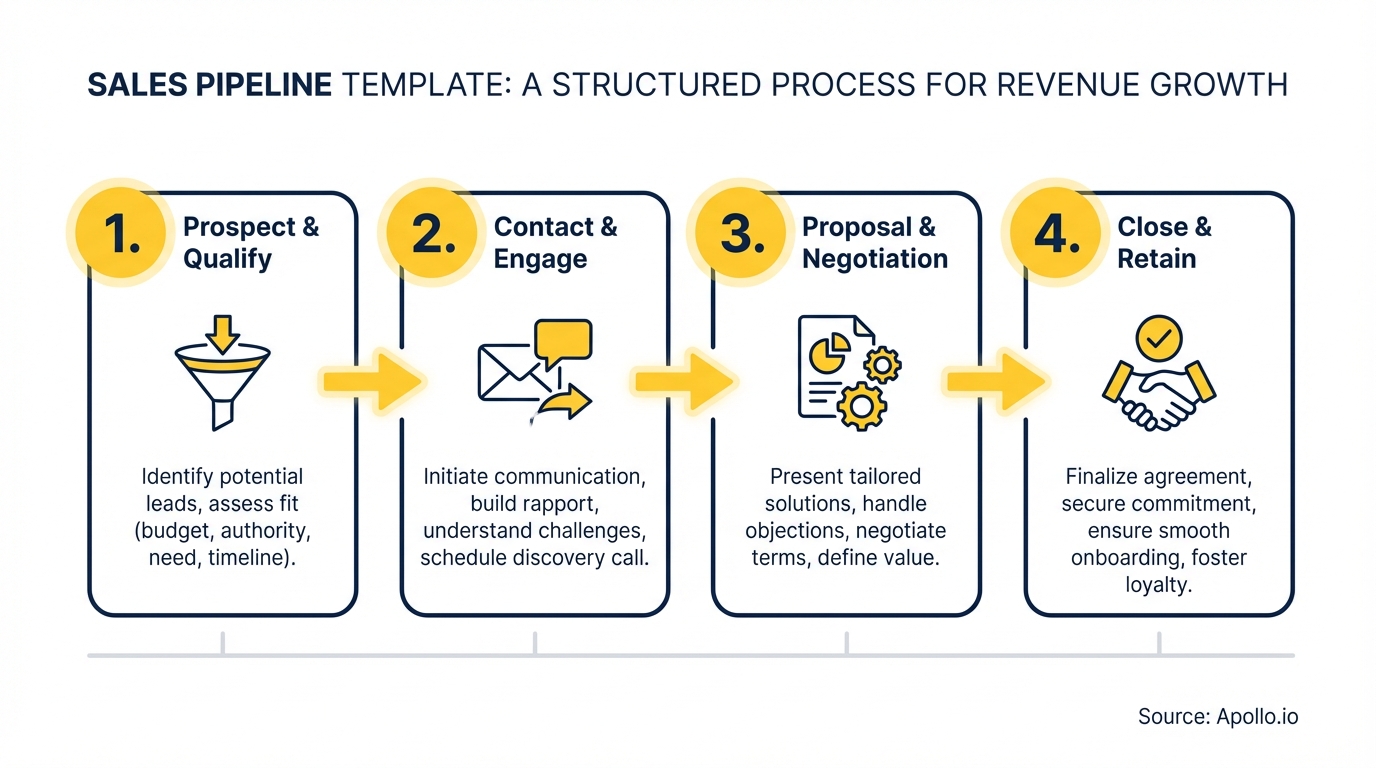
A sales pipeline template is a structured framework that maps out each stage of your sales process, from initial contact to closed deal.
It defines what actions reps take at each stage, what criteria qualify a lead to advance, and what metrics track progress.
Unlike a CRM system itself, a template provides the blueprint for how your team manages opportunities within that system.
The template typically includes five to seven stages (Prospecting, Qualification, Needs Analysis, Proposal, Negotiation, Closed Won/Lost).
Each stage has clear entry/exit criteria, expected activities, and timeline benchmarks.
For example, a lead enters Qualification only after demonstrating budget, authority, need, and timeline (BANT criteria).
Sales leaders use templates to standardize processes across reps, making coaching easier and forecasting more accurate.
Research by Gartner indicates that 60% of B2B sales organizations transitioned to data-driven selling approaches by 2025.
Templates enable this shift by creating consistent data capture points at every stage, turning subjective gut feelings into objective pipeline metrics.
Why Do Sales Teams Need Pipeline Templates?
Sales teams need pipeline templates to eliminate guesswork and create predictable revenue.
Without a template, every rep invents their own process, leading to inconsistent results and unreliable forecasts.
Templates standardize how opportunities move through stages, making it easy for managers to spot bottlenecks and coach reps on specific skills.

Templates also prevent revenue leakage.
When deals lack clear next steps or sit too long in one stage, they stall and die.
A template enforces discipline by defining maximum stage duration and required actions.
For SDRs booking meetings, templates clarify exactly what information to gather before passing leads to AEs.
For Account Executives managing deals, templates identify which opportunities deserve the most attention based on stage velocity and deal size.
The consolidation benefits matter too. Teams using separate tools for prospecting, outreach, and pipeline tracking waste hours on manual updates and data synchronization. "We reduced the complexity of three tools into one," reports Predictable Revenue.
Unified platforms eliminate that friction, keeping all pipeline data in a single workspace.
How Do SDRs Use Pipeline Templates to Book More Meetings?
SDRs use pipeline templates to track prospects from first touch to qualified meeting.
The template defines clear stages (Target Identified, First Contact, Engaged, Meeting Scheduled) with specific activities at each step.
This structure prevents leads from going cold and ensures consistent follow-up cadence.
A typical SDR template includes automated sequences for each stage.
When a prospect opens an email but doesn't reply, the template triggers a follow-up task or automatically sends a value-add message.
When engagement increases (multiple email opens, website visits), the template flags the lead as hot and prompts the SDR to make a phone call.
This automation eliminates manual tracking and ensures no prospect falls through the cracks.
Struggling to keep up with manual prospecting tasks? Automate your outreach sequences and focus on high-intent prospects with Apollo's AI-powered platform.
The best SDR templates also include lead scoring built in.
Prospects get points for job title match, company size, industry fit, and engagement behavior.
SDRs prioritize outreach to high-scoring leads first, maximizing meeting conversion rates. This data-driven approach helps SDRs hit quota consistently rather than relying on spray-and-pray tactics.
See Every Deal Stage In Real Time With Apollo
Forecasting feels like guesswork without live pipeline data. Apollo gives you instant visibility across every deal stage so you can predict revenue with confidence. Built-In boosted win rates 10% with Apollo's real-time insights.
Start Free with Apollo →What Are the Essential Stages in a Sales Pipeline Template?
Essential pipeline stages vary by sales motion, but most B2B templates include six core stages.
Each stage has a clear definition, entry criteria, and expected conversion rate.
| Stage | Definition | Key Activities | Typical Conversion Rate |
|---|---|---|---|
| Prospecting | Identifying and researching potential buyers | List building, social research, initial outreach | 20-30% to Qualification |
| Qualification | Confirming fit based on BANT or similar criteria | Discovery calls, needs assessment, budget discussion | 40-50% to Needs Analysis |
| Needs Analysis | Deep dive into pain points and solution requirements | Demo, technical calls, stakeholder meetings | 50-60% to Proposal |
| Proposal | Presenting formal solution and pricing | Proposal creation, presentation, objection handling | 60-70% to Negotiation |
| Negotiation | Finalizing terms, pricing, and contract details | Legal review, procurement discussions, final approvals | 70-80% to Closed Won |
| Closed Won/Lost | Deal outcome and post-sale handoff or loss analysis | Onboarding kickoff or loss reason documentation | 100% (terminal stage) |
Account Executives managing complex enterprise deals often add stages like Executive Alignment or Contract Review. Transactional sales teams with shorter cycles might collapse Needs Analysis and Proposal into a single stage.
The key is matching stages to your actual buyer journey, not copying a generic template without customization.

Modern templates also track stage velocity (average days in each stage) and stall indicators.
If a deal sits in Negotiation for more than 30 days, the template flags it for manager review.
This proactive approach prevents forecast surprises and helps reps identify deals needing executive intervention or competitive intelligence.
How Do RevOps Teams Build Templates That Drive Revenue?
RevOps teams build effective pipeline templates by analyzing historical conversion data and identifying drop-off points.
They start with win/loss analysis to understand which deals closed and why, then map those insights to stage definitions.
This data-driven approach creates templates based on what actually works, not theoretical best practices.
The best RevOps teams also standardize data capture at each stage. They define required fields (decision criteria, competitor mentions, budget confirmed) that reps must complete before advancing deals.
This discipline creates clean pipeline data for forecasting and helps identify coaching opportunities. For example, if reps consistently fail to capture budget information in Qualification, that signals a training gap.
Template governance matters too.
RevOps establishes clear rules for stage movement and reviews pipeline hygiene weekly.
They flag deals with missing required fields, unusually long stage durations, or skipped stages. This oversight prevents reps from gaming the system by moving deals forward prematurely to inflate pipeline metrics.
Can't see where deals are getting stuck? Get complete pipeline visibility and identify bottlenecks instantly with Apollo's deal management platform.
What Features Should Modern Pipeline Templates Include?
Modern pipeline templates in 2026 must include AI-powered insights, not just static stage definitions.
Predictive lead scoring analyzes past wins and identifies which current opportunities share similar characteristics.
Next-best-action recommendations tell reps exactly what to do (send case study, schedule demo, loop in executive) based on deal context and historical patterns.
Integration capabilities are non-negotiable.
Templates should sync automatically with your CRM, enriching contact records with firmographic data and tracking all touchpoints across email, phone, and social channels.
This eliminates manual data entry and ensures pipeline accuracy. "Having everything in one system was a game changer," notes Cyera.
Essential features include:
- Automated workflows: Trigger sequences, tasks, and alerts based on stage changes or inactivity
- Real-time collaboration: Tag team members, share notes, and coordinate multi-threading instantly
- Custom stage definitions: Adapt templates to different products, regions, or customer segments
- Mobile accessibility: Update pipeline and log activities from anywhere
- Analytics dashboards: Track conversion rates, velocity, and forecast accuracy by stage
- Activity tracking: Capture every email, call, and meeting automatically
Templates should also support different sales motions within the same platform.
Your enterprise team needs longer, more complex stages than your SMB team.
Flexible templates accommodate these variations without requiring separate systems.
Start Building Your Data-Driven Pipeline in 2026
Sales pipeline templates have evolved from static spreadsheets to intelligent, AI-powered systems that drive predictable revenue.
The best templates standardize your sales process, automate repetitive tasks, and provide actionable insights at every stage.
They help SDRs book more qualified meetings, enable AEs to prioritize high-value deals, and give RevOps teams complete visibility into pipeline health and forecast accuracy.
Implementation success depends on choosing templates that match your actual buyer journey, not generic frameworks.
Start by analyzing your historical conversion data, identifying bottlenecks, and defining clear stage criteria.
Build in AI-powered automation, CRM integration, and real-time analytics from day one. Most importantly, enforce pipeline discipline through regular hygiene reviews and required field completion.
The teams winning in 2026 consolidate their tech stack, eliminating the complexity and cost of managing separate tools for prospecting, engagement, and pipeline tracking. "We cut our costs in half," reports Census. They use unified platforms that combine verified contact data, multi-channel outreach, and deal management in a single workspace.
Ready to transform your pipeline from guesswork to precision? Schedule a Demo and see how Apollo's AI-powered platform helps teams build predictable revenue pipelines with 224M+ verified contacts, intelligent automation, and complete deal visibility.
Prove Apollo's ROI In Your First 30 Days
Budget approval stuck on unclear metrics? Apollo tracks every touchpoint from prospect to closed deal so you can show leadership exactly what's working. Built-In increased win rates 10% and ACV 10% with Apollo's analytics.
Start Free with Apollo →Don't miss these
Sales
Inbound vs Outbound Marketing: Which Strategy Wins?
Sales
What Is a Sales Funnel? The Non-Linear Revenue Framework for 2026
Sales
What Is a Go-to-Market Strategy? The 2026 GTM Playbook
See Apollo in action
We'd love to show how Apollo can help you sell better.
By submitting this form, you will receive information, tips, and promotions from Apollo. To learn more, see our Privacy Statement.
4.7/5 based on 9,690 reviews
