
Sales Order Automation: How to Eliminate Manual Processing and Accelerate Revenue
Manual order processing drains revenue and kills team productivity. In 2026, B2B buyers expect instant digital responses, not three-day email chains. Sales order automation streamlines the entire order-to-cash cycle using AI-powered workflow engines that eliminate data entry, reduce errors, and accelerate fulfillment. Research by Gartner shows sellers who effectively partner with AI tools are 3.7 times more likely to meet their sales quotas.

Apollo Eliminates 4+ Hours Of Daily Research
Tired of spending 4+ hours daily hunting for contact info? Apollo's 224M verified contacts mean your reps spend time selling, not searching. Join 550K+ companies who've reclaimed their day.
Start Free with Apollo →Key Takeaways
- Sales order automation reduces manual processing time by 60-80%, enabling teams to handle higher order volumes without adding headcount.
- AI-powered order systems improve accuracy to 96%+, eliminating costly errors from manual data entry and miscommunication.
- Modern platforms provide self-service buyer portals that 83% of B2B buyers prefer over traditional rep-driven processes.
- Automation cuts tech stack complexity by consolidating order management, CRM, and engagement tools into unified platforms.
- Data-driven order systems provide real-time visibility into pipeline health, fulfillment status, and revenue forecasting.
What Is Sales Order Automation?
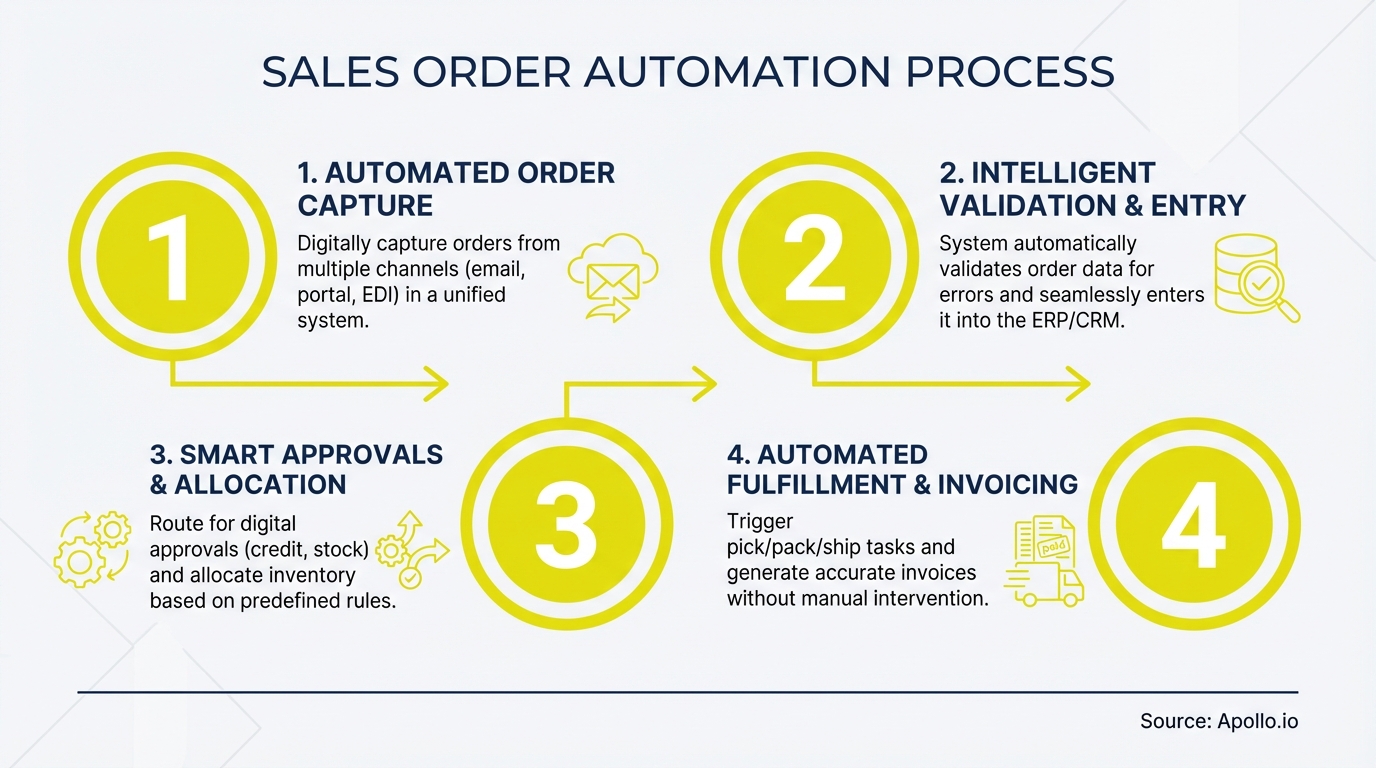
Sales order automation is technology that manages the complete order lifecycle from quote generation through fulfillment without manual intervention. The system captures orders from multiple channels (email, web portals, CRM, phone), validates pricing and inventory, routes approvals, triggers fulfillment workflows, and updates financial systems automatically.
Unlike traditional order entry where reps manually transcribe information into spreadsheets or ERP systems, automated platforms use AI to extract order details, apply business rules, and orchestrate cross-functional handoffs.
According to Gartner research, 83% of B2B buyers prefer ordering or paying through digital commerce platforms rather than working directly with sales reps. This shift demands automation that supports self-service purchasing while maintaining data accuracy across systems. For Sales Leaders managing distributed teams, automation provides consistent order processing regardless of rep experience level or geographic location.
How Does Sales Order Automation Work?
Modern order automation platforms connect three core components: data capture, workflow orchestration, and system integration. When an order arrives via any channel, the system uses AI to extract structured data (customer details, product SKUs, quantities, pricing).
Business rules validate the order against inventory levels, credit limits, and approval thresholds. Approved orders trigger automated workflows that notify fulfillment teams, update CRM records, generate invoices, and sync financial data to accounting systems.
Core automation capabilities include:

- Intelligent data extraction: AI reads emails, PDFs, and web forms to capture order details without manual data entry
- Multi-channel order capture: Unified intake from ecommerce portals, email, phone, chat, and sales rep submissions
- Dynamic pricing and quoting: Real-time price calculations based on volume, contracts, promotions, and customer segments
- Approval routing: Automated escalation to managers for orders exceeding discount or credit thresholds
- Fulfillment orchestration: Automatic creation of pick lists, shipping labels, and delivery tracking
- System synchronization: Bi-directional data flow between CRM, ERP, warehouse management, and accounting platforms
Spending hours on manual order entry? Automate your entire order-to-cash process with Apollo's workflow engine.
Why Do RevOps Teams Need Order Automation in 2026?
RevOps leaders face mounting pressure to scale revenue without proportionally scaling headcount. Manual order processing creates bottlenecks that limit growth and introduce errors that damage customer relationships. Data from B2B Ecommerce Association shows unified platforms can drive 60% of revenue with 80% automation rates.
Critical business drivers for automation:
- Scalability without headcount: Process 5-10x more orders with existing team size
- Error elimination: Reduce order mistakes from 8-12% to under 1% through automated validation
- Faster fulfillment: Cut order-to-shipment time from 48-72 hours to same-day processing
- Buyer experience: Meet customer expectations for instant order confirmation and real-time status updates
- Data consistency: Eliminate disconnects between sales, finance, and operations systems
- Forecast accuracy: Real-time pipeline visibility improves revenue predictions by 30-40%
For Account Executives managing complex B2B deals, automation handles routine reorders and contract renewals automatically, freeing time for high-value relationship building and strategic account expansion. RevOps teams report that workflow automation reduces order processing costs by 50-70% while improving customer satisfaction scores.
What Are the Key Features of Order Automation Platforms?
Enterprise-grade order automation requires more than basic workflow tools. Platforms must handle complex pricing rules, multi-currency transactions, compliance requirements, and integration with legacy systems.
Here are the non-negotiable capabilities for 2026:
| Feature Category | Core Capabilities | Business Impact |
|---|---|---|
| AI-Powered Data Capture | Email parsing, PDF extraction, form recognition, voice-to-text order entry | Eliminates 90% of manual data entry, reduces processing time from hours to minutes |
| Intelligent Routing | Rule-based approval workflows, escalation logic, SLA monitoring, exception handling | Orders flow to the right people instantly, preventing delays and missed deadlines |
| Dynamic Pricing Engine | Contract pricing, volume discounts, promotional rules, customer-specific pricing | Ensures pricing accuracy, maintains margins, supports complex B2B pricing models |
| Multi-System Integration | CRM sync, ERP connectivity, accounting integration, warehouse management APIs | Single source of truth across all systems, eliminates data silos and manual reconciliation |
| Self-Service Portal | Customer login, order history, reorder functionality, real-time status tracking | 61% of B2B buyers prefer rep-free experiences, reduces support ticket volume by 40% |
| Analytics & Reporting | Order velocity dashboards, error rate tracking, fulfillment metrics, revenue forecasting | Data-driven optimization identifies bottlenecks and process improvement opportunities |
Apollo Finds Your Best-Fit Buyers Instantly
Wasting hours qualifying leads that never convert? Apollo's intent signals and ICP scoring surface prospects actively searching for your solution. Built-In increased win rates 10% by focusing on ready-to-buy accounts.
Start Free with Apollo →Tired of juggling multiple tools for orders, CRM, and fulfillment? Consolidate your entire go-to-market tech stack with Apollo's unified platform.
How Do Sales Leaders Implement Order Automation Successfully?
Implementation success depends on clear planning, stakeholder alignment, and phased rollout. Organizations that rush deployment without process mapping typically see adoption rates below 30%.
Those that follow structured methodologies achieve 80%+ adoption within 90 days.
90-Day Implementation Roadmap:
Phase 1 (Days 1-30): Discovery & Design
- Map current order-to-cash processes across all channels and systems
- Identify pain points, bottlenecks, and error-prone manual steps
- Define automation rules, approval thresholds, and exception handling logic
- Document integration requirements for CRM, ERP, and fulfillment systems
- Establish KPIs: order processing time, error rate, customer satisfaction, cost per order
Phase 2 (Days 31-60): Build & Test
- Configure automation workflows in staging environment
- Build system integrations and test data synchronization
- Create self-service customer portal and test user experience
- Run parallel processing (automated + manual) to validate accuracy
- Train pilot group of 5-10 users on new processes
Phase 3 (Days 61-90): Launch & Scale

- Roll out automation to full sales and operations teams
- Monitor KPIs daily during first two weeks, adjust workflows as needed
- Collect user feedback and optimize based on real-world usage patterns
- Document standard operating procedures and exception handling protocols
- Plan expansion to additional order types, channels, or business units
Sales Leaders using unified GTM platforms report faster time-to-value because order automation, CRM, and engagement tools work together natively. Customer testimonial from Cyera: "Having everything in one system was a game changer for our order processing efficiency."
What ROI Can Companies Expect from Order Automation?
ROI from sales order automation typically appears within 3-6 months and compounds over time. Organizations see immediate cost savings from reduced manual labor, followed by revenue gains from faster fulfillment and improved customer experience. Data from B2B Ecommerce Association shows companies can shift from 80% manual orders to 85% online automation in just one year.
Quantifiable business outcomes:
- Cost reduction: 50-70% lower order processing costs through labor savings and error elimination
- Revenue acceleration: 20-35% faster order fulfillment increases customer lifetime value
- Margin improvement: 2-4% margin gains from pricing accuracy and discount control
- Productivity gains: Sales teams redirect 10-15 hours per week from admin to selling activities
- Customer retention: 15-25% improvement in NPS scores from faster, more accurate order processing
- Scalability: Handle 3-5x order volume without proportional headcount increases
Customer testimonial from Census highlights the financial impact: "We cut our costs in half by consolidating three separate tools into Apollo's unified platform." For Founders and CEOs evaluating automation investments, the payback period averages 4-8 months with ongoing annual savings of $200K-$500K for mid-market companies.
Ready to Automate Your Sales Order Process?
Sales order automation transforms B2B operations from reactive, error-prone manual processes to proactive, data-driven revenue engines. In 2026, buyers expect instant digital experiences, and teams need AI-powered tools to meet those expectations at scale.
Organizations that embrace automation gain competitive advantages through faster fulfillment, lower costs, and superior customer experiences.
The shift to automated order processing requires more than implementing software. It demands business process redesign, cross-functional alignment, and commitment to data-driven decision making.
Companies that successfully automate their order-to-cash cycles report 3-5x productivity improvements, 50%+ cost reductions, and significantly higher customer satisfaction scores.
For Sales Leaders, RevOps teams, and Founders looking to scale without complexity, the path forward is clear: consolidate your tech stack, automate repetitive workflows, and empower your team with AI-assisted tools. Predictable Revenue achieved this transformation and reported: "We reduced the complexity of three tools into one unified platform."
Scale Pipeline 3x Like Leadium With Apollo
Pipeline forecasting a guessing game? Apollo delivers real-time deal visibility and automated workflows that tripled Leadium's annual revenue. Join 550K+ companies turning pipeline chaos into predictable growth.
Start Free with Apollo →Start your order automation journey today. Start a trial with Apollo and discover how 550K+ companies use our all-in-one GTM platform to automate orders, engage buyers, and accelerate revenue growth.
Don't miss these
Sales
Inbound vs Outbound Marketing: Which Strategy Wins?
Sales
What Is a Sales Funnel? The Non-Linear Revenue Framework for 2026
Sales
What Is a Go-to-Market Strategy? The 2026 GTM Playbook
See Apollo in action
We'd love to show how Apollo can help you sell better.
By submitting this form, you will receive information, tips, and promotions from Apollo. To learn more, see our Privacy Statement.
4.7/5 based on 9,690 reviews
