
Sales Letter: How to Write Persuasive Copy That Converts in 2026
Sales letters are making a comeback, but not in the way you'd expect. In 2026, the most effective sales letters combine AI-powered personalization with authentic human connection across email, LinkedIn, and direct mail channels. According to Gartner, 80% of B2B sales interactions now occur in digital channels, making mastery of written sales communication essential for revenue teams. Whether you're an SDR prospecting into enterprise accounts or an AE nurturing deals, knowing how to craft compelling sales messages determines your quota attainment.

Skip The 4-Hour Research Grind With Apollo
Tired of burning half your day hunting for contact info? Apollo delivers 224M verified contacts instantly—no more manual research. Join 550K+ companies who turned wasted hours into closed deals.
Start Free with Apollo →Key Takeaways
- Sales letters blend AI personalization with human authenticity to reach buyers across digital and physical channels
- AI tools help SDRs and AEs personalize at scale while maintaining genuine connection with prospects
- Data from B2B AI research shows 100% adoption of AI in sales enablement with 48% revenue increases
- The most effective approach balances automated efficiency with personal touch across email, LinkedIn, and direct mail
- Modern sales letters focus on buyer pain points, specific value propositions, and clear next steps
What Is a Sales Letter?
A sales letter is written communication designed to persuade a prospect to take action, whether booking a meeting, requesting a demo, or making a purchase. Unlike generic marketing emails, sales letters target specific individuals with personalized messaging addressing their unique business challenges.
Modern sales letters appear across multiple channels: cold emails, LinkedIn messages, direct mail, and even social selling sequences. The format adapts to the medium, but the core principles remain: identify a problem, present a solution, and provide a clear call to action. For SDRs building pipeline, sales letters serve as the primary tool for initial outreach and qualification.
Why Do Sales Letters Still Work in 2026?
Sales letters work because buyers still make decisions based on trust, relevance, and timing. Research by Gartner predicts 75% of B2B buyers will prefer sales experiences prioritizing human interaction over AI by 2030. This validates the hybrid approach: using AI for research and personalization while maintaining authentic voice.
Sales letters cut through noise when crafted correctly. They provide detailed context that phone calls can't deliver and permanence that conversations lack. AEs closing enterprise deals use letters to summarize discovery calls, outline solutions, and reinforce value propositions. The written format allows prospects to review details on their timeline and share internally with stakeholders.
How Do SDRs Use Sales Letters to Book More Meetings?
SDRs use sales letters as their primary prospecting tool to initiate conversations with qualified leads. The most effective SDRs write 3-4 sentence emails focusing on a single pain point relevant to the prospect's role and company situation.
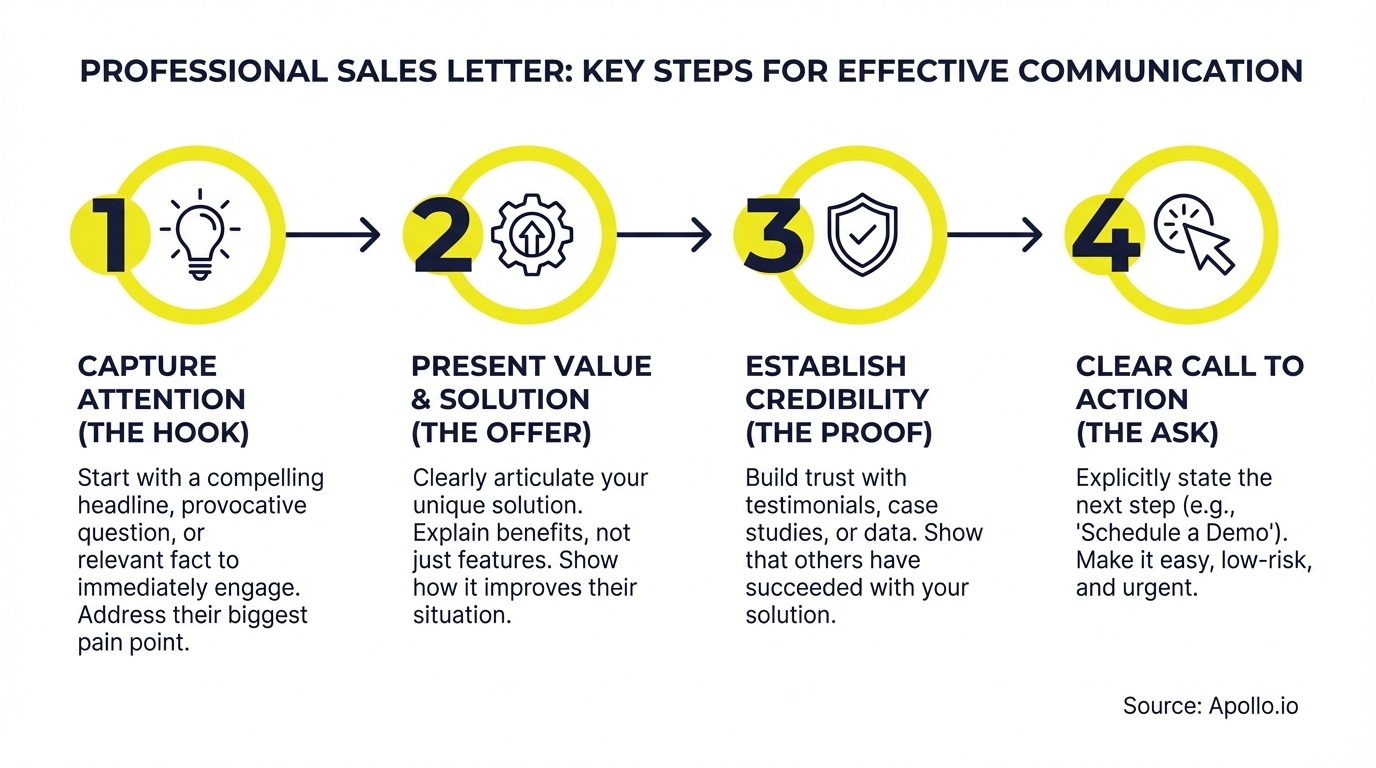
Top-performing SDRs follow this structure:
- Opening hook: Reference a specific trigger (funding round, job change, company news, mutual connection)
- Problem statement: Identify a challenge the prospect likely faces based on their role and industry
- Value proposition: Explain how your solution addresses that specific problem with proof points
- Clear CTA: Request a specific 15-minute time slot rather than vague "let's connect" language
Struggling to find qualified leads to send your sales letters? Search Apollo's 224M+ contacts with 65+ filters to identify decision-makers matching your ideal customer profile in seconds.
What Are the Essential Components of High-Converting Sales Letters?
High-converting sales letters include five non-negotiable components that work together to drive action. Each element serves a specific purpose in moving the prospect toward your desired outcome.
| Component | Purpose | Best Practice |
|---|---|---|
| Personalized Subject Line | Earn the open | Reference specific trigger or mutual connection |
| Relevant Hook | Capture attention | Mention recent company event or industry challenge |
| Problem-Solution Fit | Demonstrate value | Connect their pain point to your specific capability |
| Social Proof | Build credibility | Reference similar customer success with metrics |
| Direct CTA | Drive action | Suggest specific meeting time or next step |
Sales leaders managing teams find that training reps on these components increases response rates by 30-40%. The key is maintaining consistency across the team while allowing individual voice to shine through.
How Can AI Improve Sales Letter Personalization at Scale?
AI transforms sales letter creation by automating research, suggesting personalization elements, and optimizing messaging based on what converts. Sales teams using AI sales tools report 46% more meetings booked and 35% increases in conversion rates.
AI helps with three critical tasks:

- Prospect research: Automatically surfaces recent news, job changes, funding events, and technology stack information
- Message customization: Generates personalized opening lines and value propositions based on prospect data
- Performance optimization: Analyzes response patterns to recommend subject lines, sending times, and messaging angles
RevOps teams implementing AI see immediate efficiency gains. Instead of SDRs spending 30 minutes researching each prospect, AI surfaces relevant insights in seconds.
This allows reps to focus on crafting authentic messages rather than manual data gathering. The result: more personalized outreach without sacrificing volume.
Spending hours on manual outreach research? Automate your sequences with Apollo's AI that tailors messages based on prospect context and engagement signals.
Turn Weak Leads Into Sales-Ready Opportunities
Marketing leads never converting to real opportunities. Apollo scores and enriches every lead with buying signals so your team only works qualified prospects. Built-In increased win rates 10% with Apollo's intelligence.
Start Free with Apollo →What Mistakes Kill Sales Letter Response Rates?
The biggest mistake is writing about your company instead of the prospect's challenges.
Letters that open with "We're a leading provider of..." get deleted immediately.
Buyers care about their problems, not your product features.
Other response-killing mistakes include:
- Generic templates: Using the same letter for every prospect without customization
- Multiple CTAs: Asking prospects to book a demo AND download a guide AND watch a video
- Vague value props: Claiming to "increase efficiency" without specific metrics or examples
- Poor timing: Sending letters without considering the prospect's buying cycle or trigger events
- No social proof: Failing to reference similar customers or use cases relevant to the prospect
Account Executives closing complex deals avoid these mistakes by treating each letter as a strategic document.
They invest time in understanding the prospect's specific situation before writing a single word.
This approach, combined with insights from sales development best practices, dramatically improves response and conversion rates.
How Should Sales Letters Differ Across Channels?
Email sales letters require brevity and scan-ability.
Keep them under 150 words with short paragraphs and bullet points.
The subject line and opening sentence determine success.
Email works best for initial outreach and follow-ups in active deals.
LinkedIn messages demand even more conciseness (under 100 words) and a conversational tone.
Reference shared connections or groups.
LinkedIn excels for warm introductions and reaching executives who ignore email.
Direct mail letters allow longer format and creative presentation.
Use them for high-value accounts where you need to break through digital noise.
Sales leaders building B2B sales organizations create channel-specific templates while maintaining consistent messaging.
The core value proposition stays the same, but format and length adapt to the medium.
Teams using multi-channel approaches report 50% higher engagement than email-only strategies.
Start Writing Sales Letters That Actually Get Responses
Sales letters remain one of the most effective tools for B2B prospecting and deal advancement in 2026. The winning formula combines AI-powered personalization with authentic human connection, adapting your message to each channel while maintaining focus on buyer challenges.
For SDRs and AEs looking to improve results, start by auditing your current letters against the components outlined above. Test different hooks, value propositions, and CTAs systematically.
Track response rates by message type and continuously optimize based on what converts.
The teams seeing the best results consolidate their tech stack around platforms offering prospecting, engagement, and analytics in one workspace. As Census reported after switching to Apollo, "We cut our costs in half" by eliminating multiple point solutions.
Cyera echoed this sentiment: "Having everything in one system was a game changer."

Ready to transform your sales letter results? Get leads now with Apollo's all-in-one platform combining 224M verified contacts, AI-powered personalization, and multi-channel engagement tools that help you write better letters and book more meetings.
Prove Apollo's ROI In Your First 30 Days
Budget approval stuck on unclear metrics? Apollo tracks every touchpoint from prospect to closed deal—quantifying exactly how much time and pipeline you're gaining. Built-In increased win rates 10% and ACV 10% with measurable Apollo impact.
Start Free with Apollo →Don't miss these
Sales
Inbound vs Outbound Marketing: Which Strategy Wins?
Sales
What Is a Sales Funnel? The Non-Linear Revenue Framework for 2026
Sales
What Is a Go-to-Market Strategy? The 2026 GTM Playbook
See Apollo in action
We'd love to show how Apollo can help you sell better.
By submitting this form, you will receive information, tips, and promotions from Apollo. To learn more, see our Privacy Statement.
4.7/5 based on 9,690 reviews
