
Sales Lead Tracker: How to Capture and Convert Every Opportunity
Sales teams lose revenue every day because leads slip through the cracks. A sales lead tracker is the system that captures, monitors, and routes every prospect from first contact to closed deal. Without one, lead generation efforts produce waste instead of pipeline.
According to Market Joy, in 2024, 79% of marketing leads never convert to sales. The gap isn't always product fit or messaging. It's broken tracking. Leads get duplicated, assigned to the wrong rep, or ignored past their response window.

Apollo Eliminates 4+ Hours Of Daily Research
Tired of spending 4+ hours daily hunting for contact info? Apollo delivers verified emails and mobile numbers instantly—96% accuracy guaranteed. Join 550K+ companies who ditched manual research.
Start Free with Apollo →Key Takeaways
- A sales lead tracker captures every prospect interaction and routes leads based on fit, urgency, and team capacity to prevent revenue leakage
- Speed-to-lead matters: responding within 5 minutes makes you 100x more likely to connect than waiting 30 minutes
- AI-powered lead trackers automate data hygiene, scoring, and routing so SDRs focus on conversations instead of spreadsheet updates
- The best systems consolidate prospecting, enrichment, and engagement into one workspace to eliminate tool fragmentation
What Is a Sales Lead Tracker?
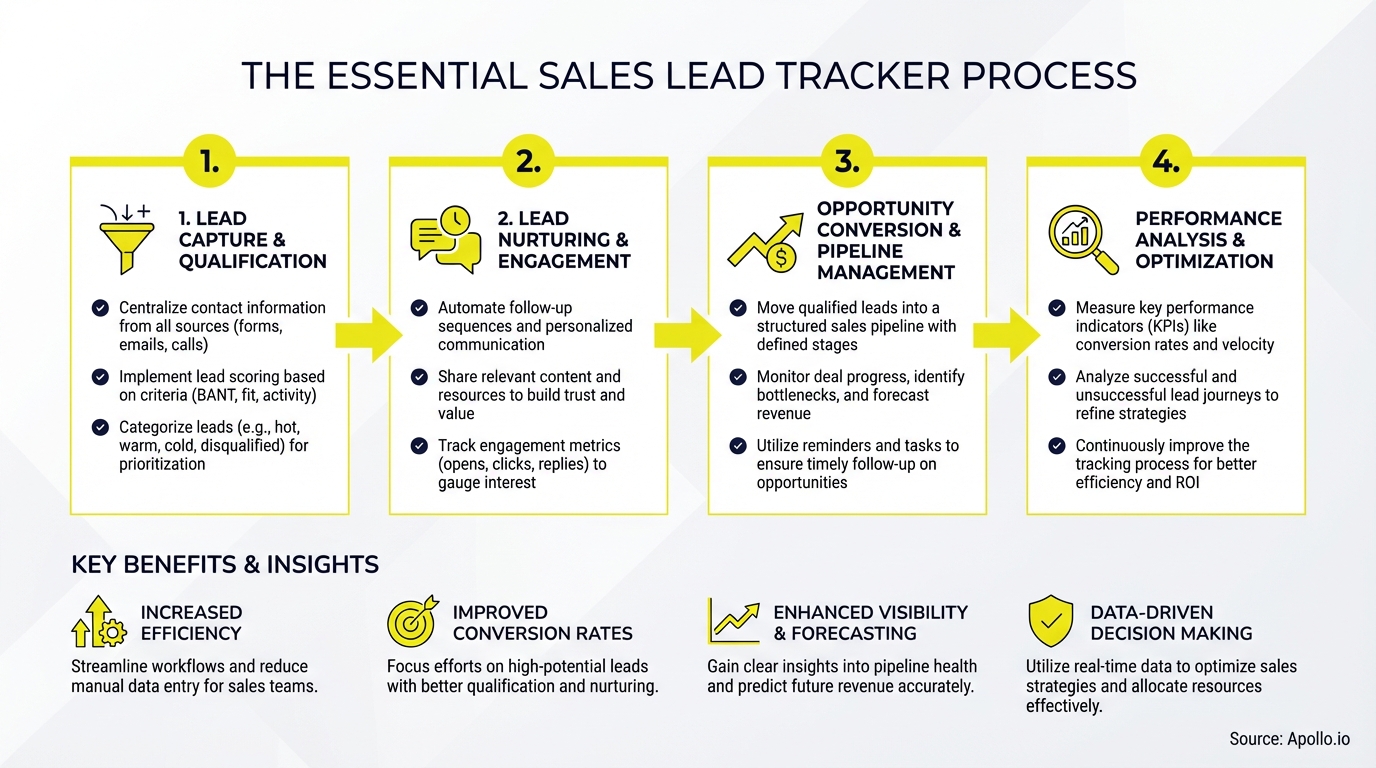
A sales lead tracker is a system that logs every prospect interaction, assigns ownership, tracks engagement history, and measures conversion progress across your sales funnel. It answers three questions: where did this lead come from, who owns it, and what happens next?
Modern lead trackers go beyond static spreadsheets. They integrate with your CRM, marketing automation platform, and sales prospecting tools to create a unified view of every contact. SDRs see call history, email opens, and website visits in one place. RevOps leaders track conversion rates by source, rep, and campaign.
The shift from manual logging to automated tracking happens when teams realize data entry steals time from selling. Research from Cirrus Insight shows companies using AI-powered lead generation tools experience a 35% increase in conversion rates compared to traditional methods.
Why Do Sales Teams Need Lead Tracking in 2026?
Lead tracking prevents three expensive problems: duplicate follow-up, missed response windows, and attribution blindness. When multiple reps contact the same prospect, you burn credibility.
When leads wait 48 hours for a reply, they've already talked to your competitor. When you can't prove which campaigns drive revenue, marketing budget becomes guesswork.
Speed-to-lead discipline separates winning teams from everyone else. Calling a lead within 5 minutes makes you 100x more likely to connect versus waiting 30 minutes.
Most teams can't sustain that response time without automation that routes inbound leads instantly and alerts the right rep.
Data governance has become a board-level issue. Stale contact information breaks attribution, routing fails when enrichment data is missing, and forecasting collapses when duplicate records inflate pipeline.
AI-powered data hygiene tools now automate deduplication and enrichment, but only if your tracker integrates with them.
How Do SDRs Use Lead Trackers to Book More Meetings?
SDRs use lead trackers to prioritize outreach based on engagement signals and fit scores. The tracker surfaces which prospects opened emails, visited pricing pages, or match your ideal customer profile.
Instead of cold calling alphabetically, SDRs contact warm leads first.

Struggling to keep up with inbound volume? Automate lead routing and follow-up sequences with Apollo's AI-powered sales automation.
The best SDRs log every touchpoint immediately so the next interaction feels personalized. If a prospect mentioned budget concerns on a call, that note appears before the follow-up email. Automated prospecting tools eliminate the gap between conversation and CRM update.
See Every Deal Stage In Real Time With Apollo
Pipeline forecasting a guessing game? Apollo delivers real-time deal visibility and intent signals so you never miss revenue opportunities. Built-In boosted win rates 10% with Apollo's scoring.
Start Free with Apollo →What Features Should a Lead Tracker Include?
A complete lead tracker captures source attribution, enrichment data, engagement history, and next-action triggers. Here's what separates basic logging from revenue-driving systems:
| Feature | Purpose | Impact |
|---|---|---|
| Automatic lead capture | Logs form fills, calls, and web visits | Zero manual data entry |
| Real-time enrichment | Adds job title, company size, tech stack | Instant qualification |
| AI scoring and routing | Prioritizes high-fit leads and assigns owners | Faster speed-to-lead |
| Multi-channel activity tracking | Syncs email, phone, and social touches | Complete engagement view |
| Pipeline stage automation | Moves leads based on actions taken | Accurate forecasting |
| Deduplication logic | Merges duplicate records automatically | Clean attribution |
Teams building high-converting prospecting lists need trackers that integrate with contact databases, not just CRMs. If enrichment happens in one tool and tracking happens in another, data gets stale between syncs.
How Do RevOps Leaders Build Governance Into Lead Tracking?
RevOps leaders treat lead trackers as the single source of truth for attribution, capacity planning, and forecasting. Governance starts with clear field definitions, required data points, and automated validation rules.
If a lead enters the system without a source, industry, or company size, routing logic breaks.

Tired of disconnected tools fragmenting your lead data? Consolidate prospecting, tracking, and engagement in Apollo's all-in-one GTM platform.
Data quality audits happen automatically when your tracker flags incomplete records, duplicate contacts, or outdated job titles. The best systems trigger enrichment workflows when key fields are missing.
For example, if a lead's company size is unknown, the tracker pulls firmographic data before routing to sales.
According to Reach Marketing, lead generation is the top goal for 91% of marketers in 2025. But generating leads without governance creates chaos. RevOps teams set SLAs for response time, define MQL-to-SQL handoff criteria, and measure conversion rates by source to prove ROI.
What Are the Biggest Lead Tracking Mistakes in 2026?
The most common mistake is treating lead tracking as a reporting exercise instead of a revenue driver. Teams log activity after the fact instead of using trackers to trigger next actions in real time.
When a prospect visits your pricing page, the tracker should alert the assigned rep immediately, not generate a weekly report.
Another failure point is tool fragmentation. If prospecting happens in one platform, enrichment in another, and engagement tracking in a third, data never syncs cleanly. Sales leaders waste hours reconciling dashboards instead of coaching reps. Consolidated prospecting tools eliminate this problem by combining contact data, tracking, and outreach in one workspace.
Ignoring AI-assisted routing is the third mistake. Manual lead assignment creates bottlenecks when reps are at capacity or out of office.
AI routing considers rep performance, territory rules, and lead fit to assign ownership instantly. Teams that adopt AI-powered tracking see faster response times and higher conversion rates.
Conclusion: Build a Lead Tracker That Drives Revenue, Not Reports
A sales lead tracker only matters if it changes rep behavior and improves conversion rates. The best systems automate data hygiene, route leads based on fit and urgency, and surface the next action so reps spend time selling instead of updating spreadsheets.
For SDRs, that means prioritizing warm leads and logging every touchpoint without manual entry. For Account Executives, it means pre-meeting intelligence that turns discovery calls into qualified opportunities.
For RevOps leaders, it means clean attribution data that proves marketing ROI and informs budget decisions.
Speed-to-lead, data governance, and AI-powered automation are no longer optional. Teams that consolidate prospecting, tracking, and engagement into one platform move faster than competitors juggling five tools.
Apollo combines 224M verified contacts, automated enrichment, and multi-channel sequences in a single workspace so revenue teams stop losing leads and start closing deals.
Ready to consolidate your sales tech stack? Get Leads Now and see how Apollo reduces tool complexity while accelerating pipeline growth.
Show Budget Impact In Days, Not Quarters
Budget approval stuck on unclear metrics? Apollo tracks every touchpoint to pipeline so you prove ROI fast. Customer. io achieved 50% YoY growth with measurable automation impact.
Start Free with Apollo →Don't miss these
Sales
Inbound vs Outbound Marketing: Which Strategy Wins?
Sales
What Is a Sales Funnel? The Non-Linear Revenue Framework for 2026
Sales
What Is a Go-to-Market Strategy? The 2026 GTM Playbook
See Apollo in action
We'd love to show how Apollo can help you sell better.
By submitting this form, you will receive information, tips, and promotions from Apollo. To learn more, see our Privacy Statement.
4.7/5 based on 9,690 reviews
