
Sales Funnel Definition: How Modern Revenue Teams Convert Prospects Into Customers
In 2026, B2B buyers navigate an average of ten sales channels before making a purchase decision. Your sales funnel must orchestrate data from prospecting tools, CRM systems, marketing automation, and self-service platforms into one unified view. According to Gartner, 65% of B2B sales organizations are transitioning from intuition-based to data-driven decision-making this year. This shift demands a modern sales funnel framework that tracks prospects across multiple touchpoints while optimizing for price sensitivity and self-service buying preferences.

Apollo Eliminates 4+ Hours Of Daily Research
Tired of spending 4+ hours daily hunting for contact info? Apollo delivers 224M verified contacts with 96% email accuracy instantly. Join 550K+ companies who replaced manual research with predictable pipeline.
Start Free with Apollo →Key Takeaways
- A sales funnel definition in 2026 means a data-driven system tracking prospects across 10+ channels with attribution and price optimization built in.
- Modern B2B funnels must accommodate self-service buyers, with 34% of revenue now coming from e-commerce channels.
- SDRs and AEs need unified platforms that consolidate prospecting, engagement, and pipeline data to reduce tool complexity.
- Data-driven funnel optimization requires clear metrics, attribution models, and governance frameworks tied to revenue outcomes.
- Price sensitivity is now the primary purchase driver for one-third of B2B buyers, making ROI storytelling critical at every funnel stage.
What Is a Sales Funnel Definition in 2026?
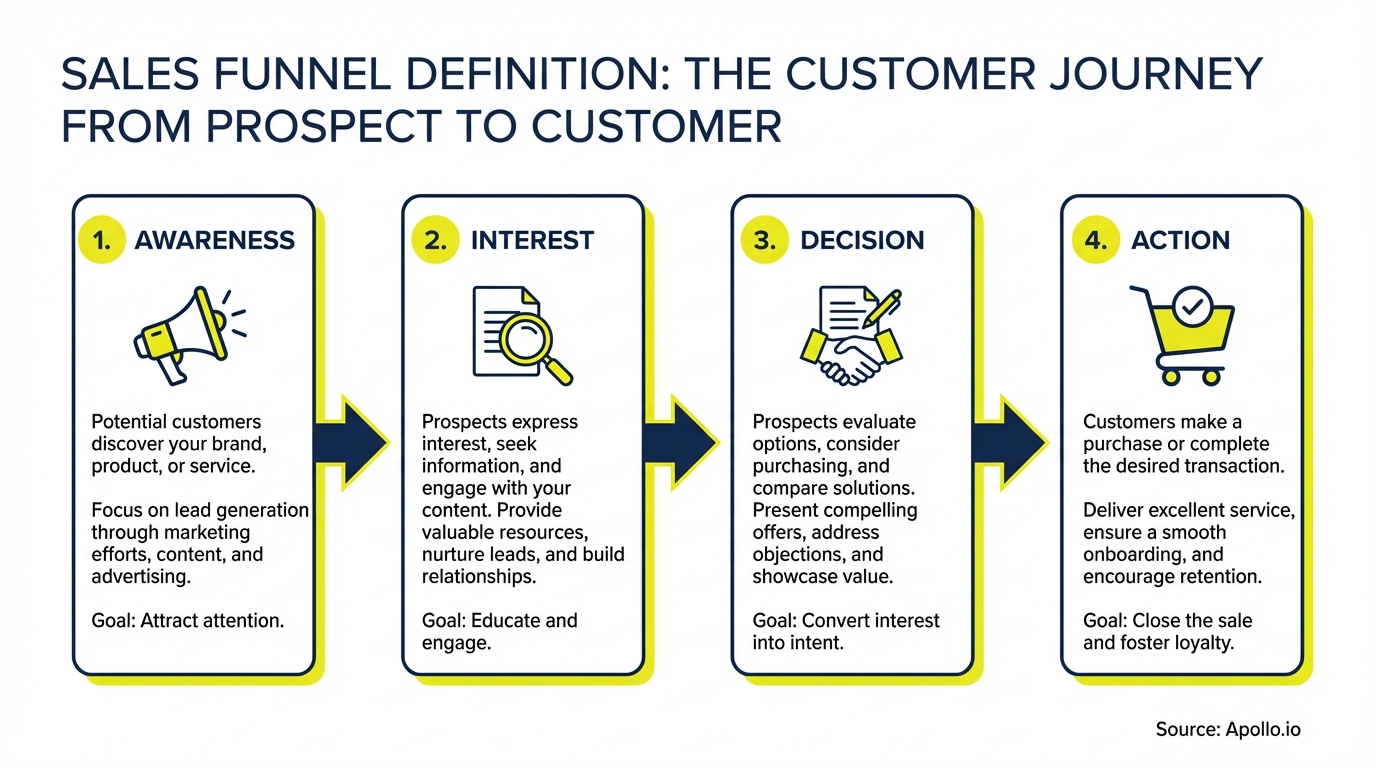
A sales funnel is a data-driven framework that maps the buyer journey from initial awareness to closed deal, tracking prospect movement across multiple channels with attribution tied to revenue outcomes. Unlike traditional linear models, modern funnels accommodate non-linear paths where buyers engage through email, social media, self-service portals, and direct sales interactions simultaneously.
The core stages remain consistent but are now instrumented with real-time data:
- Awareness: Prospects discover your solution through content, ads, or referrals
- Interest: Buyers engage with resources, demos, or sales conversations
- Evaluation: Decision-makers compare options, assess pricing, and build business cases
- Decision: Stakeholders commit and complete the purchase process
Research by McKinsey shows B2B buyers now use ten sales channels on average, up from five in 2016. Your funnel must track all these touchpoints with proper attribution to understand what actually drives conversions. For B2B sales teams, this means integrating prospecting data, engagement metrics, and deal pipeline into one system.
How Does a Data-Driven Sales Funnel Work?
A data-driven sales funnel integrates information from prospecting tools, CRM systems, marketing automation, and product analytics to create a unified view of buyer behavior. This architecture enables real-time optimization based on conversion metrics rather than gut instinct.

Essential data sources include:
- Prospecting databases: Contact information, firmographics, technographics, and intent signals
- Engagement platforms: Email opens, call recordings, meeting attendance, and content downloads
- Product usage data: Free trial activity, feature adoption, and usage patterns
- Revenue systems: Deal stages, close rates, contract values, and customer lifetime value
The funnel architecture connects these data sources with attribution models that assign credit to touchpoints based on their influence on closed revenue. RevOps leaders use this data to identify bottlenecks, optimize channel mix, and forecast pipeline with accuracy. Struggling to unify data from multiple tools? Build your entire pipeline in Apollo's unified workspace that combines 224M+ contacts with engagement tracking and deal management.

Why Are Multi-Channel Funnels Critical for SDRs?
SDRs must orchestrate outreach across email, phone, LinkedIn, and other channels because prospects engage differently based on their role, industry, and buying stage. A multi-channel funnel tracks which combination of touchpoints drives the highest meeting-booking rates for specific segments.
Effective channel orchestration maps touchpoints to funnel stages:
| Funnel Stage | Primary Channels | Key Metrics |
|---|---|---|
| Awareness | LinkedIn, content syndication, webinars | Reach, engagement rate, inbound inquiries |
| Interest | Cold email, LinkedIn InMail, cold calling | Response rate, meeting-booking rate, qualified leads |
| Evaluation | Product demos, case studies, pricing discussions | Demo completion, proposal requests, stakeholder engagement |
| Decision | Contract negotiation, ROI validation, executive reviews | Close rate, deal velocity, contract value |
For SDRs using Apollo, the platform consolidates prospecting, engagement, and pipeline tracking in one workspace. As one customer noted, "We reduced the complexity of three tools into one" (Predictable Revenue).
This consolidation eliminates context-switching and provides complete visibility into which channels drive pipeline for your specific ICP.
Turn Forecast Chaos Into Revenue Certainty
Pipeline forecasting feel like guesswork? Apollo delivers real-time deal visibility and intent signals so you can predict revenue with confidence. Built-In increased win rates 10% with Apollo's scoring and insights.
Start Free with Apollo →What Role Does Pricing Play in Funnel Optimization?
Pricing is now the primary purchase driver for one-third of B2B buyers, making price-aware funnel optimization essential. This means integrating ROI calculators, value messaging, and pricing governance directly into your funnel stages rather than treating price as a late-stage negotiation topic.
Price-aware funnel tactics include:
- Early value framing: Introduce ROI metrics and cost-benefit analysis in awareness content
- Transparent pricing tiers: Publish clear pricing on your website to qualify prospects by budget
- ROI calculators: Provide interactive tools that quantify savings and revenue impact
- Discount governance: Establish approval workflows and pricing floors to maintain margins
Account Executives managing enterprise deals find that proactive pricing discussions shorten sales cycles by eliminating stalled procurement processes.
Build pricing conversations into discovery calls, qualification frameworks, and proposal templates.
For teams using structured sales development processes, this means training SDRs to surface budget constraints early and routing prospects to appropriate pricing tiers.
How Do Self-Service Funnels Reduce Friction?
Self-service funnels allow buyers to research, evaluate, and purchase without direct sales interaction, addressing the 90% of B2B buyers who report stalled purchase processes. E-commerce channels now generate 34% of B2B revenue, making self-service a core funnel component rather than a nice-to-have feature.
Effective self-service funnel design includes:
- Transparent product information: Detailed feature comparisons, use cases, and technical specifications
- Free trials or freemium tiers: Allow buyers to evaluate your solution hands-on
- Automated onboarding: Guide users through setup with product tours and contextual help
- Simplified checkout: Enable one-click purchasing with multiple payment options
- Digital procurement integration: Connect with buyer procurement systems for enterprise purchases
Sales Leaders building hybrid funnels combine self-service paths for smaller deals with assisted sales for complex purchases. This approach maximizes conversion rates while optimizing sales team capacity. Tools like Apollo's deal management platform help teams track both self-service and sales-assisted opportunities in one pipeline view.
What Does a 90-Day Funnel Implementation Look Like?
A practical funnel rollout focuses on quick wins in data infrastructure, channel orchestration, and measurement frameworks before expanding to advanced optimization. This phased approach delivers measurable results within three months while building the foundation for continuous improvement.
Implementation timeline:
| Phase | Activities | Key Deliverables |
|---|---|---|
| Month 1: Foundation | Data audit, tool consolidation, metric definition | Unified data model, baseline conversion rates, funnel dashboard |
| Month 2: Orchestration | Channel mapping, sequence design, attribution setup | Multi-channel playbooks, attribution reports, optimization priorities |
| Month 3: Optimization | A/B testing, segment analysis, pricing experiments | Conversion lift results, segment-specific strategies, pricing recommendations |
Founders building outbound motions often start with a lead generation funnel that integrates prospecting and engagement in one platform. Census reported, "We cut our costs in half" by consolidating their tech stack into Apollo. Tired of managing multiple disconnected tools? Unify your entire go-to-market motion in Apollo's all-in-one platform that combines prospecting, engagement, and pipeline management.
How Do You Measure Funnel Performance?
Funnel performance measurement requires stage-specific metrics tied to revenue outcomes, not vanity metrics like website traffic or email opens. Focus on conversion rates between stages, velocity through the funnel, and ultimately, revenue per prospect by channel and segment.
Critical funnel metrics:
- Awareness to Interest: Inbound inquiry rate, outbound response rate, engagement score
- Interest to Evaluation: Meeting-booking rate, demo completion rate, qualified lead percentage
- Evaluation to Decision: Proposal win rate, deal velocity, average contract value
- Overall Funnel: Cost per acquisition, customer lifetime value, payback period
For RevOps teams, governance frameworks ensure data quality and consistent reporting across the organization. This includes field-level validation rules, stage-gate criteria, and regular data audits.
CEOs tracking revenue performance need executive dashboards that surface funnel health, forecast accuracy, and pipeline coverage ratios at a glance.
Conclusion: Build Your Data-Driven Funnel in 2026
Modern sales funnel definitions have evolved from simple linear models to sophisticated data-driven systems that orchestrate buyer journeys across ten or more channels. Success requires integrating prospecting, engagement, and pipeline data into one unified platform while optimizing for price sensitivity and self-service preferences.
The shift to data-driven funnels is not optional. With 65% of B2B organizations adopting this approach in 2026, teams that rely on intuition and disconnected tools will fall behind.
Start by consolidating your tech stack, instrumenting your funnel with proper attribution, and building orchestration playbooks for your key segments.
Apollo provides the all-in-one platform that powers data-driven funnels for 2M+ users and 550K+ companies. From prospecting across 224M+ business contacts to multi-channel engagement and pipeline management, everything lives in one workspace. As Cyera noted, "Having everything in one system was a game changer." Ready to build your data-driven funnel? Start free with Apollo today.
Prove Apollo's ROI In Your First 30 Days
Budget approval stuck on unclear metrics? Apollo delivers measurable pipeline impact from day one—track time saved, meetings booked, and deals closed. Built-In increased win rates 10% and ACV 10% with Apollo's scoring and insights.
Start Free with Apollo →Don't miss these
Sales
Inbound vs Outbound Marketing: Which Strategy Wins?
Sales
What Is a Sales Funnel? The Non-Linear Revenue Framework for 2026
Sales
What Is a Go-to-Market Strategy? The 2026 GTM Playbook
See Apollo in action
We'd love to show how Apollo can help you sell better.
By submitting this form, you will receive information, tips, and promotions from Apollo. To learn more, see our Privacy Statement.
4.7/5 based on 9,690 reviews
