
What Is Sales Force Automation Software? Benefits, AI Features, ROI (2026)
Sales force automation software eliminates manual data entry, automates repetitive workflows, and centralizes prospect data so your sales team can focus on selling instead of administrative busywork. In 2026, the best platforms combine automation with AI to book more meetings, shorten sales cycles, and replace 3-5 separate tools with one unified workspace.
Research by Gartner shows sellers who effectively partner with AI tools are 3.7 times more likely to meet their sales quotas. This guide covers what sales force automation software does, why it matters for SDRs and AEs, and how modern platforms cut your tech stack while boosting revenue.

Apollo Finds Verified Contacts In Seconds
Tired of spending 4+ hours daily hunting for contact info? Apollo delivers 224M verified contacts with 96% email accuracy. Join 550K+ companies who replaced manual research with instant results.
Start Free with Apollo →Key Takeaways
- Sales force automation software automates lead capture, follow-ups, and pipeline tracking to save reps 10+ hours per week
- Modern SFA platforms with AI help reps book 2.5x more meetings by personalizing outreach at scale
- Consolidating tools into one SFA platform cuts costs significantly while improving data quality
- By 2028, 60% of B2B seller work will be executed through AI-powered conversational interfaces
- Top platforms integrate with CRMs and provide real-time coaching to help teams hit quota faster
What Is Sales Force Automation Software?
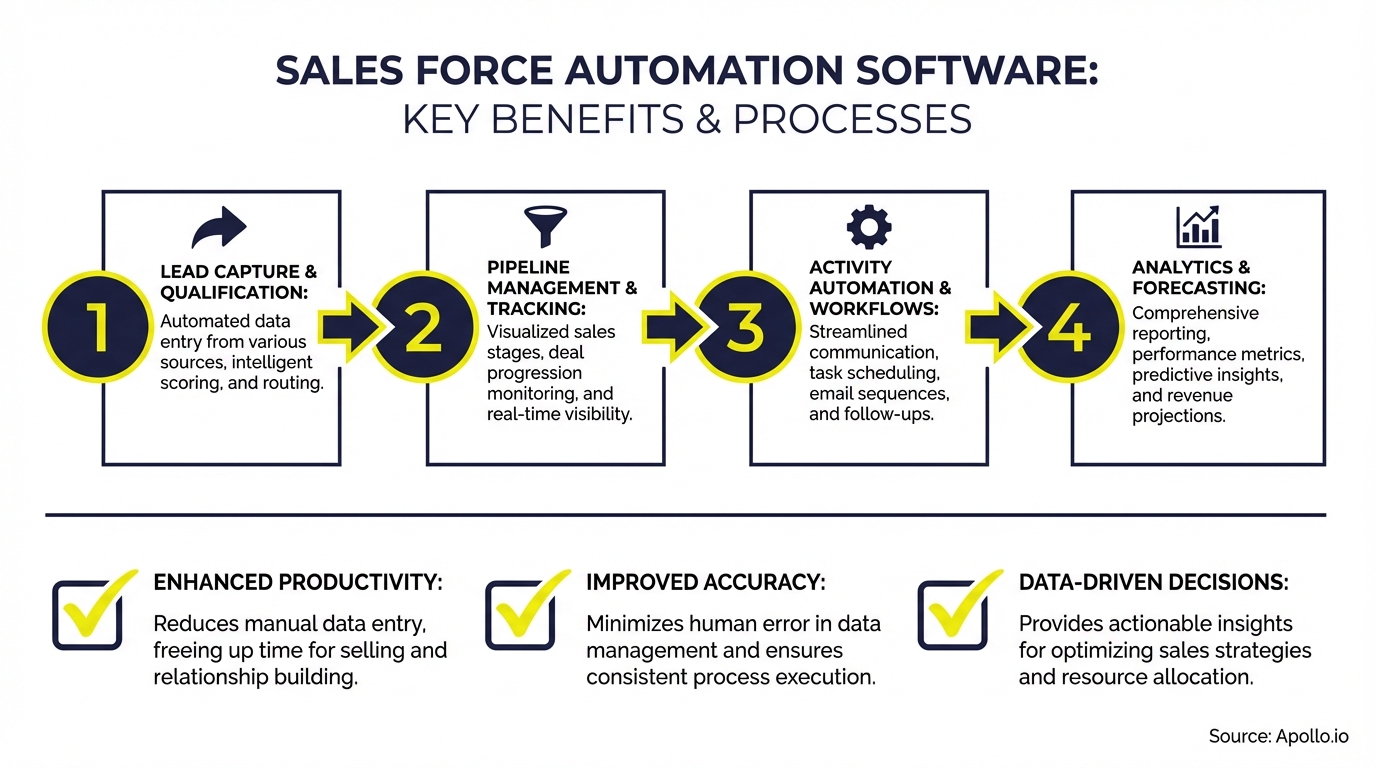
Sales force automation software is a platform that automates repetitive sales tasks like data entry, email sequences, follow-up scheduling, and activity tracking. It centralizes prospect information, streamlines workflows, and provides visibility into pipeline health so sales teams can focus on high-value activities like conversations and deal closing.
Core capabilities include contact management, lead scoring, email automation, task reminders, and reporting dashboards. Modern SFA platforms also integrate AI sales automation to generate personalized messages, research accounts, and prioritize the hottest opportunities.
Unlike basic CRMs that store contact data, SFA platforms actively automate workflows. They trigger actions based on buyer behavior, route leads to the right reps, and ensure nothing falls through the cracks.
For RevOps teams managing complex processes, this creates a single source of truth across the entire go-to-market motion.
How Does Sales Force Automation Software Work?
Sales force automation software works by connecting data sources, automating workflows, and triggering actions based on predefined rules or AI recommendations. It captures leads from forms and databases, enriches contact records with verified information, and routes prospects to the appropriate sales rep based on territory or account criteria.
Once leads enter the system, the platform automates outreach sequences across email, phone, and social channels. It tracks engagement signals like email opens and link clicks, then adjusts follow-up timing accordingly.
Reps receive notifications when prospects show buying intent, allowing them to prioritize conversations that are most likely to convert.
Advanced platforms use AI to analyze historical win patterns and recommend next-best actions. They surface relevant talking points before calls, auto-generate personalized emails, and identify which deals need attention. Workflow automation ensures repetitive tasks happen automatically while reps focus on building relationships.
Why Do Sales Teams Use SFA Platforms in 2026?
Sales teams use SFA platforms to eliminate tool sprawl, reduce manual work, and gain predictable pipeline visibility. According to Gartner, by 2028, 60% of B2B seller work will be executed through conversational user interfaces via generative AI sales technologies, up from less than 5% in 2023.
Key reasons teams adopt SFA platforms:
- Tech stack consolidation: Replace 3-5 separate tools with one unified platform, cutting costs and complexity
- Time savings: Automate data entry, follow-ups, and research so reps spend more time selling
- Data accuracy: Centralize contact information and eliminate duplicate records across systems
- Pipeline visibility: Track deal stages, forecast revenue, and identify bottlenecks in real time
- AI-powered insights: Get recommendations on which prospects to prioritize and what messaging resonates
- Faster onboarding: New reps ramp quickly with guided workflows and automated best practices
Struggling to find qualified leads? Search Apollo's 224M+ contacts with 65+ filters to build targeted prospect lists in minutes.
How Do SDRs and AEs Benefit From Sales Automation?
SDRs benefit from sales automation by eliminating manual prospecting and follow-up work, allowing them to focus on conversations that book meetings. Automated sequences ensure no prospect is forgotten, while AI research agents surface relevant talking points before every call.
For SDRs managing 100+ prospects simultaneously, automation handles the logistics. The platform sends emails, logs activities, and tracks engagement automatically.
When a prospect opens an email three times or visits the pricing page, the SDR receives an alert to call immediately. This turns reactive outreach into proactive, data-driven engagement.
Account Executives use automation to manage complex deal cycles and coordinate multi-threaded sales processes. The platform tracks all stakeholder interactions, reminds AEs to follow up with champions, and surfaces objection-handling content before important calls. Deal management features provide visibility into which opportunities need attention and why deals stall.
Sales Leaders gain real-time visibility into team performance, pipeline health, and forecast accuracy. They identify coaching opportunities by reviewing call recordings and email effectiveness.
Automation ensures consistent processes across the team, making it easier to replicate what top performers do. As one customer noted, "Having everything in one system was a game changer" (Cyera).
See Every Deal In Real-Time With Apollo
Forecasting a guessing game with stale data. Apollo tracks every deal stage automatically, surfacing stalled opportunities before they slip away. Built-In boosted win rates 10% with Apollo's live pipeline visibility.
Start Free with Apollo →What Are the Must-Have Features in 2026?
Must-have features in 2026 include AI-powered personalization, multi-channel automation, verified contact data, conversation intelligence, and seamless CRM integration. The best platforms combine these capabilities into one workspace, eliminating the need for separate prospecting, engagement, and analytics tools.

| Feature Category | Key Capabilities | Business Impact |
|---|---|---|
| AI Automation | Message generation, account research, lead scoring | Book 2.5x more meetings with personalized outreach |
| Data Enrichment | 224M+ verified contacts, waterfall enrichment | 96% email accuracy eliminates bounce rates |
| Multi-Channel Sequences | Email, phone, social outreach in one workflow | 35% increase in bookings with coordinated touchpoints |
| Conversation Intelligence | Call recording, transcription, AI summaries | Reps focus on selling, not note-taking |
| CRM Integration | Two-way sync with Salesforce, HubSpot | Single source of truth across sales and marketing |
| Pipeline Analytics | Forecasting, deal health scores, bottleneck alerts | Predictable revenue and faster deal cycles |
Platforms like Apollo's sales automation software consolidate these features into one workspace. This eliminates integration headaches and reduces the total cost of ownership compared to stitching together multiple point solutions.

How Do You Measure SFA ROI and Success?
You measure SFA ROI by tracking time savings, cost reduction, pipeline velocity, and quota attainment improvements. Successful implementations show measurable gains in rep productivity, data quality, and revenue predictability within the first quarter.
Key metrics to track:
- Time to first meeting: How quickly new leads convert to booked conversations
- Activities per rep: Number of calls, emails, and touchpoints automated vs manual
- Pipeline coverage: Ratio of qualified pipeline to quota across the team
- Win rate improvement: Percentage increase in deals closed after implementing SFA
- Tool consolidation savings: Dollars saved by replacing multiple subscriptions
- Forecast accuracy: How closely actual revenue matches predicted revenue
Teams often see significant cost reductions by consolidating their tech stack. As one customer shared, "We cut our costs in half" (Census).
Another noted, "We reduced the complexity of three tools into one" (Predictable Revenue). These savings compound when you factor in reduced training time and fewer integration maintenance costs.
Spending hours on manual outreach? Automate your multi-channel sequences with Apollo's sales engagement platform.
What Should Sales Leaders Consider When Choosing a Platform?
Sales Leaders should prioritize platforms that consolidate tools, provide real-time visibility, and scale with team growth. The right platform reduces ramp time for new hires, ensures consistent processes, and delivers actionable coaching insights without requiring constant manual oversight.
Evaluation criteria for Sales Leaders:
- All-in-one capabilities: Does it replace your prospecting, engagement, and intelligence tools?
- Data quality: How accurate is the contact database and enrichment?
- AI effectiveness: Does the AI actually improve outcomes or just add complexity?
- Team adoption: How quickly can reps learn the platform and see value?
- Integration ecosystem: Does it sync seamlessly with your existing CRM and tools?
- Coaching features: Can you review calls, track messaging effectiveness, and replicate best practices?
Founders and CEOs building outbound motions should look for platforms that deliver quick wins while supporting long-term scale. The ability to compete with better-funded competitors often comes down to workflow efficiency and data quality. Apollo for Sales Leaders provides the visibility and automation needed to drive predictable revenue growth.
Conclusion: Build Your AI-Ready Sales Motion in 2026
Sales force automation software has evolved from basic task management to AI-powered revenue engines that consolidate your entire go-to-market tech stack. The platforms winning in 2026 combine verified data, intelligent automation, and conversation insights in one workspace, helping teams book more meetings while cutting costs.
For SDRs, automation eliminates research and follow-up busywork. For AEs, it provides pre-meeting intelligence and deal health visibility.
For Sales Leaders, it delivers predictable pipeline and real-time coaching opportunities. The result is faster ramp times, higher quota attainment, and significant savings from tool consolidation.
Ready to cut your tech stack and boost team performance? Request a Demo to see how Apollo's all-in-one platform helps teams book 2.5x more meetings while replacing 3-5 separate tools.
Prove Apollo's ROI In Your First 30 Days
Budget approval stuck on unclear metrics? Apollo tracks every dollar—from first touch to closed deal. Built-In increased win rates 10% and ACV 10% with measurable pipeline impact.
Start Free with Apollo →Don't miss these
Sales
Inbound vs Outbound Marketing: Which Strategy Wins?
Sales
What Is a Sales Funnel? The Non-Linear Revenue Framework for 2026
Sales
What Is a Go-to-Market Strategy? The 2026 GTM Playbook
See Apollo in action
We'd love to show how Apollo can help you sell better.
By submitting this form, you will receive information, tips, and promotions from Apollo. To learn more, see our Privacy Statement.
4.7/5 based on 9,690 reviews
