
What Is A Sales Engineer? Role, Responsibilities, Career Path (2026)
Sales engineers bridge technical complexity and customer needs, turning sophisticated products into revenue-generating solutions. As companies adopt AI-first products and cloud-native security tools, the demand for professionals who can translate engineering into business value has never been higher. According to the U.S. Bureau of Labor Statistics, employment for sales engineers is projected to grow 5% from 2024 to 2034, faster than average for all occupations, with a median annual wage of $121,520.

Stop Manual Research - Apollo Finds Contacts Fast
Tired of spending 4+ hours daily hunting for contact info? Apollo delivers 224M verified contacts with 96% email accuracy. Join 550K+ companies who replaced manual research with instant prospecting.
Start Free with Apollo →Key Takeaways
- Sales engineers combine technical expertise with sales skills to demonstrate product value and close complex B2B deals
- The role requires a bachelor's degree in engineering or related field plus strong interpersonal abilities
- Career progression moves from basic product demos to advanced solution architecture and strategic account management
- Industry-specific expertise in SaaS, cybersecurity, or manufacturing significantly impacts compensation and responsibilities
- Sales engineers increasingly use AI tools and data enrichment platforms to identify decision-makers and personalize technical presentations
What Is A Sales Engineer?
A sales engineer is a technical professional who supports the sales process by demonstrating how complex products solve customer problems. They work alongside account executives in enterprise sales, translating engineering specifications into business outcomes that resonate with buyers.
Sales engineers typically hold engineering degrees and possess deep product knowledge. They conduct technical demos, answer sophisticated questions during sales calls, and customize solutions to match client requirements. Research from ISPE indicates this role is critical in bridging the gap between a company's technical capabilities and customer needs through a unique blend of technical knowledge and sales expertise.
Unlike traditional sales reps who focus on relationship building, sales engineers dive into technical specifications, integration requirements, and implementation roadmaps. They collaborate with product teams to relay customer feedback and often participate in sales development strategy to refine positioning for technical buyers.
What Are the Core Responsibilities of Sales Engineers?
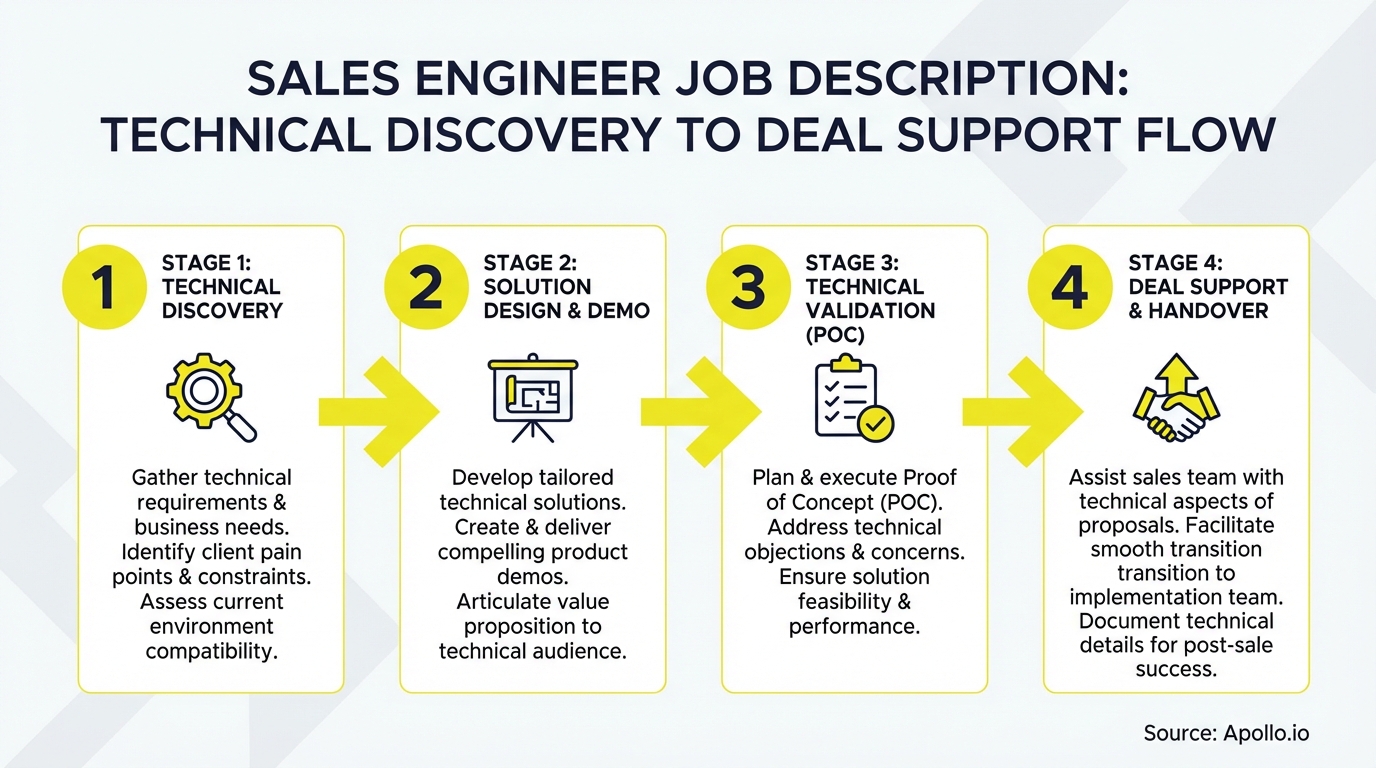
Sales engineers handle technical aspects of the sales cycle from discovery through implementation. Their responsibilities vary by company size and industry vertical but follow consistent patterns across B2B technology sales.
Product Demonstrations and Technical Presentations
Sales engineers deliver customized product demos that address specific customer pain points. They prepare technical presentations for C-level executives, configure sandbox environments, and run proof-of-concept trials.
For complex enterprise deals, they may conduct multi-day workshops demonstrating integration capabilities.
Solution Design and Architecture
They design technical solutions matching customer infrastructure and business requirements. This includes creating architecture diagrams, calculating performance metrics, and documenting implementation timelines.
Sales engineers work with customer IT teams to ensure compatibility with existing systems.

Sales Support and Objection Handling
During sales calls, they answer technical questions that account executives cannot address. They handle objections related to security, scalability, integration complexity, and competitive capabilities. Struggling to identify the right technical decision-makers? Search Apollo's 224M+ contacts with 65+ filters to find engineering leaders and technical buyers.
Customer Relationship Management
Sales engineers maintain relationships with technical stakeholders post-sale. They ensure smooth handoffs to implementation teams, gather product feedback, and identify upsell opportunities. Many use integrated sales tech stacks to track technical touchpoints alongside commercial conversations.
| Responsibility | Time Allocation | Key Skills Required |
|---|---|---|
| Product Demos | 30-40% | Presentation, product expertise, customization |
| Solution Design | 20-25% | Architecture, integration knowledge, documentation |
| Sales Support | 25-30% | Communication, objection handling, collaboration |
| Customer Relations | 10-15% | Relationship building, feedback collection, account management |
How Do Sales Engineers Support Account Executives?
Sales engineers and account executives form a two-person team for complex B2B deals. The AE owns the relationship and commercial terms while the sales engineer handles technical validation and product fit.
This partnership begins during discovery calls where AEs identify business pain points and sales engineers assess technical requirements. During demos, AEs frame business value while sales engineers demonstrate capabilities. For enterprise sales, this collaboration extends through contract negotiation, where sales engineers provide technical assurances that justify pricing.
Account Executives managing multiple deals rely on sales engineers to prioritize technical resources. Sales engineers evaluate which opportunities have genuine technical fit versus those requiring excessive customization.
They also help AEs understand competitive positioning from a technical standpoint, identifying where your product has clear advantages.

Need better pipeline visibility across your sales and technical teams? Get complete deal tracking and collaboration tools with Apollo's unified platform.
See Every Deal In Real Time With Apollo
Forecasting unreliable because deal stages aren't visible. Apollo gives you real-time pipeline visibility across every rep and deal. Built-In increased win rates 10% with Apollo's scoring.
Start Free with Apollo →What Skills and Qualifications Do Sales Engineers Need?
Sales engineers combine hard technical skills with soft sales abilities. Most companies require a bachelor's degree in engineering, computer science, or related technical field.
Advanced certifications in cloud platforms, security protocols, or industry-specific technologies strengthen candidacy.
Technical competencies include:
- Deep product knowledge and hands-on configuration experience
- Understanding of customer IT infrastructure and integration patterns
- Ability to read technical documentation and translate it for non-technical audiences
- Troubleshooting skills for demo environments and proof-of-concept scenarios
- Familiarity with APIs, databases, cloud platforms, and security frameworks
Sales and communication skills include:
- Presenting complex information clearly to diverse audiences
- Active listening to uncover unstated technical requirements
- Relationship building with technical and business stakeholders
- Negotiation and objection handling specific to technical concerns
- Time management across multiple deals and customer engagements
Companies increasingly seek sales engineers with experience in AI sales tools and data-driven prospecting. Understanding how to leverage enrichment platforms and job change alerts helps sales engineers identify buying signals and personalize technical outreach.
What Does the Sales Engineer Career Path Look Like?
Sales engineer careers progress through three distinct stages, each requiring expanded technical depth and strategic thinking.
Entry-Level Sales Engineer (0-2 Years)
Junior sales engineers focus on standard product demonstrations and basic technical support. They shadow senior engineers, learn product capabilities, and handle straightforward customer questions.
Typical activities include preparing demo environments, documenting technical requirements, and supporting proof-of-concept deployments.
Key focus areas: Product mastery, presentation skills, CRM documentation, customer communication
Mid-Level Sales Engineer (3-5 Years)
Experienced sales engineers manage complex deals independently and design custom solutions. They lead technical evaluations, handle competitive situations, and mentor junior team members.
Many specialize in specific industries or product lines, becoming subject matter experts.
Key focus areas: Solution architecture, industry expertise, objection handling, account strategy, social selling
Senior Sales Engineer (5+ Years)
Senior sales engineers handle strategic accounts, influence product roadmaps, and develop sales methodologies. They work on the largest deals, partner with executive buyers, and often transition into management or product roles.
Some become solutions architects or move into sales leadership.
Key focus areas: Strategic account planning, executive communication, team leadership, cross-functional collaboration, revenue operations
| Career Stage | Typical Salary Range (2026) | Deal Size |
|---|---|---|
| Entry-Level SE | $80K-$110K | $25K-$100K |
| Mid-Level SE | $110K-$150K | $100K-$500K |
| Senior SE | $150K-$200K+ | $500K-$5M+ |
How Do Industry Verticals Impact Sales Engineer Roles?
Sales engineer responsibilities vary significantly across industries. SaaS sales engineers focus on software integrations and API capabilities.
Manufacturing sales engineers understand industrial equipment and production processes. Cybersecurity sales engineers must demonstrate compliance frameworks and threat modeling.
SaaS and Cloud Platforms: Emphasis on integration APIs, data migration, scalability demonstrations, and multi-tenant architecture. Sales engineers need familiarity with modern dev tools and agile methodologies.
Cybersecurity Solutions: Deep knowledge of compliance standards (GDPR, SOC 2, ISO 27001), threat intelligence, and security operations. Sales engineers often hold security certifications and understand red team/blue team concepts.
Manufacturing and Industrial: Understanding of production processes, equipment specifications, and operational technology. Sales engineers may have mechanical or electrical engineering backgrounds and conduct on-site demonstrations.
Healthcare Technology: Knowledge of HIPAA compliance, clinical workflows, and electronic health records. Sales engineers work with clinical and IT stakeholders simultaneously.
For Sales Leaders building vertical-specific teams, using targeted B2B sales strategies and enriched contact data helps sales engineers connect with the right technical buyers in each industry.
Ready to Build Your Sales Engineering Team?
Sales engineers are essential for complex B2B sales, combining technical expertise with customer-facing skills to drive revenue. As product complexity increases and buyers demand deeper technical validation, companies that invest in strong sales engineering teams gain significant competitive advantages.
Whether you're hiring your first sales engineer or scaling a team, focus on candidates who balance technical depth with communication skills. Define clear competency frameworks by career stage, establish measurable KPIs, and integrate your sales engineers into cross-functional workflows with sales, product, and customer success.
For RevOps teams supporting sales engineers, consolidating your tech stack eliminates friction. "Having everything in one system was a game changer" for teams at Cyera. Try Apollo free to give your sales engineers verified contact data, automated outreach sequences, and deal management tools in one unified platform.
Show Budget Impact In Your First 30 Days
Budget approval stuck on unclear metrics? Apollo tracks every touchpoint from first contact to closed deal. Built-In increased win rates 10% and ACV 10% with Apollo's scoring and signals.
Start Free with Apollo →Don't miss these
Sales
Inbound vs Outbound Marketing: Which Strategy Wins?
Sales
What Is a Sales Funnel? The Non-Linear Revenue Framework for 2026
Sales
What Is a Go-to-Market Strategy? The 2026 GTM Playbook
See Apollo in action
We'd love to show how Apollo can help you sell better.
By submitting this form, you will receive information, tips, and promotions from Apollo. To learn more, see our Privacy Statement.
4.7/5 based on 9,690 reviews
