
Sales Email Examples That Actually Get Replies in 2026
Sales emails remain one of the highest-ROI channels in B2B outreach, but what worked in 2024 no longer cuts through in 2026. With Martal Group reporting that a 15-25% open rate is now considered acceptable for cold B2B campaigns in 2025-2026, and reply rates hovering between 3.43% and 5.8% according to Prospeo, SDRs and AEs need examples built for relevance, deliverability, and buyer self-education. This guide provides proven sales email examples with real benchmarks and implementation strategies for writing sales emails that get responses.

Research Less, Pipeline More With Apollo
Tired of your reps burning hours on manual lead research instead of selling? Apollo surfaces verified contacts instantly so your team spends time closing, not hunting. Join 550K+ companies building pipeline faster.
Start Free with Apollo →Key Takeaways
- Modern sales emails must prioritize relevance over volume, with 73% of B2B buyers avoiding suppliers who send irrelevant outreach
- Cold email reply rates now average between 3.43% and 5.8%, with top 10% campaigns achieving over 10% through micro-segmentation
- Deliverability compliance (SPF/DKIM/DMARC, one-click unsubscribe) directly impacts whether your examples reach the inbox in 2026
- Reply-focused metrics matter more than opens due to privacy changes like Apple MPP distorting open-rate accuracy
- Effective sales emails pair copy with self-serve proof assets to match the 61% of buyers who prefer rep-free research
What Are Sales Email Examples?
Sales email examples are proven templates and frameworks that demonstrate effective outreach strategies for different buyer scenarios, stages, and personas.
They serve as blueprints for SDRs, BDRs, and Account Executives to personalize and deploy at scale.
Unlike generic templates, effective examples in 2026 include relevance validation criteria, deliverability guardrails, proof-asset pairings, and realistic performance benchmarks tied to specific use cases.
The best sales email examples address trigger events (funding announcements, hiring signals, technology changes), map to buyer journey stages (awareness, consideration, decision), and integrate multi-channel touchpoints. Research from Belkins shows that reply rates dipped to 5.8% in 2024 from 6.8% in 2023 after analyzing 16.5 million cold emails, making relevance and specificity non-negotiable.
How Do SDRs Use Sales Email Examples to Book More Meetings?
SDRs leverage sales email examples as personalization frameworks rather than copy-paste templates.
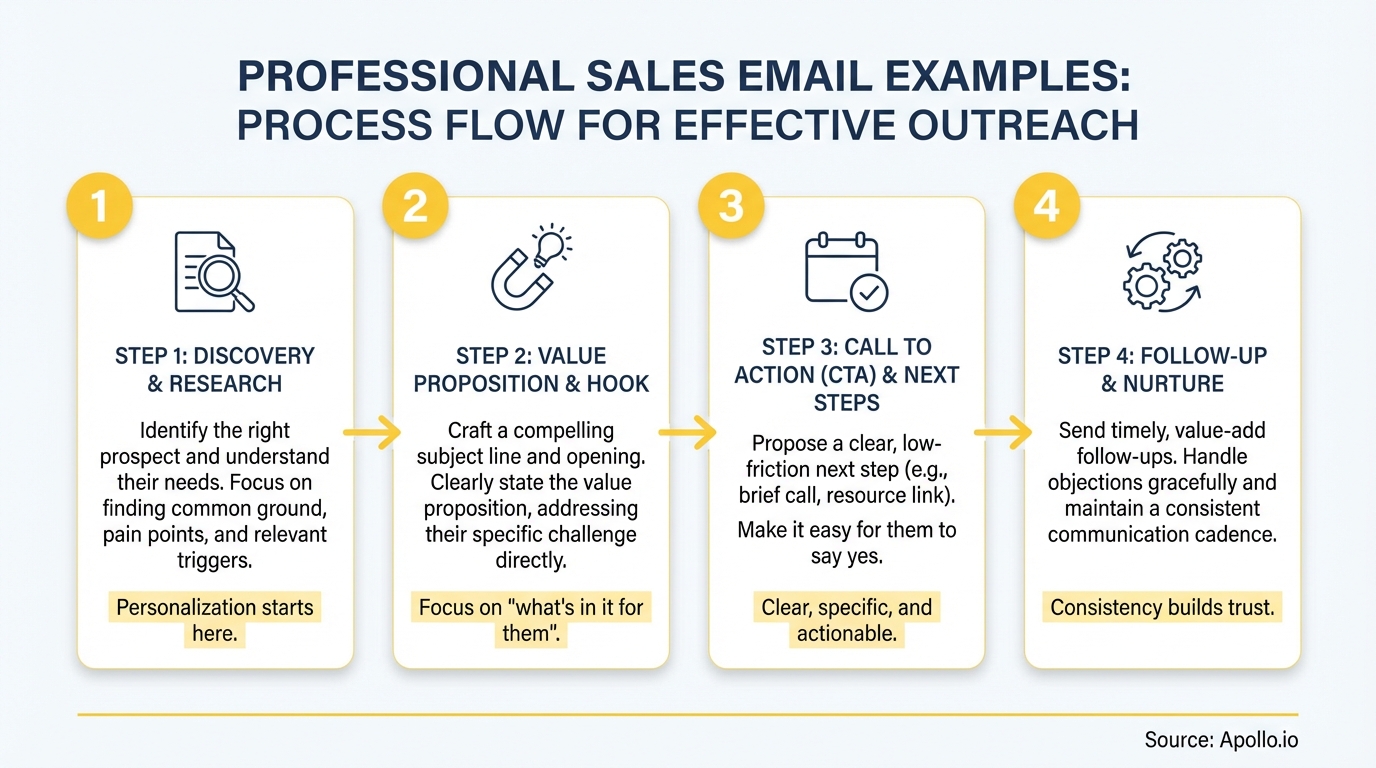
The process starts with identifying a relevant trigger (new funding round, job posting, technology adoption), selecting the matching example template, then customizing the hypothesis, proof point, and call-to-action based on prospect research.
Top-performing SDRs maintain a library of 8-12 core examples organized by trigger type, buyer persona, and deal stage.
Spending hours crafting individual emails from scratch? Automate your sequences with Apollo's multi-channel platform to deploy proven examples at scale while maintaining personalization depth.
Effective SDR email sequences typically include 4-6 touches over 14-21 days, combining email with phone and social outreach. The first email establishes relevance through a specific trigger observation, the second provides educational value or proof, the third introduces social proof or a customer story, and subsequent touches offer alternative engagement paths.
SDRs using trigger-based examples report measurably higher reply rates than those relying on generic introductions.

What Makes a Sales Email Example Effective in 2026?
Effective sales email examples in 2026 balance five critical elements: relevance validation, deliverability compliance, self-serve enablement, reply-optimized structure, and measurable benchmarks. Each example must answer "Why this prospect, why now?" within the first two sentences, include authentication-ready formatting (proper unsubscribe links, limited link count, spam-compliant language), and pair the email CTA with self-serve resources like pricing pages, security documentation, or implementation guides.
Structural best practices from high-performing subject lines include:
- Length: 6-8 sentences maximum (under 200 words)
- Personalization: Specific trigger or research insight in opening line
- Value Proposition: Clear benefit statement tied to prospect's business context
- Social Proof: Relevant customer name or metric from similar company
- CTA: Single, clear next step with self-serve alternative
- Deliverability: Maximum 2-3 links, proper unsubscribe, no spam triggers
Turn Funnel Guesswork Into Pipeline Clarity
Tired of watching marketing leads stall before they ever reach your pipeline? Apollo surfaces in-market buyers the moment they're ready, so your team works deals — not dead ends. 550K+ companies trust Apollo to fill the funnel right.
Start Free with Apollo →What Are the Best Sales Email Examples by Stage?
Sales email effectiveness varies significantly by buyer stage and relationship depth. Cold prospecting emails require stronger relevance signals and lighter asks, while follow-up emails can reference previous conversations and accelerate toward meetings.
Post-demo emails focus on addressing objections and providing proof assets that support internal champion selling.
| Stage | Primary Goal | Key Elements | Typical Length |
|---|---|---|---|
| Cold Prospecting | Establish Relevance | Trigger event, pattern interrupt, soft CTA | 6-7 sentences |
| Follow-Up | Provide Value | Educational content, proof point, meeting ask | 5-6 sentences |
| Post-Demo | Address Objections | Specific next steps, proof assets, timeline | 7-8 sentences |
| Re-Engagement | Reactivate Interest | New trigger, changed context, different angle | 5-6 sentences |
For Account Executives managing complex deals, post-demo examples should include links to ROI calculators, security questionnaires, implementation roadmaps, and comparison pages that enable champions to sell internally. Pair these with value statements that convert by addressing economic buyer priorities.
How Do You Measure Sales Email Performance?
Sales email measurement in 2026 prioritizes reply rates, positive reply rates, and meeting-booked rates over open rates due to privacy changes that inflate open metrics.
According to Optif.ai, cold outreach specifically averages 16.5% open rates, but this metric alone doesn't predict pipeline impact.
Track these benchmarks per template:
- Reply Rate: Target 5-10% for cold outreach, 15-25% for warm follow-up
- Positive Reply Rate: Target 40-60% of total replies expressing interest
- Meeting Booked Rate: Target 30-50% of positive replies converting to meetings
- Pipeline Created: Track opportunities generated per 100 emails sent
- Deliverability Rate: Monitor inbox placement (target 95%+) and spam complaint rate (keep under 0.1%)
Struggling to track which templates drive pipeline? Get complete visibility with Apollo's deal management to connect email performance directly to closed revenue.
A/B test subject lines, opening hooks, CTAs, and email length systematically.
Run tests with minimum 100-email samples per variant, and analyze results by persona and industry segment.
RevOps leaders should establish template governance with mandatory testing protocols before deploying new examples across the team.
Learn more about sales cadence best practices for structuring your testing approach.
What Sales Email Mistakes Should You Avoid?
The most common sales email mistakes in 2026 center on relevance failures, deliverability violations, and measurement misalignment. Avoid sending emails without validating fit criteria first.
Seventy-three percent of B2B buyers actively avoid suppliers who send irrelevant outreach, according to Gartner research. This means generic "spray and pray" approaches actively damage your domain reputation and future deliverability.
Critical mistakes to eliminate:
- No Trigger Validation: Sending without a specific reason why now
- Generic Personalization: Using only name/company without deeper research
- Meeting-Only CTAs: Not offering self-serve alternatives for the 61% of buyers preferring rep-free research
- Deliverability Neglect: Missing SPF/DKIM/DMARC setup, no one-click unsubscribe, excessive links
- Open-Rate Optimization: Designing for opens instead of replies and meetings
- No Proof Assets: Failing to include resources that enable champion selling
Implement relevance gates before any email sends.
Use email verification to protect deliverability, and pair every template with corresponding landing pages, case studies, or comparison resources that support buyer self-education.
Start Sending Better Sales Emails Today
Sales email effectiveness in 2026 depends on relevance, deliverability, and buyer enablement more than creative copywriting alone. The examples that drive pipeline combine trigger-based personalization, deliverability-first structure, self-serve proof assets, and reply-optimized CTAs.
SDRs and Account Executives who systematically test templates, track reply metrics instead of opens, and continuously refine based on performance data consistently outperform teams relying on generic approaches.
Build your sales email library around specific triggers, personas, and stages. Validate relevance before sending, ensure deliverability compliance, provide self-serve resources, and measure what matters (replies, meetings, pipeline).
The templates that work are those grounded in real buyer behavior, supported by proof, and optimized for the channels where deals actually close.
Ready to implement these sales email examples at scale? Start a trial with Apollo to access 224M+ verified contacts, multi-channel sequences, and the unified platform that consolidates your sales tech stack into one workspace.
Prove Pipeline ROI Faster With Apollo
Budget approval stuck on unclear metrics? Apollo delivers measurable pipeline impact from day one — so you walk into every review with proof, not promises. Leadium 3x'd their revenue. You're next.
Start Free with Apollo →Don't miss these
Sales
Inbound vs Outbound Marketing: Which Strategy Wins?
Sales
What Is a Sales Funnel? The Non-Linear Revenue Framework for 2026
Sales
What Is a Go-to-Market Strategy? The 2026 GTM Playbook
See Apollo in action
We'd love to show how Apollo can help you sell better.
By submitting this form, you will receive information, tips, and promotions from Apollo. To learn more, see our Privacy Statement.
4.7/5 based on 9,690 reviews
