
15 Sales Deck Examples That Win Deals in 2026
Your sales deck is often your only shot at winning a deal. In 2026, buyers expect data-driven narratives, AI-powered insights, and presentations that address multiple stakeholders. A weak deck costs you the deal before you even present. This guide shows you real sales deck examples that win, with frameworks SDRs and AEs can implement today to deliver winning sales pitches and close more revenue.

Apollo Cuts Research Time From Hours To Seconds
Tired of spending 4+ hours daily hunting for contact info? Apollo delivers 224M verified contacts with 96% email accuracy instantly. Join 550K+ companies who eliminated manual prospecting.
Start Free with Apollo →Key Takeaways
- Modern sales decks integrate AI-driven insights and data storytelling to address buying committee concerns and build consensus
- Hybrid omnichannel narratives meet buyers where they are, combining self-service content with rep-led presentations
- Consensus-building frameworks reduce decision conflicts and accelerate deal velocity by mapping stakeholder priorities
- ROI calculators with scenario analysis help buyers justify spend and overcome internal objections
- AI-augmented sales teams using data-driven decks are 3.7x more likely to hit quota in 2026
What Are Sales Deck Examples in 2026?
Sales deck examples are proven presentation templates and frameworks that demonstrate how top-performing teams structure their pitch narratives.
They showcase best practices for opening hooks, problem-solution frameworks, ROI calculations, and closing strategies.
In 2026, winning decks blend AI-generated insights with human storytelling to address the reality that Gartner reports 61% of B2B buyers prefer a rep-free buying experience.
Modern examples go beyond static slides. They include interactive elements, personalized data visualizations, and modular sections that adapt to different stakeholder needs.
For Account Executives closing enterprise deals, this means creating multiple deck versions for economic buyers, technical evaluators, and end users within the same buying committee.
Why Do Sales Leaders Prioritize Data-Driven Deck Frameworks?
Sales leaders invest in data-driven deck frameworks because they directly impact quota attainment and deal velocity. Research by Gartner shows sellers who effectively partner with AI tools are 3.7 times more likely to meet their sales quotas. Teams using structured, insight-backed presentations close faster and command higher deal values.

The shift matters because buyers now expect personalization at scale. Generic pitch decks fail immediately.
Sales Leaders need frameworks that let AEs customize quickly while maintaining brand consistency and proven messaging architecture. Apollo customers like Cyera report that "having everything in one system was a game changer" when building data-enriched presentations that pull real-time account intelligence.
How Do AI-Powered Insights Improve Deck Performance?
AI-powered insights transform static presentations into dynamic, personalized experiences. They analyze prospect behavior, industry benchmarks, and competitive positioning to surface the most relevant talking points for each meeting. SDRs using AI sales tools can generate custom value propositions based on firmographic data and engagement signals.

Specific applications include:
- Predictive ROI modeling: Calculate expected returns based on prospect-specific variables
- Competitive intelligence: Surface differentiators relevant to their current stack
- Stakeholder mapping: Identify decision-makers and their priorities automatically
- Content recommendations: Suggest case studies matching their industry and use case
What Should SDRs Include in Discovery-Focused Sales Decks?
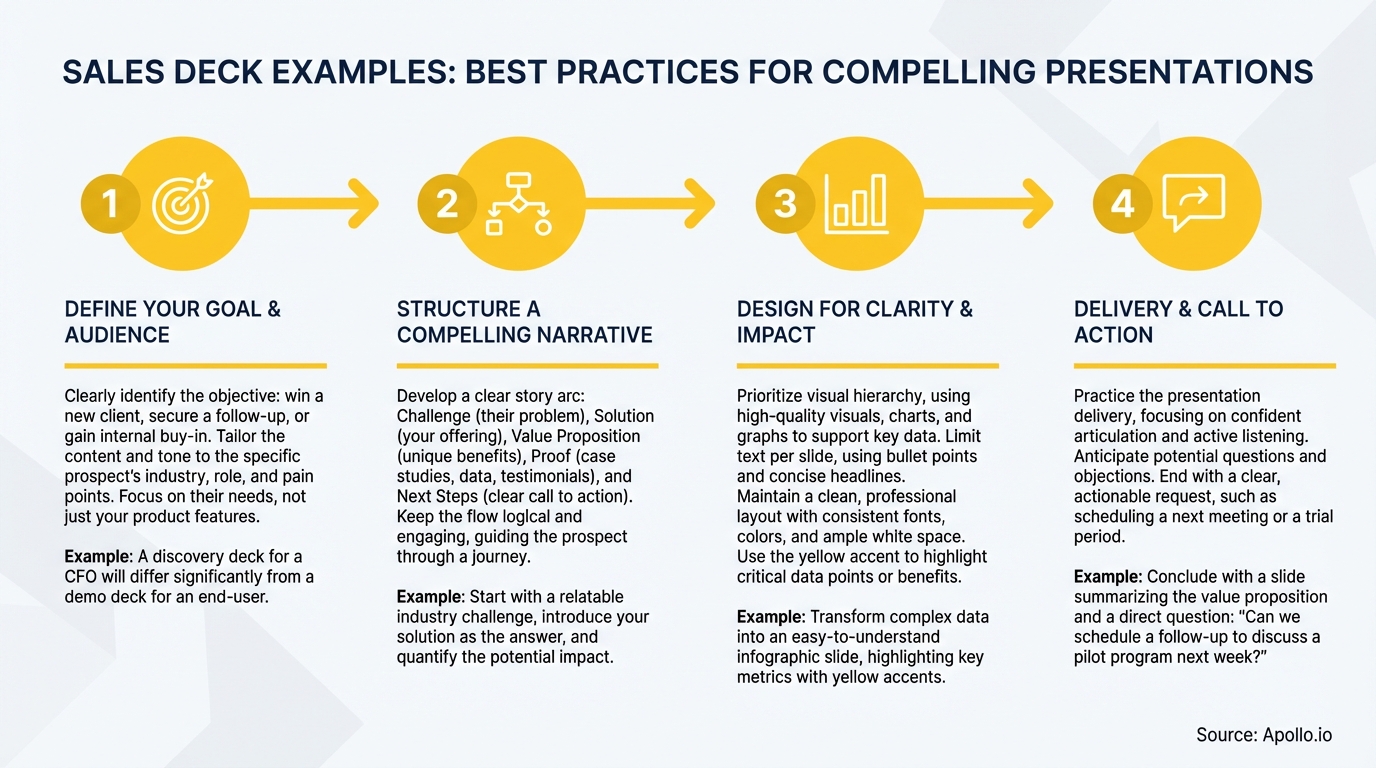
SDRs need discovery-focused decks that qualify prospects and book next meetings, not close deals. These decks should run 5-7 slides maximum and focus on problem identification rather than product features.
Start with a provocative insight about their market or role, then use questions to uncover pain points.
Essential components for SDR decks:
- Opening hook: Industry-specific challenge or surprising statistic
- Problem framework: 3-4 common pain points your ICP faces
- Discovery questions: Slide prompting conversation, not monologue
- Social proof: 1-2 customer logos in their vertical
- Next steps: Clear CTA for demo or technical evaluation
Struggling to find qualified prospects with relevant pain points? Search Apollo's 224M+ contacts with 65+ filters to build targeted lists that match your ideal buyer profile and current initiatives.
How Do Account Executives Build Consensus Across Buying Committees?
Account Executives face the challenge that Gartner found 74% of B2B buyer teams experience unhealthy conflict during the decision process. Winning decks address this by creating stakeholder-specific slides that speak to each role's priorities while maintaining a unified narrative.
Consensus-building framework:
| Stakeholder | Primary Concern | Deck Focus |
|---|---|---|
| Economic Buyer | ROI and budget impact | Cost-benefit analysis, payback period |
| Technical Evaluator | Integration and security | Architecture diagrams, compliance certs |
| End User | Ease of use and adoption | UI demos, training resources |
| Executive Sponsor | Strategic alignment | Business outcomes, competitive advantage |
Create a master deck with modular sections you can rearrange based on who's in the room. RevOps teams using deal management platforms can track which deck versions correlate with higher close rates and iterate accordingly.
Turn Unreliable Forecasts Into Revenue Clarity
Pipeline visibility a guessing game? Apollo tracks every deal stage in real-time with signals that predict close rates. Built-In increased win rates 10% with Apollo's scoring and insights.
Start Free with Apollo →What Hybrid Sales Deck Elements Drive Revenue in 2026?
Hybrid sales decks combine self-service digital content with live presentation components to meet buyers' preferences for McKinsey reports as the dominant sales strategy. This means creating assets that work both as standalone resources and as presentation frameworks.
Key hybrid elements:
- Interactive ROI calculator: Buyers can input their metrics and see personalized results
- Video-embedded slides: Product demos prospects can replay on demand
- Downloadable one-pagers: Executive summaries for internal sharing
- Linked resources: Case studies and technical docs accessible during self-service review
- Follow-up sequences: Automated content delivery based on deck engagement
Sales teams consolidating their tech stack report faster deck creation and better performance tracking. As Predictable Revenue noted, "we reduced the complexity of three tools into one" when moving to unified platforms that combine sales development, content management, and analytics.
How Should Founders Structure Investor-Ready Sales Decks?
Founders pitching to investors need sales decks that prove market traction and revenue predictability. These decks emphasize metrics over features, focusing on customer acquisition costs, lifetime value, and sales cycle data. Include your go-to-market strategy with specific channel performance and unit economics.
Investor-focused deck structure:
- Market opportunity: TAM/SAM/SOM with bottom-up validation
- Traction slides: Revenue growth, customer logos, retention rates
- Sales motion: CAC payback, sales cycle length, win rates
- Competitive positioning: Why you win deals, not just feature comparisons
- Team credibility: Revenue leaders' track records and advisor network
What Sales Deck Examples Actually Win Enterprise Deals?
Enterprise-winning decks follow a proven structure that addresses complex buying processes and extended sales cycles. They open with an executive briefing slide, include detailed security and compliance sections, and provide implementation roadmaps with clear success metrics. For AEs managing enterprise accounts and closing mega deals, these elements are non-negotiable.
Winning enterprise deck framework:
- Executive summary: One-slide business case (budget holders start here)
- Strategic context: Industry trends and competitive pressures
- Solution overview: How you solve their specific challenges
- Implementation approach: Phased rollout with quick wins
- Success metrics: KPIs and measurement framework
- Risk mitigation: Security, compliance, change management
- Investment analysis: Total cost of ownership vs. current state
- Reference customers: Similar companies with quantified results
Census reported they "cut costs in half" by consolidating their sales tools into one platform, enabling faster deck creation with real-time data enrichment and eliminating version control issues across their enterprise sales team.
Start Building High-Converting Sales Decks Today
Sales decks in 2026 require more than beautiful slides. They demand AI-powered personalization, stakeholder-specific narratives, and hybrid delivery models that respect buyer preferences.
Account Executives who master data-driven storytelling with consensus-building frameworks close faster and command premium pricing.
The best decks integrate real-time prospect intelligence, competitive insights, and ROI calculators tailored to each buyer's context. They work as both self-service resources and live presentation frameworks, adapting to how modern B2B buyers want to engage.
Teams using unified platforms report they can create personalized, high-impact decks faster while tracking what actually drives conversions.
Ready to transform your sales presentations with AI-powered insights and verified contact data? Start free with Apollo to access 224M+ contacts, intelligent enrichment, and the tools top-performing sales teams use to build decks that win.
Prove Apollo's ROI In Your First 30 Days
Budget approvals stuck on unclear metrics? Apollo tracks measurable pipeline impact from day one—quantifiable time savings, deal velocity, and win rates. Built-In increased win rates 10% and ACV 10% using Apollo's scoring.
Start Free with Apollo →Don't miss these
Sales
Inbound vs Outbound Marketing: Which Strategy Wins?
Sales
What Is a Sales Funnel? The Non-Linear Revenue Framework for 2026
Sales
What Is a Go-to-Market Strategy? The 2026 GTM Playbook
See Apollo in action
We'd love to show how Apollo can help you sell better.
By submitting this form, you will receive information, tips, and promotions from Apollo. To learn more, see our Privacy Statement.
4.7/5 based on 9,690 reviews
