
Sales Cycle Stages: How to Move Prospects From Lead to Close
Sales cycle stages define the structured path prospects take from first contact to closed deal. Understanding and optimizing each stage helps sales teams move deals forward predictably, reduce friction points, and increase win rates. According to Gartner, 60% of B2B sales organizations have transitioned to data-driven selling approaches that integrate analytics at every stage. In 2026, leading teams use AI-powered platforms to track buyer signals, automate follow-ups, and maintain consistent engagement across their entire pipeline.

Apollo Eliminates 4+ Hours Of Daily Research
Tired of spending 4+ hours daily hunting for contact info? Apollo delivers 224M verified contacts with 96% email accuracy instantly. Join 550K+ companies who stopped manual prospecting.
Start Free with Apollo →Key Takeaways
- Sales cycle stages provide a repeatable framework that transforms random outreach into predictable revenue
- Data-driven stage management cuts sales cycles while increasing win rates through targeted actions
- AI automation at each stage helps SDRs and AEs focus on high-value conversations instead of manual tasks
- Modern buyers expect hybrid experiences combining self-service resources with personalized rep engagement
- Unified platforms consolidate prospecting, engagement, and analytics into one workspace
What Are Sales Cycle Stages?
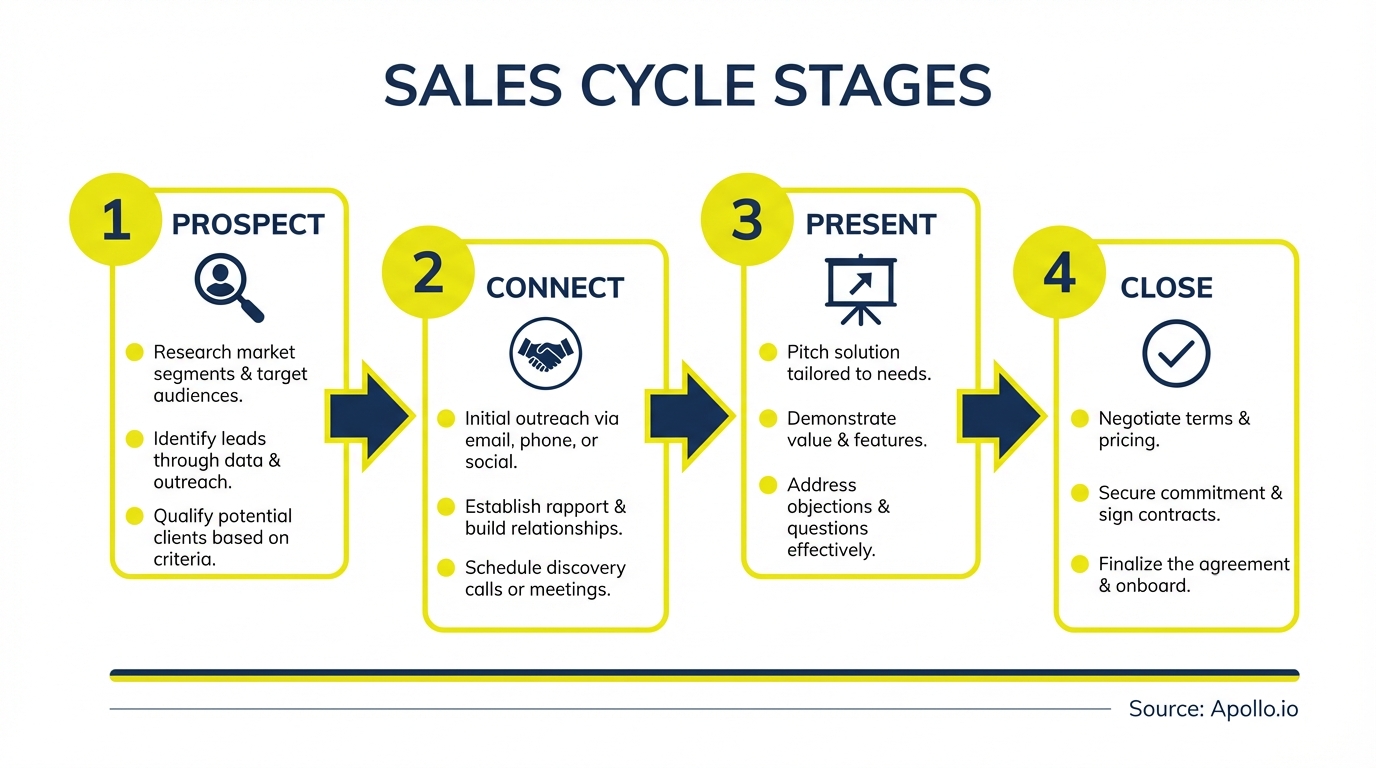
Sales cycle stages are the sequential steps a prospect moves through from initial awareness to becoming a customer. Each stage represents a distinct milestone in the buying journey with specific objectives, activities, and success criteria.
The typical B2B sales cycle includes prospecting, qualification, discovery, proposal, negotiation, closing, and expansion stages.
These stages create a shared language for sales teams to forecast revenue, identify bottlenecks, and replicate successful behaviors. Research by McKinsey shows that hybrid selling strategies aligned to buyer stages generate up to 50% more revenue through deeper customer engagement.
Why Do Sales Cycle Stages Matter in 2026?
Sales cycle stages matter because they transform unpredictable selling into a measurable, improvable system. Teams using structured stages gain visibility into exactly where deals stall, which tactics work, and how to allocate resources effectively.
For RevOps leaders, stage-based analytics reveal conversion rates, velocity metrics, and revenue forecasts with precision.

In 2026, buyer expectations have shifted dramatically. Gartner reports that 61% of B2B buyers prefer self-service digital experiences over direct rep interactions. Sales organizations must design stages that accommodate both human-led and buyer-led journeys while maintaining consistent messaging across channels.
Apollo Turns Forecast Guesswork Into Revenue
Pipeline forecasting a guessing game? Apollo delivers real-time deal visibility and verified contacts that convert. Built-In boosted win rates 10% with Apollo's signals.
Start Free with Apollo →What Are the 7 Core Sales Cycle Stages?
The seven core stages create a complete framework from initial contact through customer expansion. Each stage requires specific actions, data inputs, and success metrics.
| Stage | Primary Goal | Key Activities | Success Metric |
|---|---|---|---|
| Prospecting | Identify ideal buyers | List building, contact discovery, initial outreach | Qualified leads generated |
| Qualification | Validate fit and intent | BANT/MEDDIC scoring, budget confirmation | SQL conversion rate |
| Discovery | Uncover pain points | Needs analysis, stakeholder mapping | Discovery calls completed |
| Proposal | Present solution | Demo delivery, ROI modeling, proposal creation | Proposal acceptance rate |
| Negotiation | Address objections | Pricing discussions, contract terms, stakeholder alignment | Negotiation to close ratio |
| Closing | Finalize agreement | Contract signing, legal review, onboarding kickoff | Win rate percentage |
| Expansion | Grow account value | Upsells, cross-sells, renewals, referrals | Net revenue retention |
Struggling to track deals across these stages? Apollo's deal management platform provides complete pipeline visibility in one unified workspace.
How Do SDRs Move Prospects Through Early Stages?
SDRs focus on the prospecting and qualification stages, where speed and personalization determine success. Top-performing SDRs use AI-powered research tools to gather buyer signals like job changes, funding events, and technology adoption before making first contact.
This intelligence enables relevant, timely outreach that resonates with prospect pain points.
Modern SDRs leverage multi-channel sequences combining email, phone, and social touches across 7-10 touchpoints. Automation handles scheduling and follow-up timing while SDRs focus on crafting personalized messages and handling live conversations. Teams using proven sales development playbooks consistently hit qualification targets by aligning outreach to specific buyer stages.
What AI Tools Optimize Each Sales Cycle Stage?
AI tools transform manual, time-consuming stage activities into automated workflows. At the prospecting stage, AI-powered search engines filter millions of contacts using 65+ criteria to surface ideal buyers instantly.
During qualification, predictive scoring models analyze engagement data to prioritize high-intent prospects automatically.

Discovery and proposal stages benefit from AI conversation intelligence that captures pain points, extracts action items, and generates follow-up emails from call transcripts. For Account Executives managing complex deals, AI assistants surface relevant case studies, competitive intelligence, and stakeholder insights at exactly the right moment.
Sales leaders gain forecasting accuracy through AI models that predict close probability based on historical deal patterns and current engagement metrics.
Spending hours on manual research and data entry? Apollo's AI automation handles prospecting, enrichment, and outreach so reps focus on conversations.
How Does Data-Driven Stage Management Improve Win Rates?
Data-driven stage management replaces gut instinct with measurable insights at every decision point. Sales teams track conversion rates between stages, average time in each stage, and win rates by deal characteristics.
This visibility reveals exactly where prospects drop off and which interventions move deals forward.
For example, if discovery-to-proposal conversion drops below benchmarks, teams analyze call recordings to identify missing qualification questions or unclear value propositions. When proposals stall in negotiation, contract term analysis shows which pricing models close faster. Teams using advanced sales analytics platforms cut sales cycles through targeted optimizations informed by real performance data.
Start Moving Deals Through Your Pipeline Faster
Sales cycle stages provide the framework for predictable revenue growth, but execution depends on having the right tools and data at each step. Modern sales teams consolidate prospecting, engagement, and analytics into unified platforms that eliminate tool sprawl and data silos.
Apollo combines 224M verified business contacts, AI-powered automation, and complete pipeline management in one workspace. Sales teams using Apollo report faster ramp times, higher win rates, and significant cost savings from tool consolidation.
As one customer shared, "We reduced the complexity of three tools into one" (Predictable Revenue).
Ready to optimize your sales cycle stages with data-driven insights and AI automation? Start prospecting free with Apollo and see how unified GTM platforms accelerate deals from first contact to closed-won.
Prove Apollo's ROI In Your First 30 Days
Budget approval stuck on unclear metrics? Apollo delivers measurable pipeline impact from day one—Built-In increased win rates 10% and ACV 10% using signals. Join 550K+ companies with proven returns.
Start Free with Apollo →Don't miss these
Sales
Inbound vs Outbound Marketing: Which Strategy Wins?
Sales
What Is a Sales Funnel? The Non-Linear Revenue Framework for 2026
Sales
What Is a Go-to-Market Strategy? The 2026 GTM Playbook
See Apollo in action
We'd love to show how Apollo can help you sell better.
By submitting this form, you will receive information, tips, and promotions from Apollo. To learn more, see our Privacy Statement.
4.7/5 based on 9,690 reviews
