
Sales Conversion Rate: How to Calculate and Improve Your Results
Sales conversion rate directly determines how efficiently your team turns prospects into revenue. In 2026, B2B buying cycles are compressing while buyer expectations are rising. Teams that master conversion-rate optimization at each funnel stage consistently outperform competitors who focus solely on top-of-funnel volume. According to TrueLeads, high-performing B2B websites (top 10%) can achieve an 11.7% conversion rate, while the top 25% achieve 4.31%. This guide provides the stage-by-stage framework, benchmarks, and tactical strategies your team needs to improve conversion rates across every pipeline stage.

Apollo Finds Contacts Instantly—No Manual Work
Tired of spending 4+ hours daily hunting for contact info? Apollo delivers 224M+ verified contacts with 96% email accuracy. Join 550K+ companies closing deals faster.
Start Free with Apollo →Key Takeaways
- B2B conversion rates vary dramatically by funnel stage: visitor-to-lead averages 2-5%, while MQL-to-SQL sits at 20-25%
- The MQL-to-SQL stage is the highest-leverage bottleneck where small improvements create outsized revenue impact
- Buying-group consensus content outperforms individual personalization: teams experience 3× higher deal quality when content addresses group dynamics
- AI discovery and third-party platforms now represent measurable traffic sources requiring new attribution frameworks
- Email deliverability issues often masquerade as conversion-rate problems: authentication and sender reputation directly affect meeting conversion
What Is Sales Conversion Rate?
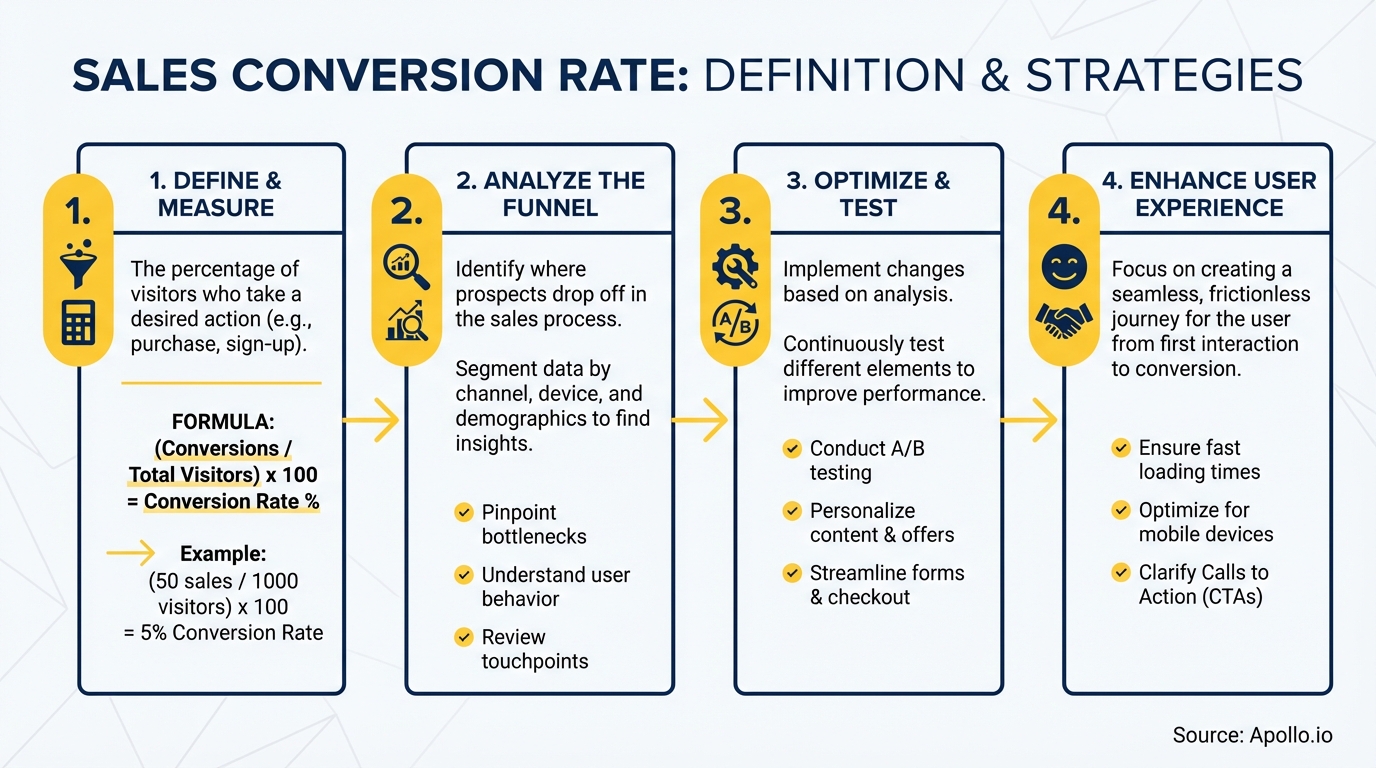
Sales conversion rate measures the percentage of prospects who complete a desired action at each stage of your sales funnel. It's calculated by dividing the number of conversions by total opportunities, then multiplying by 100.
Unlike a single metric, conversion rate represents multiple transition points: website visitor to lead, lead to marketing qualified lead (MQL), MQL to sales qualified lead (SQL), and SQL to closed deal.
Each stage requires distinct measurement and optimization strategies. Research from Lead Agency shows the average lead conversion rate for B2B companies is 2.3%, with high-performing companies reaching up to 10%. The gap between average and top performers highlights the revenue impact of systematic conversion-rate improvement across your entire funnel.
Modern B2B conversion tracking must account for buying-group dynamics, not just individual buyer actions. Teams that optimize for committee consensus rather than individual touchpoints see measurably better deal quality and faster close rates. Sales analytics platforms help teams instrument these complex, multi-stakeholder conversion paths.
What Are the Stage-by-Stage Conversion Rate Benchmarks for 2026?
Understanding where your conversion rates stand relative to industry benchmarks helps you identify the highest-leverage improvement opportunities. According to SerpSculpt, the average B2B conversion rate across all industries sits between 2% and 5%. However, this top-level metric masks significant variation by funnel stage and company maturity.
Here's the complete funnel breakdown with 2026 benchmarks:
| Funnel Stage | Average Rate | Top Quartile | Primary Bottleneck |
|---|---|---|---|
| Visitor → Lead | 2-5% | 8-12% | Form friction, unclear value prop |
| Lead → MQL | 20-25% | 35-45% | Scoring accuracy, timing |
| MQL → SQL | 11-15% | 25-35% | Handoff speed, qualification |
| SQL → Opportunity | 25-40% | 50-60% | Discovery quality, stakeholder access |
| Opportunity → Close | 15-25% | 30-40% | Business case, consensus |
Data from MarketJoy confirms that Lead to Marketing Qualified Lead (MQL) averages 20-25% with a benchmark of 22%. The MQL-to-SQL transition consistently emerges as the highest-leverage improvement area because it combines marketing qualification accuracy with sales follow-up execution.
Struggling to track conversions across your entire funnel? Apollo's deal management platform provides complete pipeline visibility with stage-by-stage conversion tracking.
Turn Forecast Guesswork Into Revenue Certainty
Pipeline forecasting a guessing game? Apollo delivers real-time deal visibility and intent signals that make your forecast rock-solid. Built-In boosted win rates 10% with Apollo's scoring and intelligence.
Start Free with Apollo →How Do SDRs and BDRs Improve Lead-to-Meeting Conversion Rates?
SDRs and BDRs face the critical lead-to-meeting conversion stage where initial interest transforms into booked conversations. This stage directly determines pipeline velocity and quota attainment. According to Landbase, sales call to appointment rates range from 13% to 25% across industries, with service industries achieving over 26%.
Top-performing SDRs focus on three high-impact activities:
- Speed-to-lead optimization: Contact leads within 5 minutes of form submission. Every hour of delay reduces conversion probability by 10%.
- Multi-channel sequencing: Combine email, phone, and social outreach. Single-channel campaigns convert 2-3× lower than coordinated sequences.
- Personalized research: Reference specific pain points from prospect's website, recent news, or job changes. Generic outreach converts at baseline rates.
Email deliverability has become a conversion-rate gate in 2026. Microsoft Outlook bulk-sender requirements now enforce stricter authentication standards, meaning poorly configured domains experience throttling that shows up as lower conversion rates.
SDRs must verify SPF, DKIM, and DMARC records are properly configured before diagnosing message-market fit issues.
BDRs working enterprise accounts face longer research cycles but higher deal values. They improve conversion by building buying-group maps early, identifying champions and blockers, and tailoring outreach to address committee dynamics rather than individual personas. HubSpot's sales team exemplifies this approach with systematic account research and multi-threaded engagement strategies.
What Is the MQL-to-SQL Bottleneck and How Do You Fix It?
The MQL-to-SQL transition represents the highest-leverage conversion improvement opportunity for most B2B teams. This stage combines marketing's lead scoring accuracy with sales' follow-up execution and qualification discipline.
When this handoff breaks, qualified opportunities leak out of your pipeline regardless of top-of-funnel performance.
Common MQL-to-SQL failure patterns include:
- Scoring misalignment: Marketing scores on engagement; sales needs intent signals and budget authority
- Follow-up delays: MQLs contacted after 24+ hours convert 60% lower than immediate follow-up
- Qualification inconsistency: SDRs apply different BANT/MEDDIC criteria, creating random SQL outcomes
- Handoff friction: Critical context from marketing touchpoints doesn't transfer to sales conversations
RevOps leaders fix this bottleneck by redefining MQL and SQL definitions collaboratively with sales and marketing, implementing SLA-based routing with automated alerts for high-intent leads, and creating qualification scorecards that SDRs complete before advancing leads. Teams that instrument this stage with conversion dashboards identify specific failure modes (scoring vs speed vs qualification) and optimize accordingly.
AI-driven qualification tools are becoming table stakes for high-performing teams. These systems analyze conversation quality, buying signals, and fit criteria to recommend SQL advancement or nurture paths. This removes human inconsistency while maintaining the judgment required for complex B2B deals. Modern AI sales tools combine scoring automation with conversation intelligence to improve this critical transition.

How Do Buying-Group Dynamics Affect Conversion Rates?
B2B conversion increasingly depends on buying-group consensus rather than individual buyer actions. Gartner's 2025 research found 74% of B2B buyer teams demonstrate unhealthy conflict during decisions.
Content tailored for buying-group relevance improves consensus by 20%, while individual-level relevance has a 59% negative impact on consensus. Buyers experiencing buying-group relevance were 3× more likely to report high-quality deals.
This shifts conversion optimization upstream to content and messaging that addresses committee concerns:
- Role-specific assets: Create separate resources for economic buyers, technical evaluators, and end users
- Consensus templates: Provide decision frameworks, vendor comparison matrices, and business case templates
- Multi-stakeholder engagement: Map buying committees early and ensure all roles receive relevant touchpoints
- Objection pre-emption: Address common blocker concerns (security, integration, change management) proactively
Account Executives managing complex deals report that conversion rates improve measurably when they facilitate internal alignment rather than just selling to champions. This means scheduling group demos, creating shared Slack channels, and providing artifacts that champions can use to build consensus internally. Enterprise sales strategies prioritize buying-group orchestration over individual relationship building.
The shift toward earlier buyer decisioning compounds this dynamic. 6sense's 2025 research shows the pre-contact favorite wins approximately 80% of the time, meaning conversion optimization has moved before sales is even involved. Teams must create shortlist-readiness content (comparison pages, ROI calculators, proof points) that influences buying groups during their independent research phase.
How Do AI Discovery and Third-Party Platforms Change Conversion Attribution?
AI-driven discovery and third-party platforms now represent measurable traffic sources that require new attribution frameworks. Forrester analysis reports AI-generated traffic representing 2-6% of total organic traffic in B2B and growing over 40% per month, with expectations of 20%+ by end of 2026.
Gartner's 2025 survey found 51% of customer journeys now start on third-party platforms.
This creates attribution complexity because traditional last-click and first-touch models miss the influence of off-site content:
- AI answer engines: Prospects research on ChatGPT, Perplexity, or Gemini before ever visiting your site
- Review platforms: G2, TrustRadius, and Capterra shape shortlists before direct engagement
- Community discussions: Reddit, Slack communities, and professional forums influence vendor selection
- Analyst reports: Gartner, Forrester, and category-specific analysts create pre-contact preferences
Sales Leaders must implement pipeline-based attribution that tracks deal sources through CRM fields rather than relying solely on web analytics. This means training SDRs to ask "How did you first hear about us?" and systematically logging responses.
Teams should also create dedicated landing pages for third-party traffic sources to measure conversion rates by channel.
The Chrome third-party cookie reversal in April 2025 adds measurement turbulence. While Google maintained a user-choice approach rather than full phaseout, retargeting and paid attribution remain volatile.
Smart teams are shifting toward first-party data capture, intent signals from tools like 6sense and Demandbase, and pipeline-based measurement rather than last-click conversion tracking.
What Conversion-Rate Improvements Drive the Most Revenue Impact?
Not all conversion-rate improvements create equal revenue impact. Teams should identify their single biggest bottleneck and focus optimization efforts there rather than trying to improve every stage simultaneously.
Use this framework to prioritize:
- Calculate stage-by-stage conversion rates: Measure actual performance at each transition point
- Compare to benchmarks: Identify stages where you're significantly below industry averages
- Model revenue impact: Calculate how a 5-point lift at each stage affects closed revenue
- Assess effort required: Balance potential impact against implementation complexity
- Pick one constraint: Focus 80% of optimization effort on the highest-leverage bottleneck
For most B2B teams, the MQL-to-SQL stage offers the best ROI because it combines clear ownership (SDRs/BDRs), measurable inputs (speed-to-lead, qualification criteria), and direct pipeline impact. A 5-point improvement in MQL-to-SQL conversion typically adds 15-20% more pipeline with zero increase in marketing spend.
Founders and CEOs building outbound-led GTM motions should focus on visitor-to-lead conversion and lead-to-meeting conversion. These stages directly determine CAC and payback period. Founder-led sales strategies that optimize conversion at these early stages create compounding advantages as teams scale.
Can't identify where deals are stalling in your pipeline? Apollo's sales pipeline builder provides AI-powered insights into conversion bottlenecks with recommended optimization actions.

Improve Your Sales Conversion Rate with Apollo
Sales conversion rate optimization requires instrumentation, benchmarking, and systematic improvement across every funnel stage. The teams that win in 2026 treat conversion as a multi-stage system rather than a single metric, optimize for buying-group consensus rather than individual touchpoints, and adapt attribution frameworks for AI-driven discovery and third-party platforms.
Apollo consolidates the entire conversion optimization stack into one platform. Our 224M+ verified contacts reduce top-of-funnel friction, multi-channel sequences improve lead-to-meeting conversion, and deal management provides complete pipeline visibility with stage-by-stage tracking.
Teams using Apollo report measurable improvements across every conversion stage while reducing tool sprawl and operational complexity.
Ready to improve conversion rates across your entire funnel? Request a Demo to see how Apollo helps sales teams instrument, benchmark, and optimize conversion at every pipeline stage.
Prove Apollo's ROI In Your First 30 Days
Budget approval stuck on unclear metrics? Apollo tracks every touchpoint from prospect to closed deal—quantifying time saved, pipeline generated, and win rates improved. Built-In increased rates 10% and ACV 10% with Apollo's intelligence.
Start Free with Apollo →Don't miss these
Sales
Inbound vs Outbound Marketing: Which Strategy Wins?
Sales
What Is a Sales Funnel? The Non-Linear Revenue Framework for 2026
Sales
What Is a Go-to-Market Strategy? The 2026 GTM Playbook
See Apollo in action
We'd love to show how Apollo can help you sell better.
By submitting this form, you will receive information, tips, and promotions from Apollo. To learn more, see our Privacy Statement.
4.7/5 based on 9,690 reviews
