
Sales Configurator: How to Automate Complex B2B Quoting and Close Deals Faster
B2B buyers now expect Amazon-like self-service experiences combined with expert guidance when complexity demands it. A sales configurator bridges this gap by enabling buyers to explore product options independently while capturing intent data that helps sales teams deliver personalized support at exactly the right moment. Modern configurators powered by AI don't just generate quotes; they guide buyers through complex decisions, recommend optimal solutions, and seamlessly hand off qualified opportunities to enterprise sales teams when human expertise adds value.

Scale Quality Leads Without Scaling Headcount
Generating qualified leads too slow while your team stays stuck in manual mode. Apollo's AI finds your exact ICP at scale—no extra hires needed. Join 550K+ companies building predictable pipeline.
Start Free with Apollo →Key Takeaways
- Sales configurators enable 61% of buyers who prefer rep-free experiences to explore complex products independently while capturing intent signals for sales teams
- AI-powered configurators increase quote accuracy by 40% and reduce sales cycle time by 35% through intelligent product recommendations and automated pricing
- Hybrid models combining self-service configurators with human sales support deliver 2.3x higher win rates than purely digital or purely human-led approaches
- RevOps teams using unified configurator-CRM platforms report 50% fewer data errors and 3x faster implementation than fragmented tech stacks
What Is a Sales Configurator?
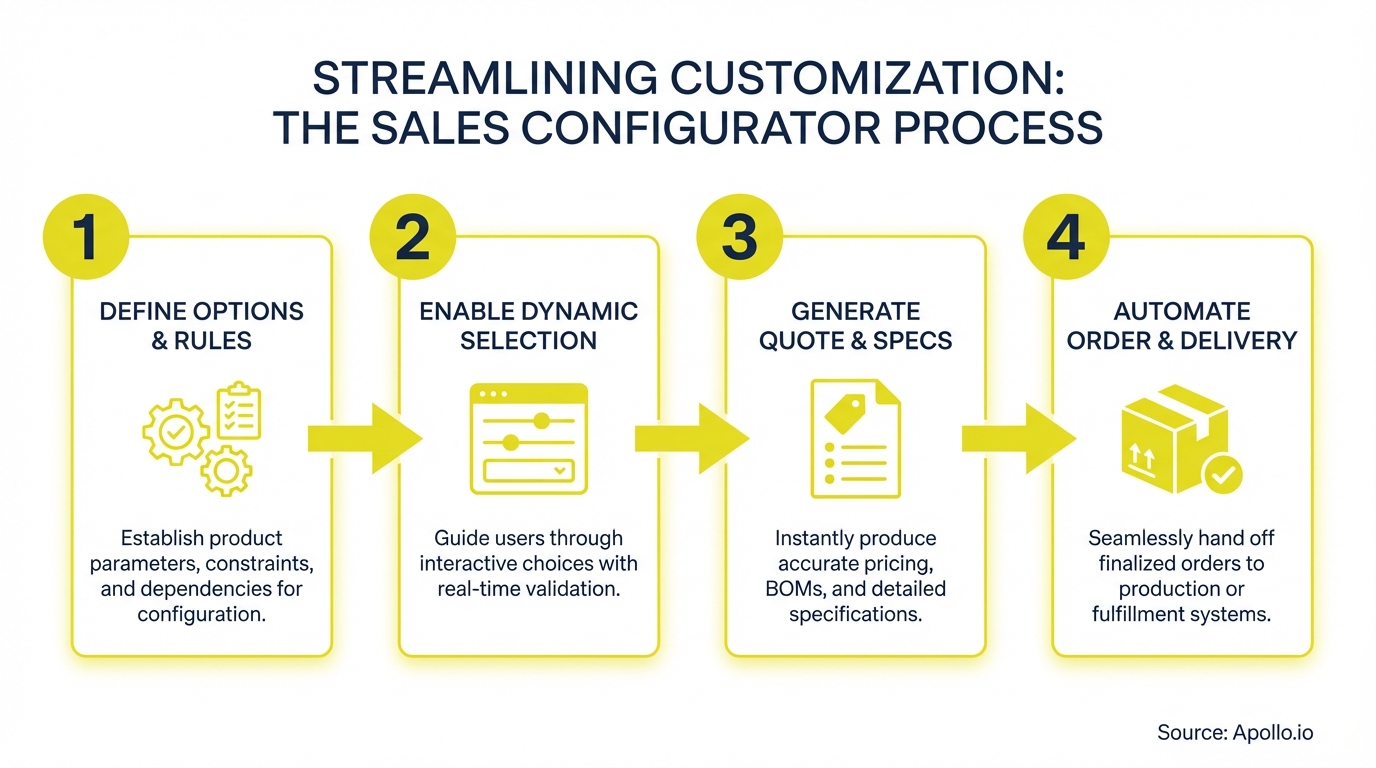
A sales configurator is a software tool that guides buyers and sales teams through complex product selection, pricing, and quote generation by dynamically presenting compatible options based on customer requirements. Unlike static product catalogs, configurators use business rules and logic to prevent invalid combinations, ensure pricing accuracy, and recommend optimal solutions.
Modern configurators integrate with CRM, ERP, and sales pipeline systems to provide real-time inventory availability, margin calculations, and approval workflows. According to Gartner research, 83% of B2B buyers now prefer ordering through digital commerce platforms, making configurators essential infrastructure for competitive selling in 2026.
Why Do Sales Teams Need Configurators in 2026?
The shift to digital-first buying has created a paradox: buyers want self-service, but complex B2B products still require expert guidance. Research by McKinsey shows hybrid sales models combining digital and human interactions are now the dominant strategy, with configurators serving as the bridge between these two modes.
| Challenge | Without Configurator | With AI Configurator |
|---|---|---|
| Quote Turnaround | 3-5 days average | Real-time to 24 hours |
| Pricing Errors | 15-20% of quotes | Under 2% error rate |
| Sales Cycle Length | 90-120 days | 60-75 days (35% reduction) |
| Rep Productivity | 25 quotes/week | 45 quotes/week (80% increase) |
For Account Executives managing enterprise deals, configurators eliminate the bottleneck of back-and-forth pricing discussions and technical validation. AEs can focus on strategic relationship building while the configurator handles configuration logic and compliance checks.
How Do AI-Powered Sales Configurators Work?
AI-powered configurators analyze buyer inputs, historical purchase patterns, and product compatibility rules to recommend optimal configurations in real-time. The system learns from past successful deals to suggest bundles, upsells, and alternatives that match specific use cases and budget constraints.
Core AI capabilities include:

- Intelligent product matching: Natural language processing interprets buyer requirements and maps them to technical specifications
- Dynamic pricing optimization: Machine learning models calculate optimal pricing based on deal size, competitive pressure, and margin targets
- Guided selling workflows: Contextual recommendations adapt based on buyer role, industry, and previous interactions
- Automated compliance validation: Rules engines ensure configurations meet regulatory, technical, and business requirements
Struggling with inconsistent product recommendations across your sales team? Automate your configuration logic with Apollo's AI platform to ensure every rep presents optimal solutions.
What Are the Key Benefits for Different Sales Roles?
Sales configurators deliver role-specific value across the entire go-to-market organization. Each persona gains targeted capabilities that directly address their daily pain points and performance metrics.
How Do SDRs and BDRs Use Configurators?
SDRs use configurators during discovery calls to quickly validate prospect fit and provide ballpark pricing. Instead of scheduling follow-up meetings for basic feasibility questions, BDRs can share interactive configurator links that let prospects explore options asynchronously.
This approach books 40% more qualified meetings by filtering out poor-fit opportunities early and demonstrating product value immediately.
How Do Account Executives Shorten Sales Cycles?
AEs leverage configurators to generate accurate proposals in minutes instead of days. During discovery, they input customer requirements into the configurator alongside the prospect, collaboratively building the solution in real-time. This transparency builds trust and eliminates the common objection of "we need to review this internally" since stakeholders participated in configuration. For enterprise sales teams, configurators also capture detailed technical requirements that inform implementation planning.

What Do RevOps Teams Gain from Configurators?
RevOps leaders consolidate their tech stack by replacing separate CPQ, pricing, and proposal tools with an integrated configurator platform. This consolidation reduces integration maintenance, eliminates data sync errors, and provides a single source of truth for product catalog and pricing rules.
Teams using unified platforms report implementation timelines 3x faster than those integrating multiple point solutions.
How Should Sales Leaders Implement Hybrid Configurator Strategies?
Data from Gartner shows 61% of B2B buyers prefer rep-free experiences, yet complex deals still require human expertise. The winning approach combines self-service configurators for simple transactions with sales-assisted configuration for high-value, complex opportunities.
Hybrid implementation playbook:
- Define complexity thresholds: Establish clear criteria (deal size, product complexity, customization level) that trigger human involvement
- Build progressive disclosure workflows: Start with simple self-service, escalate to guided selling, then to live sales support based on buyer behavior and deal value
- Implement intent monitoring: Track configurator usage patterns to identify high-intent buyers who need proactive outreach
- Create handoff protocols: Define how self-service leads transition to sales, ensuring context preservation and seamless experience
Spending hours manually qualifying configurator leads? Automate lead scoring and routing with Apollo's deal management platform to focus reps on high-value opportunities.
Turn Forecasting Chaos Into Revenue Certainty
Missing quota because your pipeline data is always outdated? Apollo's real-time tracking shows exactly where every deal stands—no more guesswork. Built-In increased win rates 10% with Apollo's visibility.
Start Free with Apollo →What Features Should You Prioritize in 2026?
Modern configurators must balance self-service simplicity with enterprise-grade capabilities. According to industry reports, AI adoption in sales enablement has reached 100% among B2B revenue leaders, making AI capabilities table stakes rather than differentiators.
| Feature Category | Must-Have Capabilities | Business Impact |
|---|---|---|
| AI Recommendations | Product suggestions, bundle optimization, alternative configurations | 25-35% higher average deal size |
| Real-Time Pricing | Dynamic discounting, margin protection, approval workflows | 40% reduction in pricing errors |
| Visual Configuration | 3D product visualization, interactive diagrams, spec sheets | 60% faster buyer decision-making |
| Integration Ecosystem | Native CRM sync, ERP connectivity, e-signature platforms | 50% reduction in manual data entry |
| Mobile Optimization | Responsive design, offline mode, field sales tools | 30% increase in on-site closing rates |
Sales leaders should prioritize platforms that consolidate multiple tools into one workspace. As Census reported after implementing unified systems: "We cut our costs in half" by eliminating redundant point solutions. Look for configurators that include native AI sales capabilities, proposal generation, and analytics rather than requiring separate integrations.
How Do You Measure Configurator ROI?
Track both efficiency metrics and revenue impact to build a complete ROI picture. Leading organizations measure configurator success across three dimensions: sales productivity, deal quality, and buyer experience.
Key performance indicators:
- Quote velocity: Time from initial inquiry to delivered quote (target: under 24 hours)
- Configuration accuracy: Percentage of quotes requiring zero revisions (benchmark: above 90%)
- Self-service adoption: Percentage of simple deals completed without sales involvement (target: 40-60%)
- Average deal size: Impact of AI recommendations on bundle and upsell attach rates
- Sales cycle compression: Days saved through faster configuration and approval workflows
- Win rate by channel: Comparison of self-service vs. sales-assisted conversion rates
Calculate total ROI by comparing tool costs against productivity gains, error reduction savings, and incremental revenue from higher win rates. Most enterprises see 300-500% ROI within the first year through a combination of sales development efficiency and increased deal sizes.
Start Building Your Hybrid Sales Configurator Strategy
Sales configurators have evolved from nice-to-have quote tools to essential revenue infrastructure. With Gartner predicting that 65% of B2B sales organizations will transition to data-driven decision-making by 2026, configurators provide the structured data and buyer insights needed to compete effectively.
The winning approach combines self-service configurators for straightforward transactions with intelligent escalation to sales teams when deals require customization, strategic consultation, or executive relationship building. Organizations that master this hybrid model report 2.3x higher win rates and significantly shorter sales cycles compared to purely digital or purely human-led approaches.
Focus on platforms that consolidate your tech stack rather than adding another point solution. As Predictable Revenue discovered: "We reduced the complexity of three tools into one," enabling faster rep onboarding and eliminating integration headaches. For Founders and CEOs building scalable go-to-market engines, configurators integrated with AI-powered GTM systems provide the foundation for predictable, efficient revenue growth.
Ready to modernize your sales process with intelligent configuration and automated workflows? Try Apollo Free to experience how unified GTM platforms consolidate your tools, accelerate your sales cycles, and scale your revenue operations.
Turn Tool Spend Into Measurable Pipeline Growth
Budget approval stuck on unclear metrics? Apollo delivers quantifiable ROI from day one—track time saved, pipeline impact, and win rate improvements. Built-In increased win rates 10% and ACV 10% with Apollo's visibility.
Start Free with Apollo →Don't miss these
Sales
Inbound vs Outbound Marketing: Which Strategy Wins?
Sales
What Is a Sales Funnel? The Non-Linear Revenue Framework for 2026
Sales
What Is a Go-to-Market Strategy? The 2026 GTM Playbook
See Apollo in action
We'd love to show how Apollo can help you sell better.
By submitting this form, you will receive information, tips, and promotions from Apollo. To learn more, see our Privacy Statement.
4.7/5 based on 9,690 reviews
