
Sales Commission Structure: How to Design Plans That Drive Revenue
Sales commission structures directly impact your team's motivation, revenue growth, and retention rates. With research showing that AI and machine learning adoption can improve conversion rates by 35-47%, smart commission design paired with modern sales technology creates a powerful revenue engine. Whether you're an Account Executive optimizing your earnings or a sales leader building a high-performing team, understanding commission structures is essential for B2B sales success in 2026.

Apollo Finds Quality Leads 3x Faster
Tired of slow lead generation killing your pipeline? Apollo's AI identifies your exact ICP from 224M+ contacts with 96% email accuracy. Join 550K+ companies closing more deals.
Start Free with Apollo →Key Takeaways
- Sales commission structures define how reps earn money based on performance, combining base salary with variable pay tied to specific metrics
- The right commission model aligns team behavior with business goals while maintaining predictable costs and motivating top performers
- Modern commission tracking requires AI-powered tools that integrate CRM data, automate calculations, and provide real-time payout visibility
- Content-driven commission models reward pipeline influence and MQL-to-SQL conversion, not just closed revenue
- Account Executives and SDRs need different commission structures that reflect their unique roles in the sales process
What Is a Sales Commission Structure?
A sales commission structure is a compensation framework that defines how sales professionals earn variable pay based on their performance. It combines base salary with commission payments tied to specific metrics like revenue closed, deals won, or pipeline generated.
The structure determines commission rates, payment timing, and performance thresholds.
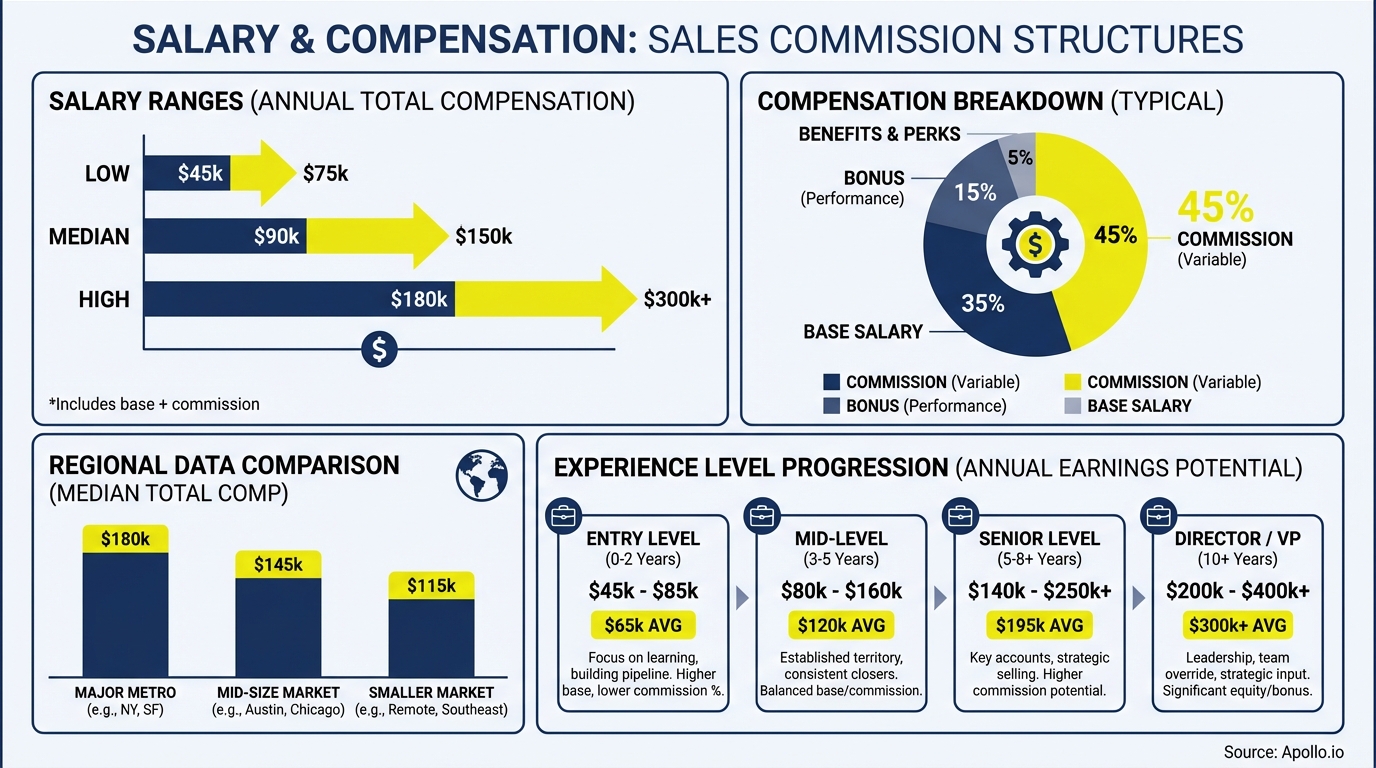
Common components include base salary (fixed pay regardless of performance), commission rate (percentage of deal value or flat fee per sale), quota (target performance level), and accelerators (higher rates after hitting quota). For example, an AE might earn $80K base plus 10% commission on all deals, with rates jumping to 15% after reaching 100% of quota.
Effective structures balance three priorities: motivating reps to perform, keeping compensation costs predictable, and aligning behavior with company goals. According to CMO Survey data, marketing budgets now account for 10.9% of company budgets, highlighting how sales and marketing alignment impacts overall revenue strategy.
What Are the Most Common Sales Commission Models?
The five most common commission models each serve different sales scenarios and business objectives. Choosing the right model depends on your sales cycle length, deal complexity, and team structure.
| Commission Model | How It Works | Best For |
|---|---|---|
| Straight Commission | 100% variable pay based on sales, no base salary | High-velocity transactional sales, experienced reps |
| Base Plus Commission | Fixed salary plus percentage of deals closed | Most B2B sales roles, balanced risk and reward |
| Tiered Commission | Rates increase as reps hit performance thresholds | Driving quota attainment, rewarding top performers |
| Revenue Share | Percentage of recurring revenue over contract lifetime | SaaS, subscription businesses, long-term accounts |
| Gross Margin Commission | Commission based on profit margin, not total revenue | Encouraging profitable deals, discounting control |
Many organizations combine models. For example, SDRs might earn flat fees per qualified meeting booked, while Account Executives earn tiered commission on closed revenue.
RevOps leaders increasingly favor hybrid models that reward both individual performance and team collaboration.
How Do Sales Leaders Design Effective Commission Structures?
Designing an effective commission structure starts with defining clear business objectives. Sales leaders must balance motivating reps, controlling costs, and driving the right behaviors across the entire sales cycle.
Step 1: Define Your Revenue Goals and Sales Roles. Identify what each role contributes to revenue.
SDRs generate pipeline, AEs close deals, and Customer Success drives expansion. Each role needs compensation aligned with their specific impact.
For example, SDRs might earn $500 per qualified opportunity, while AEs earn 10% of closed revenue.

Step 2: Set Realistic Quotas Based on Historical Data. Analyze past performance to establish achievable targets. Quotas should be attainable for 60-70% of reps with strong effort. Use sales analytics platforms to track conversion rates, deal velocity, and win rates by rep and segment.
Step 3: Choose Commission Rates That Control Costs. Total compensation (base plus commission at quota) should align with market rates for your industry and location.
A common framework: if target earnings are $150K with a 50/50 split, base is $75K and on-target commission is $75K. Commission rates are calculated backward from this target based on expected deal volume and size.
Step 4: Add Accelerators and SPIFs for Strategic Goals. Accelerators (higher commission rates above quota) reward top performers.
SPIFs (Sales Performance Incentive Funds) drive short-term focus on strategic priorities like new product adoption or specific market segments. For Founders building outbound teams, accelerators help compete with funded competitors for top talent.

Need visibility into your entire sales pipeline? Track every deal stage and commission trigger with Apollo's unified deal management platform.
Turn Forecast Guesswork Into Revenue Certainty
Pipeline forecasting a guessing game? Apollo reveals which deals will close with real-time signals and buyer intent data. Built-In increased win rates 10% using Apollo's scoring and guidance.
Start Free with Apollo →How Do Account Executives Calculate Their Commission Earnings?
Account Executives calculate commission by multiplying closed revenue by their commission rate, adjusted for quota attainment and any accelerators. Most AEs work with tiered structures where rates increase after hitting performance thresholds.
Basic Calculation Example: An AE with $500K annual quota, $75K base, and 10% commission rate closes $600K in a year. At base rate: $600K × 10% = $60K commission. Total comp: $75K base + $60K commission = $135K.
Tiered Structure Example: Same AE with tiered rates: 8% on revenue up to quota, 12% on revenue above quota. Calculation: ($500K × 8%) + ($100K × 12%) = $40K + $12K = $52K commission. Total comp: $127K.
Accelerator Example: AE reaches 120% of quota ($600K closed). Structure pays 10% up to quota, 15% from 100-120% quota. Calculation: ($500K × 10%) + ($100K × 15%) = $50K + $15K = $65K commission. Total comp: $140K.
Account Executives managing complex enterprise sales cycles often negotiate custom terms for mega-deals, including flat bonuses for strategic accounts or extended payout periods for multi-year contracts.
What Commission Metrics Matter Beyond Closed Revenue?
Modern commission structures reward behaviors beyond just closing deals. Leading sales organizations track pipeline influence, activity metrics, and content-driven conversions to incentivize the full buyer journey.
Pipeline Generation Metrics for SDRs: SDRs earn commission on qualified meetings booked, opportunities created, and MQL-to-SQL conversion rates. Typical payouts range from $50-200 per qualified opportunity depending on deal size and market.
This aligns SDR compensation with their core responsibility: filling the pipeline with quality prospects.
Multi-Touch Attribution for Complex Sales: In team selling environments, commission splits reward everyone who influenced the deal. Marketing might earn credit for generating the lead, SDRs for qualifying, AEs for closing, and Customer Success for expansion.
Attribution models (first-touch, last-touch, or multi-touch) determine split percentages.
Content Performance Metrics: For organizations with content-driven sales motions, commissions can tie to content engagement metrics like white paper downloads, webinar attendance, or demo requests that lead to pipeline. This rewards reps who effectively leverage content in their social selling strategies.
Struggling to track all these touchpoints manually? Apollo's AI-powered GTM system automatically tracks every interaction and attributes revenue across your entire team.
How Can Companies Implement AI-Powered Commission Tracking?
AI-powered commission tracking eliminates manual calculations, reduces disputes, and provides real-time visibility into earnings. Modern platforms integrate directly with CRM systems to automate the entire commission process.
Automated Data Collection: AI systems pull data from your CRM, marketing automation platform, and sales engagement tools to capture every commission-triggering event. When an AE moves a deal to "Closed Won" in your CRM, the system automatically calculates commission based on your predefined rules.
Real-Time Payout Dashboards: Reps see current earnings, quota progress, and projected commissions in live dashboards. This transparency drives motivation and reduces questions to finance teams. Sales leaders gain visibility into total commission costs and can model scenarios before changing comp plans.
Exception Handling and Dispute Resolution: AI flags anomalies like duplicate deals, split commission conflicts, or deals outside normal parameters. Machine learning identifies patterns in commission disputes and suggests rule refinements to prevent future issues.
Integration Requirements: Effective commission tracking requires clean data flowing between systems. Your CRM must be the single source of truth for deal data. Integration with your sales tech stack ensures every touchpoint is captured. According to research, only 28% of B2B content marketers report having the technology they need, highlighting the importance of consolidating tools into unified platforms.
Why Do Sales Commission Structures Fail?
Commission structures fail when they create perverse incentives, lack transparency, or become too complex to understand. The most common failures stem from misalignment between compensation and business goals.
Overly Complex Calculations: If reps can't easily calculate their own commission, they lose motivation. Structures with too many variables, exceptions, or subjective criteria create confusion and distrust. Keep formulas simple enough that reps can estimate earnings after each deal.
Misaligned Incentives: Commission structures that reward volume over quality lead to poor-fit customers, high churn, and damaged brand reputation. Gross margin commission models prevent this by tying payouts to profitability, not just revenue.
Insufficient Data Tracking: Manual commission tracking through spreadsheets leads to errors, delays, and disputes. RevOps leaders report spending significant time reconciling commission data instead of strategic analysis. Modern teams use AI sales automation platforms to eliminate these inefficiencies.
Ignoring Market Changes: Commission structures must evolve as your business model changes. SaaS companies shifting from perpetual licenses to subscriptions need to adjust from upfront commission to revenue share models. Regular reviews (quarterly or annually) keep compensation aligned with strategy.
Start Building Your Commission Structure Today
The right sales commission structure transforms your team's performance by aligning individual motivation with company revenue goals. Start by defining clear roles, setting realistic quotas based on historical data, and choosing commission models that reward the behaviors you want to see.
Implement AI-powered tracking to automate calculations and provide real-time visibility.
For Account Executives and sales leaders, the key is balancing simplicity with strategic incentives. Use tiered structures and accelerators to reward top performers while maintaining cost predictability.
Track metrics beyond closed revenue to reward pipeline generation and content-driven conversions across your entire go-to-market motion.
Ready to streamline your entire sales process from prospecting to commission tracking? Start prospecting with Apollo's all-in-one platform and consolidate your sales tech stack into one system that tracks every deal, touchpoint, and commission trigger automatically.
Prove Apollo's ROI In Your First 30 Days
Budget approval stuck on unclear metrics? Apollo tracks every touchpoint from prospect to closed deal, showing exactly which activities drive revenue. Built-In increased win rates 10% and ACV 10% using Apollo's scoring and guidance.
Start Free with Apollo →Don't miss these
Sales
Inbound vs Outbound Marketing: Which Strategy Wins?
Sales
What Is a Sales Funnel? The Non-Linear Revenue Framework for 2026
Sales
What Is a Go-to-Market Strategy? The 2026 GTM Playbook
See Apollo in action
We'd love to show how Apollo can help you sell better.
By submitting this form, you will receive information, tips, and promotions from Apollo. To learn more, see our Privacy Statement.
4.7/5 based on 9,690 reviews
