
How to Build a Sales Call Script That Converts in 2026
B2B sales teams face a critical challenge in 2026: buyers actively avoid irrelevant outreach, yet most cold call scripts still rely on generic openers that fail within seconds. A sales call script is a structured conversation framework that guides reps through discovery, objection handling, and closing while maintaining message consistency across your go-to-market motion. The best scripts in 2026 aren't word-for-word playbooks but modular frameworks that adapt to buyer context, align with your digital messaging, and capture the fields your AI tools need to automate follow-up.

Apollo Eliminates 4+ Hours Of Daily Research
Tired of spending 4+ hours daily hunting for contact info? Apollo delivers 224M verified contacts with 96% email accuracy instantly. Join 550K+ companies who stopped manual prospecting.
Start Free with Apollo →Key Takeaways
- Sales call scripts are modular conversation frameworks, not rigid word-for-word playbooks, designed to adapt to buyer context
- Modern scripts prioritize message synchronization across channels to address the 69% of buyers who report inconsistencies between websites and sellers
- Top-performing scripts include role-specific openers, permission-based discovery, and multi-stakeholder language to navigate 11-person buying committees
- AI-assisted call prep and post-call automation are reshaping scripts to capture structured data (pain, impact, next step, stakeholders) for CRM workflows
- Quality-first talk tracks outperform volume-based approaches, with top performers reaching 5-8% dial-to-meeting conversion rates
What Is a Sales Call Script?
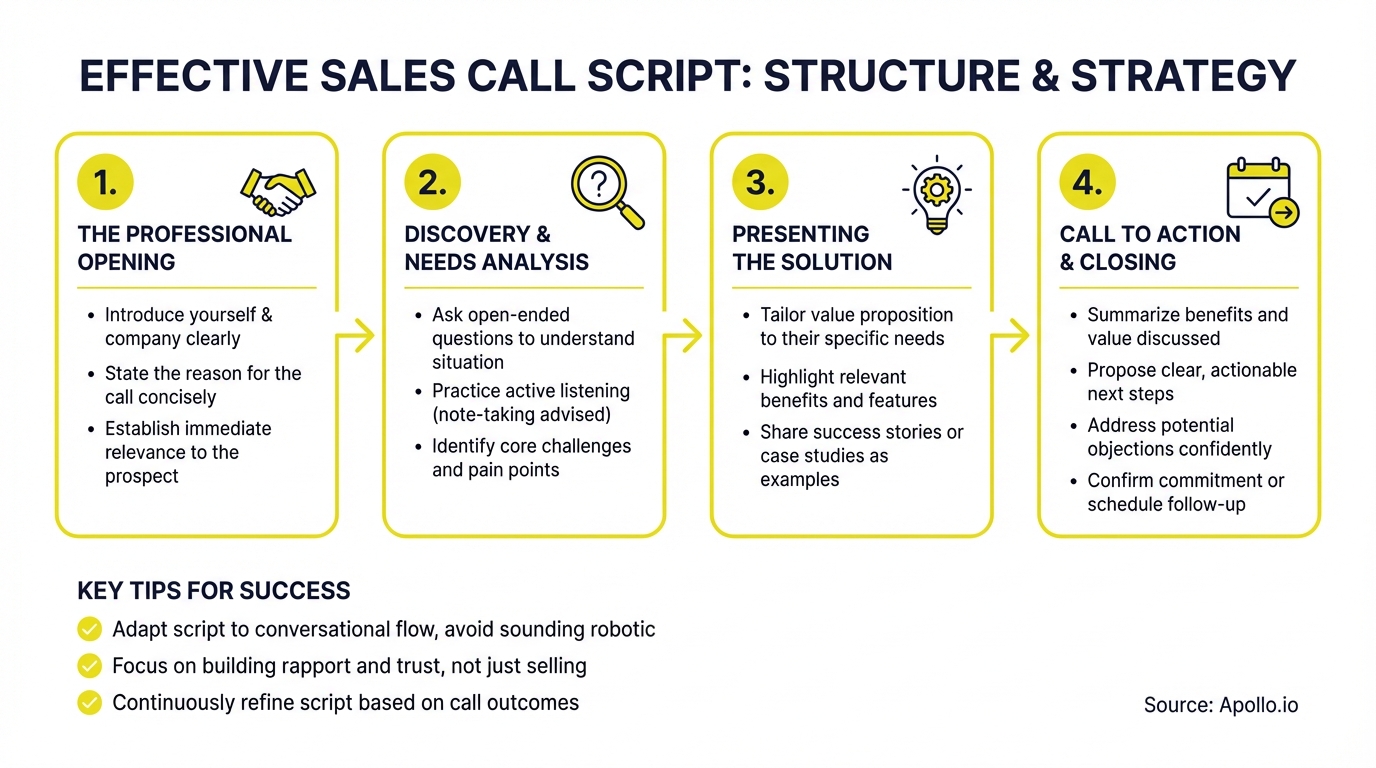
A sales call script is a structured conversation guide that sales professionals use to navigate prospect interactions from opening to close. It outlines key talking points, discovery questions, objection responses, and next-step language while leaving room for natural conversation flow.
Modern scripts function as frameworks rather than word-for-word recitations, giving reps flexibility to personalize based on real-time buyer signals.
Effective scripts in 2026 serve three purposes: they enforce message consistency across your team, they capture structured data that AI tools use for automation, and they align your phone conversations with your website and product messaging. According to Cognism, 57% of C-level and VP buyers prefer phone calls, making script quality a competitive differentiator for teams targeting senior decision-makers.
Why Do Sales Teams Need Call Scripts?
Sales scripts address three operational realities that directly impact revenue. First, they standardize messaging across reps to prevent the trust erosion that happens when different sellers tell different stories.
Second, they reduce ramp time for new hires by codifying proven talk tracks discovered through conversation intelligence platforms. Third, they create the structured call data that AI assistants need to automate CRM logging, generate follow-up emails, and surface coaching opportunities.
The business case strengthened significantly in 2026. Research from SalesHive shows a 2.3-2.5% dial-to-meeting conversion for pure cold outbound, with top performers reaching 5-8% or more. That variance often traces back to script quality, with high performers using relevance-first openers and permission-based discovery instead of generic pitches.

How Do SDRs Use Call Scripts to Book More Meetings?
SDRs using modern call scripts focus on three high-impact elements: a permission-based opener that earns the right to continue, a relevance statement tied to specific triggers or role-based pain points, and a single tight ask for a 15-minute discovery call. The opener typically includes the rep's name, company, a one-sentence value hypothesis, and an explicit permission request.
Top-performing SDRs adapt their scripts based on pre-call research signals. They reference recent company news, hiring patterns, or technology changes visible in the prospect's stack. According to Martal Group, 84% of B2B sales begin with a referral, and referred leads are four times more likely to convert, which is why high-performing scripts often open with a mutual connection or shared customer reference when available.
Need better prospect context before your next call? Search Apollo's 224M+ contacts with 65+ filters to surface buying signals and build targeted call lists.
Apollo Turns Forecast Guesswork Into Revenue
Forecasting unreliable because deal stages aren't visible in real-time. Apollo tracks every opportunity with live pipeline visibility. Built-In boosted win rates 10% using Apollo's scoring.
Start Free with Apollo →What Are the Core Components of an Effective Sales Call Script?
Effective sales call scripts in 2026 include six modular components that work together as a conversation framework:
| Component | Purpose | Example Language |
|---|---|---|
| Permission-Based Opener | Earn right to continue conversation | "Is now a good time for a quick 30-second overview?" |
| Relevance Statement | Connect to role-specific trigger or pain | "I noticed you recently expanded into EMEA..." |
| Value Hypothesis | State potential impact without pitching | "Teams in similar situations reduced ramp time by half" |
| Discovery Questions | Surface pain, impact, and buying committee | "Who else gets involved when evaluating solutions like this?" |
| Objection Responses | Address common blockers with proof points | "Fair concern. Here's how [Customer] handled that..." |
| Next-Step Language | Secure commitment with clear ask | "Can we schedule 15 minutes Thursday to explore fit?" |
For Account Executives managing complex deals, scripts must include multi-stakeholder discovery prompts. The average B2B buying group includes 11 people, and the average buying cycle lasts 11.3 months, which means AEs need scripted questions that surface who else is involved, what internal processes must be navigated, and what success metrics matter to each stakeholder.
How Should Sales Leaders Build Scripts That Scale?
Sales leaders building scalable scripts in 2026 start with conversation intelligence data, not opinions. They analyze 50-100 high-performing calls to identify the openers, questions, and objection responses that consistently advance deals.
They then codify those patterns into modular frameworks that reps can adapt based on buyer context.
Message synchronization is the second critical requirement. Scripts must mirror the language, proof points, and value propositions visible on your website and in your product marketing.
This addresses the trust problem: 69% of B2B buyers report inconsistencies between vendor websites and what sellers tell them. RevOps leaders should audit scripts quarterly against marketing messaging to eliminate disconnects.
The third requirement is AI-readiness. Modern scripts include structured prompts that capture the data fields AI assistants need: current pain, quantified impact, decision timeline, buying committee members, and next step. AI call assistants use this structured input to generate meeting summaries, log CRM data, and suggest follow-up actions without manual work.
Spending too much time on call prep and post-call admin? Let Apollo's AI handle call summaries, CRM logging, and next-step recommendations automatically.
What Common Mistakes Make Call Scripts Fail?
The most damaging mistake is treating scripts as word-for-word playbooks instead of conversation frameworks. Reps who read scripts verbatim sound robotic and lose credibility within seconds.
The fix is to train reps on the structure and key points while encouraging natural delivery that adapts to buyer responses.
The second mistake is generic openers that ignore buyer context. Data from Amra and Elma shows that 44% of sales representatives give up after only one follow-up, creating a significant gap between buyer behavior and seller persistence. Scripts that open with "How are you today?" or "Did I catch you at a bad time?" waste the first 10 seconds and trigger immediate resistance.
The third mistake is ignoring the rep-free buying preference. 61% of B2B buyers prefer an overall rep-free buying experience, which means scripts must earn the right to a conversation by offering contextual value fast. Use trigger-based openers tied to recent company changes, hiring patterns, or technology signals instead of generic industry pain points.
How Are AI Tools Changing Sales Call Scripts in 2026?
AI tools are transforming scripts from static documents into dynamic, governed workflows. Real-time agent assist platforms surface suggested responses during live calls based on what the prospect says.
Post-call automation generates meeting summaries, logs structured data to CRM, and drafts follow-up emails that maintain message consistency.
The governance implications are significant. As AI-assisted talk tracks become default for many B2B teams, organizations must standardize approved claims, required disclosures, and compliance language directly into scripts.
This protects against brand risk and regulatory exposure while maintaining the flexibility reps need to personalize.
Conversation intelligence platforms now analyze tens of thousands of calls to identify patterns that predict success. Teams use this data to refresh scripts quarterly, replacing opinion-based best practices with evidence-backed talk tracks.
The result is continuous improvement driven by what actually works in real buyer conversations, not what sales trainers think should work.
Start Building Better Sales Call Scripts
Effective sales call scripts in 2026 are modular frameworks that adapt to buyer context, enforce message synchronization, and capture structured data for AI automation. They prioritize permission-based openers, relevance statements tied to specific triggers, and multi-stakeholder discovery questions that navigate complex buying committees.
Top-performing teams build scripts from conversation intelligence data, not opinions, and refresh them quarterly based on what moves deals forward.
For SDRs, BDRs, and AEs looking to improve conversion rates, focus on three immediate improvements: replace generic openers with trigger-based relevance statements, add discovery questions that surface buying committee members and internal processes, and include structured prompts that capture the data your AI tools need for automation. These changes alone can move your team from average 2-3% conversion rates to the 5-8% range top performers achieve.
Ready to consolidate your sales tech stack and give your team the context they need for every call? Apollo combines 224M+ verified contacts, AI-powered call assistance, and automated sequencing in one workspace. Start a Trial and see how teams are cutting costs while improving conversion rates.
Prove Apollo's ROI In Your First 30 Days
Budget approval stuck on unclear metrics? Apollo tracks every dollar of pipeline impact with built-in ROI dashboards. Built-In increased win rates 10% and ACV 10% using Apollo's scoring.
Start Free with Apollo →Don't miss these
Sales
Inbound vs Outbound Marketing: Which Strategy Wins?
Sales
What Is a Sales Funnel? The Non-Linear Revenue Framework for 2026
Sales
What Is a Go-to-Market Strategy? The 2026 GTM Playbook
See Apollo in action
We'd love to show how Apollo can help you sell better.
By submitting this form, you will receive information, tips, and promotions from Apollo. To learn more, see our Privacy Statement.
4.7/5 based on 9,690 reviews
