
Sales Automation Solution: Close More Deals in Less Time
Sales teams waste two-thirds of their day on non-selling tasks. Research shows reps spend just 34% of their time actually selling, with the rest consumed by manual data entry, research, and administrative work. A sales automation solution eliminates these time-draining activities, letting your team focus on closing deals instead of hunting for contact information or updating spreadsheets.
In 2026, AI-powered automation has shifted from "nice to have" to essential competitive infrastructure. According to HubSpot, AI adoption in sales surged from 24% in 2023 to 43% in 2024. The market reflects this urgency: industry data shows the global sales force automation market was valued at $8.6 billion in 2023 and is projected to reach $19.5 billion by 2030.

Research Smarter, Not Harder With Apollo
Tired of burning hours verifying contacts that go nowhere? Apollo surfaces accurate, ready-to-engage prospects so your reps spend time selling — not searching. Join 550K+ companies building pipeline with confidence.
Start Free with Apollo →Key Takeaways
- Sales automation solutions reclaim selling time by eliminating manual prospecting, data entry, and repetitive outreach tasks
- AI-powered platforms now handle multi-step workflows from research to follow-up, consolidating your tech stack into one system
- Teams using automation report measurable productivity gains and faster pipeline velocity with proper implementation
- Modern solutions integrate governance controls and human oversight for compliant, scalable deployment
What Is a Sales Automation Solution?
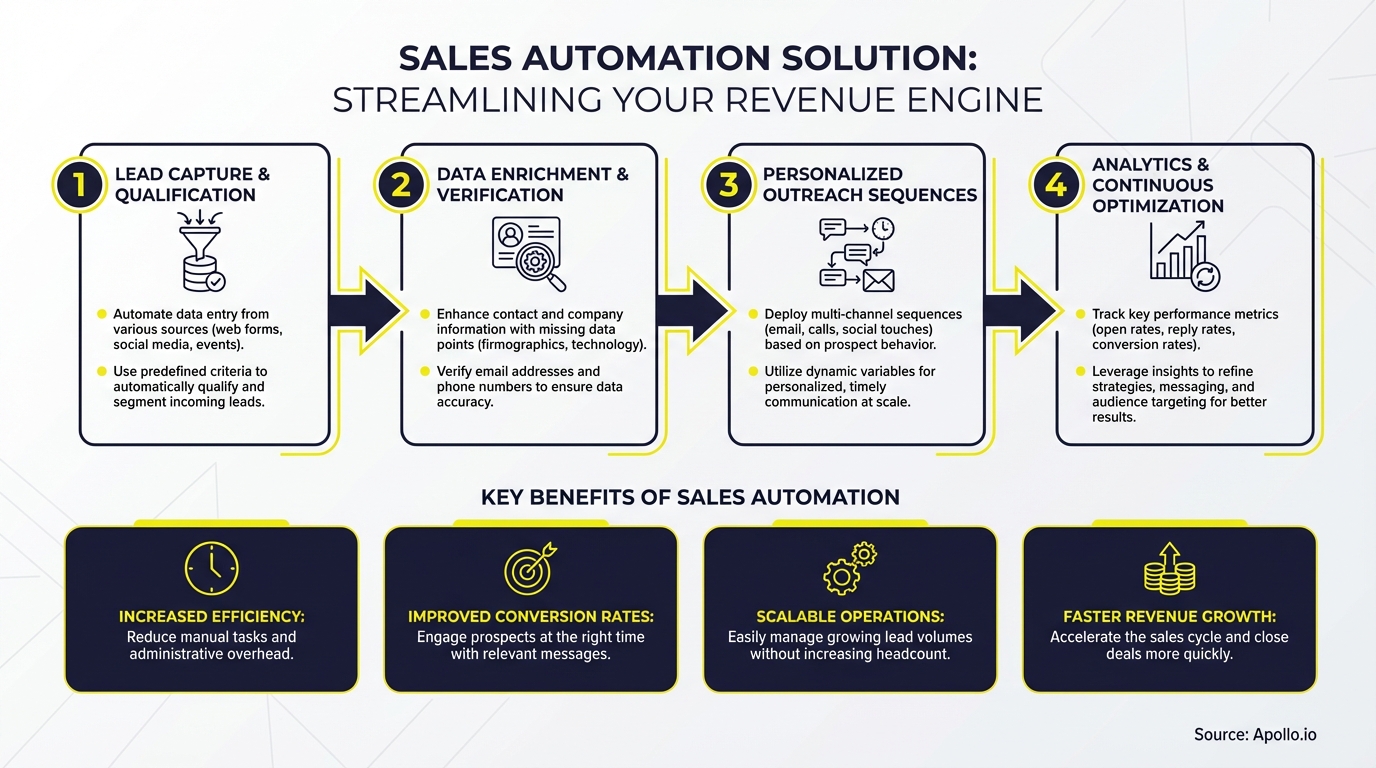
A sales automation solution is a platform that handles repetitive sales tasks through workflows, AI agents, and integrations. These systems automate prospecting, outreach sequencing, data enrichment, meeting scheduling, and CRM updates so reps can focus on conversations that close deals.
Modern platforms go beyond simple task automation. They orchestrate entire revenue workflows across prospecting, engagement, and deal management.
The best solutions combine contact databases, multi-channel outreach, conversation intelligence, and pipeline tracking in one workspace.
For example, instead of manually researching prospects, copying data into your CRM, and sending individual emails, automation handles the entire sequence: finding qualified contacts, enriching their profiles, launching personalized outreach across email and phone, and logging all activity automatically.
How Do Sales Automation Solutions Work in 2026?
Sales automation solutions in 2026 operate through three core layers: data foundation, workflow orchestration, and AI execution.
Data Foundation: The platform starts with verified business contact databases. Quality automation requires accurate firmographic data, contact details, and buying signals. Solutions pull from proprietary databases and integrate third-party enrichment sources to ensure contact accuracy.
Workflow Orchestration: Users build multi-step sequences that trigger based on prospect behavior, time delays, or specific conditions. A workflow might include: find decision-makers at target accounts → send personalized email → wait 3 days → follow up with phone call → update CRM status → notify AE when prospect responds.
AI Execution: Agentic automation now handles execution, not just suggestions. AI agents draft personalized messages, prioritize high-intent prospects, schedule meetings autonomously, and surface insights from conversation data. Research from Business Dasher shows AI in sales has helped companies achieve 50% more leads.
The shift from "assist" to "execute" marks 2026's biggest change. Platforms now run autonomous workflows that complete tasks end-to-end with human oversight rather than requiring manual approval at every step.
Why Do Sales Teams Need Automation Solutions?
Sales complexity has outpaced human capacity. Buying committees now average 13 internal stakeholders and 9 external participants, nearly doubling for purchases involving AI features.
Manual processes can't scale to meet these demands.
Time Reclamation: Reps spend 66% of their day on non-selling work. Automation returns hours to revenue-generating activities. Tasks that took 90 minutes now complete in seconds.
Consistency at Scale: Manual outreach quality degrades as volume increases. Automation maintains message quality and follow-up timing across thousands of prospects simultaneously.
Data Accuracy: Human data entry creates costly errors. Automated enrichment and CRM syncing eliminate manual updates and ensure pipeline visibility. According to CloudSense, companies with well-defined sales processes earn 28% more revenue than those without such processes.
Tech Stack Consolidation: Teams using separate tools for data, outreach, meetings, and analytics face integration headaches and inflated costs. All-in-one platforms cut tool sprawl. As one customer noted, "We reduced the complexity of three tools into one" (Predictable Revenue).
Spending hours on manual prospecting? Search Apollo's 224M+ contacts with 65+ filters to find qualified leads instantly.

How Do SDRs Use Automation to Book More Meetings?
SDRs face the highest volume of repetitive tasks: list building, research, initial outreach, and follow-ups. Automation transforms their workflow from manual execution to strategic orchestration.
Prospecting Automation: SDRs build targeted lists using filters like job title, company size, industry, and tech stack. The platform surfaces contacts matching ideal customer profiles without manual research. One search replaces hours of work.
Sequence Deployment: Multi-channel sequences combine email, phone, and social touchpoints.
SDRs create templates once, then automation personalizes messages with contact-specific details and sends them at optimal times.
Follow-ups trigger automatically based on engagement.
Meeting Scheduling: When prospects respond, integrated scheduling links let them book directly into the SDR's calendar. No back-and-forth emails. The system confirms, sends reminders, and logs the meeting in the CRM.
Activity Tracking: Every call, email, and social touch logs automatically. SDRs see exactly where each prospect stands in the sequence without manual note-taking. Sales leaders get real-time visibility into team activity and conversion rates.
Research shows businesses that automate lead management often see at least a 10% revenue increase within 6-9 months, according to Graph8.
Turn Funnel Guesswork Into Real Pipeline
Tired of watching marketing leads die before they ever reach your pipeline? Apollo surfaces in-market buyers the moment they're ready, so your team stops chasing cold leads and starts closing. 550K+ companies forecasting with confidence.
Start Free with Apollo →What Features Define Modern Sales Automation Platforms?
Modern sales automation solutions share core capabilities that distinguish them from basic CRM tools or point solutions.
| Feature Category | Capabilities | Business Impact |
|---|---|---|
| Contact Database | 224M+ verified contacts, 65+ search filters, real-time enrichment | Eliminates list-building time, ensures data accuracy |
| Multi-Channel Sequences | Email, phone, social automation with A/B testing | Increases response rates, maintains consistent outreach |
| AI-Powered Personalization | Dynamic message generation, send-time optimization | Improves engagement without manual customization |
| Meeting Automation | Scheduling links, calendar sync, reminder workflows | Reduces booking friction, eliminates scheduling emails |
| Conversation Intelligence | Call recording, transcription, coaching insights | Surfaces winning talk tracks, identifies training needs |
| Pipeline Management | Deal tracking, forecasting, stage automation | Provides revenue visibility, automates status updates |
| Integrations | CRM sync, workflow triggers, data bidirectionality | Creates single source of truth, eliminates manual data entry |
The most effective platforms combine these features in one workspace rather than forcing teams to stitch together multiple tools. "Having everything in one system was a game changer" (Cyera).
How Should Sales Leaders Implement Automation Solutions?
Implementation determines whether automation drives results or creates chaos. Sales leaders must balance speed with governance.
Start with High-Volume, Low-Risk Workflows: Begin by automating repetitive tasks with clear success metrics. Outbound prospecting sequences and meeting scheduling deliver quick wins without complex change management.
Establish Governance Before Scaling: Define approval workflows, content libraries, and compliance guardrails upfront.
RevOps leaders should control template access, sequence deployment permissions, and data usage policies.
This prevents brand risk as teams scale automation.
Build Persona-Specific Playbooks: Create distinct workflows for each buyer persona and deal stage. Generic automation produces generic results. Tailor messaging, sequence timing, and content offers to specific audience segments.
Integrate Human Touchpoints: Automation should enable personalization, not replace it. Build sequences that prompt reps to add custom video messages or research notes at key moments. The best results combine automated efficiency with human judgment.
Measure Leading and Lagging Indicators: Track both activity metrics (emails sent, calls made) and outcome metrics (meetings booked, pipeline generated). According to Windward Studios, automation in sales boosts department productivity by 14.5% and reduces marketing costs by 12.2%.
Tired of managing multiple sales tools? Consolidate your tech stack with Apollo's all-in-one automation platform.
What Results Can Teams Expect from Sales Automation?
Properly implemented automation delivers measurable improvements across pipeline velocity, team productivity, and cost efficiency.
Productivity Gains: Teams reclaim time previously spent on manual tasks. SDRs book more meetings because they focus on conversations, not research. AEs close deals faster with automated follow-ups and data enrichment.
Pipeline Acceleration: Faster response times and consistent follow-up compress sales cycles. Leads move through stages more quickly when automation ensures no prospect falls through the cracks.
Cost Reduction: Consolidating multiple tools into one platform cuts subscription costs and integration complexity. "We cut our costs in half" (Census). Teams eliminate spending on separate prospecting tools, engagement platforms, and data providers.
Quality Improvement: Automation maintains message consistency and ensures best practices at scale. New reps ramp faster using proven sequences instead of creating outreach from scratch.
The data supports these outcomes. Research shows generative AI has led to a 20% increase in customer satisfaction and a 15% boost in sales conversion rates for companies leveraging it, according to Dring.ai.
Conclusion: Choose Sales Automation That Scales with Your Team
Sales automation solutions have evolved from simple email schedulers to comprehensive revenue platforms. The best systems combine verified contact data, AI-powered workflows, and governance controls in one workspace.
Success requires choosing a platform that matches your team's maturity and growth trajectory. Look for solutions that offer quick wins for individual reps while providing the infrastructure for enterprise-scale deployment.
Prioritize platforms with strong data accuracy, native integrations, and transparent AI governance.
The market opportunity is clear: sales force automation is projected to nearly double from $8.6 billion in 2023 to $19.5 billion by 2030. Teams that implement governance-forward automation now will capture disproportionate advantages as buying committees expand and AI becomes standard in B2B sales.
For SDRs, automation means booking more meetings without working longer hours. For AEs, it means focusing on deal strategy instead of CRM hygiene.
For sales leaders, it means predictable pipeline and team visibility. For founders and RevOps, it means doing more with less by consolidating your tech stack.
Ready to reclaim your selling time? Get leads now with Apollo's all-in-one sales automation platform.
Prove Pipeline ROI From Day One
Budget approval stuck on unclear metrics? Apollo delivers measurable pipeline impact fast — so you walk into every review with numbers that justify the spend. Leadium 3x'd their revenue. Your turn.
Start Free with Apollo →Don't miss these
Sales
Inbound vs Outbound Marketing: Which Strategy Wins?
Sales
What Is a Sales Funnel? The Non-Linear Revenue Framework for 2026
Sales
What Is a Go-to-Market Strategy? The 2026 GTM Playbook
See Apollo in action
We'd love to show how Apollo can help you sell better.
By submitting this form, you will receive information, tips, and promotions from Apollo. To learn more, see our Privacy Statement.
4.7/5 based on 9,690 reviews
