
Sales Automation CRM: How to Eliminate Busywork and Close More Deals
Sales teams waste 72% of their day on non-selling activities. Manual data entry, follow-up emails, lead scoring, and pipeline updates consume hours that could drive revenue.
A sales automation CRM eliminates this busywork by combining customer relationship management with intelligent automation that handles repetitive tasks while keeping your human touch where it matters most.
According to Gartner, by 2028, 60% of B2B seller work will be executed through conversational user interfaces via generative AI sales technologies. The future of selling combines smart automation with strategic human interaction.

Skip Manual Research - Apollo Finds Contacts Fast
Tired of spending 4+ hours daily hunting for contact info? Apollo delivers 224M verified contacts with 96% email accuracy instantly. Join 550K+ companies who stopped wasting time on manual prospecting.
Start Free with Apollo →Key Takeaways
- Sales automation CRMs eliminate 70%+ of manual tasks while maintaining personalized buyer experiences
- Modern platforms integrate prospecting, engagement, and analytics in one workspace, cutting tech stack costs by 50%
- AI-powered automation handles data entry, follow-ups, and lead scoring so reps focus on closing deals
- The best systems balance automation with human oversight, ensuring quality at every touchpoint
- Implementation success requires clear governance, data quality standards, and role-specific training
What Is A Sales Automation CRM?
A sales automation CRM is a platform that combines customer relationship management with intelligent automation to handle repetitive sales tasks. It automatically captures contact data, logs interactions, scores leads, sends follow-up sequences, and updates pipeline stages without manual input.
Unlike traditional CRMs that require constant data entry, automated systems pull information from emails, calls, meetings, and web activity. They trigger actions based on buyer behavior: when a prospect opens an email three times, the system alerts the rep and suggests next steps.
When a deal stalls, it automatically launches a re-engagement sequence.
Modern sales automation CRMs replace 3-5 separate tools. Instead of juggling a CRM, email tool, dialer, data provider, and meeting scheduler, teams work from one unified workspace.
As Census shared after consolidating their stack: "We cut our costs in half."
How Does Sales Automation CRM Work?
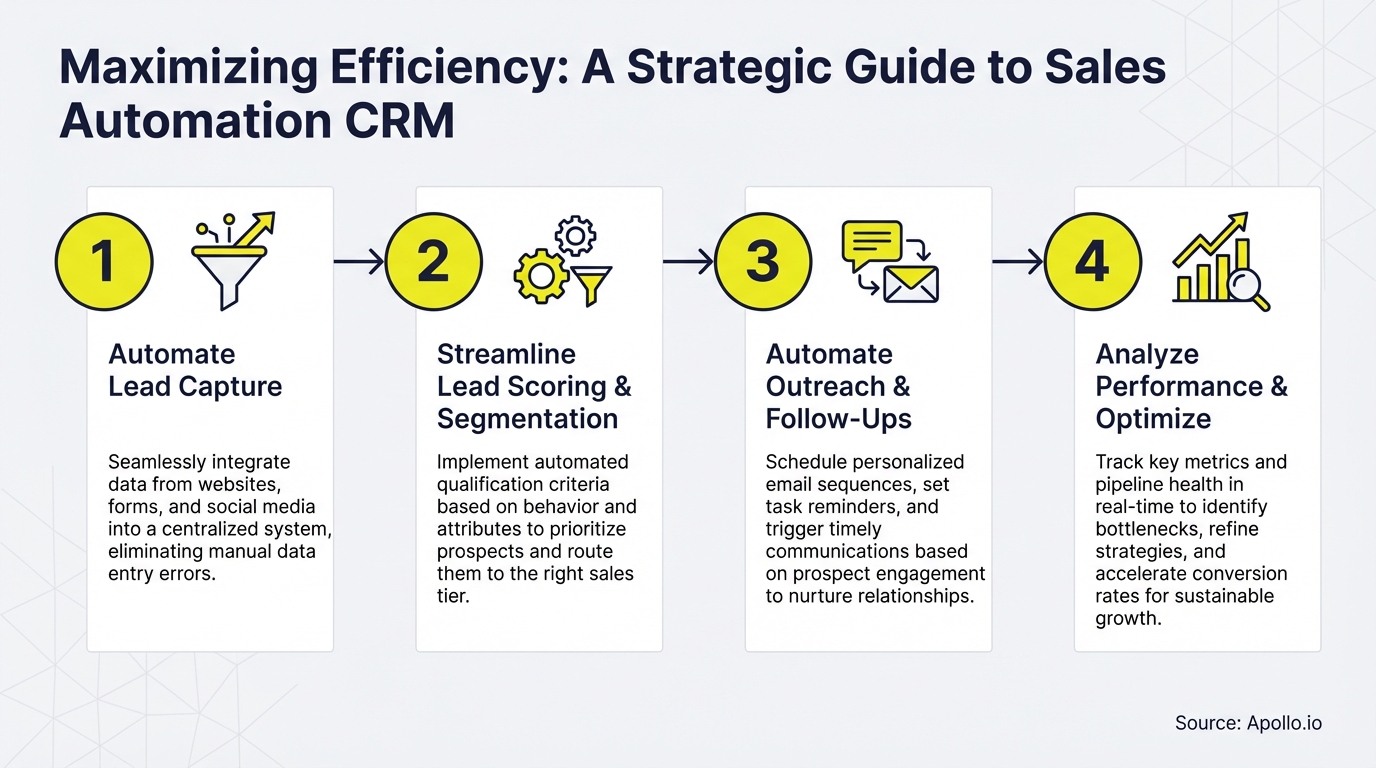
Sales automation CRM operates through three core engines: data capture, workflow automation, and intelligent triggering. The system continuously monitors sales activities and executes predefined actions based on specific conditions.
Data Capture Engine: Automatically logs emails, calls, meetings, and web visits. Enriches contact records with firmographic and technographic data. Tracks engagement signals like email opens, link clicks, and content downloads.
Workflow Automation: Executes multi-step sequences triggered by specific events. When a lead hits a qualification threshold, the system assigns them to the right rep, adds them to a nurture sequence, and schedules a task. Advanced workflow engines handle complex logic with conditional branching.
Intelligence Layer: AI analyzes patterns to score leads, predict deal outcomes, and recommend next actions. The system learns which email subject lines get responses, which call times work best, and which accounts show buying signals. Research by Gartner shows the CRM sales software market reached $25.7 billion in 2024, driven largely by AI capabilities.
Why Do Sales Teams Need Automation CRM in 2026?
Buyer expectations have fundamentally shifted. Gartner research found that 61% of B2B buyers prefer a rep-free buying experience for routine interactions. They want instant responses, personalized content, and seamless digital experiences.
Manual processes can't deliver at this speed. SDRs spending 4 hours daily on data entry and follow-ups can't respond fast enough.
Automation handles the volume while humans provide strategic guidance at critical moments.
The economics are equally compelling. Sales automation CRM consolidates your tech stack, eliminating redundant subscriptions and integration headaches.
Companies using Apollo report replacing ZoomInfo, Outreach, and other point solutions with one platform. Predictable Revenue summarized it perfectly: "We reduced the complexity of three tools into one."
Spending hours on manual outreach? Automate your sequences with Apollo's multi-channel engagement platform.
What Features Matter Most in Sales Automation CRM?
The most effective sales automation CRMs share five essential capabilities that directly impact revenue outcomes.
| Feature | Business Impact | Key Capabilities |
|---|---|---|
| Intelligent Lead Scoring | 35% increase in qualified pipeline | AI-powered scoring, behavioral triggers, intent signals |
| Multi-Channel Sequences | 2.5x more meetings booked | Email, calls, LinkedIn, SMS in coordinated workflows |
| Data Enrichment | 96% email accuracy, 70% time saved | Automatic contact discovery, real-time verification |
| Pipeline Automation | 40% faster deal cycles | Auto-stage progression, task creation, alerts |
| Native Integrations | Single source of truth | Bidirectional sync with Salesforce, HubSpot, Slack |
For Account Executives managing complex deals, pipeline automation ensures nothing falls through the cracks. Automatic stage updates, stakeholder tracking, and renewal alerts keep deals moving forward.
See Every Deal Stage In Real Time With Apollo
Forecasting unreliable because you can't see where deals actually stand. Apollo gives you real-time pipeline visibility across every stage. Built-In boosted win rates 10% with Apollo's scoring.
Start Free with Apollo →How Do SDRs Use Sales Automation CRM to Book More Meetings?
SDRs using automation CRM focus on high-value activities: researching accounts, personalizing outreach, and having conversations. The system handles everything else.
Morning Workflow: SDRs start with AI-generated account insights instead of manual research. The system surfaces recent funding announcements, tech stack changes, and job postings that signal buying intent. This intelligence takes 30 seconds instead of 30 minutes per account.
Outreach Execution: Instead of sending individual emails, SDRs enroll prospects in multi-touch sequences. The automation sends emails at optimal times, waits for engagement signals, and adjusts cadence based on responses. Well-designed sequences combine 8-12 touchpoints across email, phone, and LinkedIn.

Response Management: When prospects reply, the system alerts the SDR immediately and surfaces conversation history. Qualified responses automatically create opportunities and book meetings using integrated scheduling. SDRs report booking 46% more meetings when using AI-powered research and engagement tools.
Struggling to find qualified leads? Search Apollo's 224M+ business contacts with 65+ filters for precise targeting.
How Should RevOps Teams Implement Sales Automation CRM?
RevOps leaders must balance speed with governance. Rushed implementations create data chaos and user resistance. Successful rollouts follow a phased approach.
Phase 1 - Foundation (Weeks 1-2):
- Audit existing data quality and establish cleansing standards
- Map current workflows and identify automation opportunities
- Define lead scoring criteria with sales and marketing alignment
- Configure CRM integrations for bidirectional data sync
Phase 2 - Pilot (Weeks 3-4):
- Launch with 5-10 reps using core automation workflows
- Monitor data quality, user adoption, and performance metrics
- Gather feedback and refine sequences, scoring, and triggers
- Document best practices and create training materials
Phase 3 - Scale (Weeks 5-8):

- Roll out to full team with role-specific training
- Implement advanced workflows for deal progression and renewals
- Build dashboards for activity, pipeline, and ROI tracking
- Establish governance for data standards and automation rules
RevOps teams using unified go-to-market platforms report 60% faster implementation because they avoid complex integrations between multiple tools.
What Does The Future Hold for Sales Automation CRM?
The trajectory is clear: more AI assistance, less manual work, but human judgment remains critical. Gartner predicts that by 2030, 75% of B2B buyers will prefer sales experiences that prioritize human interaction over AI for complex decisions.
This creates a new operating model: AI handles research, data entry, scheduling, and routine follow-ups. Humans focus on strategy, relationship building, and complex problem-solving.
The best sales automation CRMs will make this division seamless.
Emerging capabilities include conversational AI that drafts personalized emails based on buyer signals, predictive analytics that forecast deal outcomes with 85%+ accuracy, and autonomous agents that handle qualification and discovery calls. Sales Leaders will coach teams on strategic selling while automation manages execution.
Start Automating Your Sales Process Today
Sales automation CRM is no longer optional. Teams that automate repetitive tasks close deals faster, build healthier pipelines, and scale without adding headcount.
The key is choosing a platform that consolidates your tech stack while maintaining the human touch buyers expect.
Apollo combines 224M+ verified business contacts, multi-channel engagement, and AI-powered workflows in one workspace. Companies using Apollo report 2.5x more meetings, 35% more bookings, and significant cost savings from tool consolidation. Cyera summarized their experience: "Having everything in one system was a game changer."
Stop juggling disconnected tools. Get Leads Now with Apollo's unified sales automation CRM.
Prove Apollo's ROI In Your First 30 Days
Budget approval stuck on unclear metrics? Apollo tracks every dollar—from prospect to closed deal. Built-In increased win rates 10% and ACV 10% with measurable pipeline impact.
Start Free with Apollo →Don't miss these
Sales
Inbound vs Outbound Marketing: Which Strategy Wins?
Sales
What Is a Sales Funnel? The Non-Linear Revenue Framework for 2026
Sales
What Is a Go-to-Market Strategy? The 2026 GTM Playbook
See Apollo in action
We'd love to show how Apollo can help you sell better.
By submitting this form, you will receive information, tips, and promotions from Apollo. To learn more, see our Privacy Statement.
4.7/5 based on 9,690 reviews
