
Sales Analytics Tools: What They Are and How to Choose the Right One
Sales teams in 2026 face a critical challenge: too many tools, too much data, and not enough actionable insights. Modern sales analytics tools have evolved from basic reporting dashboards into AI-powered platforms that predict outcomes, automate workflows, and consolidate multiple systems into one workspace. Research by McKinsey shows companies implementing AI-enabled account planning experience 5% to 15% sales uplift within a year.

Apollo Eliminates 4+ Hours Of Daily Research
Tired of spending 4+ hours daily hunting for contact info? Apollo delivers 224M verified contacts with 96% email accuracy instantly. Join 550K+ companies who replaced manual research with predictable pipeline.
Start Free with Apollo →Key Takeaways
- Modern sales analytics tools use AI to predict deal outcomes and automate repetitive tasks, delivering up to 15% revenue lift
- Tool consolidation saves teams significant costs while improving data accuracy and workflow efficiency
- RevOps leaders report 40% higher conversion rates when using AI-powered market research and lead scoring
- Successful implementation requires clear ICP alignment, data governance, and cross-functional buy-in from 5+ decision-makers
- Top platforms combine prospecting, engagement tracking, pipeline management, and conversation intelligence in one system
What Are Sales Analytics Tools?
Sales analytics tools are software platforms that collect, process, and visualize sales data to help teams make informed decisions. They track metrics like pipeline velocity, win rates, deal size, and rep performance across the entire sales cycle.
Modern platforms go beyond basic reporting. They integrate with CRMs, email systems, and calling tools to automatically capture activity data.
AI algorithms identify patterns in successful deals, score leads based on conversion likelihood, and recommend next-best actions for reps.
The most effective tools combine multiple capabilities: prospecting databases, engagement tracking, pipeline forecasting, and conversation intelligence. According to Gartner, B2B buying committees now involve an average of five decision-makers, making unified analytics essential for understanding complex deal dynamics.
Why Do Sales Leaders Need Analytics Tools in 2026?
Sales leaders face mounting pressure to deliver predictable revenue with leaner teams. Analytics tools provide visibility into what's working, identify bottlenecks early, and enable data-driven coaching at scale.
Key benefits include:

- Accurate forecasting: AI models analyze historical patterns and current pipeline health to predict quarterly outcomes within 5% accuracy
- Rep productivity: Automated activity tracking shows who's executing the playbook and who needs coaching
- Deal risk identification: Algorithms flag stalled opportunities based on engagement gaps, stakeholder involvement, and timeline drift
- Tech stack consolidation: All-in-one platforms replace 3-5 separate tools, cutting costs and eliminating data silos
Organizations using AI tools for market research achieve 40% higher conversion rates and 30% faster lead execution, according to McKinsey research. For RevOps leaders managing complex tech stacks, consolidation delivers immediate ROI through reduced licensing costs and improved data quality.

Struggling to track pipeline health across multiple systems? Get complete visibility with Apollo's unified deal management and analytics platform.
How Do Sales Analytics Tools Work?
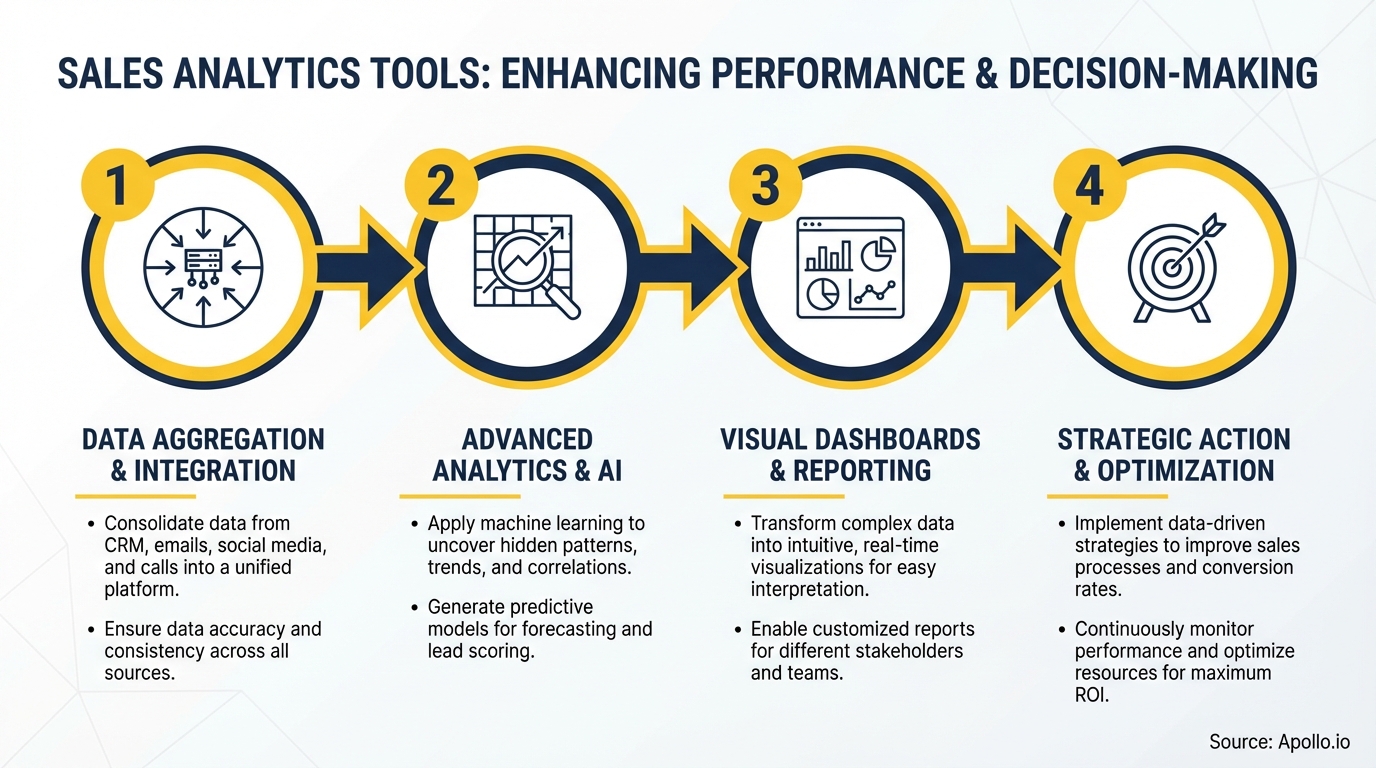
Sales analytics platforms function through four core processes: data collection, integration, analysis, and visualization. They connect to your existing sales tech stack via APIs and native integrations.
Data collection methods:
- CRM sync: Automatically pulls opportunity data, contact records, and activity logs from Salesforce, HubSpot, or similar systems
- Email tracking: Captures open rates, reply rates, and engagement patterns from sales sequences
- Call recording: Transcribes conversations and extracts key moments, objections, and next steps
- Website behavior: Tracks prospect interactions with your content and product pages
AI engines process this data to generate insights. Machine learning models identify which activities correlate with closed deals, which accounts show buying signals, and which messaging resonates with specific personas.
The platform surfaces these insights through customizable dashboards, automated alerts, and embedded recommendations within your workflow.
For SDRs and BDRs, this means real-time guidance on which prospects to contact next and what message to send. For Account Executives, it provides pre-meeting intelligence and deal health scores.
Sales Leaders get executive dashboards showing team performance, forecast accuracy, and conversion metrics by stage.
What Data Sources Do These Tools Integrate With?
Modern sales analytics platforms integrate with 10-50+ data sources to create a complete picture of sales performance. Core integrations include CRM systems (Salesforce, HubSpot, Pipedrive), communication tools (Gmail, Outlook, Slack), calling platforms (Aircall, RingCentral), and marketing automation (Marketo, Pardot).
Advanced platforms also connect to LinkedIn Sales Navigator, intent data providers, calendar systems, and customer success tools. The key is unified data flow: activities logged in one system automatically update records across the entire stack, eliminating manual data entry and ensuring accuracy.
Turn Unreliable Forecasts Into Revenue Certainty
Pipeline forecasting a guessing game? Apollo's real-time deal tracking shows exactly where every opportunity stands. Built-In increased win rates 10% with Apollo's scoring and signals.
Start Free with Apollo →How Can RevOps Teams Implement Sales Analytics Successfully?
RevOps leaders drive analytics adoption by aligning technology with process and ensuring clean data governance. Successful implementation follows a structured approach focused on quick wins and measurable outcomes.
Implementation framework:
| Phase | Timeline | Key Activities | Success Metrics |
|---|---|---|---|
| Planning | 2-3 weeks | Define ICP, audit data quality, map existing workflows, secure stakeholder buy-in | 5+ decision-makers aligned, clear ROI targets set |
| Integration | 1-2 weeks | Connect CRM, email, calling tools; configure data sync rules; validate accuracy | 95%+ data sync accuracy, zero duplicate records |
| Pilot | 4 weeks | Deploy to 5-10 reps, gather feedback, refine dashboards and alerts | 80%+ daily active usage, 20%+ productivity gain |
| Scale | Ongoing | Roll out company-wide, build custom reports, train teams, optimize workflows | Team-wide adoption, forecast accuracy within 5% |
Start with high-impact use cases like lead scoring or pipeline forecasting. Demonstrate value quickly to secure broader adoption.
Establish data governance policies: who owns data quality, how often to audit records, and standardized field definitions across teams.
Tired of managing multiple disconnected tools? Apollo consolidates prospecting, engagement, analytics, and AI into one platform.
What Features Should Sales Leaders Look for in Analytics Tools?
The best sales analytics platforms combine real-time visibility, predictive intelligence, and workflow automation. Evaluate tools based on your team's specific needs and existing tech stack.
Essential capabilities:
- Pipeline analytics: Track deal progression, identify bottlenecks, forecast revenue by stage and rep
- Activity tracking: Monitor calls, emails, meetings per rep with automatic logging from all channels
- AI-powered insights: Get recommended actions, deal risk alerts, and win probability scores
- Custom dashboards: Build role-specific views for SDRs, AEs, managers, and executives
- Conversation intelligence: Analyze call recordings for objections, competitor mentions, and successful talk tracks
- Attribution reporting: Connect marketing touches to closed deals with multi-touch attribution models
For Founders and CEOs evaluating platforms, prioritize tools that consolidate multiple functions. Platforms like Apollo's all-in-one GTM solution replace separate tools for prospecting, engagement, analytics, and data enrichment. Census reported cutting costs in half after consolidation, while Cyera noted having everything in one system was a game changer.
How Do AI Features Improve Sales Analytics?
AI transforms analytics from backward-looking reports into forward-looking guidance. Machine learning models trained on millions of sales interactions predict which deals will close, which prospects are most likely to respond, and what message will resonate best.
Practical AI applications include automated lead scoring (ranking prospects by conversion likelihood), next-best-action recommendations (suggesting optimal follow-up timing and channel), deal health monitoring (flagging at-risk opportunities), and forecast automation (predicting quarterly revenue with high accuracy). Sales teams using AI-powered platforms report 35% increases in meeting bookings and 46% more pipeline from AI research capabilities.
What Are the Top Sales Analytics Tools for 2026?
The market offers dozens of sales analytics platforms, from standalone reporting tools to comprehensive revenue operations suites. Choose based on team size, existing tech stack, and primary use case.
Leading platforms by category:
- All-in-one GTM platforms: Apollo.io (prospecting + engagement + analytics + AI), HubSpot Sales Hub (CRM-native analytics), Salesforce Einstein (AI-powered CRM insights)
- Conversation intelligence: Gong, Chorus.ai, ExecVision (call recording and analysis)
- Forecasting specialists: Clari, Aviso, BoostUp (AI-powered revenue prediction)
- Activity tracking: Outreach, SalesLoft, Apollo (email and call analytics)
Apollo stands out for RevOps teams seeking consolidation. The platform combines a 224M+ contact database, multi-channel engagement sequencing, pipeline management, and analytics in one workspace.
Predictable Revenue reduced complexity from three tools into one after switching to Apollo. This consolidation eliminates data sync issues, reduces training time, and cuts licensing costs by 40-60% compared to using separate point solutions.
Start Driving Revenue with Unified Sales Analytics
Sales analytics tools have evolved from nice-to-have dashboards into must-have revenue engines. The best platforms combine data intelligence, AI-powered insights, and workflow automation to help teams close more deals faster.
Success requires three elements: clean data governance, cross-functional alignment among decision-makers, and tools that consolidate rather than complicate your tech stack. Teams that nail this achieve 15% revenue lift, 40% higher conversion rates, and significant cost savings from tool consolidation.
For sales leaders evaluating options in 2026, prioritize platforms that serve multiple roles (SDRs, AEs, RevOps, executives) in one workspace. Look for AI features that provide actionable guidance, not just pretty charts.
And choose vendors with proven integration ecosystems that work with your existing CRM and communication tools.
Apollo delivers all of this in one unified platform: 224M+ verified business contacts, AI-powered prospecting and messaging, multi-channel engagement tracking, pipeline analytics, and conversation intelligence. Over 550K+ companies use Apollo to cut their tech stack, improve data quality, and drive predictable revenue growth.
Ready to consolidate your sales tech stack and boost team productivity? Request a Demo to see how Apollo's unified platform replaces 3-5 separate tools while delivering better results.
Prove Apollo's ROI In Your First Month
Budget approval stuck on unclear metrics? Apollo tracks every touch to closed revenue—Built-In increased win rates 10% and ACV 10% with Apollo's scoring. Show leadership measurable pipeline impact from day one.
Start Free with Apollo →Don't miss these
Data
How to Structure a Marketing Team That Actually Drives Revenue in 2026
Data
Solving Data Synchronization Headaches Across Multiple Business Systems
Data
What Marketing Metrics Should B2B Teams Track in 2026?
See Apollo in action
We'd love to show how Apollo can help you sell better.
By submitting this form, you will receive information, tips, and promotions from Apollo. To learn more, see our Privacy Statement.
4.7/5 based on 9,690 reviews
