
Sales Analyst: Definition, Responsibilities, and Career Path
Sales analysts are becoming the secret weapon behind high-performing revenue teams in 2026. As B2B sales organizations shift toward data-driven strategies and AI-augmented processes, the role of the sales analyst has evolved from number-cruncher to strategic revenue architect. These professionals bridge the gap between raw data and actionable insights, helping sales development teams optimize every stage of the buyer journey while cutting through the noise of fragmented tech stacks.

Apollo Eliminates 4+ Hours Of Daily Research
Tired of reps spending hours hunting for contact info? Apollo delivers 224M verified contacts with 96% email accuracy—instantly. Join 550K+ companies who ditched manual prospecting.
Start Free with Apollo →Key Takeaways
- Sales analysts turn complex data into actionable insights that directly impact quota attainment and revenue growth
- By 2026, 60% of B2B sales organizations have transitioned to data-driven selling approaches, making analysts critical to competitive advantage
- Top sales analysts combine technical skills (SQL, CRM platforms, visualization tools) with business acumen and stakeholder communication
- AI-powered analytics platforms help sales analysts consolidate 3-5 tools into one workspace, reducing costs while improving forecast accuracy
- The role commands competitive salaries ($65K-$110K) with clear paths to senior analyst, RevOps, or sales leadership positions
What Is A Sales Analyst?
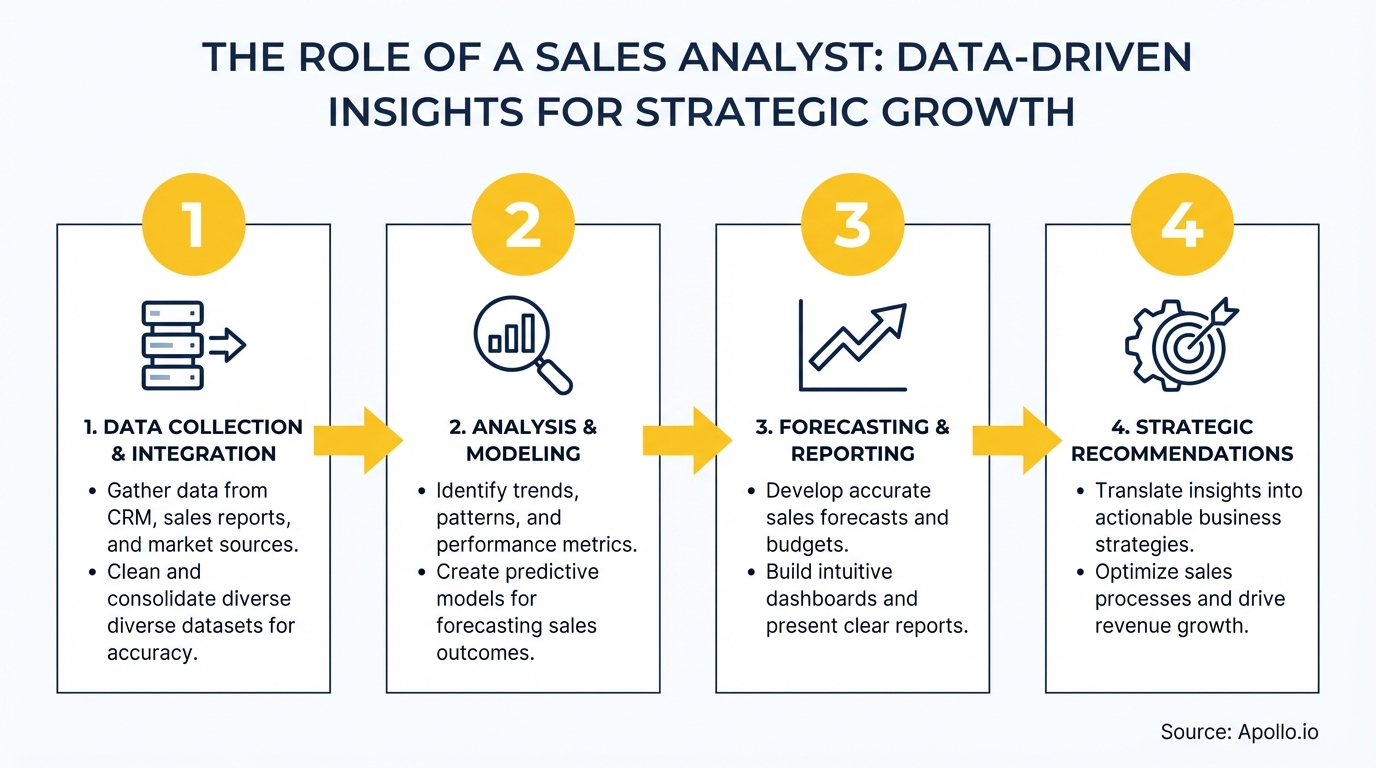
A sales analyst is a data-focused professional who analyzes sales performance metrics, identifies trends, and provides strategic recommendations to improve revenue outcomes. They serve as the analytical backbone of sales organizations, transforming raw CRM data, pipeline metrics, and market intelligence into insights that guide territory planning, quota setting, compensation design, and go-to-market strategy.
Unlike traditional sales roles focused on closing deals, sales analysts work behind the scenes to optimize the entire revenue engine. They answer critical questions like: Which lead sources generate the highest-quality opportunities?
Where are deals stalling in the pipeline? How should we allocate resources across territories?
What forecasting models most accurately predict quarterly revenue?
Research by Gartner indicates that 60% of B2B sales organizations have transitioned to a data-driven selling approach by 2025, cementing the sales analyst as a mission-critical role. For sales leaders managing teams in 2026, having a skilled analyst means the difference between reactive fire-fighting and proactive revenue optimization.
What Does a Sales Analyst Do Day-to-Day?
Sales analysts tackle diverse responsibilities that blend technical analysis with business strategy. A typical day includes pulling data from multiple systems (CRM, marketing automation, conversation intelligence platforms), building dashboards that track key performance indicators, conducting cohort analyses to understand conversion patterns, and presenting findings to sales leadership.
They also collaborate closely with RevOps teams to maintain data hygiene, work with SDRs and AEs to understand field-level challenges, partner with finance on forecasting models, and support strategic initiatives like territory redesigns or new market entries. The best analysts don't just report what happened but explain why it happened and recommend what to do next.
Why Are Sales Analysts Important in 2026?
Sales analysts have become indispensable as B2B sales complexity has exploded. Modern sales organizations juggle longer buying cycles, larger decision-making committees, hybrid selling motions, and an overwhelming array of tools and data sources.
Without skilled analysts to make sense of this complexity, sales leaders fly blind.
According to Gartner, sellers who effectively partner with AI tools are 3.7 times more likely to meet their sales quotas. Sales analysts play a crucial role in this partnership by identifying which AI capabilities deliver ROI, training teams on data interpretation, and ensuring AI-generated insights translate into field execution.
The shift toward advanced sales analytics has also changed buyer expectations. B2B buyers now conduct extensive independent research before engaging with sales teams, making it critical for sellers to leverage data for personalized, insight-driven conversations. Sales analysts equip reps with the intelligence they need to add value at every touchpoint.
How Do Sales Analysts Impact Revenue Growth?
Sales analysts drive revenue growth through multiple levers. They identify high-performing lead sources and recommend budget reallocation, reducing customer acquisition costs by 15-25%.
They spot pipeline bottlenecks and propose process improvements that accelerate deal velocity. They build predictive models that improve forecast accuracy from 60% to 85%+, enabling better resource planning.
For Account Executives managing complex enterprise deals, analysts provide competitive intelligence, pricing guidance, and historical win/loss patterns that increase close rates. For sales leaders, analysts deliver executive dashboards that surface risks and opportunities in real-time, replacing monthly retrospectives with proactive intervention.
| Impact Area | Typical Improvement | Business Outcome |
|---|---|---|
| Lead Quality | 20-30% increase in MQL-to-SQL conversion | More efficient SDR teams, lower CAC |
| Pipeline Velocity | 10-15% reduction in sales cycle length | Faster revenue recognition, increased capacity |
| Forecast Accuracy | 15-25% improvement in prediction precision | Better hiring/investment decisions |
| Win Rates | 5-10% increase in close rates | Higher quota attainment, improved morale |
| Retention | 12-18% reduction in early-stage churn | Improved LTV, predictable revenue streams |
What Skills Do Sales Analysts Need?
Successful sales analysts combine three skill categories: technical proficiency, business acumen, and communication excellence. On the technical side, analysts must be comfortable with SQL for database queries, Excel/Google Sheets for modeling, and visualization tools like Tableau, Looker, or Power BI for reporting. Familiarity with CRM platforms (Salesforce, HubSpot) and deal management systems is essential.
Business acumen separates good analysts from great ones. This includes understanding sales methodologies (MEDDIC, Challenger, SPIN), recognizing how different industries buy, knowing which metrics matter most for different stakeholder groups, and connecting data insights to strategic business outcomes.
Analysts who understand the difference between correlation and causation, and who can design proper experiments, deliver exponentially more value.
Communication skills are equally critical. Analysts must translate complex statistical findings into clear recommendations for non-technical audiences, build trust with skeptical sales veterans who may distrust data, and influence cross-functional decisions through compelling storytelling.
The ability to present to C-level executives while also coaching individual reps requires exceptional emotional intelligence.
What Technical Tools Do Sales Analysts Use?
The modern sales analyst's tech stack typically includes 5-8 specialized tools, though forward-thinking organizations are consolidating toward unified platforms. Core categories include CRM systems for transaction data, business intelligence tools for visualization, statistical software for advanced modeling, conversation intelligence platforms for qualitative insights, and data enrichment services for account intelligence.
Struggling to manage data across disconnected systems? Apollo's unified platform combines 224M+ verified contacts with built-in analytics, eliminating the complexity of maintaining separate prospecting, engagement, and reporting tools. Organizations like Census report cutting their costs in half by consolidating their tech stack.
| Tool Category | Common Platforms | Primary Use Case |
|---|---|---|
| CRM Systems | Salesforce, HubSpot, Pipedrive | Transaction data, pipeline tracking, activity logging |
| BI & Visualization | Tableau, Looker, Power BI, Domo | Dashboard creation, executive reporting, trend analysis |
| Data Warehousing | Snowflake, BigQuery, Redshift | Centralized data storage, complex queries, historical analysis |
| Statistical Analysis | R, Python, SPSS | Predictive modeling, segmentation, experimentation |
| Conversation Intelligence | Gong, Chorus, ExecVision | Call analysis, objection tracking, rep coaching insights |
| Data Enrichment | Apollo.io, ZoomInfo, Clearbit | Contact/account data, technographics, intent signals |
How Do Sales Analysts Use AI and Automation?
AI has transformed the sales analyst role from manual report-builder to strategic insight architect. In 2026, analysts leverage AI across four key areas: predictive analytics (forecasting deal outcomes and identifying at-risk opportunities), prescriptive recommendations (suggesting next-best actions for reps), natural language processing (analyzing call transcripts and email sentiment), and automated reporting (generating routine dashboards without manual effort).
Data from Gartner shows that 75% of B2B sales organizations now augment traditional sales playbooks with AI-guided selling solutions. Sales analysts are responsible for evaluating these AI tools, ensuring data quality feeds accurate models, interpreting AI-generated insights for field teams, and measuring the ROI of AI sales automation investments.
The most sophisticated analysts don't just consume AI outputs but actively improve model performance. They conduct A/B tests on AI-generated messaging, refine lead scoring algorithms based on closed-loop feedback, identify bias in automated recommendations, and train machine learning models on company-specific data patterns.
This human-AI collaboration represents the future of the role.
What AI Capabilities Matter Most for Sales Analysts?
Four AI capabilities deliver outsized value for sales analysts. First, lead scoring models that predict conversion probability help SDRs prioritize outreach and improve connection rates by 30-40%.
Second, deal risk algorithms flag opportunities likely to slip or close-lost, enabling proactive intervention. Third, natural language generation creates personalized email copy and call scripts at scale, which analysts can test and optimize.
Fourth, churn prediction models identify at-risk customers before they churn, allowing customer success teams to intervene early. For RevOps leaders managing cross-functional initiatives, AI-powered attribution modeling finally answers which marketing and sales activities truly drive pipeline, replacing guesswork with evidence-based budget allocation.
How Do SDRs and AEs Work With Sales Analysts?
The relationship between sales analysts and frontline sellers determines whether insights translate into results. High-performing organizations establish regular collaboration rhythms: weekly pipeline reviews where analysts surface risks and opportunities, monthly territory planning sessions where analysts recommend account prioritization, and quarterly business reviews where analysts present macro trends and strategic recommendations.
For SDRs trying to book more meetings, analysts provide data-driven answers to critical questions: Which industries have the highest response rates? What messaging resonates in different buyer personas?
Which outreach cadences optimize for both volume and quality? When should SDRs disqualify prospects versus persist?
Analysts turn these questions into dashboards and playbooks that make every rep smarter.
Account Executives managing complex deals rely on analysts for competitive intelligence, pricing guidance, and stakeholder mapping insights. Analysts might reveal that deals involving procurement typically take 30% longer to close, prompting AEs to engage legal earlier.
Or they might show that multi-threaded deals with three+ champions close at 2x the rate, encouraging broader relationship-building strategies.
How Do Sales Analysts Support Sales Leaders?
Sales analysts serve as the strategic right-hand for VPs of Sales and CROs. They build executive dashboards that track leading indicators (pipeline generation, sales velocity, activity metrics) alongside lagging indicators (revenue, quota attainment, win rates).
They conduct cohort analyses that reveal which reps are trending up or down, informing coaching priorities and performance improvement plans.
For sales leaders planning annual operating plans, analysts model different scenarios: What happens if we hire five more AEs versus investing in enablement? How much pipeline do we need to generate next quarter to hit year-end targets?
What's the break-even point for expanding into a new vertical? These analyses replace gut-feel decisions with evidence-based strategy.
Analysts also play a critical role in sales compensation design. They model how different commission structures incentivize desired behaviors, identify unintended consequences of current plans, and forecast total compensation costs under various performance scenarios.
This work directly impacts retention, motivation, and overall sales effectiveness.
What Is the Career Path for Sales Analysts?
Sales analysts enjoy multiple career trajectories, each leveraging different aspects of the role. The most common path is vertical progression: Junior Sales Analyst to Sales Analyst to Senior Sales Analyst to Manager of Sales Analytics.
At senior levels, analysts lead teams, own forecasting models, and drive strategic initiatives like CRM migrations or territory redesigns.
Many analysts transition laterally into Revenue Operations, where they take on broader responsibilities including systems administration, process design, and cross-functional coordination between sales, marketing, and customer success. RevOps roles command premium salaries ($120K-$180K+) and position professionals as strategic business partners to executive leadership.
A third path leads into sales leadership. Analysts who develop strong business acumen and relationship skills can move into frontline sales management, bringing data-driven coaching and forecasting capabilities that differentiate them from traditional sales managers.
Apollo Finds Your Best Prospects First
Missing in-market buyers while your pipeline stays empty? Apollo's intent signals reveal which accounts are ready to buy right now. Built-In increased win rates 10% with smarter targeting.
Start Free with Apollo →Some analysts also pivot into product management, business strategy, or finance roles where analytical rigor is highly valued.
| Career Stage | Typical Title | Salary Range (2026) | Key Responsibilities |
|---|---|---|---|
| Entry-Level | Junior Sales Analyst, Sales Operations Analyst | $55K - $75K | Report building, data cleaning, ad-hoc analysis |
| Mid-Level | Sales Analyst, Business Analyst | $75K - $100K | Dashboard ownership, trend analysis, stakeholder reporting |
| Senior-Level | Senior Sales Analyst, Lead Analyst | $100K - $130K | Strategic projects, predictive modeling, executive presentations |
| Management | Manager/Director of Sales Analytics | $130K - $170K | Team leadership, forecasting ownership, strategic planning |
| Leadership | VP of Revenue Operations, VP of Sales Strategy | $170K - $250K+ | Cross-functional strategy, systems architecture, executive partnership |
How Do Sales Analysts Build Forecasts?
Sales forecasting represents one of the most critical and challenging responsibilities for sales analysts. Accurate forecasts enable better hiring decisions, inventory management, cash flow planning, and investor communications.
In 2026, analysts combine multiple forecasting methodologies rather than relying on a single approach.
Bottom-up forecasting aggregates individual rep projections, adjusted for historical accuracy patterns. Top-down forecasting applies historical conversion rates and velocity metrics to current pipeline.
Statistical forecasting uses time-series models and regression analysis to project future performance. The best analysts triangulate across all three methods, identifying discrepancies that warrant investigation.
Advanced forecasting also incorporates external signals: macroeconomic indicators, seasonality patterns, competitive dynamics, and market trends. Analysts might notice that deals in the financial services vertical are taking 20% longer to close due to regulatory changes, prompting a downward adjustment to near-term forecasts.
Or they might see intent data suggesting increased demand in a particular segment, justifying an upward revision.
What Metrics Do Sales Analysts Track?
Sales analysts monitor dozens of metrics, but the most impactful fall into five categories. Pipeline health metrics include coverage ratios (pipeline value divided by quota), stage distribution, aging analysis, and velocity trends.
Activity metrics track calls, emails, meetings booked, and demos delivered. Conversion metrics measure stage-to-stage progression rates and overall lead-to-customer conversion.
Efficiency metrics compare input (time, money, effort) to output (pipeline, revenue, customers), revealing where resources are well-deployed versus wasted. Finally, outcome metrics track revenue attainment, quota achievement, average deal size, and customer lifetime value.
The key is not tracking everything but focusing on the metrics that drive decision-making and behavior change.
| Metric Category | Key Metrics | Why It Matters |
|---|---|---|
| Pipeline Health | Coverage ratio, weighted pipeline, stage distribution | Early warning system for revenue risk |
| Activity | Calls/emails per rep, meeting booking rate, demo volume | Leading indicator of future pipeline generation |
| Conversion | MQL-to-SQL, SQL-to-opportunity, opportunity-to-close | Identifies process bottlenecks and optimization opportunities |
| Efficiency | Cost per lead, CAC payback period, sales cycle length | Reveals where to invest or cut resources |
| Outcome | Revenue attainment, quota achievement, win rate, ACV | Bottom-line success measures that drive compensation and planning |
How Do Sales Analysts Ensure Data Quality?
Data quality represents the foundation of effective sales analytics, yet most organizations struggle with incomplete records, duplicate entries, and inconsistent field usage. Sales analysts address this through both preventive and corrective measures.
On the preventive side, they establish clear data entry standards, implement validation rules in CRM systems, and train sales teams on the business impact of clean data.
Corrective measures include regular data audits, automated de-duplication processes, and enrichment workflows that fill in missing information. Analysts also build data quality dashboards that track completeness rates, staleness metrics, and accuracy scores by team or individual.
When data quality improves, they quantify the business impact, creating positive reinforcement loops.
Tired of incomplete contact records slowing down your analysis? Apollo's data enrichment automatically fills in missing email, phone, and company data, maintaining 96% email accuracy across 224M+ business contacts. Organizations like Cyera found that having everything in one system was a game changer for data consistency.
What Data Governance Practices Do Sales Analysts Implement?
Effective data governance balances accessibility with security and compliance. Sales analysts typically establish tiered access controls, ensuring sensitive information (deal amounts, competitor details, compensation data) is restricted to appropriate roles.
They document data definitions and calculation methodologies in a central wiki, preventing confusion when metrics are discussed across teams.
Analysts also implement change management processes for reporting updates, ensuring stakeholders understand when dashboards are modified and why. They establish SLAs for data freshness (pipeline reports refreshed daily, forecast models updated weekly) and create escalation paths when data quality issues impact decision-making.
Finally, they work with legal and compliance teams to ensure data handling meets regulatory requirements, particularly for organizations operating in multiple jurisdictions.
How Do Sales Analysts Support Territory Planning?
Territory planning represents one of the highest-impact projects sales analysts tackle. Poor territory design creates quota inequity, demotivates top performers, and leaves revenue on the table.
Analysts approach territory planning as an optimization problem, balancing multiple variables: total addressable market per territory, geographic distribution, account complexity, rep capacity, and historical performance patterns.
The process typically starts with market analysis: How many target accounts exist in each region? What's the average deal size and sales cycle by industry or company size?
Which accounts are actively buying versus dormant? Analysts then model different territory scenarios, projecting revenue potential and workload for each.
The goal is roughly equal opportunity while accounting for rep experience levels and specialization.
Advanced territory planning also considers strategic priorities. If the company is expanding into healthcare, analysts might create dedicated healthcare territories even if initial account counts are low.
If enterprise deals require specialized expertise, they might carve out strategic accounts into a separate segment. The key is translating executive strategy into field execution through thoughtful territory design.
What Challenges Do Sales Analysts Face?
Sales analysts navigate several persistent challenges. Data quality issues top the list, with incomplete CRM records, duplicate entries, and inconsistent field usage undermining analysis accuracy.
Many analysts spend 40-50% of their time on data cleaning rather than insight generation, a frustrating reality that drives burnout.
Stakeholder management presents another challenge. Sales leaders often want instant answers to complex questions, forcing analysts to choose between speed and rigor.
Reps may resist data-driven recommendations that challenge their intuition or experience. Cross-functional partners (marketing, finance, customer success) may have competing definitions of key metrics, requiring extensive alignment work.
Technical limitations also constrain impact. Legacy CRM systems may lack API access for custom reporting.
Disconnected tools create data silos that prevent holistic analysis. Budget constraints limit access to advanced analytics platforms or external data sources.
Analysts must often deliver world-class insights with second-tier tools, requiring creativity and technical ingenuity.
How Do Sales Analysts Overcome These Challenges?
Successful analysts develop strategies to address each challenge. For data quality, they automate as much as possible, building validation rules, enrichment workflows, and exception reports that flag issues proactively.
They also cultivate executive sponsorship for data quality initiatives, framing clean data as a revenue enabler rather than administrative burden.

For stakeholder management, analysts establish clear communication rhythms, setting expectations around turnaround times and level of effort. They build self-service dashboards that answer 80% of routine questions, freeing time for strategic deep-dives.
They also develop strong relationships with key stakeholders, understanding their priorities and communication preferences.
For technical limitations, analysts prioritize tool consolidation and platform investments that reduce complexity. They make the business case for modern analytics infrastructure by quantifying time savings and decision-making improvements. Organizations like Predictable Revenue reduced the complexity of three tools into one by adopting unified go-to-market platforms, eliminating integration headaches and improving data consistency.
How Is the Sales Analyst Role Evolving?
The sales analyst role is evolving rapidly as AI, automation, and changing buyer behaviors reshape B2B sales. Three trends are particularly significant.
First, AI is automating routine reporting and basic analysis, pushing analysts toward higher-value strategic work. Analysts who once spent days building pipeline reports now spend hours validating AI-generated insights and recommending actions.
Second, the lines between sales analytics, marketing analytics, and customer success analytics are blurring. Organizations increasingly expect analysts to understand the entire customer journey, from initial awareness through renewal and expansion.
This requires broader skill sets and deeper cross-functional collaboration, with many analysts evolving into Revenue Operations roles.
Third, the emphasis is shifting from descriptive analytics (what happened) to predictive and prescriptive analytics (what will happen and what should we do about it). Analysts must develop stronger statistical modeling skills and business judgment to make recommendations that executives trust and field teams will execute.
The future belongs to analysts who combine technical depth with strategic thinking and communication excellence.
What New Skills Will Sales Analysts Need?
Future-ready sales analysts must add several capabilities to their toolkit. Machine learning fundamentals become increasingly important, not to build models from scratch but to interpret AI-generated insights, identify when models are failing, and improve algorithm performance.
Understanding bias, overfitting, and feature engineering separates analysts who leverage AI effectively from those who blindly trust outputs.
Change management and organizational psychology also grow in importance. As analysts recommend process changes or tool implementations, they must help teams through transitions, address resistance, and ensure adoption.
Technical solutions fail without human buy-in, making soft skills increasingly critical.

Finally, storytelling and visualization skills become differentiators. With data abundance, the analysts who can distill complex findings into compelling narratives and intuitive visuals will drive the most impact.
This means moving beyond static dashboards toward interactive tools, video presentations, and narrative-driven reports that engage diverse audiences.
How to Become a Sales Analyst
Breaking into sales analytics typically requires a combination of education, technical skills, and relevant experience. Most analysts hold bachelor's degrees in business, economics, statistics, or related fields.
Some positions prefer candidates with MBA degrees or specialized certifications in data analysis (Google Data Analytics Certificate, Tableau Desktop Specialist, Salesforce Administrator).
For career switchers, several entry points exist. Sales or customer success professionals can transition by taking on analytical projects within their current roles, building dashboards for their teams, or volunteering for cross-functional analytics initiatives. Data analysts from other functions can pivot by developing sales domain knowledge through online courses, informational interviews, and studying B2B sales processes.
The most direct path involves building a portfolio of analytical projects. Create sample dashboards using publicly available datasets, write blog posts analyzing sales trends, or contribute to open-source sales analytics tools.
These artifacts demonstrate capability far better than resumes alone, helping candidates stand out in competitive job markets.
What Should Aspiring Sales Analysts Focus On?
Aspiring analysts should prioritize three development areas. First, master the technical fundamentals: SQL for data extraction, Excel for modeling, and at least one visualization tool (Tableau, Looker, Power BI).
Build projects that showcase these skills, ideally using sales or CRM data. Free datasets from companies like Kaggle or simulated CRM data can serve as practice material.
Second, develop business acumen by learning sales methodologies, understanding common metrics, and following thought leaders in sales operations and revenue analytics. Read books like "The Sales Development Playbook" and "Predictable Revenue," follow sales analytics blogs, and join communities like Revenue Collective or Pavilion where practitioners share insights.
Third, practice communication and storytelling. Take online courses in data visualization and presentation skills.
Volunteer to present at meetups or create video content explaining analytical concepts. The ability to translate technical findings into business impact separates good analysts from great ones, and it's a skill that improves with deliberate practice.
Turn Forecasting Guesswork Into Revenue Certainty
Missing quota because pipeline visibility is a black box? Apollo gives you real-time deal tracking and predictable forecasting that turns stage movements into closed revenue. Built-In increased win rates 10% and ACV 10%.
Start Free with Apollo →Conclusion: Sales Analysts as Revenue Architects
Sales analysts have evolved from back-office number-crunchers to strategic revenue architects who shape how modern B2B organizations compete and win. As data volumes explode and AI capabilities advance, the role only grows in importance.
Organizations that invest in talented analysts, equip them with modern tools, and integrate them deeply into strategic planning will outperform competitors flying blind on intuition alone.
For professionals considering this career path, the timing couldn't be better. Demand for skilled sales analysts far exceeds supply, salaries are competitive and rising, and the work offers intellectual challenge alongside tangible business impact.
Whether you're a sales professional looking to leverage your field experience, a data analyst seeking a more strategic role, or a recent graduate exploring career options, sales analytics offers a rewarding and future-proof path.
The best sales analysts don't just report the past but shape the future. They identify opportunities before competitors, spot risks before they materialize, and recommend strategies that compound over time.
In an era where data-driven decision-making separates winners from losers, sales analysts are the secret weapon behind high-performing revenue teams.
Ready to transform your sales analytics with AI-powered intelligence and unified data? Start Your Free Trial and join 550K+ companies using Apollo to consolidate their tech stack, improve data quality, and drive predictable revenue growth.
Don't miss these
Sales
Inbound vs Outbound Marketing: Which Strategy Wins?
Sales
What Is a Sales Funnel? The Non-Linear Revenue Framework for 2026
Sales
What Is a Go-to-Market Strategy? The 2026 GTM Playbook
See Apollo in action
We'd love to show how Apollo can help you sell better.
By submitting this form, you will receive information, tips, and promotions from Apollo. To learn more, see our Privacy Statement.
4.7/5 based on 9,690 reviews
