
Regional Sales Manager Salary: What to Expect in 2026
Regional Sales Managers are critical leaders who oversee sales territories, manage distributed teams, and drive revenue across multiple markets. If you're considering this career path or negotiating compensation, understanding the full salary picture matters.
As of 2026, regional sales managers earn significantly different amounts based on geography, industry, company size, and territory complexity. This guide breaks down exactly what you can expect to earn, what drives compensation differences, and how emerging technologies are reshaping both the role and the pay structure.

Apollo Eliminates 4+ Hours Of Daily Research
Tired of spending 4+ hours daily hunting for contact info? Apollo delivers 224M verified contacts instantly so your team can focus on closing. Join 550K+ companies who stopped wasting time on manual prospecting.
Start Free with Apollo →Key Takeaways
- Regional Sales Managers in the U.S. earn an average of $101,370 annually in 2026, with top performers exceeding $138,821.
- Total compensation packages vary dramatically by region, with Central Region managers averaging $180,498 including base, commission, and bonuses.
- Industry sector, territory complexity, and company size create 30-50% salary variations for the same role title.
- AI-powered sales tools are shifting Regional Sales Manager responsibilities from administrative tasks to strategic coaching, impacting compensation structures.
- Transparent salary negotiation requires understanding base vs. variable pay splits, equity components, and regional cost-of-living adjustments.
What Is a Regional Sales Manager Salary?
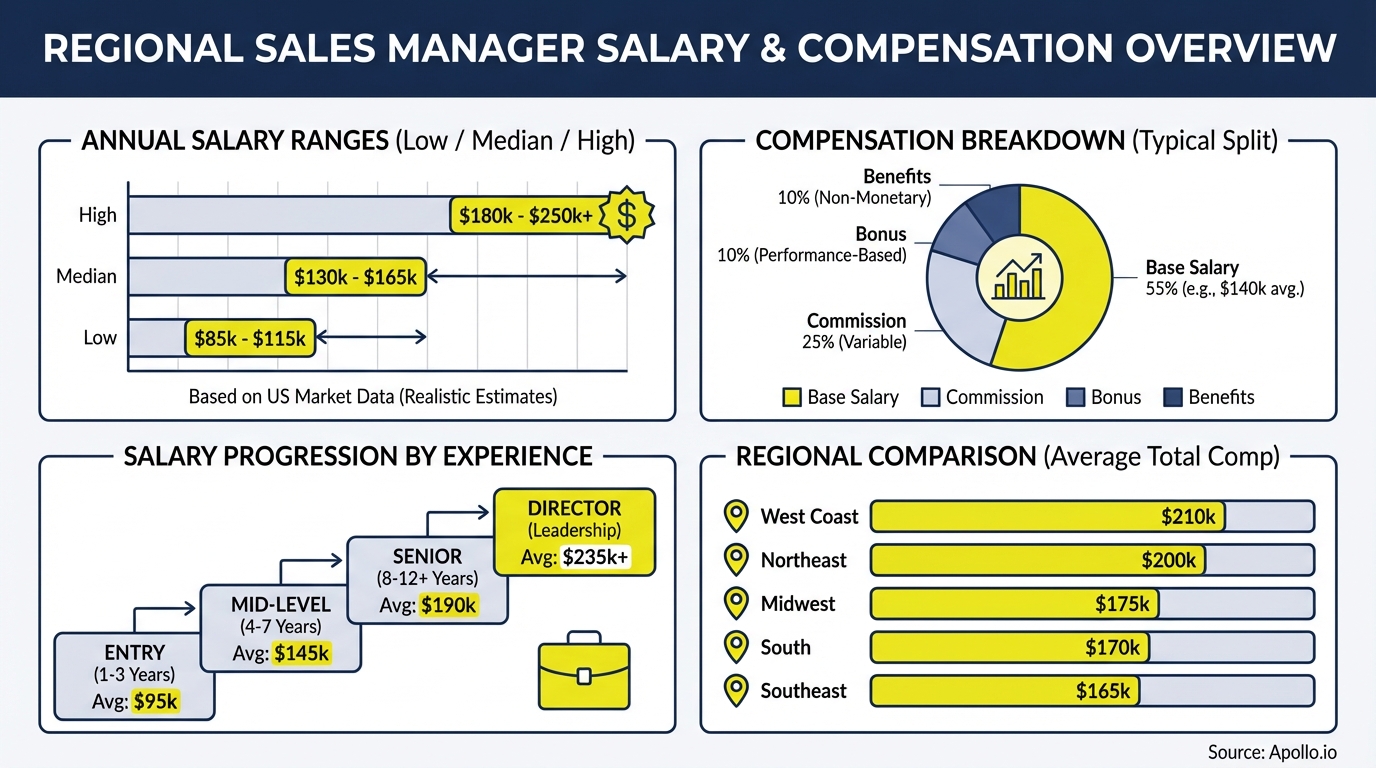
A Regional Sales Manager salary is the total compensation package paid to sales leaders who oversee multiple territories, manage distributed sales teams, and drive revenue across a defined geographic region. According to ACBSP career data, the average annual salary for a Regional Sales Manager in the United States is $101,370 as of January 2026, with the top 10% earning over $138,821. This represents the base salary component, but total compensation typically includes variable pay, bonuses, equity, and benefits that can increase total earnings by 40-80%.
The role itself demands a unique combination of individual contributor sales expertise and team leadership capabilities. Regional Sales Managers typically oversee 5-15 sales representatives across multiple states or countries, set territory quotas, coach underperformers, and serve as the critical link between enterprise sales strategies and on-the-ground execution. They spend 60% of their time on coaching and strategy, 25% on forecasting and reporting, and 15% on direct selling to key accounts.
Compensation structures reflect this dual responsibility. Most Regional Sales Managers operate on a 60/40 or 70/30 base-to-variable split, meaning if total on-target earnings (OTE) equal $150,000, the base salary might be $90,000-$105,000 with the remainder tied to team performance metrics like regional quota attainment, win rates, and pipeline velocity.
How Much Do Regional Sales Managers Earn by Region in 2026?
Regional salary variations for Regional Sales Managers are substantial and reflect local market conditions, cost of living, industry concentration, and competitive talent dynamics. Data from the 2024 National Sales Compensation Survey shows that Regional Sales Managers in the Central Region reported an average base salary of $129,392, with total compensation averaging $180,498 when including commissions, bonuses, and equity.
| Region | Average Base Salary | Total Compensation (OTE) | Variable Pay % | Key Industries |
|---|---|---|---|---|
| Northeast (NY, MA, NJ) | $125,000 - $145,000 | $185,000 - $220,000 | 32-40% | Financial Services, SaaS, Healthcare IT |
| West Coast (CA, WA, OR) | $130,000 - $155,000 | $195,000 - $240,000 | 35-45% | Technology, SaaS, Biotech |
| Central (IL, TX, CO) | $115,000 - $135,000 | $170,000 - $200,000 | 30-38% | Manufacturing, Logistics, Energy |
| Southeast (GA, FL, NC) | $105,000 - $125,000 | $155,000 - $185,000 | 30-35% | Healthcare, Financial Services, Distribution |
| Remote (National Territory) | $120,000 - $140,000 | $180,000 - $210,000 | 33-40% | SaaS, Technology, Professional Services |
West Coast markets command premium compensation due to high cost of living, intense competition for sales talent, and concentration of high-growth technology companies. A Regional Sales Manager overseeing California and Washington territories for a SaaS company typically earns 20-30% more than a peer managing Southeast territories for a manufacturing firm, even with identical team sizes and quota responsibilities.
Remote regional roles have become increasingly common since 2023, with 40% of Regional Sales Manager positions now offering location flexibility. These roles typically pay closer to coastal market rates but below the absolute top tier, reflecting companies' desire to attract national talent pools while managing compensation costs.
What Drives Regional Salary Differences?
Four primary factors create regional salary variations: cost of living adjustments, local talent supply and demand, industry concentration, and territory revenue potential. A Regional Sales Manager in San Francisco managing a $5M territory with 8 reps will earn significantly more than a peer in Atlanta managing a $3M territory with 10 reps, even if both hit 100% of quota.
Cost of living adjustments typically add 15-25% to base salaries in expensive metros. Companies use tools like the Council for Community and Economic Research (C2ER) Cost of Living Index to calibrate offers.
For example, a role with a $120,000 base in Dallas might pay $145,000-$150,000 in New York City or $155,000-$160,000 in San Francisco for identical responsibilities.

Territory revenue potential directly impacts variable compensation. A Regional Sales Manager overseeing high-value enterprise accounts in a mature market will have higher OTE than one managing SMB accounts in an emerging territory, reflecting the larger commission pool available from bigger deals.
This creates scenarios where two managers with the same base salary earn $60,000-$80,000 difference in total compensation based purely on territory assignment.
What Are the Components of Regional Sales Manager Compensation?
Regional Sales Manager compensation packages consist of five core components: base salary, variable compensation (commissions and bonuses), equity or stock options, benefits, and perquisites. Understanding how each component works and varies by company type is essential for accurate compensation comparison and negotiation.
| Compensation Component | Typical Range (% of Total) | Payment Structure | Key Factors |
|---|---|---|---|
| Base Salary | 55-70% of OTE | Bi-weekly or monthly fixed pay | Experience, region, company size, industry |
| Variable Compensation | 30-45% of OTE | Quarterly or monthly based on performance | Team quota attainment, individual metrics, company performance |
| Equity/Stock Options | 5-20% of total comp (startups higher) | Vesting schedule (typically 4 years) | Company stage, valuation, role seniority |
| Benefits Package | 15-25% of base salary value | Health, dental, vision, 401k match, PTO | Company size, industry standards, location |
| Perquisites | $5,000-$15,000 annual value | Car allowance, expense account, phone/internet | Travel requirements, client entertainment needs |
How Does Base vs. Variable Compensation Split Work?
The base-to-variable split represents the fundamental risk-reward trade-off in sales compensation. Regional Sales Managers typically operate on a 60/40 to 70/30 split, meaning 60-70% of their on-target earnings (OTE) comes from guaranteed base salary, while 30-40% depends on performance metrics.
A manager with $150,000 OTE on a 65/35 split would earn $97,500 base salary and $52,500 in variable compensation at 100% quota attainment.
Variable compensation for Regional Sales Managers differs from individual contributor roles because it's tied to team performance rather than personal deals. Most compensation plans use a blended formula: 70% weighted to regional team quota attainment, 20% to individual objectives (like coaching effectiveness or pipeline quality), and 10% to company performance.
This structure aligns Regional Sales Managers with team development rather than deal hoarding.
Accelerators and decelerators add complexity. Many plans include accelerators that pay 1.5x or 2x commission rates once teams exceed 100% of quota, rewarding managers who build high-performing organizations.
Conversely, if regional attainment falls below 70-80%, variable pay may be reduced or eliminated, creating significant income variability. Top-performing Regional Sales Managers can earn 130-150% of their OTE in strong years, while underperformers might earn only their base salary.
Struggling to track team performance across multiple territories? Apollo's deal management platform gives Regional Sales Managers complete pipeline visibility across all reps in one unified workspace.
What Role Does Equity Play in Total Compensation?
Equity compensation varies dramatically based on company stage and can represent 5-30% of total compensation value for Regional Sales Managers. Pre-IPO startups typically offer larger equity grants (0.05-0.25% of company ownership) to offset lower base salaries, while public companies provide smaller grants but with immediate liquidity.
A Regional Sales Manager joining a Series B startup might receive 15,000-25,000 stock options with a four-year vesting schedule and one-year cliff, representing significant upside if the company successfully exits.
Public company equity typically comes as Restricted Stock Units (RSUs) that vest quarterly over four years. A Regional Sales Manager at a public SaaS company might receive $40,000-$80,000 in annual RSU grants, providing additional compensation beyond base and variable pay.
These grants often refresh annually, creating "equity stacking" where managers accumulate multiple overlapping vesting schedules.
Valuing equity requires understanding strike prices, company valuation trends, and exit probabilities. A 0.1% equity stake in a company valued at $500M represents $500,000 in paper value, but actual realized value depends on exit timing, valuation at exit, and preference stack dynamics.
Many Regional Sales Managers discount startup equity by 50-70% when comparing offers due to these uncertainties.
What Factors Impact Regional Sales Manager Salary Beyond Geography?
Five key factors beyond geographic location significantly impact Regional Sales Manager compensation: industry sector, company size and stage, territory complexity, years of experience, and specialization. A Regional Sales Manager in cybersecurity software will earn 25-40% more than a peer in consumer goods, even managing identical team sizes in the same city.
How Does Industry Affect Regional Sales Manager Salaries?
| Industry Sector | Average Base Salary | Total OTE Range | Typical Variable % | Growth Outlook |
|---|---|---|---|---|
| SaaS/Cloud Software | $130,000 - $155,000 | $195,000 - $240,000 | 35-45% | Strong (12-15% annual) |
| Cybersecurity | $135,000 - $160,000 | $205,000 - $255,000 | 35-45% | Very Strong (18-22% annual) |
| Healthcare Technology | $125,000 - $145,000 | $185,000 - $220,000 | 32-40% | Strong (10-14% annual) |
| Financial Services | $120,000 - $140,000 | $175,000 - $210,000 | 30-38% | Moderate (6-9% annual) |
| Manufacturing/Industrial | $105,000 - $125,000 | $155,000 - $185,000 | 30-35% | Stable (4-6% annual) |
| Professional Services | $115,000 - $135,000 | $170,000 - $200,000 | 30-38% | Moderate (7-10% annual) |
| Telecommunications | $110,000 - $130,000 | $160,000 - $190,000 | 30-35% | Stable (5-7% annual) |
Technology sectors, particularly SaaS and cybersecurity, command premium compensation due to high customer lifetime values, recurring revenue models, and intense competition for sales talent. Average deal sizes in these industries range from $50,000-$500,000 annually with multi-year contracts, creating large commission pools that support higher variable compensation.
A Regional Sales Manager in enterprise SaaS overseeing $8M in annual recurring revenue can earn $80,000-$120,000 in variable pay alone.
Traditional industries like manufacturing and telecommunications offer more stable but lower compensation. These sectors typically have longer sales cycles, lower margins, and more mature markets with less explosive growth potential.
However, they often provide better work-life balance, lower stress, and more predictable earnings, which appeals to experienced managers seeking stability over maximum compensation.
How Do Company Size and Stage Affect Pay?
Company size and growth stage create 30-50% compensation variations for identical Regional Sales Manager roles. Startups (50-200 employees) typically offer $110,000-$130,000 base salaries with aggressive variable compensation plans (40-50% of OTE) and significant equity grants.
Mid-market companies (200-1,000 employees) provide $125,000-$145,000 base salaries with moderate variable pay (30-40%) and smaller equity components. Enterprise organizations (1,000+ employees) offer $135,000-$160,000 base salaries with conservative variable plans (25-35%) but minimal equity and stronger benefits packages.
The trade-off centers on stability versus upside. Startup Regional Sales Managers face higher risk with unproven products, smaller teams, and uncertain funding, but enjoy significant equity upside and faster career progression.
Enterprise managers have established brands, larger budgets, proven processes, and stable compensation, but limited equity value and slower advancement. Many sales leaders move from enterprise to startup mid-career to capture equity value, then return to enterprise for stability later.
Series stage matters significantly for startups. A Regional Sales Manager joining at Series A (pre-product-market fit) might earn $115,000 base with 0.15-0.25% equity but face high execution risk.
The same role at Series C (proven model, scaling phase) offers $135,000 base with 0.05-0.10% equity but much higher success probability. Compensation strategy should align with risk tolerance and career stage.
What Impact Does Territory Complexity Have on Compensation?
Territory complexity drives 15-30% compensation variations independent of geography. Factors include number of states covered, travel requirements, team size, account mix (enterprise vs.
SMB), and market maturity. A Regional Sales Manager covering 8 Western states with extensive travel, 12 reps, and primarily enterprise accounts will earn significantly more than a peer managing 3 Northeastern states with minimal travel, 8 reps, and mid-market accounts.
Travel intensity correlates directly with compensation. Managers spending 50%+ of their time traveling for customer meetings, team coaching, and territory coverage typically receive $10,000-$20,000 in additional base salary plus enhanced expense allowances.
Companies recognize that extensive travel creates lifestyle challenges and family disruption, requiring premium compensation to attract talent.
Account mix complexity also drives pay differences. Managing 50 enterprise accounts with 18-month sales cycles, complex buying committees, and $250,000+ average contract values requires different skills than managing 300 SMB accounts with 45-day cycles and $15,000 average deals.
Enterprise-focused Regional Sales Managers typically earn 20-25% more due to higher revenue responsibility and longer-term strategic planning requirements.
How Do Regional Sales Managers Negotiate Salary Effectively in 2026?
Effective salary negotiation for Regional Sales Managers requires understanding market rates, quantifying your value, timing your request strategically, and negotiating total compensation rather than just base salary. The most successful negotiations happen during initial offer discussions or after demonstrating significant performance improvements.
What Data Should You Use to Support Salary Negotiations?
Successful negotiations rely on three data types: market compensation benchmarks, quantified performance metrics, and competitive offers. Market benchmarks from sources like ACBSP and industry-specific compensation surveys provide objective baselines. For example, if market data shows Regional Sales Managers in your industry and region averaging $135,000 base salary, and you're currently at $120,000, you have a 11% gap to discuss.
Quantified performance metrics prove your value beyond market rates. Prepare specific data points: regional quota attainment over multiple quarters, year-over-year revenue growth, team retention rates, and pipeline quality improvements.
A Regional Sales Manager who increased regional revenue from $6M to $9M (50% growth) while maintaining 95% team retention has clear leverage for above-market compensation.
Competitive offers provide the strongest negotiation leverage. If you receive a written offer for $145,000 base plus 35% variable from a competitor, your current employer must match or exceed to retain you.
However, use this tactic carefully; companies may question your commitment if you frequently shop offers. Reserve competitive offers for serious compensation gaps (15%+) or when genuinely considering departure.
How Do Sales Leaders Structure Compensation Packages for Regional Managers?
Sales leaders building Regional Sales Manager compensation packages balance four objectives: market competitiveness, internal equity, performance alignment, and budget constraints. Most organizations use compensation bands with 20-30% ranges between minimum and maximum for each level.
For example, a Regional Sales Manager II role might have a base salary range of $120,000-$155,000, with placement depending on experience, performance, and market conditions.
Internal equity ensures managers with similar responsibilities earn comparable compensation. If one Regional Sales Manager earns $140,000 managing 10 reps and $7M territory while another earns $165,000 managing 8 reps and $5M territory, the discrepancy creates retention risk and morale issues.
Sales leaders regularly conduct compensation audits to identify and correct these gaps.
Performance alignment ties compensation structure to desired behaviors. If the company wants Regional Sales Managers focused on team development rather than personal selling, the variable compensation plan should weight coaching metrics (rep ramp time, team quota attainment, pipeline quality) over individual deal closure.
Many companies are shifting from pure quota-based variable pay to balanced scorecards including team development, forecast accuracy, and customer retention.
For Sales Leaders building compensation frameworks, data-driven sales analytics provide the performance metrics needed to justify compensation decisions and identify top performers worthy of premium pay.
Turn Sporadic Leads Into Steady Pipeline
Struggling with inconsistent lead quality and off-target ICP outreach? Apollo delivers 224M verified contacts with laser-focused targeting so every prospect matches your ideal buyer. Join 550K+ companies who transformed scattered leads into predictable revenue.
Start Free with Apollo →How Are AI and Sales Technology Impacting Regional Sales Manager Compensation?
AI-powered sales tools and automation platforms are fundamentally reshaping Regional Sales Manager responsibilities and, consequently, compensation structures. Between 2023 and 2026, the role has shifted from administrative coordination to strategic coaching and data-driven decision-making.
This evolution is creating a 15-25% compensation premium for managers who effectively leverage technology to drive team performance.
Regional Sales Managers using AI-powered platforms report 40% less time spent on administrative tasks like data entry, activity tracking, and forecast compilation. This time reallocation allows focus on high-value activities: coaching underperformers, analyzing deal patterns, identifying territory whitespace, and developing strategic account plans.
Companies increasingly compensate managers based on team productivity metrics (pipeline velocity, win rates, average deal size) rather than raw activity metrics.
The technology skills premium is real. Regional Sales Managers proficient in modern sales platforms, revenue intelligence tools, conversation analytics, and predictive forecasting command 10-20% higher compensation than peers with traditional skill sets.
Job descriptions increasingly require "experience with modern sales tech stack" and "data-driven decision making," reflecting this shift.
What Sales Technologies Do Top-Performing Regional Managers Use?
| Technology Category | Primary Use Case | Impact on Manager Productivity | Compensation Correlation |
|---|---|---|---|
| Revenue Intelligence Platforms | Pipeline analysis, forecast accuracy, deal insights | 50% faster pipeline reviews, 30% better forecast accuracy | Managers using these tools earn 12-18% more |
| Conversation Analytics | Call recording, coaching opportunities, best practice identification | 3x more coaching sessions, 25% faster rep ramp | Teams show 35% higher quota attainment |
| Sales Engagement Platforms | Multi-channel outreach automation, template optimization | 40% increase in rep activity capacity | Enables larger team management (compensation scales with team size) |
| Unified GTM Platforms | Prospecting, engagement, data enrichment in single workspace | Eliminates 3-5 separate tools, reduces team training time 60% | Managers consolidating tech stack report higher strategic time allocation |
The trend toward unified go-to-market platforms represents the most significant shift in how Regional Sales Managers operate. Instead of managing separate tools for prospecting, engagement, data enrichment, and analytics, leading managers are consolidating onto single platforms that provide end-to-end visibility.
This consolidation reduces complexity, improves data quality, and allows managers to focus on strategic decisions rather than tool administration.
Managing multiple disconnected sales tools across your team? Apollo's unified GTM platform gives Regional Sales Managers everything in one workspace - prospecting, engagement, intelligence, and pipeline management. As one Regional Sales Manager at Cyera noted, "Having everything in one system was a game changer."
How Will AI Change Regional Sales Manager Compensation by 2028?
AI will likely create a bifurcated compensation landscape by 2028. Elite Regional Sales Managers who effectively leverage AI for predictive coaching, automated administrative tasks, and data-driven strategy will command 25-35% premium compensation compared to 2026 levels.
These managers will oversee larger teams (15-20 reps vs. current 8-12) with higher productivity per rep, justifying increased compensation despite managing through technology rather than direct oversight.
Conversely, managers who resist technology adoption or focus primarily on administrative coordination will face compensation stagnation or decline. As AI handles routine tasks like pipeline updates, activity tracking, and basic forecasting, the value of managers who primarily perform these functions diminishes.
Companies will increasingly structure compensation plans rewarding strategic coaching skills, data interpretation capabilities, and technology proficiency.
New compensation metrics will emerge. By 2028, expect Regional Sales Manager variable pay tied to metrics like: AI-adoption rates across teams, coaching effectiveness scores derived from conversation analytics, predictive forecast accuracy compared to actual results, and team skill development velocity.
The role is evolving from "manager" to "performance coach and strategist," and compensation will reflect this higher-value positioning.
What Career Progression and Salary Growth Can Regional Sales Managers Expect?
Career progression for Regional Sales Managers typically follows three paths: vertical advancement to Director or VP of Sales roles, lateral expansion to larger territories or strategic accounts, or specialized roles in sales operations, enablement, or revenue operations. Each path offers distinct compensation growth trajectories and skill development opportunities.
How Do Regional Sales Managers Progress to Director and VP Roles?
| Career Stage | Typical Tenure | Base Salary Range | Total OTE Range | Key Responsibilities |
|---|---|---|---|---|
| Regional Sales Manager | 2-4 years | $105,000 - $145,000 | $155,000 - $220,000 | Manage 8-12 reps, single region, quota delivery |
| Senior Regional Sales Manager | 2-3 years | $130,000 - $165,000 | $195,000 - $250,000 | Manage 12-18 reps, multiple regions, strategic accounts |
| Director of Sales | 3-5 years | $155,000 - $195,000 | $235,000 - $300,000 | Manage 3-5 Regional Managers, national strategy, board reporting |
| VP of Sales | 4-7 years | $185,000 - $250,000 | $280,000 - $400,000+ | Entire sales organization, C-suite peer, company strategy |
Vertical progression requires demonstrating consistent quota over-achievement (110-120% annually), strong team development (low attrition, fast ramp times), and strategic thinking beyond tactical execution. Most companies require at least two years of strong performance before promoting Regional Managers to Director roles. According to ASU Online research, demand for sales managers is projected to grow 7% from 2016 to 2026, creating advancement opportunities for top performers.
The compensation jump from Regional Manager to Director level is substantial, typically 35-50% in total compensation. However, the role shift is significant.
Directors spend 70% of their time on strategy, planning, and cross-functional leadership versus the 60% tactical execution time Regional Managers allocate. Many high-performing individual Regional Managers struggle with this transition because it requires delegating tactical work and developing managers rather than directly coaching reps.
Alternative career paths offer different value propositions. Lateral moves to larger territories or enterprise strategic account management can increase compensation 15-25% without the organizational complexity of director roles.
These positions allow continued direct customer and rep interaction while earning director-level compensation through higher quota responsibility and commission potential.
What Skills Accelerate Regional Sales Manager Career Growth?
Five core competencies separate rapidly-advancing Regional Sales Managers from peers: data-driven decision making, strategic territory planning, effective coaching and development, cross-functional leadership, and technology proficiency. Managers who excel in these areas advance to Director roles 12-18 months faster than average and command 15-25% higher compensation at each career stage.
Data-driven decision making means using pipeline analytics, conversion rates, win/loss patterns, and forecasting models to guide team strategy rather than relying on intuition. Top managers can articulate exactly why their team will hit 105% of quota next quarter based on pipeline coverage ratios, historical close rates by deal size, and rep productivity trends.
This analytical rigor builds executive confidence and justifies promotion to strategic roles.
Effective coaching separates great managers from good ones. The best Regional Sales Managers use structured development frameworks, conduct regular pipeline reviews with specific improvement actions, and leverage conversation analytics to identify coaching opportunities. Their teams consistently show faster ramp times (4-5 months vs. 6-8 months average), higher rep retention (85%+ vs. 70% industry average), and stronger quota attainment distribution (70% of reps at 90%+ vs. 50% typical).

Technology proficiency increasingly differentiates top performers. Regional Sales Managers who deeply understand their sales tech stack, can train reps on advanced features, and identify process improvements through technology adoption are more valuable.
As companies invest in unified platforms and AI-powered tools, managers who drive adoption and demonstrate ROI become essential strategic assets worthy of accelerated advancement.
What Are the Most Common Regional Sales Manager Compensation Questions?
How Often Do Regional Sales Managers Receive Raises?
Regional Sales Managers typically receive annual merit increases of 3-5% based on performance and cost-of-living adjustments. High performers can negotiate 8-12% increases during annual reviews by demonstrating quota over-achievement, team development success, and expanded responsibilities.
Promotion to Senior Regional Manager or Director roles typically includes 20-35% base salary increases plus variable compensation restructuring.
Many companies conduct semi-annual compensation reviews for sales leadership roles due to the direct revenue impact. If you consistently exceed quota by 15%+ and develop high-performing teams, consider requesting mid-year compensation discussions rather than waiting for annual cycles.
Present quantified results: revenue growth, team productivity improvements, and market compensation data supporting your request.
Should Regional Sales Managers Prioritize Base Salary or Variable Compensation?
This depends on your risk tolerance, confidence in quota attainability, and career stage. Early-career managers with financial obligations (mortgage, family expenses) should prioritize higher base salary for stability, accepting slightly lower OTE.
Experienced managers confident in their ability to build high-performing teams should negotiate higher variable compensation percentages, which can increase total earnings by $30,000-$60,000 annually.
Consider the company's quota-setting philosophy. If the organization has a history of achievable quotas (70%+ of managers hitting 90%+ attainment), aggressive variable compensation makes sense.
If quotas are consistently missed (only 40-50% of managers hitting target), prioritize base salary to protect against underperformance due to unrealistic expectations rather than execution quality.
Most compensation experts recommend a 60/40 to 70/30 base-to-variable split as optimal. This provides income stability while maintaining significant upside for over-performance.
Splits more aggressive than 50/50 create excessive risk, while splits more conservative than 75/25 reduce motivation and alignment with company growth objectives.
How Does Remote Work Affect Regional Sales Manager Salaries?
Remote work has created geographic arbitrage opportunities for Regional Sales Managers. Professionals living in lower cost-of-living areas while managing national or multi-state territories can negotiate salaries 15-25% higher than local market rates but 10-15% below expensive metro rates.
For example, a Regional Sales Manager living in Austin, Texas managing a national territory might earn $135,000 base (versus $110,000 for local Austin roles and $155,000 for equivalent San Francisco positions).
However, remote roles often require increased travel (40-60% vs. 20-30% for location-based roles) to maintain team connection and customer relationships. Ensure your compensation package includes adequate travel allowances, expense budgets, and work-from-home stipends.
Many companies provide $3,000-$5,000 annually for home office setup, plus $1,000-$2,000 monthly for travel-related expenses.
The remote work premium is stabilizing in 2026 after the dramatic shifts of 2020-2023. Companies initially overpaid for remote roles to compete nationally for talent, but compensation is now normalizing to regional market rates with adjustments for territory coverage requirements and travel intensity.
What Compensation Differences Exist Between Enterprise and SMB Regional Sales Managers?
Enterprise-focused Regional Sales Managers typically earn 20-30% more than SMB-focused peers due to longer sales cycles, complex deal structures, larger contract values, and more strategic customer relationships. An enterprise Regional Sales Manager overseeing $10M in annual recurring revenue across 50 accounts will earn $145,000-$165,000 base compared to $115,000-$135,000 for an SMB manager overseeing $8M across 400 accounts.
The skill sets differ significantly. Enterprise Regional Managers need deep industry expertise, executive relationship capabilities, complex negotiation skills, and long-term strategic planning abilities.
SMB managers require process efficiency, high-volume coaching capabilities, transactional sales expertise, and operational excellence. Neither is inherently more valuable, but enterprise complexity and revenue concentration per account commands higher compensation.
Career progression also differs. Enterprise Regional Managers more commonly advance to VP of Sales or Chief Revenue Officer roles due to their strategic customer experience and executive relationship skills.
SMB managers often transition to sales operations, enablement, or process improvement roles where their operational efficiency expertise adds value. Both paths offer strong compensation growth, but enterprise tracks typically reach higher absolute compensation levels ($300,000-$500,000+ OTE for VPs at large companies).
How Can Regional Sales Managers Maximize Their Total Compensation?
Maximizing total compensation requires strategic focus across five areas: consistently exceeding quota, developing high-performing teams, expanding scope and responsibility, negotiating equity and benefits effectively, and positioning for promotion. The most successful Regional Sales Managers treat their compensation as a multi-year growth strategy rather than annual negotiation.
What Performance Metrics Drive Compensation Increases for Regional Managers?
Five metrics most strongly correlate with above-average compensation growth: regional quota attainment, team quota attainment distribution, revenue growth year-over-year, team retention rate, and rep development speed. Regional Sales Managers who consistently achieve 110%+ quota, maintain 80%+ team retention, and develop reps to full productivity in under five months earn 25-40% more than peers with average performance.
Quota attainment is the foundational metric, but distribution matters equally. A manager hitting 105% regional quota with all reps at 95-115% attainment demonstrates better leadership than one hitting 115% with two star reps at 180% and five struggling reps at 40%.
Companies increasingly evaluate managers on team performance consistency rather than relying on a few top performers.
Rep development speed directly impacts company growth capacity. If you can ramp new hires to full productivity in four months versus the six-month company average, you enable faster scaling and higher ROI on recruiting investment.
Quantify this value in compensation discussions: "My team's 4-month ramp time versus company 6-month average generates $200,000 additional revenue per new hire annually."
For RevOps leaders and Sales Leaders analyzing compensation effectiveness, sales analytics platforms provide the performance data needed to identify top performers, justify above-market compensation, and optimize comp plan structures based on actual team performance patterns.
How Should Regional Sales Managers Approach Compensation Negotiations During Job Changes?
Job changes provide the strongest leverage for significant compensation increases, typically 20-35% compared to 3-8% for internal raises. Approach negotiations strategically by researching market rates, documenting your performance track record, understanding the company's compensation philosophy, and negotiating total compensation rather than fixating on base salary alone.
Timing matters significantly. Negotiate after receiving a written offer but before accepting.
Once you accept, leverage disappears. Express enthusiasm for the role and company, then position your compensation request as ensuring fairness and alignment: "I'm excited about this opportunity and confident I can drive significant impact.
Based on my research and track record, I believe $145,000 base and 35% variable better reflects market rates for this role and my experience."
Focus on total compensation components beyond base salary. If the company won't increase base, negotiate for higher variable percentage, signing bonus ($10,000-$25,000 is reasonable for Regional Manager roles), additional equity, accelerated review timeline (6 months vs. 12 months), or enhanced benefits (extra PTO, executive coaching, professional development budget).
Many companies have more flexibility on these components than base salary adjustments.
Leverage competing offers carefully. If you have a written offer from another company, you can share general parameters ("I have another offer at $150,000 base with similar variable structure") without revealing the company name.
However, only use this approach if genuinely willing to walk away. Bluffing damages your reputation and relationship with the hiring manager if discovered.
Take Control of Your Regional Sales Manager Compensation Strategy
Regional Sales Manager compensation in 2026 reflects a complex interplay of geography, industry, company size, performance, and technology proficiency. With average salaries of $101,370 and total compensation packages ranging from $155,000 to $240,000+, understanding what drives these variations is essential for maximizing your earning potential.
The most successful Regional Sales Managers approach compensation strategically: they research market rates thoroughly, quantify their performance impact, negotiate total compensation rather than just base salary, invest in technology skills that command premium pay, and position themselves for vertical advancement by demonstrating strategic leadership beyond tactical execution.
As AI and unified sales platforms continue reshaping the role, the compensation premium for technology-proficient managers will grow. Those who embrace modern tools, consolidate their tech stack for efficiency, and leverage data-driven insights to coach their teams will command 15-25% higher compensation than peers relying on traditional management approaches.
Whether you're negotiating your first Regional Sales Manager role or seeking advancement to Director level, the key is demonstrating value that extends beyond quota attainment. Build high-performing teams, develop reps faster than company averages, embrace technology that multiplies your impact, and articulate your strategic contributions in compensation discussions.
The market rewards managers who drive sustainable team performance, not just individual success.
Ready to elevate your team's performance and justify premium compensation? Request a demo to see how Apollo's unified GTM platform helps Regional Sales Managers consolidate their tech stack, coach more effectively with AI-powered insights, and drive the team performance metrics that lead to higher compensation.
Prove Apollo's ROI In Your First Quarter
Budget pressure stalling your tool decisions. Apollo delivers measurable impact fast: GTM Ops saw 4x more meetings, Built-In gained +10% win rates and +10% ACV. Join 550K+ companies with clear ROI.
Start Free with Apollo →Don't miss these
Sales
Inbound vs Outbound Marketing: Which Strategy Wins?
Sales
What Is a Sales Funnel? The Non-Linear Revenue Framework for 2026
Sales
What Is a Go-to-Market Strategy? The 2026 GTM Playbook
See Apollo in action
We'd love to show how Apollo can help you sell better.
By submitting this form, you will receive information, tips, and promotions from Apollo. To learn more, see our Privacy Statement.
4.7/5 based on 9,690 reviews
