
Inbound vs Outbound Sales: Which Strategy Drives Better Results?
Choosing between inbound and outbound sales feels like picking sides in a debate that never ends. But the smartest teams in 2026 aren't choosing at all. They're blending both strategies into a hybrid model that captures warm leads while actively hunting new opportunities. Research by McKinsey shows companies using hybrid sales strategies report up to 50% more revenue through broader customer engagement. This approach gives sales teams the best of both worlds: inbound's cost efficiency and outbound's predictable pipeline.

Apollo Finds Contacts In Seconds, Not Hours
Tired of spending 4+ hours daily hunting for contact info? Apollo delivers 224M+ verified contacts with 96% email accuracy. Join 550K+ companies closing deals faster.
Start Free with Apollo →Key Takeaways
- Inbound sales nurtures leads who find you, while outbound proactively targets ideal prospects
- Hybrid strategies combining both approaches deliver up to 50% more revenue than single-method teams
- AI-powered platforms consolidate inbound and outbound workflows into one system, cutting tech costs significantly
- SDRs using hybrid models report faster pipeline growth and higher meeting conversion rates
- The winning formula in 2026 matches outbound precision with inbound nurturing at each buyer stage
What Is Inbound vs Outbound Sales?
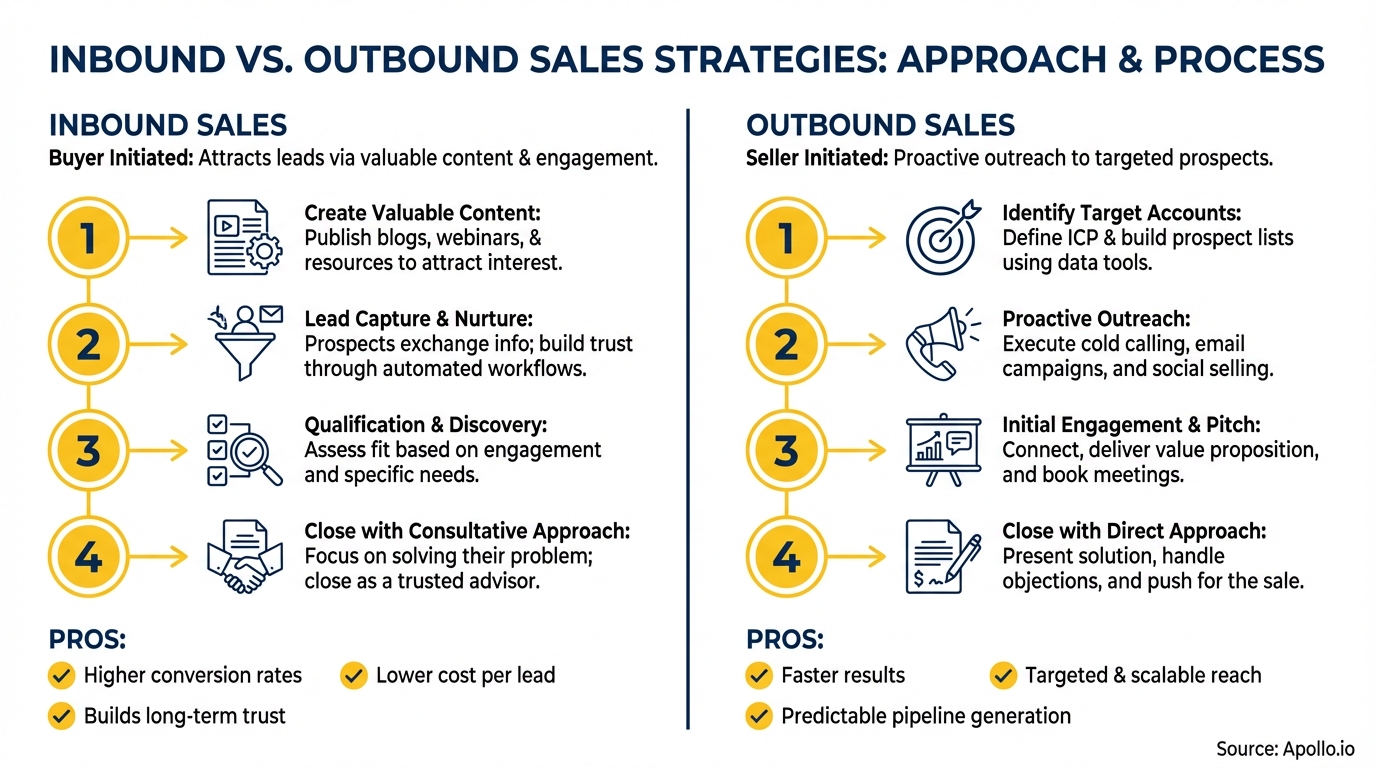
Inbound sales focuses on leads who discover your company through content marketing, SEO, social media, or referrals. These prospects raise their hand first by downloading resources, requesting demos, or engaging with your brand.
Outbound sales takes the opposite approach: your team identifies target accounts and initiates contact through cold emails, calls, and social outreach.
The fundamental difference lies in who starts the conversation. Inbound waits for buyer interest signals, while outbound creates those signals through proactive prospecting. According to Gitnux research, inbound leads cost 61% less than outbound leads on average, but outbound gives teams control over exactly who they target and when.
Both methods serve different stages of market maturity. Early-stage companies often lean on outbound prospecting to build initial traction. Established brands leverage inbound to handle growing demand efficiently.
How Does Inbound Sales Work in 2026?
Inbound sales starts when a prospect engages with your content, website, or social presence. Marketing teams create valuable resources that attract ideal buyers searching for solutions.
When prospects convert (downloading guides, attending webinars, requesting information), they enter your sales funnel as marketing-qualified leads (MQLs).
Sales Development Representatives then qualify these inbound leads based on fit, budget, timeline, and pain points. High-quality MQLs become sales-qualified leads (SQLs) and move to Account Executives for discovery calls and demos.
The process feels consultative because prospects already understand your value proposition before speaking with sales.
Key inbound channels include:
- Content marketing (blogs, guides, case studies)
- SEO and organic search traffic
- Social media engagement and community building
- Paid advertising (PPC, social ads, retargeting)
- Referral programs and customer advocacy
How Does Outbound Sales Work in 2026?
Outbound sales begins with identifying your ideal customer profile (ICP) and building targeted prospect lists. SDRs research accounts matching specific criteria like company size, industry, technology stack, and growth signals.
They then reach out through personalized cold emails, social messages, and phone calls to book discovery meetings.
Struggling to find qualified leads? Search Apollo's 224M+ contacts with 65+ filters to build targeted prospect lists in minutes.
Modern outbound relies heavily on multi-channel sequences that combine email, phone, and social touches over 7-14 days. AI-powered tools help personalize outreach at scale by analyzing prospect data and suggesting relevant messaging. The goal is booking qualified meetings with decision-makers who fit your ICP perfectly.
Successful outbound requires:
- Precise targeting using firmographic and technographic data
- Personalized messaging that addresses specific pain points
- Persistent follow-up across multiple channels
- Quick response times when prospects engage
- Continuous testing and optimization of sequences
What Are the Key Differences Between Inbound and Outbound Sales?
The core distinctions between inbound and outbound sales impact everything from cost structure to team workflows. Understanding these differences helps sales leaders allocate resources effectively and set realistic expectations for each approach.

| Factor | Inbound Sales | Outbound Sales |
|---|---|---|
| Lead Source | Prospects find you through content, search, ads | Your team identifies and contacts target accounts |
| Cost Per Lead | 61% lower on average (Gitnux) | Higher upfront investment in tools and headcount |
| Conversion Rate | 10x more effective when properly executed | Lower initial conversion, higher intent targeting |
| Sales Cycle | Often shorter due to pre-education | Varies based on account complexity |
| Scalability | Scales with content and brand awareness | Scales linearly with team size and tools |
| Control | Limited control over lead volume and timing | Full control over target accounts and outreach pace |
| Best For | High lead volume, complex buyers' journeys | Enterprise sales, niche markets, new market entry |
How Do SDRs Balance Inbound and Outbound Strategies?
SDRs in 2026 manage both inbound leads and outbound prospecting simultaneously, but success requires clear prioritization frameworks. Top-performing teams allocate time based on lead quality and pipeline gaps.
For example, an SDR might dedicate mornings to responding to high-intent inbound leads and afternoons to targeted outbound sequences.
The key is segmentation. SDRs qualify inbound leads quickly using BANT (Budget, Authority, Need, Timeline) or MEDDIC frameworks.
High-quality inbound leads get immediate attention, while lower-fit leads enter nurture campaigns. For outbound, SDRs focus on accounts matching strict ICP criteria to maximize meeting conversion rates.
Spending hours on manual outreach? Automate your multi-channel sequences with Apollo's engagement platform.
Successful SDRs use these tactics:
- Time-blocking for inbound response (under 5 minutes) and outbound prospecting
- Automated lead routing to match SDR specialization or territory
- Unified workflows in one platform (not juggling 3-5 separate tools)
- AI assistance for research, personalization, and follow-up prioritization
Why Are Hybrid Sales Models Winning in 2026?
Hybrid sales models combine inbound's cost efficiency with outbound's targeting precision, creating a compound effect that single-strategy teams can't match. Companies using hybrid approaches benefit from multiple lead sources, reduced dependency on any single channel, and the ability to adapt quickly to market changes.
The data supports this shift. High-growth firms reported a 46% increase in adoption of outbound sales calls between 2023 and 2024, according to SMPS research. Meanwhile, these same companies maintained strong inbound programs, recognizing that warm leads still convert at higher rates.
Hybrid models also reduce risk. When inbound lead flow drops due to algorithm changes or market shifts, outbound fills the gap.
When outbound sequences hit response fatigue, inbound provides a steady stream of educated prospects. For Account Executives managing complex deals, this diversified pipeline creates more predictable revenue.
Teams using unified GTM platforms consolidate their tech stack, eliminating the complexity of managing separate tools for prospecting, engagement, and deal management. As one customer put it: "We reduced the complexity of three tools into one" (Predictable Revenue).
Turn Unreliable Forecasts Into Revenue Clarity
Missing quota because your pipeline visibility is a guessing game? Apollo reveals real-time deal stages and surfaces in-market buyers before competitors. Built-In increased win rates 10% with Apollo's scoring.
Start Free with Apollo →How to Build a Hybrid Sales Strategy That Actually Works
Start by auditing your current pipeline sources and identifying gaps. Calculate the true cost per opportunity for both inbound and outbound channels.
Map your buyer journey to understand where prospects need nurturing versus active outreach.
Next, define clear handoff processes between marketing, SDRs, and AEs. Inbound leads should receive responses within 5 minutes, while outbound prospects enter sequences triggered by specific engagement signals.
Use a single source of truth for all prospect data to avoid duplicate outreach or missed opportunities.
Implementation checklist:
- Set ICP criteria that apply to both inbound qualification and outbound targeting
- Create unified messaging frameworks that work across all channels
- Establish SLAs for inbound response times (under 5 minutes) and outbound follow-up cadence
- Build sequences that blend inbound nurturing with outbound touches based on engagement
- Train SDRs on both skill sets: consultative inbound qualification and proactive outbound prospecting
- Implement AI-powered automation to handle routine tasks while maintaining personalization

Start Building Your Hybrid Sales Engine Today
The inbound versus outbound debate misses the point entirely. Winning teams in 2026 orchestrate both strategies through unified platforms that eliminate tool bloat and data silos.
Whether you're an SDR booking meetings, a sales leader building predictable pipeline, or a founder competing with funded competitors, hybrid selling gives you the flexibility to adapt and scale.
The companies seeing the biggest gains are those who consolidated their tech stack. "Having everything in one system was a game changer" (Cyera). Stop juggling separate tools for prospecting, engagement, enrichment, and deal management.
Start with a platform that handles inbound and outbound in one workspace.
Ready to cut your tech stack and boost pipeline? Start a free Apollo trial and get access to 224M+ verified contacts, AI-powered sequences, and deal management all in one platform. Join 2M+ users who've already made the switch.
Prove Apollo's ROI In Your First Month
Budget approval stuck on unclear metrics? Apollo tracks every touchpoint from first contact to closed deal, showing exactly what drives revenue. Built-In increased win rates 10% and ACV 10% with Apollo's pipeline intelligence.
Start Free with Apollo →Don't miss these
Sales
Inbound vs Outbound Marketing: Which Strategy Wins?
Sales
What Is a Sales Funnel? The Non-Linear Revenue Framework for 2026
Sales
What Is a Go-to-Market Strategy? The 2026 GTM Playbook
See Apollo in action
We'd love to show how Apollo can help you sell better.
By submitting this form, you will receive information, tips, and promotions from Apollo. To learn more, see our Privacy Statement.
4.7/5 based on 9,690 reviews
