
How to Use Past Conversation Data to Customize Future Outreach in 2026
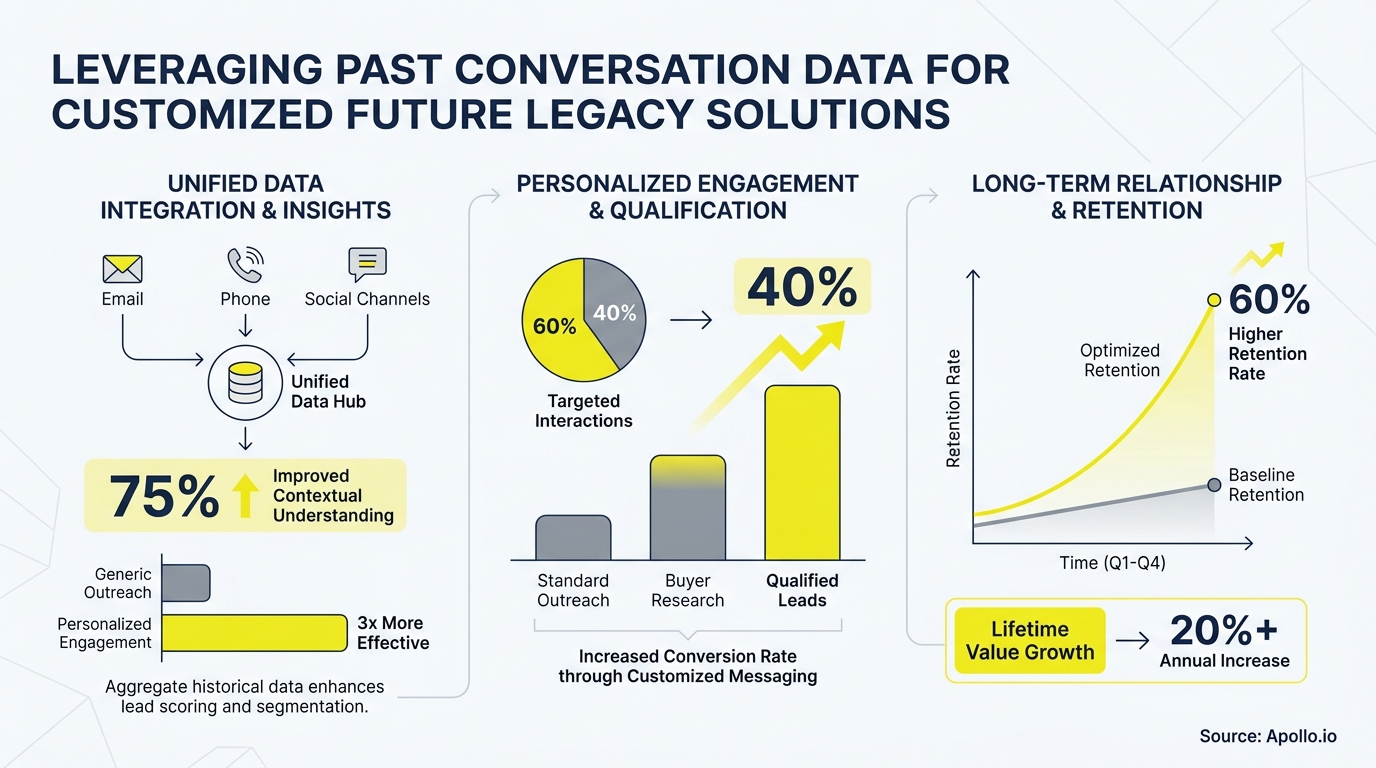
Your buyers don't want more outreach. They want memory. A Gartner survey found 73% of B2B buyers actively avoid suppliers that send irrelevant messages. The fix isn't more automation or longer sequences. It's using what buyers already told you: their objections, use cases, concerns, and next steps. Past conversation data is your richest first-party signal, and most teams aren't using it. Learning how to use past conversation data to customize future outreach is the difference between getting ignored and getting replies. Pair that with a solid data enrichment strategy and you have a compounding personalization advantage.

Let Apollo Find Your Leads Instantly
Tired of burning hours verifying contact info that leads nowhere? Apollo surfaces accurate, ready-to-work leads so your reps spend time selling — not searching. Join 600K+ companies building pipeline faster.
Start Free with Apollo →Key Takeaways
- Conversation signals (objections, use cases, stakeholders, urgency) are richer than third-party intent data because they capture actual buyer language.
- Personalized outreach based on prior conversations significantly outperforms generic templates in open rates and reply rates.
- Personalization backfires when it adds noise or feels intrusive — guardrails and a "helpful vs. creepy" decision rule are essential.
- RevOps and SDR teams need a taxonomy for labeling CRM notes before AI can act on them reliably.
- Data governance — consent, retention, and access controls — is now a personalization requirement, not just a compliance checkbox.
What Counts as Past Conversation Data?
Past conversation data includes any recorded buyer interaction that reveals intent, concern, or context. It goes well beyond CRM notes.
| Data Source | What It Captures | Personalization Signal |
|---|---|---|
| Call transcripts | Objections, competitor mentions, pain language | Next message framing |
| Email threads | Questions asked, content downloaded, timing | Stage and urgency |
| Meeting notes | Stakeholders involved, use cases discussed | Multi-thread outreach targets |
| Chatbot/web logs | Pages visited, topics explored, form fills | Self-service interest areas |
| CRM activity history | Deal stage, last contact, promises made | Follow-up timing and framing |
These signals are more valuable than third-party intent data because they reflect what buyers actually said, not just what pages they visited. Understanding how intent data works helps you see where conversation signals fit in the larger personalization stack.
How Do You Convert Conversation Signals into Next-Best Outreach?
The conversation-to-next-step mapping is where most teams fall short. They log notes but never translate them into a specific message, asset, or channel decision.
Use this four-step signal taxonomy:
- Label the signal type: Objection, use case, stakeholder mentioned, urgency indicator, or unresolved question.
- Map to buyer stage: Early-stage signals (problem awareness) get educational assets. Late-stage signals (pricing objection, legal review) get specific responses or human escalation.
- Select the next asset or message: Match the signal to a concrete output — a case study, a comparison doc, a direct answer email, or a no-touch nurture sequence.
- Choose channel: High-urgency, late-stage signals warrant a direct call or personalized email. Low-urgency early-stage signals can go into automated nurture.
Research from Outreach found that customized emails have 10% higher open rates and double the reply rates compared to standard templates.
The payoff is real — but only if the customization reflects actual conversation context, not just a first-name variable.
Spending hours manually writing personalized follow-ups? Automate conversation-aware sequences with Apollo's multi-channel engagement platform.

How Can SDRs and AEs Turn Call Notes into Personalized Follow-Ups?
SDRs and AEs can use call notes to build follow-ups that feel like continuations of a conversation, not cold restarts. The key is structured note-taking that AI and sequences can act on.
For SDRs booking discovery calls:
- Tag every call note with: primary pain, objection raised, competitor mentioned, and decision timeline.
- Use those tags to branch into the right sequence step — not the next generic step.
- Reference the buyer's exact language in the subject line: "Re: your Q on [specific concern]" outperforms any template opener.
For AEs managing active deals:
- Log every stakeholder mentioned in discovery and map them to a multi-thread outreach plan.
- When a legal or procurement objection surfaces, trigger a pre-built "late-stage objection" sequence with the right asset attached.
- After each call, update the CRM with one field: "What is the buyer's stated next step?" That single field drives the next touchpoint.
According to Martal, 77% of B2B buyers will not even consider a purchase if the content isn't personalized to their needs. For AEs, that means every follow-up email must connect to something the buyer specifically raised, not a generic value proposition.
Turn Funnel Guesswork Into Pipeline Wins
Pipeline forecasting a guessing game because marketing leads never convert? Apollo surfaces ready-to-close prospects with verified contacts and real-time buying signals. Top revenue teams rely on Apollo to fill the funnel with quality — not volume.
Schedule a Demo →What Are the "Helpful vs. Creepy" Guardrails for Conversation-Based Personalization?
Conversation-based personalization crosses into "creepy" territory when it references details the buyer didn't expect you to retain, uses data outside its original context, or applies pressure based on inferred urgency.
Use this decision rule before sending any conversation-informed message:
- Would the buyer recognize this detail as something they shared with you? If yes, safe to reference. If no, don't use it.
- Does the message add value the buyer can't get from your website? If not, it's noise. A Gartner analysis found personalized journeys can make customers 2x more likely to feel overwhelmed — more detail is not always better.
- Is the conversation data older than 90 days? Treat stale signals as expired. Re-qualify before personalizing.
- Did the buyer disengage after the last personalized touch? Stop the conversation-informed sequence and switch to a lighter nurture track.
The goal is relevance, not surveillance. Reference shared context to show you listened. Don't reference inferred context to show you tracked them.
How Do RevOps Teams Govern Conversation Data for AI Outreach?
RevOps teams govern conversation data for AI outreach by establishing taxonomy standards, retention rules, and access controls before connecting data to any automation layer.
The August 2025 Salesloft Drift incident — where compromised OAuth tokens exposed Salesforce data — is a clear reminder: conversation data is both a personalization asset and a regulated operational risk. Governance must keep pace with capability.
RevOps governance checklist:
- Define a standard CRM note taxonomy (objection, use case, stakeholder, urgency, next step) and enforce it with required fields.
- Set retention windows: purge or anonymize conversation records after a defined inactivity period.
- Audit third-party app access quarterly — especially tools with OAuth connections to your CRM.
- Align seller outreach, nurture content, and website messaging to the same buyer context. A Gartner survey found 69% of B2B buyers report inconsistencies between supplier website content and seller messaging — a direct trust killer.
Strong customer data enrichment practices keep CRM records accurate enough for AI to act on. Without clean, labeled data, AI outreach amplifies noise instead of relevance. See also how Apollo protects your data for a model of responsible data handling.
How Do You Measure Whether Conversation-Informed Outreach Is Working?
Measure conversation-informed outreach by tracking relevance signals, not just volume metrics. Reply rate, meeting acceptance rate, and unsubscribe rate tell you whether your personalization is landing or backfiring.
| Metric | What It Tells You | Target Direction |
|---|---|---|
| Reply rate | Message relevance | Up vs. generic sequences |
| Meeting acceptance rate | Context accuracy | Up vs. cold outreach baseline |
| Unsubscribe / opt-out rate | Overwhelm or irrelevance signal | Down vs. templated sequences |
| Deal velocity | Whether follow-ups are advancing stages | Shorter time between stages |
| Sequence branch usage | Whether reps are tagging signals correctly | High branch diversity = good taxonomy adoption |
Run a simple A/B test: take one segment of prospects with tagged conversation history and send conversation-informed follow-ups. Compare reply rates against a control group receiving standard sequence steps. The delta is your personalization ROI. Data from Rivo shows personalized emails deliver six times higher transaction rates in B2B businesses — a strong benchmark for setting improvement targets.
Want conversation intelligence and outreach in one platform? Apollo's AI call assistant captures, summarizes, and connects call insights to your next outreach step automatically.

Start Turning Conversations into Pipeline
The best follow-up email you can send in 2026 is one that proves you were paying attention. Past conversation data — call notes, objections, use cases, stakeholder names, and next steps — is your highest-signal personalization input.
It's more actionable than third-party intent and more persuasive than any template.
The operational steps are clear: build a signal taxonomy, map signals to next-best actions, apply guardrails to stay relevant without feeling intrusive, and govern your data before connecting it to AI automation. For RevOps, SDRs, and AEs alike, this is the framework that separates memory-driven outreach from the generic sequences buyers have learned to ignore.
Apollo brings conversation intelligence, contact data enrichment, and multi-channel sequences into a single platform — so your team doesn't need three tools to close the loop between a call and a follow-up. As Cyera put it: "Having everything in one system was a game changer."
Get Leads Now and start turning every conversation into your next best outreach.
Prove Pipeline ROI Before Next QBR
Budget approval stuck on unclear metrics? Apollo delivers measurable pipeline impact from day one — so you walk into every QBR with numbers, not narratives. Leadium 3x'd annual revenue after switching.
Start Free with Apollo →Don't miss these
Sales
Inbound vs Outbound Marketing: Which Strategy Wins?
Sales
What Is a Sales Funnel? The Non-Linear Revenue Framework for 2026
Sales
What Is a Go-to-Market Strategy? The 2026 GTM Playbook
See Apollo in action
We'd love to show how Apollo can help you sell better.
By submitting this form, you will receive information, tips, and promotions from Apollo. To learn more, see our Privacy Statement.
4.7/5 based on 9,690 reviews
