
How to Use Enriched Contact Data to Segment by Company Hierarchy Levels
Most B2B outreach fails not because the message is wrong, but because it lands at the wrong level. A CFO and a DevOps engineer both receive the same email about your platform, and both delete it. The fix is hierarchy-based segmentation, powered by enriched contact data that tells you exactly where each person sits in the org.
Enriched contact data lets you segment contacts by seniority, department, reporting structure, and corporate family, so every message matches the authority level and priorities of its recipient. Cleanlist.ai reports that 88% of B2B marketers who personalize messaging by organizational structure exceeded their revenue goals.

Research Less. Pipeline More With Apollo.
Tired of your reps burning hours verifying contacts instead of closing deals? Apollo delivers accurate business contact data so your team spends time selling, not searching. Join 600K+ companies building pipeline faster.
Start Free with Apollo →Key Takeaways
- Enriched contact data adds seniority, department, and corporate-family fields that make hierarchy-based segmentation possible at scale.
- Buying decisions average 13 stakeholders across multiple departments, so targeting only "the decision-maker" leaves most of the buying group unaddressed.
- Hierarchy segments decay quickly as people change roles; always-on enrichment with job-change alerts is required to keep segments accurate.
- RevOps teams that apply field-level confidence scoring and title normalization see cleaner routing and fewer mis-targeted sequences.
- Hidden influencers (finance, security, ops) often control internal deal momentum; enrichment helps you identify and activate them with role-specific content.
What Is Hierarchy-Based Segmentation with Enriched Contact Data?
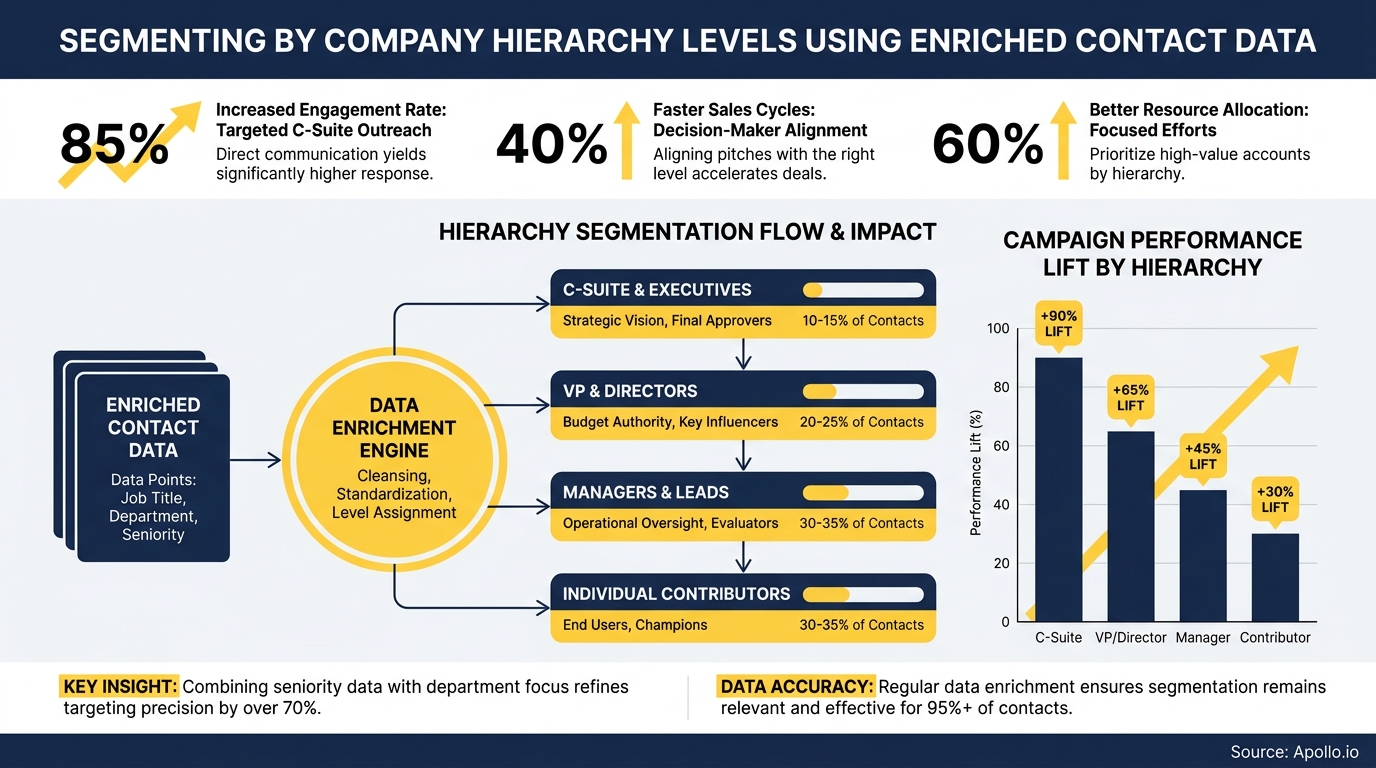
Hierarchy-based segmentation is the practice of grouping contacts by their organizational level, reporting structure, and corporate position, using enriched attributes rather than raw job titles alone. Raw titles like "Manager, Enterprise Solutions" are ambiguous; enriched fields like seniority tier (C-suite, VP, Director, Manager, IC), department, business unit, and parent/subsidiary affiliation remove that ambiguity.
This is distinct from simple firmographic segmentation (industry, company size). Hierarchy segmentation maps who within the company receives what message. It requires a structured data enrichment approach that appends normalized role fields to every contact record before segmentation rules are applied.
Why Does Hierarchy Segmentation Matter for B2B GTM Teams?
Buying decisions are collective, not individual. Forrester's Buyers' Journey Survey found an average of 13 people involved in a B2B purchase, with 89% of deals involving two or more departments.
Targeting only the named economic buyer ignores the champions, influencers, and technical evaluators who shape the final decision.
Research from getmonetizely.com indicates that companies implementing sophisticated segmentation strategies achieve up to 20% higher revenue growth compared to those without. For SDRs and AEs, this translates directly: sequences calibrated by seniority tier generate replies from the right stakeholders instead of silence from the wrong ones.
Struggling to reach the right level at target accounts? Search Apollo's 230M+ contacts with 65+ filters including seniority and department to build hierarchy-precise lists instantly.
What Enrichment Fields Power Hierarchy Segmentation?
Effective hierarchy segmentation depends on a minimum viable set of enriched fields that go beyond what most CRMs capture natively.
| Field | What It Enables | Hierarchy Use Case |
|---|---|---|
| Seniority Level | Normalized tier (C-suite, VP, Director, Manager, IC) | Route exec brief vs. practitioner checklist |
| Department / Function | Finance, Engineering, Security, Ops, Sales, Marketing | Identify hidden influencers beyond the primary buyer |
| Reporting Line / Title Normalization | Standardized title mapped to level taxonomy | Deduplicate contacts across subsidiaries |
| Parent / Subsidiary Account | Corporate family tree (HQ vs. BU vs. subsidiary) | Prevent duplicate outreach; align territory rules |
| Last Enriched Date | Timestamp of most recent field verification | Flag stale hierarchy records for re-enrichment |
Apollo's contact enrichment appends these fields continuously, including job-change alerts that flag when a contact moves to a new role, keeping your hierarchy segments from going stale.
Turn Weak Leads Into Pipeline With Apollo
Tired of marketing leads that never convert to real opportunities? Apollo surfaces high-intent prospects with 97% email accuracy so your team engages the right buyers at right moment. Join 600K+ companies building predictable pipeline.
Start Free with Apollo →How Do RevOps Teams Build a Governance Framework for Hierarchy Enrichment?
RevOps leaders need a governance layer to ensure enriched hierarchy fields are trustworthy enough to drive routing and sequencing decisions. Without it, mis-targeted sequences fire at the wrong level and damage sender reputation.
A sales professional wrote on Reddit that their team sets a minimum accuracy threshold for each field, fills only when enrichment data clears that threshold, and periodically spot-checks enriched records against data with known accuracy. That same thread emphasized: "Prioritize the fields that change routing and conversion, set a minimum accuracy per field per country-industry, fill only when a provider clears it, and fall back to the next tier for gaps."
Apply this as a practical governance checklist:
- Title normalization: Map raw titles to a 5-tier taxonomy (C-suite, VP, Director, Manager, IC) before any segmentation rule fires.
- Confidence scoring: Assign a confidence score per field; only use seniority for routing when score exceeds your defined threshold.
- Parent/child deduplication: Resolve subsidiary contacts to their corporate parent to prevent territory overlap and duplicate sequences.
- Enrichment SLA: Set a maximum "last enriched date" age (e.g., 90 days) before a hierarchy record is flagged for refresh.
- Human-in-the-loop validation: Spot-check a sample of enriched seniority fields monthly against source profiles to validate provider accuracy.
Learn more about building a systematic approach in Apollo's guide on how to build a data enrichment strategy.

How Do SDRs and AEs Use Hierarchy Segments to Drive More Pipeline?
SDRs and AEs use hierarchy segments to send different sequences to different levels within the same target account, running multi-threaded plays that cover the full buying group instead of a single contact.
A practical hierarchy-to-content mapping looks like this:
- C-suite / VP: 2-minute exec brief focused on business outcomes, risk reduction, and competitive positioning. Short, direct, high-authority framing.
- Director / Senior Manager: ROI justification document and functional evaluation criteria. Speaks to team impact and departmental KPIs.
- Manager / Practitioner (IC): Implementation checklist, integration specs, and hands-on demo offer. Speaks to workflow and day-to-day usability.
- Hidden influencers (Finance, Security, Legal, Ops): Risk/compliance memo and internal ROI model formatted for internal sharing. Equips them to advocate upward.
According to my-outreach.com, companies that strategically apply segmentation often observe a 5-8x increase in ROI from personalized outreach and ABM programs. For AEs managing multi-stakeholder deals, arming each level with the right asset accelerates internal alignment and shortens cycles.
Apollo's B2B data enrichment for smarter routing connects enriched hierarchy fields directly to sequence enrollment rules, so the right asset goes to the right level automatically.
How Do You Keep Hierarchy Segments Accurate Over Time?
Hierarchy segments decay faster than most teams expect. Contact data degrades significantly each year as professionals change roles, get promoted, or move companies, meaning your "VP of Engineering" segment can become unreliable within months without active maintenance.
The solution is always-on enrichment with job-change monitoring. Apollo's enrichment continuously refreshes role, seniority, and department fields and surfaces job-change alerts when a contact moves.
This means your C-suite segment stays populated with current executives, not former ones. Pair this with a "last enriched date" field in your CRM to trigger automatic re-enrichment workflows before stale records affect routing.
For teams managing large contact databases, waterfall enrichment runs contacts through multiple verified data sources sequentially, maximizing field coverage for hierarchy attributes like seniority and corporate parent. This is especially valuable for enterprise accounts where subsidiary structures are complex.
Data from enricher.io shows that 74% of B2B organizations report that enrichment directly improves lead conversion, an outcome that depends entirely on keeping enriched fields current and accurate.

Start Segmenting by Hierarchy with Apollo in 2026
Hierarchy-based segmentation is the difference between spray-and-pray outreach and precision multi-threading that covers the full buying group. The playbook is straightforward: enrich contacts with normalized seniority, department, and corporate-family fields; apply a governance framework with confidence scoring and enrichment SLAs; map each hierarchy level to a purpose-built asset; and keep segments current with always-on job-change enrichment.
Apollo consolidates enrichment, search, sequencing, and CRM sync into one platform, so RevOps teams maintain a single source of truth for hierarchy data while SDRs and AEs execute level-specific sequences without switching tools. "Having everything in one system was a game changer," noted the team at Cyera.
Ready to build hierarchy-precise segments from verified contact data? Start Your Free Trial and use Apollo's 65+ search filters, continuous enrichment, and automated sequences to reach every level of the buying group with the right message.
Prove Pipeline ROI With Apollo
ROI pressure killing your next budget approval? Apollo delivers measurable pipeline impact so you can walk into every review with hard numbers. Join 600K+ companies turning GTM spend into undeniable revenue proof.
Schedule a Demo →Don't miss these
Sales
Inbound vs Outbound Marketing: Which Strategy Wins?
Sales
What Is a Sales Funnel? The Non-Linear Revenue Framework for 2026
Sales
What Is a Go-to-Market Strategy? The 2026 GTM Playbook
See Apollo in action
We'd love to show how Apollo can help you sell better.
By submitting this form, you will receive information, tips, and promotions from Apollo. To learn more, see our Privacy Statement.
4.7/5 based on 9,690 reviews
