
How to Use AI in Sales: Proven Strategies for Revenue Teams
AI has moved from boardroom buzzword to daily workflow reality for sales teams in 2026. According to Optif, 89% of revenue organizations now use AI-powered tools, a substantial increase from 34% in 2023. Yet many teams struggle with governance, ROI measurement, and knowing which AI capabilities actually drive revenue. This guide shows you how to implement AI in sales with accountability, focusing on agentic workflows that execute tasks autonomously while maintaining human oversight. You'll learn practical frameworks for prospecting, outreach, deal management, and measuring real business impact.

Apollo Eliminates 4+ Hours Of Daily Research
Tired of spending 4+ hours daily hunting for contact info? Apollo delivers verified prospects with 96% email accuracy instantly. Join 550K+ companies who stopped manual research and started closing deals.
Start Free with Apollo →Key Takeaways
- AI in sales works best when embedded into daily workflows (CRM, email, meetings) rather than standalone tools, reducing context-switching and increasing adoption
- Agentic AI systems that execute multi-step workflows (research → outreach → follow-up) deliver measurable productivity gains, but require governance frameworks to prevent hallucinations and off-brand messaging
- Sales teams using AI report better revenue outcomes: 83% saw growth versus 66% without AI, despite widespread quota pressure
- By 2027, 95% of seller research workflows are expected to begin with AI, making early adoption critical for competitive advantage
- Successful AI implementation requires clear ROI measurement, segment-specific playbooks (SMB vs. enterprise), and human-in-the-loop review processes
What Is AI in Sales and Why Does It Matter in 2026?
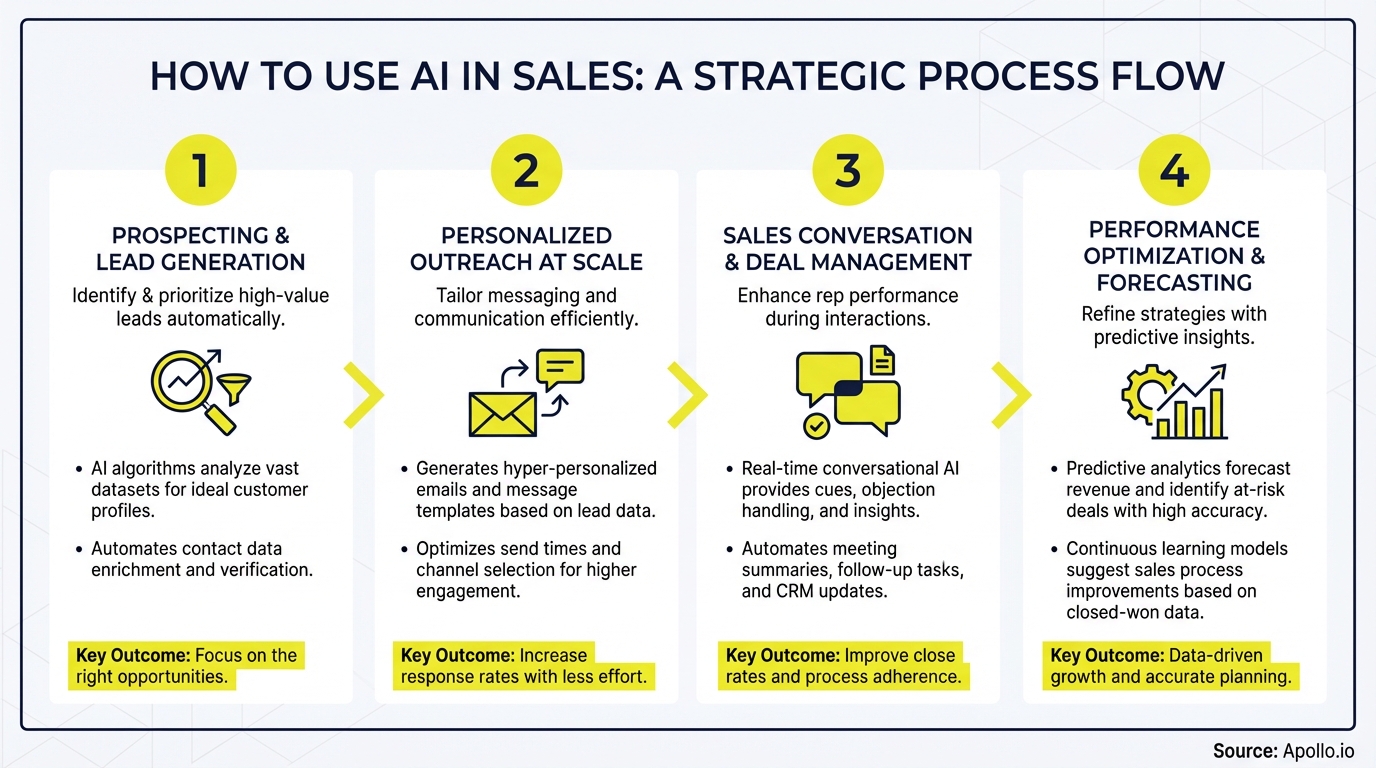
AI in sales refers to machine learning systems that automate repetitive tasks, generate insights from data, and execute multi-step workflows with minimal human intervention. In 2026, this spans from basic automation (email sequencing, data enrichment) to agentic systems that autonomously research prospects, draft personalized outreach, schedule meetings, and update CRM records.
The shift matters because buyer behavior has fundamentally changed. Forrester research shows 89% of B2B buyers now use generative AI for self-guided research, meaning they're more informed and selective than ever.
Sales teams need AI to match buyer sophistication, respond at scale, and focus human effort on high-value conversations rather than manual data entry.
Research from MarketsandMarkets shows that by 2027, 95% of seller research workflows are expected to begin with AI, a significant jump from less than 20% in 2024. Teams that master AI-powered prospecting, engagement, and deal management now will have a multi-year competitive advantage as these capabilities become table stakes.
How Do SDRs and BDRs Use AI for Prospecting?
SDRs and BDRs use AI to compress research time, identify ideal prospects, and personalize outreach at scale. The most effective implementations focus on three core workflows: intelligent contact discovery, account prioritization, and automated sequence personalization.
Intelligent Contact Discovery: AI-powered search filters let SDRs query databases using natural language ("VP Sales at Series B SaaS companies hiring aggressively") and surface contacts matching complex buying signals. Modern platforms combine firmographic data, technographic signals, and intent data to surface prospects actively researching solutions. Struggling to find qualified leads? Search Apollo's 224M+ contacts with 65+ filters and AI-powered recommendations.
Account Prioritization: AI scoring models analyze historical win/loss data to predict which accounts are most likely to convert. These systems surface "lookalike" accounts based on your best customers and flag buying signals like leadership changes, funding rounds, or technology adoption patterns.
Automated Personalization: Rather than writing each email manually, SDRs provide AI systems with account context (recent news, pain points, competitive intel) and the AI generates tailored messaging. According to Wezesha Marketing, personalized email campaigns have 41% higher click-through rates than non-personalized campaigns, and 57% of B2B marketers use AI-powered tools for email marketing.
What Are the Best AI Use Cases for Account Executives?
Account Executives use AI to shorten sales cycles, improve deal forecasting, and deliver better buyer experiences. The highest-impact applications focus on pre-meeting intelligence, conversation analysis, and deal risk prediction.
Pre-Meeting Intelligence: AI systems aggregate data from CRM, past interactions, social signals, and intent data to create comprehensive account briefings. AEs enter meetings knowing the prospect's tech stack, recent initiatives, competitive landscape, and likely objections. This preparation turns discovery calls into consultative conversations.
Conversation Intelligence: AI call assistants transcribe sales calls in real-time, extract action items, identify objections, and flag coaching opportunities. Sales leaders can analyze patterns across hundreds of calls to refine messaging and identify what separates top performers. Tired of taking notes during calls? Let Apollo's AI handle call summaries, action items, and CRM updates automatically.
Deal Risk Prediction: AI models analyze deal velocity, engagement patterns, and historical data to predict which opportunities are at risk. Systems flag deals with low champion engagement, stalled next steps, or misaligned buying committees so AEs can intervene before deals slip. Research from Dring.ai shows AI-driven pricing optimization increases profit margins by 12%.

How Should Sales Leaders Implement AI Governance?
AI governance prevents hallucinations, maintains brand consistency, and protects against compliance risks. Effective frameworks balance autonomy with oversight through clear policies, human review checkpoints, and quality assurance processes.
Core Governance Components:
- Content Approval Workflows: Define which AI-generated content requires human review (external emails, proposals, contracts) versus what can be automated (internal notes, CRM updates, research summaries)
- Brand Voice Guidelines: Train AI systems on approved messaging frameworks, tone guidelines, and competitive positioning. Store examples of on-brand versus off-brand content
- Data Usage Policies: Specify which customer data can be used for AI training, how to handle sensitive information, and when to flag potential compliance issues
- Citation Standards: Require AI-generated insights to link to source data (CRM fields, intent signals, news articles) so reps can verify accuracy
Salesforce research found 53% of sellers don't know how to get the most value from genAI at work, and roughly half don't know how to use it safely. Sales leaders must provide training on prompt engineering, output validation, and escalation procedures for edge cases.
Turn Forecasting Chaos Into Revenue Certainty
Pipeline forecasting a guessing game? Apollo tracks every deal stage in real time, so your forecast matches reality. Built-In boosted win rates 10% with Apollo's deal intelligence.
Start Free with Apollo →What AI Workflows Drive the Highest ROI for RevOps Teams?
RevOps teams use AI to eliminate data debt, forecast accurately, and optimize the entire revenue engine. The highest-return workflows focus on data enrichment, pipeline health monitoring, and revenue attribution.
Automated Data Enrichment: AI systems continuously update CRM records with job changes, company updates, and technographic data. This eliminates manual research and ensures sales teams always work with current information. Clean data improves forecast accuracy and prevents reps from wasting time on outdated contacts.
Pipeline Health Monitoring: AI analyzes deal progression across stages, identifies bottlenecks, and flags anomalies (deals stuck in one stage too long, low activity on high-value opportunities). RevOps can then implement targeted interventions like sales enablement, process changes, or resource reallocation.
Revenue Attribution: AI connects touchpoints across marketing, SDR outreach, AE conversations, and customer success to show which activities actually drive revenue. This replaces simplistic "first touch" or "last touch" models with multi-touch attribution that reveals true ROI of each channel and campaign.
| Workflow | Primary Benefit | Key Metric |
|---|---|---|
| Data Enrichment | Eliminate manual research | Hours saved per rep per week |
| Pipeline Monitoring | Prevent deal slippage | Forecast accuracy improvement |
| Revenue Attribution | Optimize channel mix | Cost per qualified opportunity |
| Conversation Analysis | Scale best practices | Win rate by rep segment |
How Do You Measure AI ROI in Sales?
Measuring AI ROI requires establishing baselines, tracking leading indicators, and connecting productivity gains to revenue outcomes. The most rigorous approaches use controlled experiments and segment analysis rather than vanity metrics.
Baseline Metrics to Capture:
- Hours spent on manual research, data entry, and administrative tasks
- Outreach volume and response rates per rep
- Average deal cycle length by segment
- Win rates and average deal size
- Ramp time for new hires
Leading Indicators of AI Impact:
- Increase in activities per rep (calls, emails, meetings booked)
- Improvement in email response rates and meeting acceptance rates
- Reduction in time from lead to first meaningful conversation
- Decrease in deals lost to "no decision"
Revenue Outcome Metrics: The ultimate measure is whether AI increases revenue per rep, shortens sales cycles, or enables you to close deals you would have lost. Track quota attainment by cohort (AI users vs. non-users), pipeline generation efficiency (cost per qualified opportunity), and new business closed per rep per quarter.
What Are the Key Differences Between SMB and Enterprise AI Strategies?
SMB and enterprise sales teams need different AI approaches due to deal complexity, buying committee size, and risk tolerance. SMB strategies emphasize speed and volume, while enterprise strategies focus on relationship depth and risk mitigation.
SMB AI Strategy: Maximize automation to handle high deal volume with lean teams. Use AI for rapid qualification, automated sequences, and self-service buyer experiences. Governance can be lighter since individual deal risk is lower. Focus on tools that consolidate your tech stack to control costs. According to Rev Empire, 56% of sales professionals use AI daily, with that figure projected to rise.
Enterprise AI Strategy: Deploy AI for deep account research, competitive intelligence, and stakeholder mapping across complex buying committees. Maintain strict governance with human review of all customer-facing content. Use AI to coordinate multi-threaded deals and ensure consistent messaging across sales, solutions engineering, and executive sponsors. Prioritize conversation intelligence to capture institutional knowledge.
Start Using AI in Sales Today
The gap between AI-powered sales teams and those still relying on manual processes is widening rapidly. Teams that implement AI thoughtfully in 2026 will have a multi-year advantage in productivity, buyer engagement, and revenue growth.
Start with high-impact, low-risk workflows like automated data enrichment and AI-assisted email drafting. Establish governance frameworks early to prevent quality issues as you scale.
Measure relentlessly, focusing on leading indicators that connect to revenue outcomes. Most importantly, choose platforms that consolidate your tech stack rather than adding more point solutions.
Apollo provides an all-in-one AI-powered GTM system that helps teams prospect smarter, engage at scale, and close deals faster. With 224M+ verified contacts, AI-powered search, automated sequences, conversation intelligence, and deal management in one workspace, Apollo eliminates the need for multiple tools. "We reduced the complexity of three tools into one," says Collin Stewart of Predictable Revenue. "Having everything in one system was a game changer," reports the team at Cyera.
Start Free with Apollo and see how AI-powered sales intelligence can transform your revenue operations.
Prove Apollo's ROI In Your First 30 Days
Budget approval stuck on unclear metrics? Apollo tracks every dollar impact—from pipeline generated to time saved. Built-In increased win rates 10% and ACV 10% with measurable Apollo insights.
Start Free with Apollo →Don't miss these
Sales
Inbound vs Outbound Marketing: Which Strategy Wins?
Sales
What Is a Sales Funnel? The Non-Linear Revenue Framework for 2026
Sales
What Is a Go-to-Market Strategy? The 2026 GTM Playbook
See Apollo in action
We'd love to show how Apollo can help you sell better.
By submitting this form, you will receive information, tips, and promotions from Apollo. To learn more, see our Privacy Statement.
4.7/5 based on 9,690 reviews
