
How to Track Follow-Up Metrics After a Prospect Clicks an Email Link
A prospect clicking a link in your email feels like a win. But in 2026, that click is often noise, not signal. Security scanners, Apple Mail Privacy Protection, and corporate firewalls routinely click every link in an email before the human ever reads it. If your follow-up sequences fire on raw clicks, you're likely routing bot-triggered events to SDRs and wasting rep time on cold leads. This guide shows you how to validate intent, build a layered post-click metric stack, and connect email engagement to real pipeline outcomes.

Research Less, Pipeline More With Apollo
Tired of your reps burning hours verifying contact info instead of selling? Apollo surfaces accurate, ready-to-contact leads so your team spends time closing, not researching. Join 600K+ companies building predictable pipeline.
Start Free with Apollo →Key Takeaways
- A raw email click is not a buying signal. Validate intent with landing-page sessions, time-on-page, and downstream actions before routing to sales.
- Bot clicks from security scanners and privacy tools corrupt CTR, A/B tests, and follow-up triggers — filter them before acting.
- The most valuable post-click metric is CRM stage progression, not click count.
- Account-level tracking outperforms contact-level tracking in complex B2B deals with multiple stakeholders.
- Segment follow-up by engagement depth: high-intent actions (demo request, pricing visit) warrant rep outreach; low-intent clicks warrant nurture sequences.
Why Is a Click an Unreliable Signal on Its Own?
A click becomes unreliable the moment a security scanner or privacy tool fires it before the human reads the email. As Validity warned in January 2026, security scanners, mailbox providers, and privacy tools can click email links before any human does, distorting CTR, A/B tests, unsubscribe data, and follow-up triggers.
A sales professional wrote on Reddit that their corporate firewalls clicked all links, including unsubscribe, the same second the email was sent. After switching to a manual opt-out message, opt-outs dropped substantially. The lesson: never route a lead to sales based solely on a click event.
Signs a click may be bot-generated:
- Click occurs within 1-2 seconds of send time
- All links in the email are clicked simultaneously
- No corresponding landing-page session in your analytics
- No scroll depth, time-on-page, or form interaction recorded
What Is the Post-Click Metric Stack?
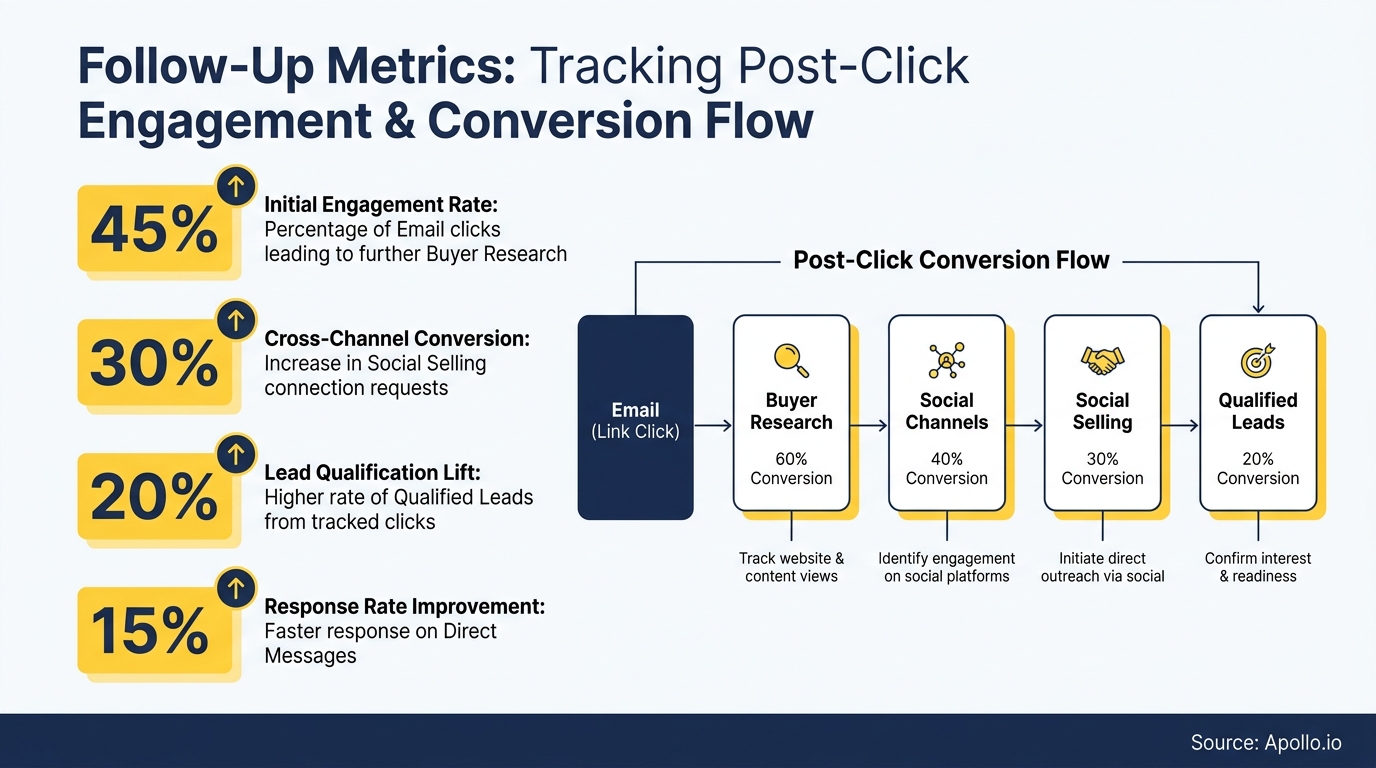
The post-click metric stack is a six-layer hierarchy that separates bot noise from genuine buyer intent, ordered from least to most meaningful.
| Layer | Metric | How to Capture | CRM Action |
|---|---|---|---|
| 1. Validated Click | Human-confirmed click (no same-second fire, session exists) | Bot-filter in ESP + GA4 session match | Log activity, do not trigger sequence |
| 2. Landing Engagement | Time on page, scroll depth, pages visited | UTM parameters + session analytics | Update lead score +5 |
| 3. High-Value Page Visit | Pricing, demo, or case study page | Page-level event tracking | Update lead score +15, alert AE |
| 4. Conversion Action | Form fill, demo request, content download | Form submission event | Create/update opportunity, assign to rep |
| 5. Sales Reply or Meeting | Positive reply, meeting booked | Sequence reply tracking + calendar integration | Move to active pipeline stage |
| 6. CRM Stage Progression | Opportunity created, stage advanced | CRM workflow automation | Track pipeline influenced by email campaign |
Research from Total Product Marketing shows the average B2B services email click rate was 3.64% as of January 2025. Most of those clicks will not convert. The stack above ensures you invest follow-up resources only where deeper engagement confirms intent.
Spending hours on manual follow-up decisions? Automate your sequences with Apollo's multi-channel sales engagement platform and trigger the right action at each engagement layer.
How Do SDRs and RevOps Teams Build a Conditional Follow-Up Playbook?
SDRs should segment follow-up by engagement depth, not treat every click identically. A commenter shared a firsthand perspective that reply rate climbed from 3% to 11% after they stopped treating all opens and clicks the same and instead sequenced based on engagement level, routing multi-open contacts into a social channel sequence and single-open/bounce contacts into a different follow-up track.
Conditional follow-up rules by engagement depth:
- Click only, no session: Likely bot. No action. Continue existing sequence.
- Validated click + 30+ seconds on page: Send a relevant follow-up email referencing the specific content clicked. Do not call.
- Pricing or demo page visit: Alert AE or senior SDR. Personalize next touch to that specific interest. Reference the content in your outreach.
- Form fill or demo request: Immediate rep assignment. Call within the same business day.
- Multiple contacts from same account clicking: Escalate to account-level play. Involve AE and marketing for coordinated outreach.
RevOps leaders should encode these rules as workflow automations in your CRM, not rely on manual rep judgment. According to Salesgenie, follow-up emails can increase the chance of a response by 11%, but only when the follow-up is relevant to what the prospect engaged with. Irrelevant outreach actively damages response rates: a Gartner 2025 sales survey found 73% of B2B buyers actively avoid suppliers that send irrelevant outreach.
For writing follow-up emails that actually get responses, match the message to the specific link the prospect clicked. Generic follow-ups waste the engagement signal you just captured.

How Does Account-Level Tracking Change Post-Click Analysis?
Account-level tracking means monitoring engagement across every contact at a target company, not just the individual who clicked. In B2B, buying decisions involve multiple stakeholders.
When three people from the same account click your email in the same week, that is a buying-group signal, not three independent events.
Account-level metrics to track after a click:
- Number of unique contacts from the account who clicked or visited
- Seniority of contacts engaging (economic buyer vs. end user)
- Pages visited across all account contacts combined
- Repeat visits within a 14-day window
- Total content engagement score across the buying group
A 6sense 2025 Buyer Experience Report found that 94% of buying groups ranked preferred vendors before first contact, and the preferred vendor won 77% of the time. This means post-click tracking must identify whether your email is reaching an account already in active evaluation mode. If so, accelerate the account play, do not wait for a single contact to convert.
For Account Executives managing enterprise deals, account-level click data should feed directly into deal intelligence. Email personalization tied to content engagement lets AEs reference exactly what the buying group has been reading, making every conversation more relevant.
Turn Funnel Guesswork Into Pipeline Clarity
Marketing leads not converting to real opportunities. Apollo surfaces in-market buyers with verified contact data so your team stops chasing cold leads and starts building pipeline that actually closes. Trusted by 600K+ companies.
Start Free with Apollo →What Does a Post-Click Metrics Dashboard Look Like?
A post-click metrics dashboard replaces raw CTR reporting with revenue-impact metrics that connect email engagement to pipeline. Build two views: one for individual lead activity and one for account-level rollups.
Lead-level dashboard columns:
- Validated human clicks (bot-filtered)
- Landing-page session created (yes/no)
- Time on page (seconds)
- High-value page visited (pricing, demo, case study)
- Conversion action taken (form, meeting booked)
- Days to first positive reply
- CRM stage at time of click vs. current stage
Account-level rollup metrics:
- Unique contacts engaged per account
- Account engagement score (sum of all contact activity)
- Pipeline influenced by email campaign
- Opportunities created within 30 days of first click
- Revenue closed attributed to campaign
According to Kondo, tailored content and CTAs within emails can increase conversion rates by over 200%. A dashboard that surfaces which content topics drive the deepest engagement lets you continuously refine what links you include and how you follow up. For campaign-level attribution, use pipeline-influenced reporting rather than last-touch alone, since most B2B conversions involve multiple email touches before an opportunity is created.
Struggling to keep pipeline data clean and connected to your email sequences? Track email engagement to pipeline outcomes in one workspace with Apollo.
How Do You Start Tracking Follow-Up Metrics Today?
Tracking follow-up metrics after a prospect clicks a link starts with three immediate setup steps: bot filtering, UTM tagging, and CRM workflow automation.
Implementation checklist:
- Enable bot-click filtering in your email platform (look for "Bot Click" event exclusion in reporting settings)
- Add UTM parameters to every link: source, medium, campaign, and content (the specific link topic)
- Set up landing-page session matching in GA4 or your analytics tool to confirm human arrival
- Create CRM workflows that update lead score based on page visited and time on page
- Build account-level engagement rollups that aggregate all contact activity by company domain
- Define rep-alert thresholds: pricing page visit = immediate AE notification; form fill = same-day call
- Report on pipeline influenced and closed-won revenue per campaign, not CTR alone
Check that your email deliverability is solid before investing in click tracking. Clicks you cannot measure are often emails that never reached the inbox. Also review your send timing strategy: emails sent at optimal times generate cleaner engagement data with less noise from after-hours security scans.

Start Turning Clicks into Pipeline
A click is the beginning of an intent signal, not the end. Validate it against session data, score it by engagement depth, track it at the account level, and only escalate to rep outreach when the data shows genuine buying-group momentum.
Teams that build this layered approach stop wasting SDR time on bot-triggered sequences and start connecting email activity to measurable pipeline.
Apollo gives B2B GTM teams a unified workspace to run sequences, track engagement, enrich contact records, and connect activity to pipeline without stitching together five separate tools. As Cyera put it: "Having everything in one system was a game changer." Start Prospecting with Apollo and build a follow-up system that converts clicks into closed deals.
Prove Pipeline ROI With Apollo
ROI pressure killing your tool budget? Apollo delivers measurable pipeline impact your leadership can see — faster. Leadium 3x'd annual revenue. Get the same results.
Start Free with Apollo →Don't miss these
Sales
Inbound vs Outbound Marketing: Which Strategy Wins?
Sales
What Is a Sales Funnel? The Non-Linear Revenue Framework for 2026
Sales
What Is a Go-to-Market Strategy? The 2026 GTM Playbook
See Apollo in action
We'd love to show how Apollo can help you sell better.
By submitting this form, you will receive information, tips, and promotions from Apollo. To learn more, see our Privacy Statement.
4.7/5 based on 9,690 reviews
