
How to Segment Leads by Industry for Customized Message Campaigns (2026)
Most B2B campaigns fail not because of poor copywriting, but because they treat a healthcare compliance officer and a SaaS RevOps leader as the same person. Industry segmentation fixes that — but only when it goes deeper than swapping a merge field. According to MarketingProfs, 71% of B2B buyers expect personalized interactions and become frustrated without them. If you want to build a B2B email list that actually converts, segmentation by vertical is your starting point.
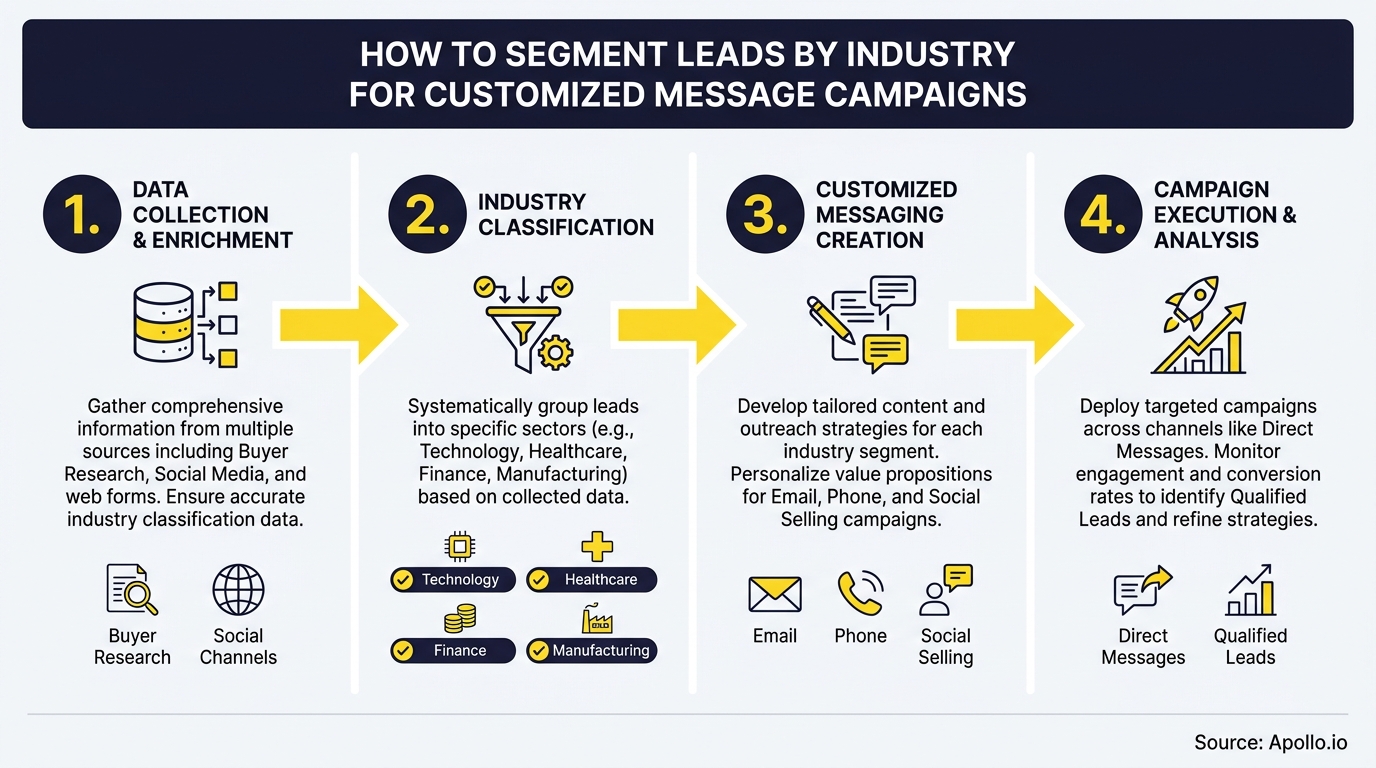
This guide gives SDRs, BDRs, marketers, and RevOps leaders a repeatable framework: map verticals using NAICS codes, enrich leads with the right fields, build a message matrix, and deploy consistent sequences across every channel.

Let Apollo Find Your Best Leads Fast
Tired of burning hours manually hunting down contact info that's already outdated? Apollo surfaces verified, in-market prospects so your team sells instead of searches. Join 600K+ companies building pipeline with confidence.
Start Free with Apollo →Key Takeaways
- Industry segmentation is most effective when layered with role, buying stage, and intent signals — not used alone.
- A NAICS-to-message matrix gives every vertical a distinct pain point, proof point, and call to action, so reps stop sending generic outreach.
- Buying committees average more than a dozen stakeholders, so your campaign assets must serve multiple roles inside the same account.
- The 80/20 rule applies: keep 80% of your message shared across a vertical, then swap the CTA and proof point per role or buying stage.
- Omnichannel consistency — email, phone, ads, and content — is what separates a campaign from a single email blast.
Why Does Industry Segmentation Matter for Message Campaigns?
Industry segmentation matters because buyers evaluate vendors on vertical expertise, not just features. Research from BOL Agency shows that nearly 60% of B2B customers expect fully or mostly personalized content when researching a product, and 66% expect it at the point of purchase. Sending a generic sequence to a manufacturing plant manager and a fintech CFO wastes both their time and yours.
Industry also acts as a proxy for shared pain points, regulatory context, buying cycles, and budget structures. A healthcare organization cares about HIPAA risk.
A logistics company cares about carrier cost variance. These are not the same message — and they should never be the same email.
Beyond email open rates, B2B International notes that companies offering more personalized experiences see higher contract values, shorter sales cycles, and increased customer loyalty — outcomes that matter to every revenue leader under quota pressure.
How Do You Map Leads to Industries Using a NAICS Framework?
Map leads to industries by anchoring your CRM taxonomy to NAICS (North American Industry Classification System) codes, which gives every segment a standardized, consistent label your automation tools can act on.
Here is a practical NAICS-to-vertical mapping for B2B GTM teams:
| NAICS Range | Vertical Label | Primary Pain Point | Proof Point Type |
|---|---|---|---|
| 5112, 5415 | SaaS / Software | Pipeline velocity, churn | ARR growth case study |
| 5221–5239 | Financial Services | Compliance, risk scoring | Regulatory win story |
| 6211–6216 | Healthcare / Life Sciences | Data privacy, audit trails | HIPAA-safe workflow ROI |
| 3111–3399 | Manufacturing | Supply chain cost, downtime | Operational efficiency stat |
| 5411–5419 | Professional Services | Utilization rate, client retention | Revenue-per-head benchmark |
To enrich leads with NAICS codes at scale, use a data enrichment layer that appends industry classification automatically. Struggling to find industry-verified contacts? Search Apollo's 230M+ contacts with 65+ filters including industry and NAICS codes to build clean, segmented lists from the start.

What Is a NAICS-to-Message Matrix and How Do You Build One?
A NAICS-to-message matrix is a lookup table that maps each vertical segment to a specific pain point, value statement, social proof asset, and CTA — so every rep and every automated sequence pulls from the same approved messaging.
Build yours with these five columns per row:
- Vertical / NAICS code — the segment identifier
- Top pain point — one sentence, written in the buyer's language
- Value hook — how your product resolves that specific pain
- Proof asset — a case study, stat, or testimonial from the same vertical
- Buying-stage CTA — awareness (read), consideration (demo), decision (trial/proposal)
A sales professional wrote on Redditthat signal-based personalization works best: rather than researching every prospect for 20 minutes, look for one specific trigger — a new hire, a funding round, a product launch — and build the entire message around that single signal.
It takes 2-3 minutes per message and drives significantly better reply rates than generic templates.
That is exactly what the matrix enables: pre-built, trigger-aligned messages your SDRs can deploy in minutes, not hours. Pair it with intent data to know which verticals are actively researching your category right now.
How Do SDRs and BDRs Apply Buying-Committee Segmentation?
SDRs and BDRs apply buying-committee segmentation by sending role-specific messages to every stakeholder within a target account, not just the primary contact. Industry alone is not enough — Forrester's 2024 State of Business Buying research found that the average B2B purchase involves 13 people, and 89% of purchases span two or more departments.
For each vertical segment, map at least three roles:
- Economic buyer(CFO, VP Finance): ROI, cost reduction, payback period
- Technical evaluator(IT, RevOps, CTO): Integration, security, implementation time
- End user champion(SDR, AE, marketer): Time saved, workflow simplicity, adoption speed
The 80/20 rule applies here. A commenter added in a Reddit discussion that you can write 80% of the email the same across a segment, then swap the final section and CTA to match the specific role. This keeps content production manageable while making every message feel relevant.
For RevOps leaders, the priority is making sure your CRM captures role and department fields alongside industry — so sequences can trigger the right version automatically. See how CRM integration with HubSpot and Salesforce keeps these fields synced without manual cleanup.
Turn Weak Leads Into Pipeline With Apollo
Quota slipping because marketing leads never convert? Apollo surfaces in-market buyers at the right moment — so your team stops guessing and starts closing. Nearly 100K paying customers already rely on it.
Schedule a Demo →What Does an Omnichannel Industry Segmentation Execution Checklist Look Like?
An omnichannel execution checklist ensures your industry-specific messages are consistent across email, phone, paid ads, and content — not siloed in a single channel. B2B buyers use an average of 10 interaction methods across a purchase journey, so a message that lands in email but contradicts what a prospect sees in a retargeting ad creates confusion and erodes trust.
Use this checklist before launching any industry-segmented campaign:
- Data readiness: NAICS/industry field populated for 90%+ of target accounts
- Role fields: Job title and department captured and mapped to buyer role
- Message matrix approved: Pain point, hook, proof asset, and CTA confirmed per vertical
- Sequence built: Email + call + social steps mapped to buying stage (awareness → consideration → decision)
- Ad creative aligned: Paid retargeting copy matches the email message for the same vertical
- QA suppression rules: Contacts missing industry field excluded from segmented sequences
- Enablement assets ready: Industry-specific one-pager, case study, or ROI sheet available for reps to attach
Spending too much time building sequences manually? Automate your industry-specific sequences with Apollo's multi-channel sales engagement platform and keep messaging consistent from first touch to closed deal.
Research from Data Mania confirms that 80% of business buyers are more likely to purchase from companies offering tailored experiences — and that tailoring must extend across every channel they use, not just the inbox.
How Do You Measure Whether Industry Segmentation Is Working?
Measure industry segmentation effectiveness by tracking reply rate, meeting conversion rate, and pipeline created per vertical — then compare each vertical's performance against your baseline to see which segments respond best to which messages.
Key metrics to track by vertical:
| Metric | What It Tells You | Action If Low |
|---|---|---|
| Reply rate by industry | Message resonance in that vertical | Rewrite pain point hook |
| Meeting-to-send ratio | CTA effectiveness | Test a different buying-stage CTA |
| Opportunity rate by segment | ICP fit by vertical | Narrow or expand NAICS range |
| Content asset engagement | Proof point relevance | Swap case study to same-vertical story |
According to Salesgenie, 71% of consumers abandon irrelevant experiences — meaning a poorly targeted sequence does not just underperform, it actively damages your sender reputation and buyer trust. Measure and iterate per vertical every 30 days.
For AEs managing deals later in the funnel, vertical-specific performance data also informs which proof assets to share during discovery and evaluation. Pair segmentation analytics with proven prospect nurturing strategies to keep hesitant leads moving through the pipeline.
How Do You Scale Industry Segmentation Without Overcomplicating Your Stack?
Scale industry segmentation by consolidating your data, enrichment, sequencing, and analytics into a unified platform rather than stitching together separate tools for each function. The biggest bottleneck for most teams is not creative — it is data quality and workflow fragmentation.
Apollo gives GTM teams a single workspace to find leads by industry, enrich contact records, launch multi-channel sequences, and track performance — without juggling five separate subscriptions. Customers like Predictable Revenue put it simply: "We reduced the complexity of three tools into one."
For teams building outbound from scratch, start with free lead generation strategies to validate your vertical before investing in full campaign production. Once a segment proves itself in reply rate and pipeline, expand the message matrix and automate the sequence.
Use Apollo's inbound form optimization to capture industry and role data at the point of conversion, so every new lead lands pre-segmented in the right nurture track without manual routing.

Start Sending Messages That Actually Fit the Industry
Industry segmentation is not a one-time list filter — it is a system. When you anchor segments to a NAICS taxonomy, enrich leads with role and intent fields, build a message matrix, and deploy consistent omnichannel sequences, your campaigns stop feeling like mass mail and start feeling like genuine expertise.
The teams winning in 2026 are moving beyond vertical labels to industry-plus-intent-plus-role targeting, because buyers expect it and competitors who do it will take the meeting first. Build the foundation now: clean data, a message matrix, and a platform that keeps everything in one place.
Ready to segment smarter? Start a free trial with Apollo and build your first industry-segmented campaign using 230M+ verified contacts and 65+ search filters — no extra tools required.
Prove Pipeline ROI With Apollo
ROI pressure killing your next tool renewal? Apollo delivers measurable pipeline impact from day one — so you walk into budget reviews with real numbers. Leadium 3x'd annual revenue. Your team is next.
Start Free with Apollo →Don't miss these
Sales
Inbound vs Outbound Marketing: Which Strategy Wins?
Sales
What Is a Sales Funnel? The Non-Linear Revenue Framework for 2026
Sales
What Is a Go-to-Market Strategy? The 2026 GTM Playbook
See Apollo in action
We'd love to show how Apollo can help you sell better.
By submitting this form, you will receive information, tips, and promotions from Apollo. To learn more, see our Privacy Statement.
4.7/5 based on 9,690 reviews
