
How to Optimize Email Design and Layout for Different Campaigns in 2026
Most email teams optimize for opens. That's the wrong metric. With Apple Mail Privacy Protection inflating open rates across B2B inboxes, the layout decisions that actually move revenue are the ones that drive clicks, conversions, and pipeline. Writing sales emails that get responses starts before the copy — it starts with structure.
The problem is that most teams use one template for every campaign type.
A re-engagement email should look nothing like a demo request email.
A newsletter needs a completely different content block order than an event invitation. This guide gives you a campaign-by-campaign layout framework, plus an accessibility and deliverability preflight checklist that most teams skip entirely.

Qualified Leads, Zero Manual Digging
Tired of burning hours verifying contact info before a single email goes out? Apollo surfaces accurate, ready-to-contact prospects so your team sells instead of researches. Join 600K+ companies building pipeline faster.
Start Free with Apollo →Key Takeaways
- Email layout should be optimized for clicks and downstream conversion, not open rates — Apple Mail Privacy Protection makes opens an unreliable signal.
- Different campaign types (newsletter, nurture, demo, re-engagement) require different link counts, CTA hierarchy, and content block order.
- Nearly all HTML emails fail accessibility checks — fixing contrast, alt text, and link labels is a fast, underused competitive advantage.
- Deliverability is now a design problem: unsubscribe UX, HTML cleanliness, and segmentation directly affect inbox placement.
- Personalization at the layout level — not just the subject line — produces stronger engagement, especially for B2B buyers who prefer self-service research.
What Is the Campaign Layout Matrix and Why Does It Matter?
A campaign layout matrix maps each email campaign type to its optimal link count, CTA hierarchy, content block order, and primary KPI.
Without it, teams default to a single template that underperforms across every campaign type.
According to Instapage, personalized emails produce a 29% higher open rate and a 41% higher click-through rate — but layout-level personalization by campaign type is where most teams leave performance on the table.
| Campaign Type | Recommended Links | CTA Hierarchy | Content Block Order | Primary KPI |
|---|---|---|---|---|
| Newsletter | 3–6 | Multiple equal CTAs | Header → Digest sections → Footer nav | CTOR (click-to-open rate) |
| Nurture / Drip | 2–4 | Primary CTA + secondary resource | Problem → Insight → Proof → CTA | Click rate, content engagement |
| Demo / Trial Request | 1 | Single high-intent CTA only | Hook → Value prop → Social proof → CTA | Demo bookings, conversion rate |
| Event / Webinar | 1–2 | Register CTA dominant, calendar add secondary | Event details → Speaker → Date/time → CTA | Registrations |
| Re-engagement | 1 | Single low-friction action | Minimal copy → Single CTA → Unsubscribe visible | Re-activation rate, list hygiene |
For high-intent campaigns like demo requests, single-link layouts consistently outperform multi-link designs. For nurture and newsletter formats, 2–5 links optimize click volume without diluting intent.
Match the link density to the conversion goal, not to how much content you want to promote.
Turn Funnel Guesswork Into Pipeline You Trust
Tired of leads that never convert and forecasts you can't believe in? Apollo surfaces quality prospects and buying signals so your pipeline reflects reality. Join 600K+ companies closing with confidence.
Start Free with Apollo →How Should SDRs and Marketing Teams Structure B2B Email Layouts?
SDRs and marketing teams need different email layout logic because they're optimizing for different actions at different funnel stages. SDRs sending cold or warm outreach should use minimal layouts: short copy, one clear CTA, no distracting navigation, and a plain-text-friendly fallback.
Marketing teams running nurture campaigns can use richer templates with proof modules and secondary resources.
Research from Powered By Search shows that detailed segmentation can drive 30% more opens and 50% more clicks than unsegmented campaigns. That lift comes not just from who receives the email, but from whether the layout matches what that segment needs to act.
- SDRs / BDRs: Plain or lightly styled layout, one CTA (meeting link or reply prompt), no image-heavy headers. Learn more about email personalization for sales to match content to buyer context.
- Marketing / RevOps:Modular template with hero block, proof block, and CTA block. Use role-specific modules: ROI data for CFOs, technical specs for IT, implementation timelines for ops.
- AEs (Account Executives): Mid-funnel layouts with case study or comparison content. One primary CTA (next step), one secondary link (supporting resource).
- Re-engagement flows: Strip the layout to bare essentials. One sentence, one button, visible unsubscribe. Complexity increases spam complaints.
Spending hours building sequences manually? Automate your multi-channel sequences with Apollo's sales engagement platform and launch campaign-type-specific layouts at scale.

What Accessibility and Deliverability Checks Should You Run Before Every Send?
Every email should pass a preflight checklist covering accessibility and deliverability before it goes out. The Email Markup Consortium's 2025 analysis of 443,585 HTML emails found 99.89% had Serious or Critical accessibility issues — 59.37% had insufficient color contrast, 51.42% lacked image alt text, and 72.04% had links without discernible text. These aren't edge cases; they're the default state of most email campaigns.
According to the Sinch Mailgun 2026 Email Impact Report, which analyzed 400+ billion emails sent in 2025, nearly 18% of emails fail to reach the inbox. Many of those failures trace directly back to layout and design decisions.
Accessibility preflight:
- Color contrast ratio meets WCAG AA (minimum 4.5:1 for body text)
- All images have descriptive alt text (not empty or generic)
- All links have discernible anchor text (no "click here" or "read more" without context)
- Font size is at least 14px for body copy, 16px preferred
- CTA buttons are at least 44x44px tappable target area
- Logical heading order (H1 → H2 → H3, no skipped levels)
- No critical information conveyed by image alone (always use real HTML text)
Deliverability preflight:
- One-click unsubscribe is present and functional (Gmail bulk-sender requirement for 5,000+ messages/day)
- Unsubscribe link is visible in the footer, not hidden or tiny
- Plain-text version matches HTML version in substance
- Image-to-text ratio is balanced (image-heavy emails trigger spam filters)
- No deceptive formatting or misleading sender identity
- SPF, DKIM, and DMARC authentication confirmed before sending
- Campaign is segmented by engagement level to protect sender reputation
These checks are especially important for teams sending at volume. Poor email deliverability doesn't just hurt one campaign — it degrades your domain reputation for every future send.
How Does Personalization Affect Email Layout Decisions?
Personalization affects email layout when it moves beyond the subject line to the content block level. Subject-line personalization is the starting point — data from Karizma Marketing shows personalized subject lines are 26% more likely to be opened. But layout-level personalization — showing the right content module to the right audience segment — is where B2B campaigns see the largest downstream impact.
For B2B campaigns, audience-specific layout modules outperform generic templates.
CFOs respond to ROI proof blocks.
Technical buyers scan architecture or integration sections. Operations leaders want implementation timeline details.
Building modular templates lets you assemble the right block order for each audience without creating entirely separate emails from scratch.
The timing of your sendmatters too, but the layout determines what happens after the open. Also note:Sopro reports that almost half of all email opens occur on mobile devices — meaning every layout decision must render correctly on small screens with tappable CTAs and legible single-column formatting.
How Can AI Help Optimize Email Design and Layout in 2026?
AI helps optimize email design by generating and testing modular layout variants, CTA copy, personalized content blocks, and accessibility checks at a speed manual processes can't match. The Validity/Litmus State of Email 2026 found that marketers with deeply integrated AI are 75% more likely to achieve top-tier email ROI — but only 12% of organizations have reached that level of AI maturity.
The opportunity is significant. Most teams use AI only for subject lines. High-performing teams use it to generate layout variants by campaign type, test CTA hierarchy, run automated accessibility QA, and build persona-specific content modules. Pair AI-generated layout testing with sequence diagnostics to identify which layout configurations are actually driving clicks and replies — not just opens.
Struggling to turn email engagement into booked meetings? Apollo's meeting scheduling tools connect directly to your outreach sequences so every CTA click turns into a calendar event without manual follow-up.

How to Put It All Together: Start Converting, Not Just Sending
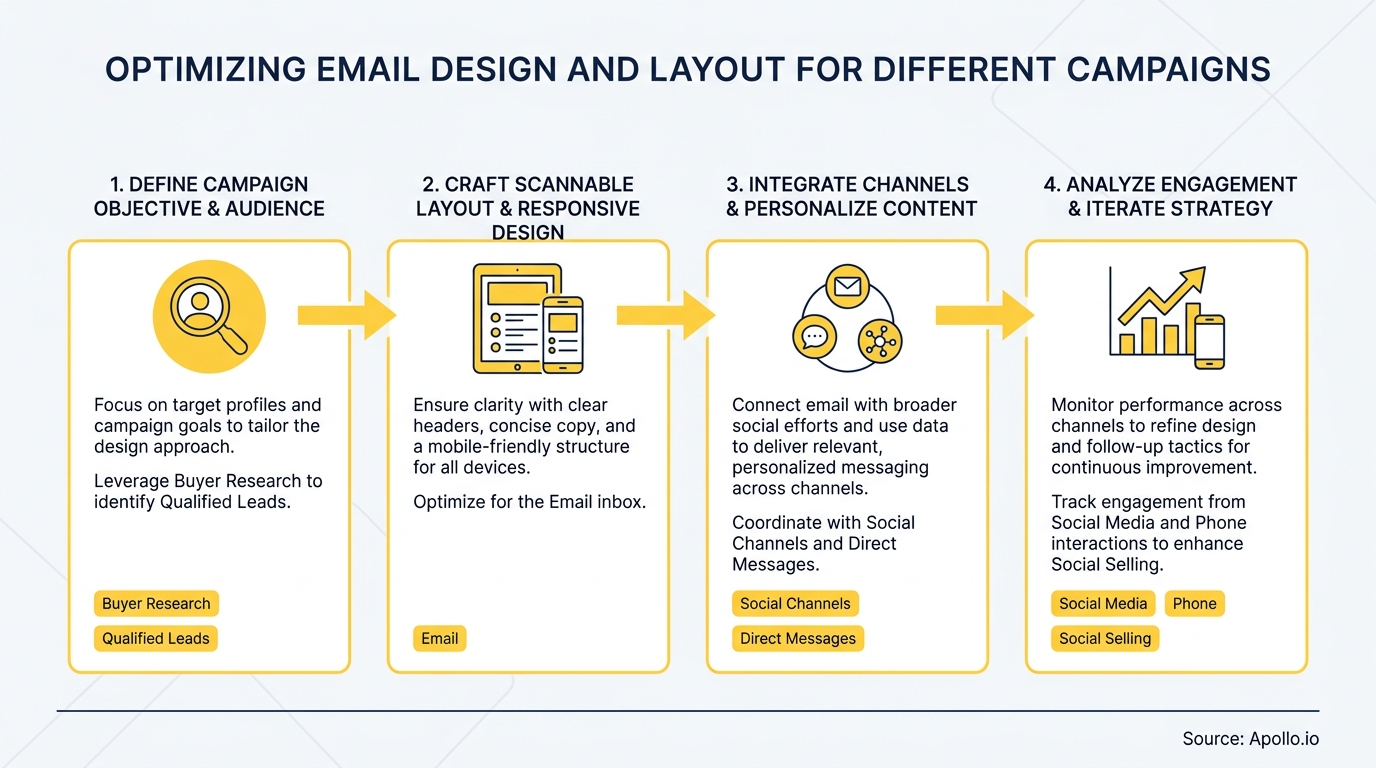
Optimizing email design and layout for different campaigns requires three things working together: a campaign-type-specific layout matrix, an accessibility and deliverability preflight checklist, and personalization that goes beyond the subject line to the content block level.
Teams that treat layout as a strategic variable — not a one-size template — consistently outperform those that don't.
The practical starting point: pick your highest-volume campaign type, apply the layout matrix above, run the preflight checklist before your next send, and measure CTOR instead of raw opens.
For B2B GTM teams building outbound sequences, Apollo's email campaign tools let you build, personalize, and sequence campaign-type-specific layouts from a single unified platform — so you spend less time managing templates and more time closing pipeline.
Ready to launch better-performing campaigns across every stage of your funnel? Schedule a demo with Apollo and see how 600K+ companies use one workspace for prospecting, outreach, and engagement.
Prove Pipeline ROI Before Next Quarter
Budget approval stuck on unclear metrics? Apollo delivers measurable pipeline impact so you justify every dollar with confidence. Teams like Leadium 3x'd revenue — your CFO will notice.
Start Free with Apollo →Don't miss these
Sales
Inbound vs Outbound Marketing: Which Strategy Wins?
Sales
What Is a Sales Funnel? The Non-Linear Revenue Framework for 2026
Sales
What Is a Go-to-Market Strategy? The 2026 GTM Playbook
See Apollo in action
We'd love to show how Apollo can help you sell better.
By submitting this form, you will receive information, tips, and promotions from Apollo. To learn more, see our Privacy Statement.
4.7/5 based on 9,690 reviews
