
How to Measure the Success of a Cold Email Campaign
Most cold email dashboards are measuring the wrong things. Open rates look reassuring, reply rates feel like progress, but neither tells you whether your campaign is actually generating pipeline. If you want to know how to build a cold email campaign that closes deals, you need a measurement framework that starts with deliverability and ends with revenue, not one that stops at opens.
This guide gives SDRs, AEs, and RevOps leaders a practical cold email success scorecard for 2026, covering every metric that actually predicts pipeline.

Research Less, Pipeline More With Apollo
Tired of burning hours verifying contact info instead of closing deals? Apollo surfaces accurate, ready-to-engage prospects so your reps spend time selling — not searching. Join 600K+ companies building pipeline faster.
Start Free with Apollo →Key Takeaways
- Deliverability is the first gate: if emails aren't reaching inboxes, no other metric is meaningful.
- Open rates are increasingly unreliable diagnostics due to Apple Mail Privacy Protection and bot activity, making reply rate the more trustworthy engagement signal.
- Positive reply rate, not total reply rate, is the metric that predicts pipeline and meetings booked.
- Cold email benchmarks differ significantly from opt-in email marketing benchmarks, and mixing them leads to misguided optimization decisions.
- Smaller, tightly segmented campaigns consistently outperform high-volume blasts in reply rate and downstream conversion.
Why Is Deliverability the Starting Point for Cold Email Measurement?
Deliverability is the foundation of cold email measurement because a campaign that never reaches the inbox cannot generate any meaningful engagement data. Before diagnosing subject lines or copy, confirm your emails are actually landing in inboxes.
Gmail tightened enforcement in late 2025, and Microsoft introduced new Outlook requirements for domains sending over 5,000 emails per day, requiring SPF, DKIM, and DMARC authentication. Non-compliant messages can be rejected outright.
Your deliverability scorecard should include:
- Inbox placement rate: Target above 90%. If under 90%, the problem is infrastructure, not copy.
- Bounce rate: Keep below 3%. High bounce rates signal list quality issues and damage sender reputation.
- Spam complaint rate: Stay below 0.10%. Google's sender guidance warns that reaching 0.30% risks permanent rejection.
- Authentication pass rate: SPF, DKIM, and DMARC must all pass before measuring anything else.
Struggling to reach inboxes consistently? Improve email deliverability in 5 steps and protect your sender reputation before scaling sends. For a deeper dive, Apollo's guide to email deliverability and spam filters covers the technical fixes that move the needle.
Why Are Open Rates Misleading as a Cold Email Success Metric?
Open rates are misleading because Apple Mail Privacy Protection preloads tracking pixels, registering opens even when a recipient never reads the email. This inflates reported open rates and makes them unreliable for diagnosing copy or subject line performance.
Research from Martal notes that the spike in open rates seen in 2022-2023 is attributed to Apple Mail Privacy Protection inflating tracking data, which is precisely why reply rate has become a more reliable indicator. According to Mailmend, sales emails specifically see an average open rate of just 23.9%, though sector variation is significant:Focus Digital reports open rates ranging from 46.31% in energy management to 25.71% in SaaS.
Use open rate as a directional diagnostic only. If opens are very low alongside low replies, subject line or sender reputation may be the issue.
If opens are high but replies are low, the problem is copy, offer, or targeting.
What Is a Good Cold Email Reply Rate in 2026?
A good cold email reply rate in 2026 falls between 3% and 5%, with top-performing campaigns in well-targeted segments reaching significantly higher. According to The Digital Bloom, average B2B cold email reply rates generally range from 3% to 5.1% across 2024 and 2025.
Industry top-performer benchmarks vary considerably. Research from Built for B2B shows that top performers include SaaS/Technology at 10-12%, Professional Services at 8-11%, Manufacturing at 7-10%, Healthcare Tech at 6-9%, and Financial Services at 5-8%.
A sales professional wrote on Redditthat most teams test the wrong variable: "They test the EMAIL when they should be testing the AUDIENCE. Same email to two different ICPs will give you wildly different results. We spent weeks optimizing copy when the real problem was we were targeting the wrong company size. Once we locked in the right audience, even mediocre emails got 15%+ reply rates."
The lesson: benchmark reply rates by ICP segment, persona, and account tier, not just campaign averages. Smaller, tightly defined lists consistently outperform high-volume blasts.

How Do SDRs Separate Positive Replies from Vanity Engagement?
SDRs should track positive reply rate separately from total reply rate because total replies include out-of-office messages, unsubscribes, and "not interested" responses that inflate engagement numbers without contributing to pipeline.
Break your reply tracking into these categories:
| Reply Type | Pipeline Value | Action |
|---|---|---|
| Positive (interested, requesting info) | High | Move to meeting booking immediately |
| Meeting booked | Very High | Hand off to AE or qualify further |
| Not interested | None | Log and suppress from sequence |
| Out of office | Neutral | Re-queue for follow-up after return date |
| Unsubscribe | None | Remove immediately and honor request |
For meeting conversion benchmarks, Reachoutly reports the average cold email conversion rate to a booked meeting is around 0.1% across B2B campaigns. A Reddit discussion on cold email metrics notes that a 2-3% meeting booking rate is considered a strong indicator of quality targeting. The gap between these figures shows how much segmentation and personalization quality matter.
Spending hours manually tracking reply types across inboxes? Apollo's sales engagement platform tracks sequence performance, reply categorization, and meeting bookings in one unified workspace, so SDRs spend time selling, not sorting inboxes.
How Do You Translate Cold Email Metrics into Pipeline and Revenue?
Translating cold email metrics into pipeline requires connecting engagement data to downstream CRM outcomes: opportunities created, qualified meetings held, deals won, and revenue attributed to cold outreach.
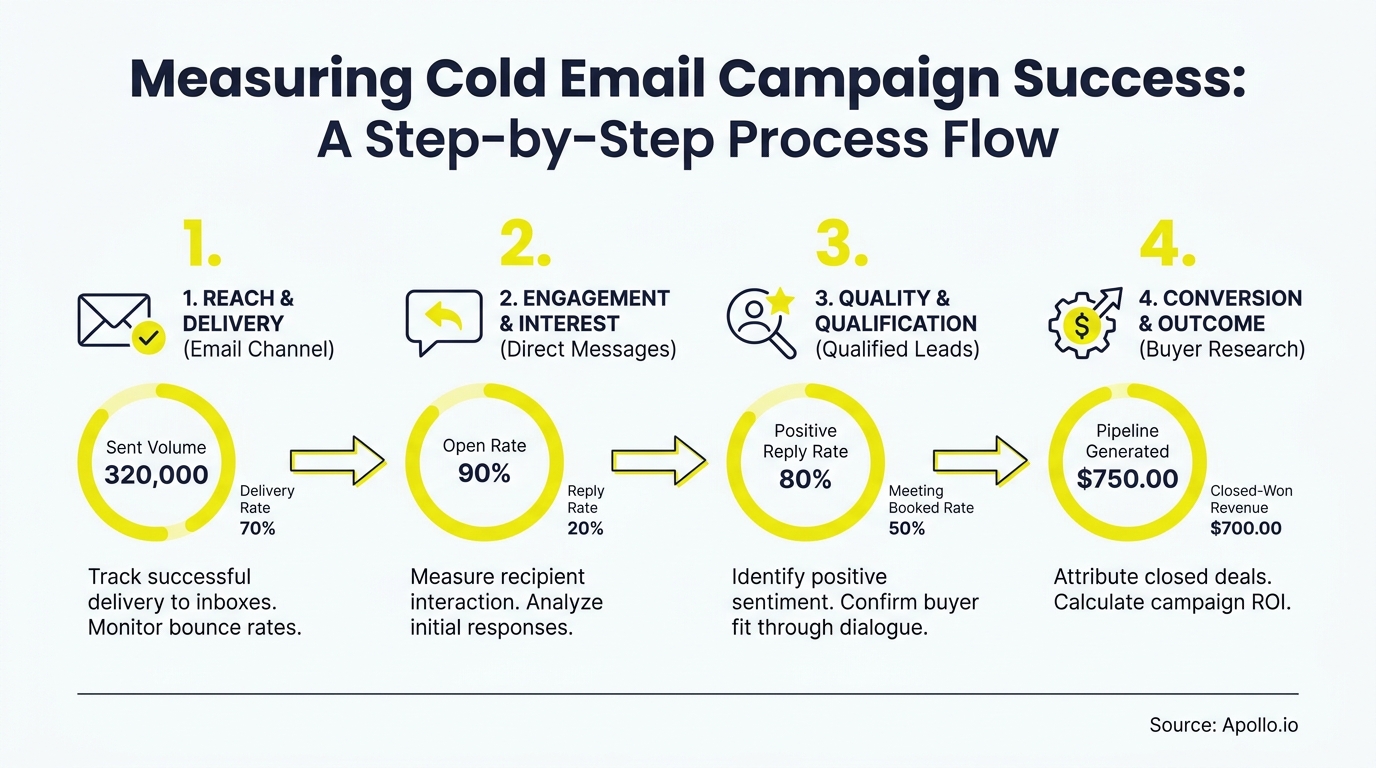
Build your measurement funnel in this order:
- Emails delivered to inbox (deliverability gate)
- Opens (directional diagnostic only)
- Total replies (engagement signal)
- Positive replies (pipeline signal)
- Meetings booked (conversion signal)
- Qualified opportunities created (revenue signal)
- Closed-won revenue (ROI signal)
RevOps leaders find that most teams have strong data at steps 1-3 and weak or missing data at steps 4-7. Closing this attribution gap requires connecting your email platform to your CRM so that every positive reply, booked meeting, and created opportunity traces back to the originating sequence and message variant.
For outbound prospecting teams building pipeline from scratch, this full-funnel view is what separates programs that generate revenue from programs that generate activity metrics. Need to track deals from first email through close? Apollo's deal management tools connect your outreach data directly to pipeline visibility.
Turn Funnel Guesswork Into Real Pipeline
Pipeline forecasting a guessing game because marketing leads never convert? Apollo surfaces in-market buyers with verified contact data so your team stops chasing dead-end leads. Top performers close more — start now.
Start Free with Apollo →What Are the Biggest Cold Email Measurement Pitfalls to Avoid?
The biggest cold email measurement pitfalls are using opt-in email marketing benchmarks to evaluate cold outreach, and optimizing copy before locking in audience fit.
Cold email and opt-in email marketing are different channels with different benchmarks. Comparing them leads to misguided conclusions:
| Metric | Opt-In Email Marketing | Cold Email Outreach |
|---|---|---|
| Open rate benchmark | 35%+ (inflated by MPP) | Diagnostic only, not a success metric |
| Primary success metric | Click-through rate | Positive reply rate |
| List source | Opted-in subscribers | Prospected contacts matching ICP |
| Compliance framework | CAN-SPAM / GDPR opt-in | CAN-SPAM legitimate interest |
| Volume strategy | Broadcast to full list | Smaller segments outperform blasts |
A commenter added in a Reddit discussiona practical diagnostic framework: "Minimum 500 emails before you judge anything. At 500 sent, check deliverability first. If under 90% are landing in inboxes, it's infrastructure not strategy. If opens are solid but reply rate is under 1%, your copy or targeting is the problem. Change one variable at a time."
The other major pitfall: scaling before validating. Sending 5,000 emails to an untested ICP wastes budget and damages domain reputation. Validate with 50-100 sends per segment, confirm positive reply rate, then scale the winners. Email personalization and tight ICP targeting are the levers that move reply rates before volume scaling makes sense.
How Can You Build a Cold Email Success Scorecard for Your Team?
A cold email success scorecard organizes your KPIs into three tiers: deliverability gates, engagement diagnostics, and revenue outcomes. Review each tier in sequence before drawing optimization conclusions.
| Tier | Metric | Target Benchmark |
|---|---|---|
| Deliverability | Inbox placement rate | Above 90% |
| Deliverability | Bounce rate | Below 3% |
| Deliverability | Spam complaint rate | Below 0.10% |
| Engagement | Open rate (diagnostic) | Directional only |
| Engagement | Total reply rate | 3%–5% average; 8%+ top performers |
| Engagement | Positive reply rate | Segment and track separately |
| Revenue | Meeting booked rate | 2%–3% for quality targeting |
| Revenue | Opportunity creation rate | Track by sequence and persona |
| Revenue | Closed-won revenue per 1,000 sends | Set internal baseline, improve quarterly |
For AEs and revenue leaders, the scorecard works best when tied to sales automation workflows that automatically route positive replies, trigger follow-up sequences, and log pipeline events. Manual tracking breaks down at scale and creates attribution gaps that undercount cold email ROI.

Start Measuring What Actually Drives Pipeline
Cold email measurement in 2026 starts with deliverability, runs through positive reply rate and meetings booked, and ends with closed revenue. Open rates are a diagnostic signal, not a success metric.
Positive reply rate is the leading indicator that separates active pipeline from vanity engagement.
The teams generating the most pipeline from cold outreach combine tight ICP targeting, verified contact data, and unified tracking across sequence, reply, meeting, and deal stages. Apollo consolidates prospecting, multi-channel sequencing, meeting scheduling, and deal tracking in one platform, so you measure the full funnel without stitching together five tools.
Schedule a Demo and see how Apollo gives your team a complete cold email measurement stack in one workspace.
Prove Pipeline ROI With Apollo
ROI pressure killing your tool budget? Apollo delivers measurable pipeline impact from day one — so you walk into every budget review with real numbers. Leadium 3x'd annual revenue. Your proof starts now.
Start Free with Apollo →Don't miss these
Sales
Inbound vs Outbound Marketing: Which Strategy Wins?
Sales
What Is a Sales Funnel? The Non-Linear Revenue Framework for 2026
Sales
What Is a Go-to-Market Strategy? The 2026 GTM Playbook
See Apollo in action
We'd love to show how Apollo can help you sell better.
By submitting this form, you will receive information, tips, and promotions from Apollo. To learn more, see our Privacy Statement.
4.7/5 based on 9,690 reviews
