
How to Measure the Accuracy and Completeness of an Enriched Data Set in 2026
Enriched data is only as valuable as its accuracy. If your enriched records contain stale job titles, invalid emails, or missing firmographics, every downstream workflow — from SDR outreach to AI-powered personalization — degrades in quality. Learning what data enrichment is and how to do it right is the first step, but measuring the output is where most teams fall short.
According to Forbes, poor data quality costs organizations an average of $12.9 million annually. That figure makes measurement a revenue protection priority, not a nice-to-have audit.

Get Verified Contacts, Skip the Research
Tired of burning hours chasing bad emails and dead-end numbers? Apollo delivers 97% accurate business contact data so your team spends time selling, not searching. Join 600K+ companies building pipeline that actually converts.
Start Free with Apollo →Key Takeaways
- Accuracy and completeness are distinct, measurable dimensions — each requires its own KPIs and acceptance thresholds.
- B2B contact data decays continuously, so accuracy scores are time-bound and require refresh SLAs, not one-time audits.
- Field-level scorecards, not aggregate coverage percentages, predict whether enriched data is truly pipeline-ready.
- Downstream validation — tracking how enriched fields affect AI outputs, deliverability, and routing — is the most reliable accuracy signal.
- RevOps and sales leaders who enforce publish-ready gates and drift monitoring protect both pipeline quality and team productivity.
What Are Accuracy and Completeness in an Enriched Data Set?
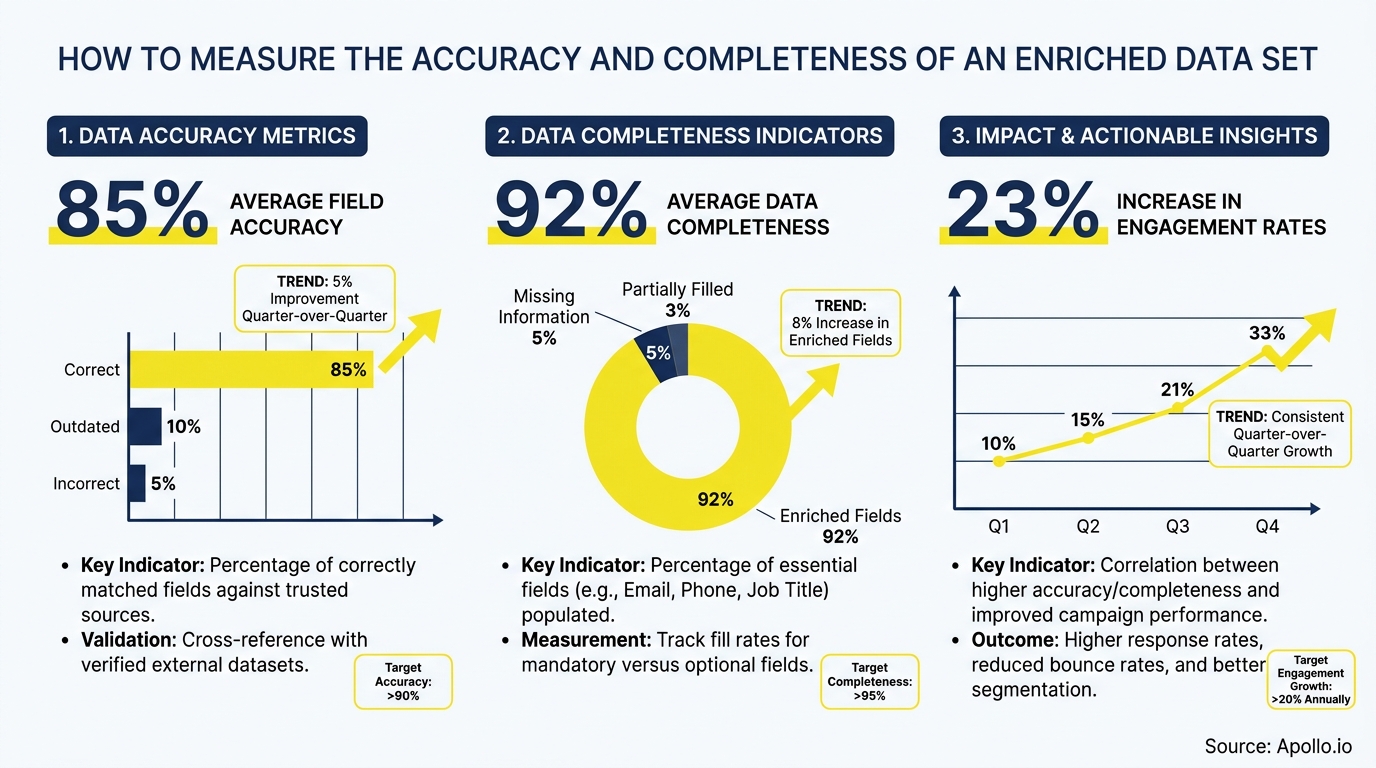
Accuracy measures how closely enriched field values match real-world truth. Completeness measures the absence of missing data across required fields. As Atlanexplains, these are distinct data quality dimensions: completeness tracks whether essential data exists, while accuracy tracks whether existing data is correct.
These two dimensions are often conflated. A record can be 100% complete but entirely inaccurate — for example, a contact with every field populated but an outdated title and a defunct email address.
Both dimensions need independent measurement frameworks.
- Accuracy: Does the email resolve? Does the job title match the contact's current role? Is the company HQ correct?
- Completeness: Are required fields populated (email, title, company, industry, employee count, phone)?
- Freshness: When was each field last verified? Fields older than your SLA threshold should be treated as incomplete.
How Do You Build a Field-Level Measurement Framework?
A field-level scorecard is the most reliable way to measure enriched data quality because it weights fields by revenue impact rather than treating all fields equally. Stop relying on a single aggregate coverage percentage — it hides the gaps that actually break pipelines.
Here is a practical scorecard structure for B2B GTM teams:
| Field | Measurement Method | Acceptance Threshold | Use Case Weight |
|---|---|---|---|
| Business email | Bounce rate testing | <1% bounce rate | Critical (SDR, ABM) |
| Job title | Spot-check vs. current profile | >90% match rate | Critical (routing, personalization) |
| Company name | Domain match validation | >95% match rate | High (all motions) |
| Industry code | Sample audit vs. ground truth | >85% match rate | High (segmentation, AI personalization) |
| Employee count | Cross-reference with firmographic sources | Within 20% of verified range | Medium (ICP scoring) |
| Direct dial | Phone verification calls on sample | >80% connect rate | High (SDR outbound) |
As noted by Landbase, direct verification methods include email bounce rate testing (targeting below 1%), phone verification calls, and validating job titles and company statuses — all of which should be part of your regular measurement cadence.
Tired of enriching contacts only to watch emails bounce? Start free with Apollo's 230M+ verified business contacts and 97% email accuracy.

Why Does Enriched Data Decay — and How Do You Monitor It?
Enriched data accuracy has an expiration date because B2B contacts change roles, companies, and contact details continuously. According to Cleanlist, B2B contact data decays at an average rate of 2.1% per month, amounting to 22.5% annually.
This means a dataset that was 95% accurate at enrichment time may fall to roughly 73% accuracy within a year — without a single field being touched. Treating accuracy as a static score is one of the most common measurement mistakes RevOps teams make.
Drift monitoring practices that work:
- Tag each enriched field with a verified-on timestamp and flag records that exceed your SLA window (e.g., 90 days for email, 180 days for firmographics).
- Run weekly sampling on a 200-record truth set to track accuracy half-life by field type.
- Trigger re-enrichment workflows automatically when records cross the staleness threshold.
- Log incidents when stale data causes deliverability failures or routing errors, and run postmortems to trace root cause to specific fields.
A data engineer shared a firsthand perspective on Redditthat accuracy defects in enriched data cascade far beyond the original field: a single misclassified identifier propagated across multiple business objects, creating compounding errors in downstream reporting. Field-level validation prevents exactly this kind of silent data rot.
Turn Funnel Guesswork Into Real Pipeline
Pipeline forecasting a guessing game because leads stall before they ever reach your AEs? Apollo surfaces high-intent prospects and keeps your funnel moving with verified contacts. 600K+ companies finally forecast with confidence.
Start Free with Apollo →How Do RevOps Teams Enforce Publish-Ready Data Gates?
RevOps teams enforce publish-ready status by defining minimum completeness thresholds per motion and blocking records from entering sequences, routing, or AI workflows until those thresholds are met. Gating is not just a data hygiene practice — it is a pipeline protection mechanism.
Sample gate thresholds by use case:
- SDR outbound sequences: Verified email + job title + company name required. No gate bypass.
- ABM campaigns: Full firmographic set required (industry, HQ, employee count, revenue range) plus buying committee coverage.
- AI personalization: Persona-mapped fields (industry, title seniority, technographic signals) must meet completeness threshold before content variant is assigned.
- CRM routing: Territory-defining fields (company size, geo, industry) must be present and within SLA freshness window.
For SDRs and BDRs, routing a contact with an outdated title to the wrong sequence wastes outreach capacity and damages sender reputation. For AEs managing larger accounts, incomplete firmographics mean inaccurate territory assignment and missed quota attribution.
Building gates into the CRM workflow eliminates both failure modes.
A commenter added in a Reddit discussion that their team enforces categorical checks — for example, ensuring state fields contain no more than 50 unique entries and that timestamps never exceed the current date. These lightweight automated rules catch a surprising volume of enrichment errors before they reach production systems.
Want to build a data enrichment strategy that includes built-in quality gates? Apollo's enrichment platform supports field-level verification across 65+ data attributes.
How Does Poor Enrichment Quality Affect AI and Downstream Workflows?
Poor enrichment quality directly degrades AI outputs because AI models use enriched fields as the context for personalization, segmentation, and routing decisions. A wrong industry code assigns the wrong content variant.
An outdated title sends a C-suite sequence to a mid-level manager. These are not edge cases — they are systematic failures when measurement is absent.
For GTM teams using AI-assisted outreach or content personalization, field-level accuracy in the enriched dataset is a prerequisite, not an enhancement. Downstream validation — monitoring bounce rates, connect rates, and routing accuracy as proxies for data quality — gives teams a real-world accuracy signal that spot checks alone cannot provide.
Enrichment quality also affects the ROI of contact data enrichment directly. Clean, complete records reduce wasted outreach, improve deliverability, and increase the proportion of records that are usable for a given motion.
What Governance Cadence Should Teams Follow in 2026?
A practical governance cadence combines automated checks with periodic human-reviewed audits. This keeps measurement lightweight enough for RevOps teams to sustain without becoming a manual QA bottleneck.
| Cadence | Activity | Owner |
|---|---|---|
| Weekly | 200-record sample accuracy check; bounce rate review; SLA breach alerts | RevOps |
| Monthly | Field-level completeness scorecard review; re-enrichment triggers for decayed records | RevOps / Data Ops |
| Quarterly | Ground-truth audit (match enriched fields against verified external sources); SLA renegotiation with enrichment vendors | RevOps / Sales Ops leadership |
| Post-incident | Postmortem when data defect causes routing failure, deliverability spike, or AI personalization error | RevOps + affected team lead |
This cadence aligns with the best practices for data enrichment and cleansing that high-performing GTM teams use to maintain a single source of truth across CRM and outreach systems.

How Do You Get Started Measuring Enriched Data Quality Today?
Start with a 200-record truth set sampled from your active pipeline. Measure accuracy field by field against a ground-truth source.
Calculate completeness as the percentage of required fields populated per motion. Set SLA thresholds, document them, and build automated alerts for breaches.
That single exercise will reveal more about your enrichment quality than any vendor accuracy claim.
Apollo's CRM enrichment tool verifies and enriches records across 65+ data attributes — so your field-level scorecards start from a higher baseline and require less remediation over time. With 97% email accuracy and 230M+ contacts, Apollo gives B2B GTM teams the verified foundation their measurement frameworks need.
Ready to stop guessing at data quality? Request a Demo and see how Apollo's enrichment platform keeps your data accurate, complete, and pipeline-ready.
Prove Pipeline ROI Before Next QBR
Budget approval stuck on unclear metrics? Apollo delivers measurable pipeline impact from day one — so you walk into every QBR with proof, not promises. Leadium 3x'd annual revenue. You're next.
Start Free with Apollo →Don't miss these
Sales
Inbound vs Outbound Marketing: Which Strategy Wins?
Sales
What Is a Sales Funnel? The Non-Linear Revenue Framework for 2026
Sales
What Is a Go-to-Market Strategy? The 2026 GTM Playbook
See Apollo in action
We'd love to show how Apollo can help you sell better.
By submitting this form, you will receive information, tips, and promotions from Apollo. To learn more, see our Privacy Statement.
4.7/5 based on 9,690 reviews
