
How to Manage Lead Data and Ensure It Stays Updated Over Time
Your CRM is aging like milk. Every quarter you don't refresh it, roughly one in four records drifts toward inaccuracy, costing your team bounced emails, misdirected calls, and wasted pipeline. Learning how to manage lead data and ensure it stays updated over time is no longer optional for B2B GTM teams — it's a revenue protection strategy. Apollo's sales intelligence platform was built specifically to solve this problem at scale, combining a 230M+ contact database with continuous enrichment in one workspace.

Verify Every Lead Before You Dial
Tired of burning hours on leads that bounce or go nowhere? Apollo delivers 97% email accuracy so your team reaches real buyers — not dead ends. Start building pipeline that actually converts.
Start Free with Apollo →Key Takeaways
- B2B contact data decays at approximately 2.1% per month, meaning a significant portion of your database becomes inaccurate every year without active maintenance.
- Poor data quality carries a massive financial cost for U.S. businesses, making ongoing enrichment one of the highest-ROI investments in your GTM stack.
- Different fields decay at different rates — email addresses need near-continuous verification, while firmographics can be refreshed quarterly.
- Stale lead data directly harms email deliverability: inbox placement and spam complaint rates are now tied to list hygiene under Gmail and Yahoo sender requirements.
- RevOps leaders who implement a field-level refresh cadence and governance model see measurable improvements in attribution reliability and rep efficiency.
Why Does Lead Data Decay So Fast?
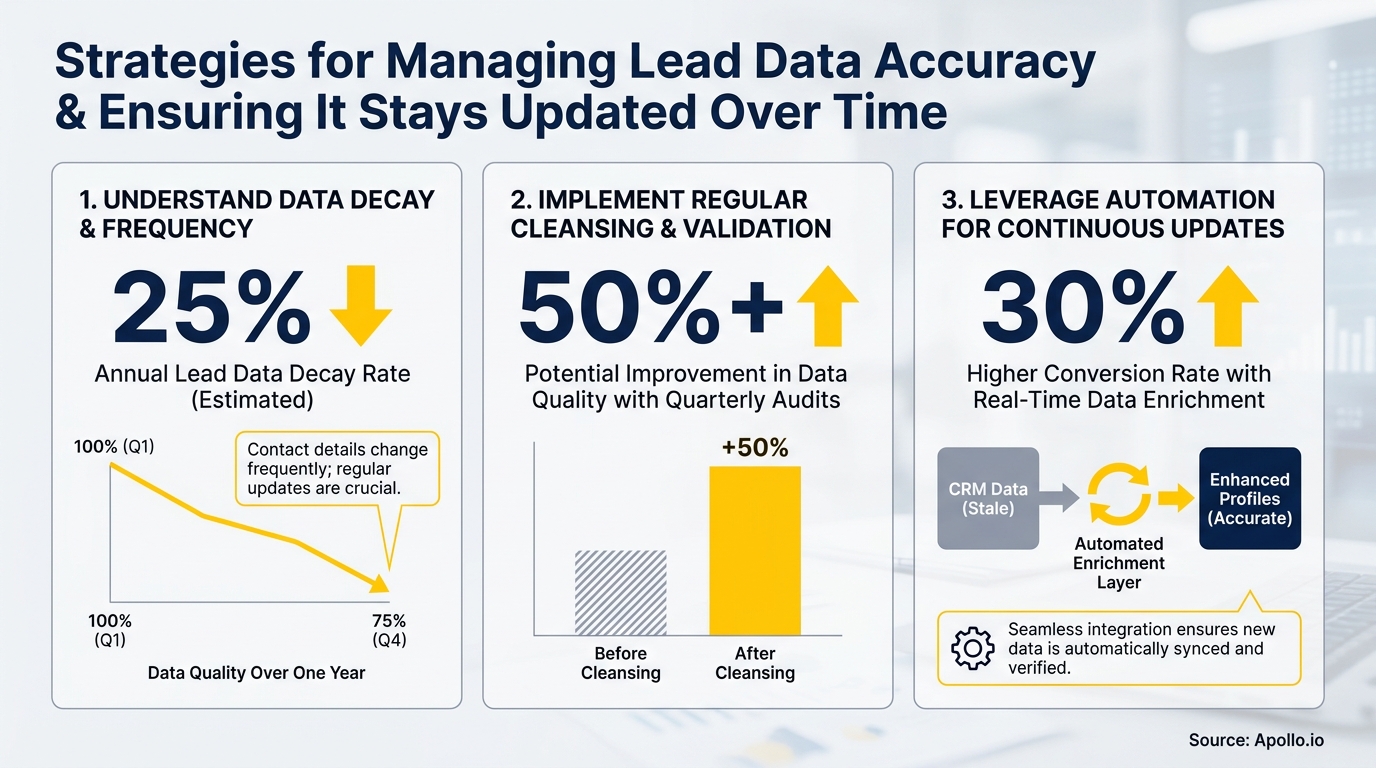
B2B lead data decays because professionals change jobs, get promoted, switch companies, and update contact details constantly. According to research cited by Landbase, some studies indicate a monthly decay rate of 2.1% — meaning roughly a quarter of your database becomes inaccurate within a year. And data from Integrateputs the broader financial impact in stark terms: poor data quality costs U.S. businesses an estimated $3.1 trillion annually.
For SDRs and AEs, this decay translates directly into hard bounces, wrong-number dials, and personalization errors that damage sender reputation. As AI adoption scales across revenue teams, stale records compound the problem — bad data fed into automation produces bad outreach at scale.
What Is a Field-Level Refresh Cadence?
A field-level refresh cadence maps each data field to the frequency it needs to be re-verified, based on how quickly that field type changes in the real world. Not all fields decay equally — email addresses shift faster than company headquarters addresses.
| Field | Recommended Cadence | Rationale |
|---|---|---|
| Work email | Continuous / before each send | Job changes invalidate email instantly; deliverability depends on it |
| Job title / role | Quarterly | Promotions and reorgs happen frequently; affects personalization and routing |
| Firmographics (revenue, headcount) | Semi-annual | Company growth stages shift; affects ICP scoring and segmentation |
| Industry / vertical | Annual | Rarely changes; high cost to re-verify frequently |
| Direct phone / mobile | Quarterly | Changes with job transitions; critical for call-based SDR workflows |
This field-level thinking mirrors how the U.S. Census Bureau's Business Register operates — continuously updated, with frequency varying by data item based on how fast each element changes. Apply the same logic to your CRM.
How Does Stale Data Hurt Email Deliverability?
Stale lead data is a deliverability threat, not just a personalization problem. Hard bounces from outdated email addresses signal poor list hygiene to mailbox providers, eroding sender reputation and reducing inbox placement rates over time.
Gmail and Yahoo's bulk-sender requirements now enforce spam complaint thresholds below 0.3% (with best practice well below 0.1%), DMARC alignment, and one-click unsubscribe — all of which become harder to maintain when your list is full of stale records.
For teams running high-volume outbound sequences, this makes email verification before every send a non-negotiable step. Data cleansing and enrichment done on a rolling basis protects sender reputation and ensures your outreach actually reaches inboxes.
Struggling with bounce rates and stale contacts? Keep your contact records fresh with Apollo's continuous data enrichment.
Turn Funnel Guesswork Into Pipeline Clarity
Forecasts unreliable because leads stall before becoming opportunities. Apollo surfaces high-intent prospects and keeps your pipeline moving with real data. Join 600K+ companies forecasting with confidence.
Start Free with Apollo →How Should RevOps Leaders Govern Lead Data Quality?
RevOps leaders should establish a Lead Data Governance model that defines ownership, SLAs, and audit processes for each data field — not just a quarterly cleanup project. Governance turns data hygiene from a one-time task into a repeatable operating system.
A practical governance framework includes four components:
- RACI ownership: Assign a data steward (typically RevOps) accountable for each field category. SDRs flag stale records during prospecting; AEs update deal-stage fields after discovery calls.
- Definition of done: Each field has a clear standard — for example, "email is verified within 30 days" or "job title matches contact's current role as of last enrichment."
- Audit trail: Log when each field was last verified and by what source. This supports attribution reliability and compliance traceability.
- Suppression management: Unsubscribes and opt-outs must propagate across all connected systems within 24 hours to avoid compliance exposure.
When governance is absent, measurement suffers too. Teams without trustworthy lead data lose confidence in their attribution models, making it harder to know which channels and campaigns actually drive pipeline.
A clean, governed dataset is the foundation of reliable revenue reporting.

What Tools Help Automate Lead Data Updates?
The most effective approach to keeping lead data current combines automated enrichment, intent signals, and CRM-native workflows — replacing one-off list uploads with always-on refresh. Manual quarterly data projects can't keep pace with the rate of change in B2B contact data.
Key capabilities to look for in your toolset:
- Continuous auto-enrichment: Triggers re-verification when a contact's record crosses a freshness threshold, without manual intervention.
- Event-driven updates: Enriches a record when a trigger fires — a job change signal, a form fill, or an inbound website visit — rather than on a fixed schedule only.
- Waterfall enrichment: Queries multiple data sources in sequence to maximize field coverage when one source lacks a value.
- Intent data integration: Overlays buyer intent signals onto existing records to prioritize which contacts to re-engage first. Learn more about how intent data powers smarter B2B sales.
- Duplicate detection and merging: Prevents the same contact from existing in multiple states across your CRM and engagement tools.
Apollo consolidates prospecting, enrichment, engagement, and data governance into one platform. As Census noted: "Having everything in one system was a game changer." Rather than stitching together separate data vendors, enrichment tools, and sequence platforms, teams using Apollo work from a single source of truth. Building a data enrichment strategy is far simpler when enrichment is native to your prospecting and outreach workflow.
Working from a fragmented stack with outdated records? Enrich and verify your CRM contacts automatically with Apollo.
How Do SDRs and AEs Keep Their Pipelines Clean in Practice?
SDRs and AEs are the first line of defense against stale lead data — they interact with contacts daily and can flag inaccuracies in real time. The challenge is building that feedback loop into their workflow without adding manual burden.
Practical steps for reps:
- Use a verified prospecting list built from enriched, recently-verified records rather than static CSV exports.
- Flag any bounced email or disconnected number immediately back to the CRM record — don't just move on.
- Check enriched contact profiles before high-priority calls or emails to confirm title and company are still current.
- Use job-change alerts to trigger re-engagement sequences when a known contact moves to a new company — a warm signal for new pipeline.
For RevOps leaders supporting these teams, the goal is to make keeping data clean the path of least resistance. When verification is embedded in the prospecting and sequencing workflow, reps don't have to think about it separately.
How Do You Build a 90-Day Lead Data Refresh Plan?
A 90-day rollout plan gives GTM teams a structured path from reactive cleanup to proactive, ongoing data governance. Start small, prove ROI, then scale.
- Days 1-30 (Audit and baseline): Run a full CRM audit. Identify the percentage of records missing key fields (email, title, phone). Set a freshness baseline — what percentage of contacts were verified within the last 90 days?
- Days 31-60 (Prioritize and enrich): Enrich your highest-priority segments first: active pipeline, top ICP accounts, and any contacts in active sequences. Verify all emails before the next send cycle. Review your contact data enrichment approach to confirm it covers all key fields.
- Days 61-90 (Automate and govern): Implement field-level SLAs and assign ownership. Configure auto-enrichment triggers for job-change events and new inbound leads. Set up a monthly data health dashboard to track field completeness, bounce rates, and enrichment coverage over time.
Teams that complete this cycle consistently report cleaner pipelines, better deliverability, and more trustworthy attribution data. The goal isn't a perfectly clean database on day one — it's a system that keeps data fresh automatically, month after month.

Start Managing Lead Data the Right Way in 2026
Managing lead data over time requires a shift from periodic cleanup to continuous governance. Define field-level refresh cadences, automate enrichment triggers, govern ownership with clear SLAs, and protect deliverability by verifying contacts before every send cycle.
Apollo gives B2B GTM teams — from SDRs to RevOps leaders — a unified platform to prospect, enrich, engage, and keep data fresh without juggling multiple vendors. Trusted by nearly 100,000 paying customers including Anthropic, Redis, and Smartling, Apollo replaces the complexity of a fragmented data stack with one workspace for everything.
Start Prospecting — build your list, enrich your CRM, and keep your lead data accurate from day one.
Prove Pipeline ROI With Apollo
ROI pressure killing your tool budget? Apollo delivers measurable pipeline impact from day one — quantifiable wins your leadership can't argue with. Leadium 3x'd revenue. You're next.
Start Free with Apollo →Don't miss these
Sales
Inbound vs Outbound Marketing: Which Strategy Wins?
Sales
What Is a Sales Funnel? The Non-Linear Revenue Framework for 2026
Sales
What Is a Go-to-Market Strategy? The 2026 GTM Playbook
See Apollo in action
We'd love to show how Apollo can help you sell better.
By submitting this form, you will receive information, tips, and promotions from Apollo. To learn more, see our Privacy Statement.
4.7/5 based on 9,690 reviews
