
How to Ensure AI-Generated Recommendations Align With Your Strategy
Your AI recommendation engine may be your most active GTM contributor in 2026 — but is it working toward your strategy or against it? According to Martechcube, sales organizations that give sellers AI-enabled next-best actions are 2.6x more likely to achieve commercial growth. The catch: those recommendations only create value when they are grounded in your actual strategy, not generic patterns.
This guide gives B2B GTM teams — from RevOps and SDRs to AEs and revenue leaders — a practical framework for encoding strategy into AI systems, scoring outputs before they reach reps, and building human approval workflows that scale. If you are serious about selling with AI rather than just using it, start here.

Scale Smarter, Not Harder With Apollo
Tired of manual research eating your selling time? Apollo automates lead generation so your team spends hours closing, not hunting. 600K+ companies already scaled their pipeline without adding headcount.
Start Free with Apollo →Key Takeaways
- AI recommendations only drive commercial growth when they are explicitly grounded in your ICP, funnel objectives, and brand constraints — not left to generic model defaults.
- The gap between AI adoption and measurable business impact is a governance problem, not a technology problem.
- A Strategy-Fit Gate — a scoring rubric with pass/fail thresholds and human approval steps — is the most practical way to filter misaligned outputs before they reach reps.
- RevOps leaders must treat AI recommendation logic the same way they inspect territory design and pipeline stages: with defined rules, audit trails, and override rights.
- Ungoverned AI in GTM workflows carries real enterprise risk; distributed governance, embedded at the team level, is the 2026 standard.
Why Do AI Recommendations Drift from Strategy?
AI recommendations drift from strategy when the inputs fed to the model do not reflect your actual go-to-market priorities. Most AI tools default to pattern-matching on historical data — which encodes past behavior, not future intent.
If your ICP has shifted, your pricing model changed, or you entered a new segment, the model is still optimizing for yesterday's playbook.
A data scientist shared a firsthand perspective on Redditthat captures this perfectly: after being asked to build an AI strategy, their team produced a vague mandate about LLMs improving efficiency. Leadership loved it. Nothing changed for months because there was no concrete business problem attached to it. Vague strategy produces misaligned recommendations.
Research from RSM US shows that 92% of executives experienced challenges with AI implementation, and 62% said generative AI was harder to implement than expected. The root cause is almost always misaligned inputs, not model quality.
What Strategy Inputs Should You Encode into AI Systems?
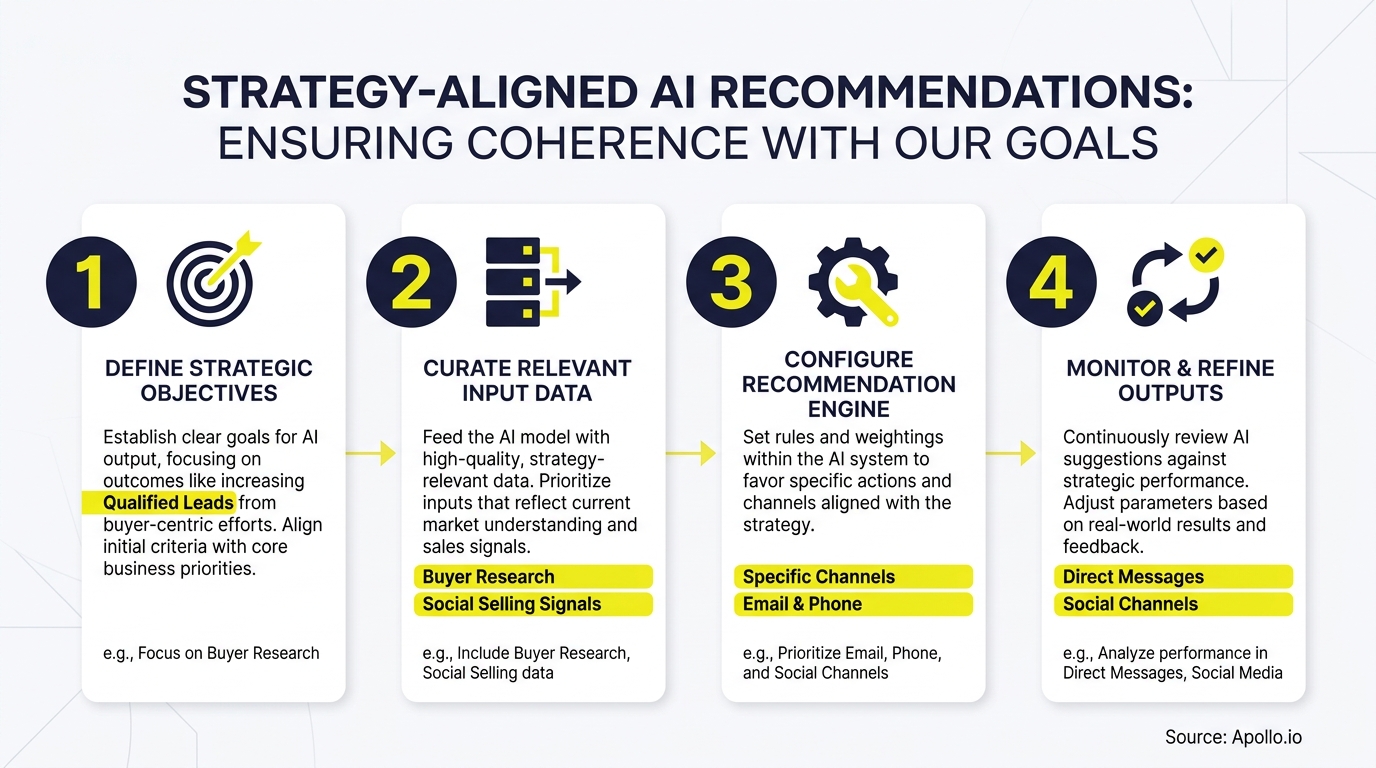
To keep AI recommendations strategy-aligned, you must make your strategy machine-readable before the model generates any output. This is not a one-time prompt — it is a structured context layer that governs every recommendation.
The core strategy inputs to encode include:
- ICP definition: Industry, company size, tech stack, revenue range, buying signals, and disqualifying attributes
- Funnel stage objectives: Awareness, consideration, and decision-stage KPIs tied to pipeline targets
- Brand and voice constraints: Approved messaging, tone guidelines, proof points, and off-limits claims
- Risk boundaries: Regulatory constraints, competitor mention rules, pricing claim restrictions
- Deal-stage criteria: What qualifies a lead to advance, what triggers disqualification, and what requires human review
For teams building a winning GTM plan, this context layer becomes the foundation for every AI-assisted workflow — from prospecting filters to messaging generation to pipeline prioritization. Pair it with a strong data enrichment strategy so the inputs stay current as your market evolves.

How Does a Strategy-Fit Gate Work?
A Strategy-Fit Gate is a scoring rubric that evaluates each AI-generated recommendation against your encoded strategy inputs before that recommendation reaches a rep or triggers an action. It replaces ad hoc human review with a structured, repeatable process.
Here is a practical scoring rubric for B2B GTM teams:
| Criterion | Weight | Pass Threshold | Fail Action |
|---|---|---|---|
| ICP fit (firmographic + technographic match) | 30% | Score ≥ 7/10 | Reject / re-filter |
| Funnel stage alignment | 20% | Matches current stage objective | Reroute to correct stage |
| Brand and message compliance | 20% | Zero prohibited claims | Escalate to marketing review |
| Risk boundary check | 20% | No regulatory or legal flags | Escalate to legal / enablement |
| ROI or outcome tie | 10% | Linked to a measurable KPI | Return for revision |
Recommendations scoring below 70% overall go to human review before deployment. Recommendations scoring above 70% on all individual criteria can be auto-approved for lower-stakes workflows.
High-stakes outputs — outbound sequences, pricing proposals, executive briefings — require a human sign-off regardless of score.
Struggling to keep your pipeline targets aligned with AI-surfaced accounts? Build a strategy-aligned sales pipeline with Apollo's qualification filters so only ICP-fit prospects enter the funnel in the first place.
Turn Funnel Guesswork Into Real Pipeline
Pipeline forecasting a guessing game because leads stall before they ever become opportunities? Apollo surfaces high-intent buyers so your team works deals that convert. Top performers close more — not by working harder, but by starting smarter.
Schedule a Demo →How Should RevOps Leaders Build a Human Approval Workflow?
RevOps leaders should build human approval workflows that match the risk level of each recommendation type, not apply blanket review to everything. Blanket review creates bottlenecks; zero review creates risk.
A tiered approval model works as follows:
- Tier 1 — Auto-approve: ICP-matched contact lists, enrichment updates, meeting summaries. Low stakes, high volume.
- Tier 2 — Manager review: Outbound sequences, account prioritization changes, persona targeting shifts. Medium stakes.
- Tier 3 — Cross-functional sign-off: Pricing recommendations, competitive positioning, new segment targeting, executive-level messaging. Requires sales, marketing, and legal alignment.
This structure reflects what Forrester warned about in its 2026 B2B predictions: traditional top-down governance is inadequate for AI embedded in day-to-day GTM workflows. Distributed governance — where sales managers, campaign owners, RevOps, and legal all hold defined approval rights — is the practical answer.
A commenter added in a Reddit discussionthat the clearest way to demonstrate AI value is to run the math: AI team plus infrastructure costs should be less than the cost of the manual alternative. That same logic applies to approval workflows — automate what is low-risk and cheap to check, escalate what is high-stakes and costly if wrong.
How Do SDRs and AEs Apply Strategy-Fit Checks in Practice?
SDRs and AEs apply strategy-fit checks by treating AI recommendations as a first draft, not a final instruction. The role of the rep is to validate context that the model cannot see: relationship history, recent call sentiment, deal-specific nuance, and competitive dynamics in a specific account.
For SDRs, the practical checklist before acting on an AI-generated outreach recommendation:
- Does the prospect match the current ICP definition (not last quarter's)?
- Is the recommended message consistent with approved brand voice?
- Does the recommended channel and timing match what intent signals suggest?
For AEs managing active deals, strategy-fit validation means checking whether the AI-recommended next-best action aligns with the deal stage, the buyer committee's stated priorities, and the account plan. Intent data is a critical input here — it tells reps whether the AI's timing recommendation reflects real buyer activity or a stale signal.
According to TryKondo, 83% of sales teams using AI reported revenue growth. The differentiator among those teams is not the AI tool — it is whether reps know when to trust, challenge, or override the recommendation.
Want AI-generated outreach that is already grounded in verified contact data and ICP filters before it reaches your reps? Explore Apollo's AI sales automation, which connects prospecting, enrichment, and sequencing in one governed workspace.
What Governance Checklist Should B2B Teams Use in 2026?
B2B teams should use a governance checklist that covers inputs, outputs, approval rights, and audit trails — applied at the workflow level, not just the policy level. This is the practical translation of frameworks like NIST AI RMF into day-to-day GTM operations.
AI Recommendation Governance Checklist for 2026:
- Strategy inputs are documented and version-controlled (ICP, personas, messaging rules, risk constraints)
- Each AI workflow has a named owner with defined approval authority
- Pass/fail thresholds are set per recommendation type, not applied universally
- High-stakes outputs require cross-functional sign-off before deployment
- All AI-generated outputs are logged with timestamps, model version, and approver identity
- Override decisions are recorded with a reason code for model feedback
- Governance rules are reviewed quarterly or when ICP, product, or market conditions change
According to Digital Commerce 360, 91% of B2B companies plan to increase AI spending over the next 12 months. Without a governance checklist embedded in those workflows, that investment produces recommendations that are fast but not strategic. Pair this checklist with a clear B2B marketing funnel framework so every AI-assisted workflow is anchored to a funnel-stage objective.
How Do You Measure Whether AI Recommendations Are Actually Aligned?
Measure AI recommendation alignment by tracking outcome metrics at each funnel stage, not just output volume. The question is not how many recommendations the AI generated — it is how many of those recommendations, when acted on, produced the intended strategic outcome.
Key alignment metrics by role:
- SDRs: Meeting-booked rate on AI-recommended sequences vs. manually selected sequences
- AEs: Win rate on AI-prioritized accounts vs. rep-selected accounts
- RevOps: Pipeline coverage accuracy when AI-recommended ICP filters are applied
- Marketing: Content engagement and conversion rate on AI-generated vs. human-written assets
Review these metrics monthly against your strategic KPIs. When AI recommendations consistently underperform on a specific metric, trace the failure to its input: the ICP definition is stale, the scoring rubric weight is miscalibrated, or a risk boundary is too broad.
Fix the input, not just the prompt.

Conclusion: Make Your Strategy the Operating System for AI
Keeping AI-generated recommendations aligned with your strategy is an ongoing operating discipline, not a one-time setup task. Encode your ICP, funnel objectives, brand constraints, and risk boundaries as structured inputs.
Score every output against those inputs with a Strategy-Fit Gate. Route approvals by risk tier.
Measure alignment by outcome, not volume.
The teams winning with AI in 2026 are not the ones with the most sophisticated models — they are the ones that have made their strategy legible to machines and kept humans in the loop where judgment matters most. Apollo gives B2B GTM teams a unified workspace where prospecting data, AI-powered messaging, and pipeline workflows are governed in one place, so recommendations start aligned by design.
Start Free with Apollo and build a GTM motion where every AI recommendation is grounded in your strategy from the first signal to the closed deal.
Prove Pipeline ROI From Day One
ROI pressure killing your tool adoption? Apollo ramps new reps faster with scalable, repeatable workflows built for entire teams. 600K+ companies see measurable pipeline impact — without the guesswork.
Start Free with Apollo →Don't miss these
Sales
Inbound vs Outbound Marketing: Which Strategy Wins?
Sales
What Is a Sales Funnel? The Non-Linear Revenue Framework for 2026
Sales
What Is a Go-to-Market Strategy? The 2026 GTM Playbook
See Apollo in action
We'd love to show how Apollo can help you sell better.
By submitting this form, you will receive information, tips, and promotions from Apollo. To learn more, see our Privacy Statement.
4.7/5 based on 9,690 reviews
