
How to Maintain Consistent Outreach Messaging Across Teams
Your SDR sends one value prop. Your AE delivers another on the discovery call. Your marketing site says something different entirely. By the time a buyer reaches a decision, they've received three conflicting stories from the same company. According to Allego, 69% of B2B buyers report significant discrepancies between the information on a vendor's website and the messages delivered by their sales reps. That gap costs deals.
This guide gives you a practical operating system for maintaining consistent outreach messaging across SDR, AE, marketing, and CS teams, from building a shared message library to running drift audits and measuring what's working.

Scale Smarter With Apollo's GTM Engine
Tired of inconsistent processes slowing your team's growth? Apollo standardizes your outreach with verified contacts and AI-powered workflows. Join 600K+ companies building predictable pipeline at scale.
Start Free with Apollo →Key Takeaways
- Message inconsistency is a buyer-trust problem, not just a brand problem. Conflicting claims across channels erode confidence and stall deals.
- Most inconsistency stems from process gaps, not tool gaps: no shared targeting criteria, no agreed sequence structure, and no review rhythm.
- A centralized message library with approved claims, persona value props, and stage-specific proof points is the foundation of any consistency system.
- Aligned sales and marketing teams are 67% better at closing deals, making cross-team governance a direct revenue lever.
- AI scales outreach volume fast, but without approved message guardrails, it also scales inconsistency. Governance must come first.
Why Does Outreach Messaging Go Inconsistent Across Teams?
Outreach messaging goes inconsistent because each team builds its own assets in isolation, with no shared source of truth. Marketing writes website copy and ads.
Product marketing creates decks. SDRs write their own email sequences.
AEs develop talk tracks on the fly. None of these are formally reconciled.
A sales professional wrote on Redditthat the inconsistency usually comes from three things: no standardized targeting criteria so everyone builds lists differently, no agreed sequence structure so everyone writes different emails at different intervals, and no weekly review rhythm so nobody catches problems until results are already bad. That diagnosis is accurate for most GTM teams.
The structural problem is deeper than process. Research from The Growth Syndicate shows aligned organizations achieve 2.4x higher revenue growth than misaligned peers. Yet most B2B commercial teams collaborate formally on only a fraction of their shared activities. Misalignment is the default, not the exception.
What Does a Message Drift Audit Look Like in Practice?
A message drift audit is a structured review that compares claims, value props, and proof points across every customer-facing asset to identify contradictions and gaps. Run it quarterly, or any time you launch a new product, reposition, or hire a new cohort of SDRs.
Here is a practical checklist:
| Asset Type | What to Check | Owner |
|---|---|---|
| Website homepage and pricing page | Core value prop, key claims, ICP language | Marketing |
| SDR email sequences | Subject lines, opening hooks, proof points, CTAs | Sales Enablement |
| AE talk tracks and demo scripts | Pain framing, differentiators, objection responses | Sales Leadership |
| Marketing ads and nurture emails | Headline claims, offer language, persona alignment | Demand Gen |
| CS onboarding and renewal messaging | Value reinforcement, expansion framing | Customer Success |
The audit output should be a simple conflict log: where do assets contradict each other, where are claims missing proof, and where does buyer-stage alignment break down. Assign a message owner for each asset category with a clear SLA for updates after any product or positioning change.

How Do SDRs and AEs Keep Messaging Aligned Across the Funnel?
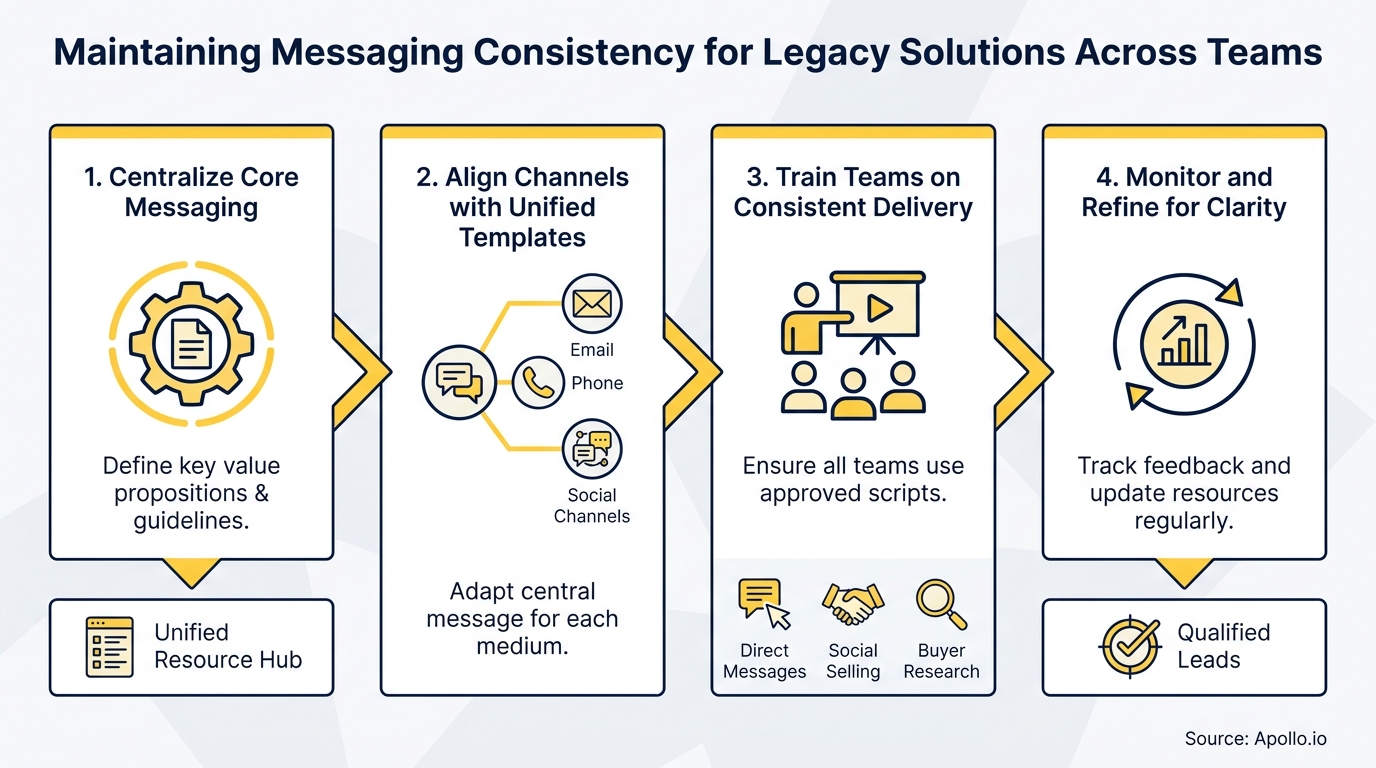
SDRs and AEs stay aligned when they work from the same approved message library, not from individually saved email drafts or outdated slide decks. The library should contain: a core narrative (the one-sentence company story), persona-specific value props, stage-specific proof points, and approved objection responses.
For SDRs, consistency means every sequence uses the same ICP framing and the same approved claims, regardless of who wrote the original template.
For AEs, it means demo scripts and talk tracks reference the same differentiators SDRs used to book the meeting.
When these two teams use different language, buyers notice.
As BrandRusso notes, inconsistent messages erode the trust that B2B relationships depend on, creating hesitation that kills sales opportunities.
Struggling to keep your team's outreach coordinated and on-message? Apollo's multi-channel sales engagement platform lets teams share sequences, templates, and approved messaging in one workspace, so every rep sends the right message at the right stage.
A strong cross-functional team structure formalizes this alignment. Schedule a monthly message sync between marketing, sales enablement, and sales leadership. Review top-performing and bottom-performing sequences together. Update the shared library based on what the data shows.
Turn Funnel Guesswork Into Real Pipeline
Pipeline forecasting a guessing game because leads stall before they ever become opportunities? Apollo surfaces high-intent prospects and keeps your funnel moving with verified contacts. Top teams close more — start yours today.
Start Free with Apollo →How Should Teams Personalize Without Breaking Message Consistency?
Consistent personalization means keeping the core narrative stable while swapping in persona-specific proof and context. The structure stays the same; only the evidence layer changes.
Use this model:
- Core narrative (locked): The company story, primary value prop, and key differentiators. These do not change by rep or by channel.
- Persona layer (variable): Pain points, use cases, and proof points specific to the buyer's role, industry, or stage.
- Signal layer (dynamic): Recent trigger events, intent signals, or account-specific context that makes the message timely.
A Reddit user shared a firsthand perspectivethat personalizing each email with something specific to the prospect nearly doubled their team's reply rate. The key insight: personalization does not require abandoning a consistent structure. It requires building a structure flexible enough to carry personalized evidence without drifting off-message.
According to Sopro, sales teams see a positive ROI when using personalization in cold email campaigns for nearly 9 out of 10 teams. Personalization works best when it sits inside a consistent framework, not when it replaces one.
Tools like intent data give teams the signal layer they need to personalize without guessing. When reps know why an account is in-market, they can select the right proof point from the approved library rather than writing something new from scratch.
What Are the AI Guardrails Teams Need for Messaging Governance in 2026?
AI guardrails for messaging governance are the policies, approved content libraries, and review workflows that prevent AI-generated outreach from drifting outside approved claims. In 2026, this is not optional. A Forrester analysis warned that ungoverned generative AI use in commercial applications could create significant enterprise risk, and that buyers using AI-generated information feel less confident when that information is inaccurate.
Practical AI guardrails for GTM teams include:
- Approved claims list: A documented set of product claims, statistics, and value statements reps and AI tools are authorized to use.
- Prompt standards: Standardized prompts that pull from the approved message library rather than generating from scratch.
- Review workflow: A lightweight approval step for any AI-generated sequence before it goes live at scale.
- CRM hygiene rules: Clean, consistent data inputs so AI personalization pulls accurate context, not stale or incorrect account details.
Governance does not slow teams down when it is built into the workflow from the start. It prevents the much costlier problem of reps or AI agents sending conflicting claims to the same buying committee. For teams building or auditing their sales tech stack, the ability to centralize message governance inside a single platform is a significant operational advantage.
Is your team spending time managing disconnected tools instead of closing deals? Apollo's AI sales automation keeps outreach grounded in approved sequences and templates, so every rep works from the same playbook without constant oversight.
How Do You Measure Outreach Message Consistency Across Teams?
Message consistency is measurable when you track the right signals across channels and teams. Most GTM teams measure outreach volume and reply rates but skip the consistency layer entirely.
Core message consistency KPIs to track:
| KPI | What It Measures | Review Cadence |
|---|---|---|
| Template adherence rate | % of sequences using approved templates vs. custom | Monthly |
| Claim variance score | Number of unapproved claims found in outbound assets | Quarterly audit |
| Channel message match rate | Alignment between email, call, and ad messaging by persona | Quarterly |
| Reply rate by sequence version | Performance delta between approved vs. ad hoc sequences | Monthly |
| Deal stage message alignment | Whether SDR and AE messaging aligns at handoff | Per deal review |
Data from Salesgenie shows companies with aligned sales and marketing teams are 67% better at closing deals. Measurement creates the accountability loop that keeps alignment from degrading over time. Without it, drift is invisible until it shows up as lost pipeline.
RevOps leaders own this measurement layer. Connecting sequence performance data to CRM outcomes gives leadership a clear view of where messaging is working and where reps are going off-script. Pair that with a quarterly data synchronization review to keep the inputs clean.

How Do You Build a Consistent Outreach Messaging System That Scales?
Building a scalable message consistency system requires three things: a centralized message library, a clear governance workflow, and a unified platform that keeps prospecting, sequencing, and reporting in one place.
Content Status reports that brands with consistent messaging experience an average 23% revenue increase.
That outcome does not happen by accident.
It requires deliberate infrastructure: approved templates, role-specific playbooks, and a review cadence that catches drift before it compounds.
As Forbes notes, consistent messaging conveys professionalism and increases buyer trust while reducing confusion caused by unaligned messages. In a buying environment where committees average 11 stakeholders and buyers are well into their evaluation before contacting a vendor, every touchpoint either reinforces or undermines that trust.
Apollo consolidates prospecting, multi-channel engagement, AI automation, and analytics in one workspace, eliminating the tool fragmentation that causes message drift in the first place. Customers like Predictable Revenue report that working in a unified platform reduced the complexity of managing three separate tools into one.
That kind of consolidation is not just a cost win. It is a consistency win.
Ready to build outreach your whole team can run consistently? Request a demo of Apollo and see how teams use a single platform to align messaging, automate sequences, and measure what drives pipeline.
Prove Pipeline ROI Before Next QBR
Budget approval stuck because you can't quantify pipeline impact? Apollo delivers measurable wins fast — more meetings, higher conversion, clear attribution. Leadium 3x'd revenue. Your CFO will notice.
Schedule a Demo →Don't miss these
Sales
Inbound vs Outbound Marketing: Which Strategy Wins?
Sales
What Is a Sales Funnel? The Non-Linear Revenue Framework for 2026
Sales
What Is a Go-to-Market Strategy? The 2026 GTM Playbook
See Apollo in action
We'd love to show how Apollo can help you sell better.
By submitting this form, you will receive information, tips, and promotions from Apollo. To learn more, see our Privacy Statement.
4.7/5 based on 9,690 reviews
