
How to Link a Company Record with Multiple Contacts in the Database (2026)
Most B2B deals don't involve one person. They involve procurement, legal, finance, and the end user, all at the same company. If your database only supports one contact per account, your CRM is actively breaking your sales process. Learning how to link a company record with multiple contacts in the database is one of the highest-leverage data modeling decisions a revenue team can make. If you're already wrestling with data synchronization headaches across multiple business systems, this is where clean account architecture starts.

Build Pipeline on Verified Data
Tired of hours lost chasing bad contact info before a single email goes out? Apollo surfaces accurate, ready-to-work leads so your team sells instead of researches. Nearly 100K paying customers trust Apollo to keep their pipeline moving.
Start Free with Apollo →Key Takeaways
- B2B buying is cross-functional by default, making one-to-many company-to-contact linking essential for accurate pipeline coverage.
- Assigning contact roles (economic buyer, technical evaluator, legal approver) inside each company record dramatically improves routing, personalization, and attribution accuracy.
- Poor link integrity is a governance problem, not just a data entry problem. Survivorship rules and merge policies must be defined proactively.
- RevOps leaders who treat contact-to-account linking as systems design, not a one-time cleanup, avoid the compounding cost of dirty relationship data.
- Starting with verified, role-enriched contact data from the outset reduces the effort required to build and maintain these links at scale.
Why Does One-to-Many Company-Contact Linking Matter?
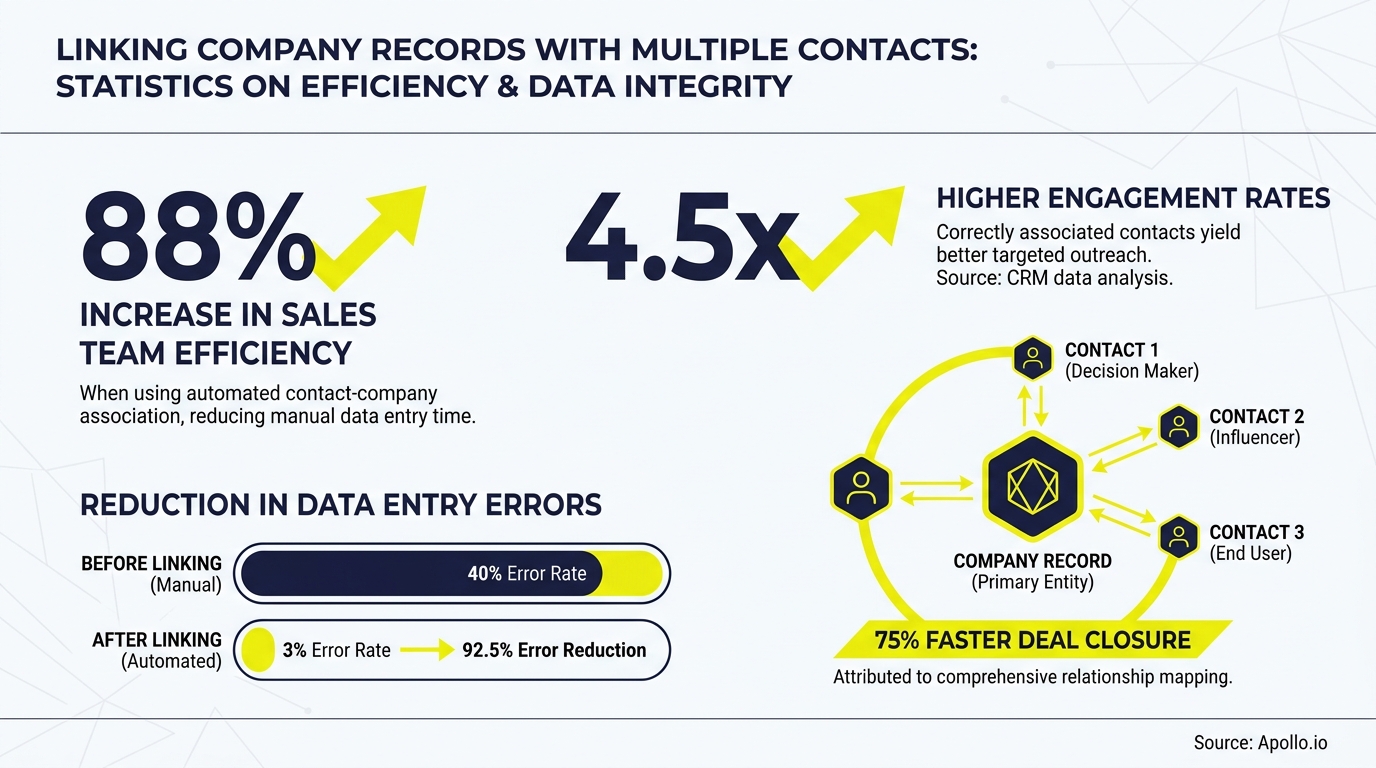
One-to-many linking matters because B2B buying committees are the norm, not the exception. According to a Forrester report published in December 2024, an average of 13 people are involved in B2B buying decisions and 89% of purchases involve two or more departments. A database that stores only one contact per company record cannot map that reality. The result: missed stakeholders, orphaned activities, and deals that stall because the wrong person was contacted at the wrong stage.
This is also why finding better buyer leads requires more than just a name and email. You need full stakeholder coverage, mapped to the right account, with roles attached.
How Does the One-to-Many Data Model Actually Work?
The one-to-many model stores a single company record as the parent object and links multiple individual contact records to it as children, each with their own fields, activity history, and role metadata. This is distinct from duplicating the company record for each contact, which creates fragmentation and attribution errors.
| Model | Structure | Risk |
|---|---|---|
| One contact per account | 1:1 relationship | Breaks multi-threaded deals |
| Duplicate company records | Many:Many (uncontrolled) | Attribution chaos, dedup cost |
| One-to-many (recommended) | 1:Many with role labels | Requires governance to sustain |
Modern CRMs support this natively, but the data model only delivers value if contact roles are explicitly assigned. Labels like "economic buyer," "technical evaluator," or "legal approver" turn a flat list of names into a structured buying committee map. As noted by Smarte, the sheer volume of data makes manual cleaning impossible, leading to duplication and confusion when multiple records exist for the same contact. Role-based linking reduces this by making each contact's relationship to the account explicit.
How Do RevOps Teams Implement Multi-Contact Linking at Scale?
RevOps teams implement scalable multi-contact linking through four core steps: data model design, role taxonomy definition, automation rules, and merge/survivorship governance.
- Define the company record as the canonical parent. All contacts, deals, and activities roll up to it. Never create a company record per contact.
- Build a role taxonomy. Define the contact roles your team uses (champion, economic buyer, blocker, technical evaluator) and enforce them as required fields on the association, not on the contact itself.
- Automate association creation. Use CRM workflows or enrichment tools to auto-link inbound leads to existing company records based on email domain matching and firmographic rules. Manual linking doesn't survive high-volume inbound.
- Write survivorship rules for merges. Define which fields win when duplicate contacts are merged and what happens to their company associations. A Reddit user shared a firsthand perspective that the clean fix is to keep one contact record but attach notes, emails, and calls to the Account+Contact association, so when a contact moves to a new company, you create a new association and the old history stays with the original account.
Struggling to keep contact records clean and enriched as you scale? Apollo's contact enrichment tools automatically append verified role and firmographic data to keep your account-contact links accurate.

What Are the Most Common Mistakes When Linking Contacts to Company Records?
The most common mistakes are domain-only matching, missing role metadata, and treating deduplication as a one-time project rather than an ongoing process.
- Domain-only matching creates false positives. Companies with multiple subsidiaries, holding structures, or shared email domains will incorrectly merge contacts across separate entities.
- No role labels on associations. Storing contacts under a company without defining their role makes the data structurally correct but operationally useless for routing and personalization.
- Ignoring the division/ownership problem. A Reddit user managing a complex multi-division setup wrote on Reddit that after five years they settled on one dedicated ownership field per division rather than multi-owner fields, because users would accidentally remove all selections when editing their own entry. The human behavior must be accounted for in the data model.
- Letting merge governance lag behind growth. As CRMs improve dedupe tooling, teams need formal policies for what happens to company associations when records merge, including ID changes and lifecycle sync.
According to Forbes Agency Council, integration of multiple data sources is a top challenge for B2B businesses, often creating data silos, inefficiencies, and inaccuracies in customer insights. Linking architecture is only as strong as the integration layer feeding it.
Turn Weak Leads Into Pipeline That Closes
Pipeline forecasting a guessing game because marketing leads never convert? Apollo surfaces in-market buyers with verified contact data so your team reaches real opportunities — not dead ends. Nearly 100K paying customers trust Apollo to fill funnels that actually close.
Schedule a Demo →How Do SDRs and AEs Benefit from Properly Linked Account Records?
SDRs and AEs benefit from properly linked account records because they can see every stakeholder at a target company in one view, including their role, engagement history, and department, without switching tools or reconciling spreadsheets.
- SDRs can identify the right first contact at an account (usually the champion or technical evaluator) rather than defaulting to whoever is easiest to find.
- AEs managing active deals can track engagement across the full buying committee. If the economic buyer goes dark, they can pivot to the champion without losing context.
- Marketing teams can suppress or target contacts at an account based on deal stage, preventing conflicting outreach while a deal is in negotiation.
This multi-threaded visibility is what separates teams running account-based motions from those still working lead lists. If your team is building toward an ABM model, review how sales intelligence tools support richer account graphs with full stakeholder mapping. You can also explore how sales automation can enforce linking rules at scale without manual intervention.
Need to discover and link every stakeholder at your target accounts before your next outbound push? Search Apollo's 230M+ verified contacts with 65+ filters to build complete buying committee coverage by account.
How Do You Maintain Link Integrity Over Time?
Maintaining link integrity requires treating it as ongoing systems governance, not a one-time data cleanup. Three operational habits sustain clean company-contact relationships:
- Scheduled enrichment cycles. Run contact enrichment quarterly (or trigger it on CRM activity) to catch job changes, title updates, and domain migrations before they corrupt your account-contact map.
- Duplicate detection automation. Set up automated dedup rules that flag new contacts who match an existing record by email, phone, or name+company combination before they are saved as separate records.
- Ownership and stewardship RACI. Assign a named owner for account-contact link quality, typically a RevOps analyst or CRM admin. Without a named owner, link governance degrades under volume pressure.
Agentic AI tools for routing, summarization, and next-best-action depend entirely on correct company-contact relationships. Errors in your linking layer now propagate faster than ever through AI-assisted workflows, making relationship structure a production-critical requirement, not just a CRM hygiene item.

Build Smarter Account Records Starting Today
Linking a company record to multiple contacts with defined roles is foundational to every account-based motion, multi-threaded deal, and AI-assisted workflow your team runs. The data model is straightforward.
The hard part is governance: merge rules, role taxonomy, enrichment cadence, and ownership. Start with the model, enforce it through automation, and assign a human owner to sustain it.
Apollo brings contact discovery, enrichment, engagement, and pipeline management into one unified platform, so your account records stay complete without stitching together multiple tools. Trusted by nearly 100K paying customers including Anthropic, Cyera, and Redis, Apollo gives GTM teams the verified data and workflow automation to build and maintain the account-contact architecture their pipeline depends on.
Request a Demo and see how Apollo helps your team build complete, role-enriched account records across your entire target market.
Prove Pipeline ROI From Day One
ROI pressure killing your tool budget before it even gets approved? Apollo delivers measurable pipeline impact fast — 46% more meetings with AI, real results your leadership can't argue with. Start free today.
Start Free with Apollo →Don't miss these
Sales
Inbound vs Outbound Marketing: Which Strategy Wins?
Sales
What Is a Sales Funnel? The Non-Linear Revenue Framework for 2026
Sales
What Is a Go-to-Market Strategy? The 2026 GTM Playbook
See Apollo in action
We'd love to show how Apollo can help you sell better.
By submitting this form, you will receive information, tips, and promotions from Apollo. To learn more, see our Privacy Statement.
4.7/5 based on 9,690 reviews
