
How to Incorporate Storytelling in Email and Call Scripts
AI is flooding inboxes with generic outreach.
A May 2026 Gartner report found 69% of B2B buyers now turn to sales reps specifically to validate AI-generated insights — not to receive a pitch.
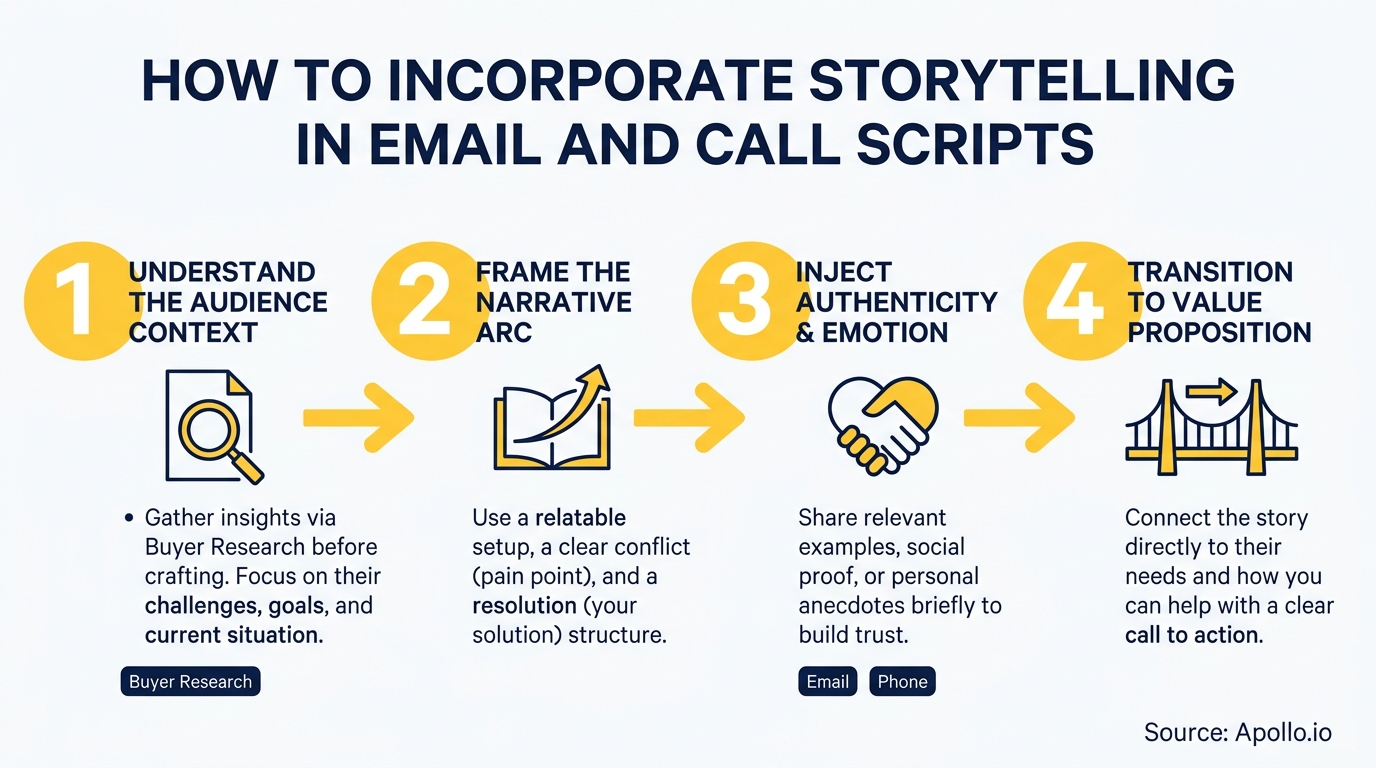
The reps who win are the ones who replace generic templates with a clear, role-specific story: here's what we saw, here's what a customer did about it, here's what makes sense next.
That formula works across sales emails and cold call scripts alike.

Research Smarter, Not Harder With Apollo
Tired of your reps burning hours on manual lead research instead of closing deals? Apollo surfaces verified contacts instantly so your team spends time selling. Join 600K+ companies building pipeline faster.
Start Free with Apollo →Key Takeaways
- Buyers use AI to research independently — your story's job is to validate their thinking and add context they can't find online.
- One validated customer narrative can power four role-specific scripts (economic buyer, technical evaluator, end user, procurement) without rebuilding from scratch each time.
- A proof-backed microstory follows a four-part formula: signal, tension, customer proof, low-friction question.
- Email sets the narrative hook; the call script continues the same story rather than restarting the pitch.
- SDRs and AEs who measure reply quality, multi-thread rate, and meeting-to-opportunity conversion can prove which stories drive pipeline.
Why Do Most B2B Stories Fail in Emails and Calls?
Most B2B stories fail because they are generic, inconsistent, or irrelevant to the specific person receiving them. A 2025 Gartner survey of 632 B2B buyers found 73% actively avoid suppliers that send irrelevant outreach, and 69% notice inconsistencies between what sellers say and what the company website shows. Buyers research independently, form a preferred vendor before first contact, and arrive at the sales conversation already skeptical.
The fix is not more creativity. It is more specificity.
A story lands when it references a real signal (a hire, a funding round, a regulation, an intent spike), names the business tension that signal creates, cites a customer who faced the same tension, and asks one low-friction question. That four-part structure — signal → tension → proof → question — is the only storytelling formula that survives a busy inbox.
According to research published on ResearchGate, 65% of B2B buyers prefer to engage with salespeople who use stories to explain complex solutions. The opportunity is real. The execution gap is in relevance, not narrative technique.
What Is the Story-to-Script Matrix?
The story-to-script matrix maps one validated customer narrative into four role-specific touchpoints so the same proof reaches every member of the buying committee without sounding copy-pasted. Forrester's 2024 State of Business Buying found the average purchase involves 13 people across two or more departments — meaning one generic script reaches almost none of them effectively.
| Buyer Role | Core Fear | Email Opener | Call Opener |
|---|---|---|---|
| Economic Buyer (VP/CFO) | Budget risk, missed ROI | "[Company] just expanded its sales team by 30% — here's the revenue leakage we typically see at that stage and how one CFO closed it." | "I sent you a note about a pattern we see after rapid headcount growth. Two minutes to tell you what the CFO at [similar company] did about it?" |
| Technical Evaluator | Integration failure, rework | "Your team recently added [tool] — here's the data-sync issue that surfaces 90 days in and how [customer] avoided it." | "Did you see my email about the [tool] integration gap? Quick question about how your team is handling that handoff today." |
| End User (SDR/AE) | Quota pressure, wasted time | "[Customer]'s SDR team cut research time per account significantly after one workflow change — happy to share the exact setup." | "I work with a lot of SDR teams hitting the same wall with [specific friction]. Worth 90 seconds to hear how one team fixed it?" |
| Procurement/Legal | Vendor risk, compliance exposure | "Here's the one-page security and compliance summary [similar company in your sector] used to get this approved in two weeks." | "I know procurement reviews can stall at the security questionnaire stage. We have a pre-filled pack that cut approval time for [customer] — want me to send it?" |
The call opener always references the email. This continuity matters: email sets the narrative hook, and the call continues the same story rather than restarting with a cold introduction. Pair this approach with guidance on the best times to email and call prospects to maximize the chance each touchpoint lands when buyers are most receptive.

How Do SDRs Build a Proof-Backed Microstory?
SDRs build a proof-backed microstory by combining a specific trigger signal with a verified customer outcome in three sentences or fewer. The formula: (1) We noticed [signal]. (2) Teams in your position usually face [tension]. (3) [Customer] solved it by [proof] — is that relevant to where you are now?
What counts as credible proof in a microstory:
- Named customer + measurable outcome (e.g., "[Customer] reduced onboarding time by X weeks")
- Verified metric from a published case study, not an internal estimate
- Role-matched outcome — revenue figures for economic buyers, workflow metrics for end users
- Consistent wording across email, call, and any follow-up collateral
Build a shared proof library your whole team uses. Each entry should include: the customer name (or approved anonymized description), the verified outcome, the role it resonates with, and the signal that makes it relevant. This prevents the inconsistency that Gartner's buyer research flags as a top trust-killer. Data from The Trust Agencyreinforces why this matters: people are 22 times more likely to remember a story-based fact than data presented plainly — so the story your rep tells on a call needs to match the one in the follow-up email exactly.
Spending hours manually researching signals before crafting each microstory? Apollo's AI sales automation surfaces account signals and drafts personalized outreach so your team can focus on adding the human context that converts.
Turn Funnel Gaps Into Closed Deals
Tired of watching marketing leads stall before they ever become real opportunities? Apollo surfaces in-market buyers with verified contact data so your pipeline stays full — not forecasted on hope. Join 600K+ companies building predictable revenue.
Start Free with Apollo →How Do AEs Use Storytelling to Unstick Stalled Deals?
AEs use storytelling to unstick stalled deals by reframing the cost of inaction with a role-specific customer example rather than repeating product features. Forrester's 2024 data found 86% of B2B purchases stall — and the accounts most likely to move are those where the AE helps an internal champion build a business case using a story their CFO or legal team can immediately understand.
For Account Executives managing multi-stakeholder deals, the follow-up email after a stalled conversation should:
- Reference the specific concern raised in the last call
- Name a customer in a similar situation who faced the same hesitation
- State the outcome that customer achieved in one concrete, role-matched metric
- Suggest one low-effort next step (a 15-minute call, a one-page summary, an intro to a customer reference)
This approach also serves the hidden buying committee. The 2025 Edelman-professional networks B2B Thought Leadership Impact Report found 71% of hidden decision-makers have little or no direct interaction with sales, yet 95% say strong thought leadership increases their receptiveness to outreach. Stories shared in follow-up emails reach those stakeholders through your champion — so make them easy to forward. See how to craft email personalization that keeps prospects engaged throughout the buying process.
How Do You Measure Whether Your Story-Based Scripts Are Working?
You measure story-based scripts by tracking reply quality, multi-thread rate, and meeting-to-opportunity conversion — not just open rates. Open rates tell you the subject line worked; reply quality tells you the story landed.
| KPI | What It Measures | Story Optimization Signal |
|---|---|---|
| Positive reply rate | Story relevance to that role | Low rate = wrong signal or mismatched proof |
| Multi-thread rate | How many roles you reached per account | Low rate = matrix not deployed across roles |
| Meeting-to-opportunity % | Story quality in discovery call | Low rate = call script diverges from email story |
| Stall-to-advance rate | Follow-up story effectiveness | Low rate = proof not role-matched or champion-ready |
For AI governance, apply a simple approval loop before deploying AI-drafted scripts at scale: (1) AI drafts using signal + proof library input. (2) Rep reviews for accuracy and role fit. (3) Manager spot-checks proof claims against the approved library. (4) Marketing confirms customer references are approved for use. A May 2026 Gartner study found AI saves sellers an average of 4.8 hours per week, yet 72% of sales organizations fail to reinvest that time in high-value activities. The approval loop is how you turn saved time into better stories, not just more volume.
Running multi-channel sequences but struggling to keep email and call narratives consistent at scale? Apollo's sales engagement platform lets your team run coordinated email, phone, and social sequences from one workspace — so the story your prospect hears on a call matches exactly what they read in their inbox.

How to Start Incorporating Storytelling in Your Scripts Today
Incorporate storytelling in your email and call scripts by starting with one validated customer story and building your proof library before writing a single template.
Research from Higo Creative shows 62% of B2B marketers find storytelling in content marketing effective — the gap between knowing it works and executing it consistently is almost always a process problem, not a creativity problem.
Three steps to start this week:
- Pick one customer story with a verified, role-matched outcome. Get written approval to use it.
- Map it to the four-role matrix. Write one email opener and one call opener per role using the signal-tension-proof-question formula.
- Run a two-week A/B test against your current templates. Measure positive reply rate and meeting-to-opportunity conversion, not just opens.
For cold email introductions and discovery call openers, the story-first approach replaces the generic value proposition opener that most buyers now ignore. Pair it with the right send times and a consistent multi-channel cadence, and your scripts start doing the work your buyers actually want from a sales rep: helping them validate a decision they're already working toward.
Ready to build story-driven sequences that reach the right contacts at the right time? Get Leads Now and put your storytelling framework to work with Apollo's full GTM platform.
Prove Pipeline ROI With Apollo
ROI pressure killing your tool budget? Apollo delivers measurable pipeline impact from day one — no guesswork, no waiting. Leadium 3x'd annual revenue. See your returns fast.
Start Free with Apollo →Don't miss these
Sales
Inbound vs Outbound Marketing: Which Strategy Wins?
Sales
What Is a Sales Funnel? The Non-Linear Revenue Framework for 2026
Sales
What Is a Go-to-Market Strategy? The 2026 GTM Playbook
See Apollo in action
We'd love to show how Apollo can help you sell better.
By submitting this form, you will receive information, tips, and promotions from Apollo. To learn more, see our Privacy Statement.
4.7/5 based on 9,690 reviews
