
How to Improve Reply Rates Through Strategic Follow-Up Emails in 2026
Most B2B follow-up sequences fail not because of bad copy, but because of bad strategy. SDRs send too many emails, say the same thing twice, and wonder why reply rates keep dropping. The fix is a tighter, more deliberate approach: fewer touches, more value per touch, and a clear rule for when to stop. If you're still building on a foundation of weak outreach, start with how to write sales emails that get responses before optimizing your follow-up sequence.

Research Less, Pipeline More With Apollo
Tired of your reps burning hours on manual lead research instead of selling? Apollo surfaces verified contacts instantly so your team spends time closing, not digging. Join 600K+ companies building pipeline faster.
Start Free with Apollo →Key Takeaways
- Three follow-up emails outperform one, but a fourth touch actively damages reply rates and triggers spam complaints.
- Each follow-up must introduce something new: a use case, a proof point, or a relevant trigger — not a generic reminder.
- Deliverability problems can kill reply rates before copy even matters; fix authentication and domain health first.
- Buying committees average 13 stakeholders, so follow-ups that include internal-share assets outperform those that only prompt an individual reply.
- AI can help draft and prioritize follow-ups, but human review is essential — the majority of decision makers are bothered by outreach that feels machine-generated.
What Does a Strategic Follow-Up Email Sequence Look Like?
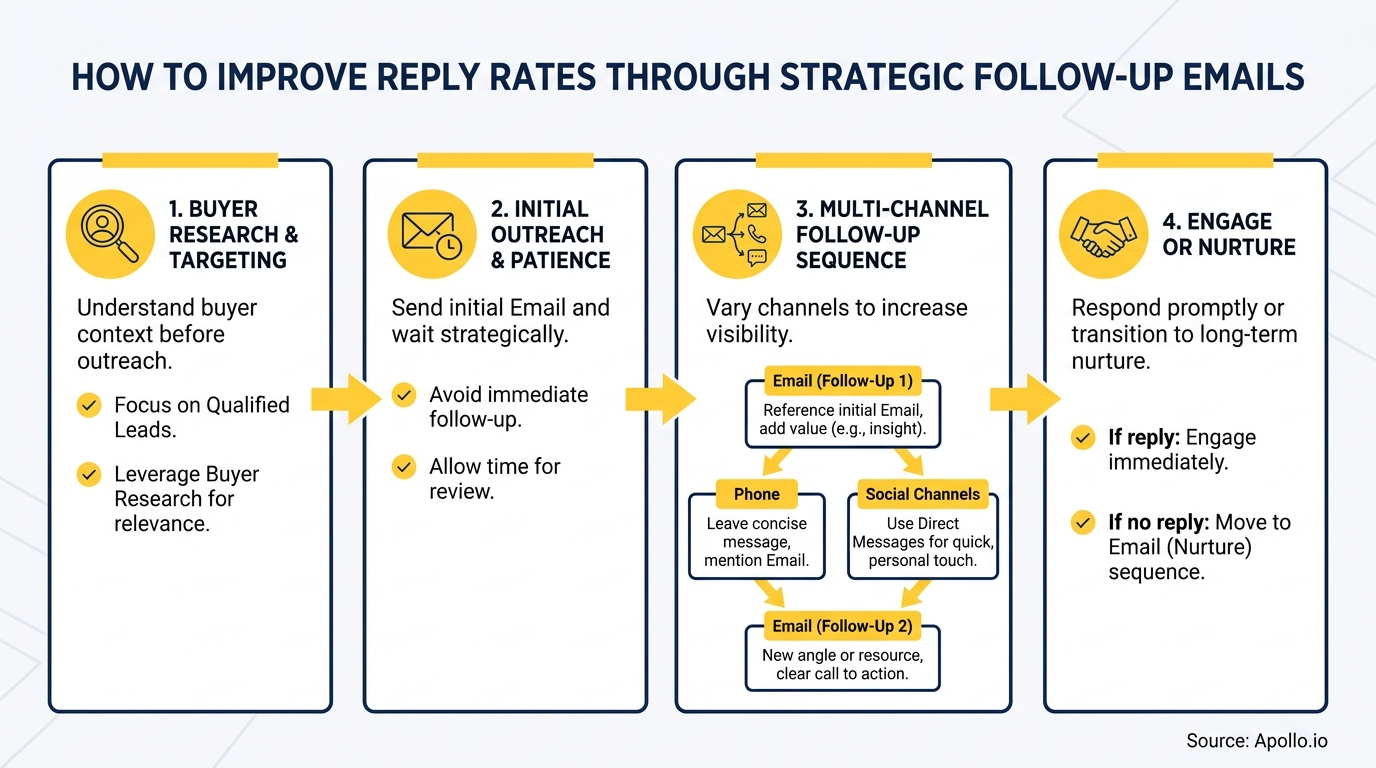
A strategic follow-up email sequence is a planned series of 2–3 messages sent after an initial cold email, each adding new value rather than repeating the original ask. According to Belkins, average reply rates dipped to 5.8% in 2024, down from 6.8% in 2023 — meaning the cost of a generic, repetitive sequence is now measurable. The goal is to earn each subsequent touch, not automate persistence.
| Touch | Timing | Purpose | Content Angle |
|---|---|---|---|
| Email 1 | Day 1 | Open a conversation | Specific insight or trigger relevant to their role |
| Email 2 | Day 4–5 | Add proof | Customer story, benchmark, or use case |
| Email 3 | Day 9–12 | Graceful close | Low-friction ask or permission to re-engage later |
| Email 4+ | — | Stop | Response rates drop sharply; spam risk rises |
A sales professional wrote on Redditthat three emails maximum works better than five or more: "They're not ignoring you, they're just busy — and a 4th email starts feeling creepy. The follow-ups should add something new each time, not just 'just checking in.'"
How Many Follow-Up Emails Should SDRs Actually Send?
SDRs should send a maximum of three follow-up emails per sequence. Research from Belkins confirms that response rates consistently drop with each subsequent follow-up, with the decline accelerating sharply after the third message. Beyond three touches, you're not improving your odds — you're damaging your sender reputation.
The diminishing-returns curve is steep. A fourth follow-up in a cold sequence is a net-negative investment: lower reply probability plus higher spam complaint risk. For SDRs managing high-volume prospecting, the smarter play is running more tightly segmented sequences rather than extending cadence length. Spending hours on manual outreach? Automate your sequences with Apollo's multi-channel sales engagement platform to keep every touch relevant and on schedule.
Turn Funnel Gaps Into Qualified Pipeline
Tired of watching marketing leads die before they ever reach your AEs? Apollo surfaces high-intent prospects and keeps your funnel full with verified contacts. Nearly 100K paying customers stopped guessing and started closing.
Start Free with Apollo →What Should Each Follow-Up Email Say to Improve Reply Rates?
Each follow-up should introduce one new element that wasn't in the previous email. Generic "just checking in" messages actively repel modern B2B buyers: a Gartner survey of 632 B2B buyers found that 73% actively avoid suppliers who send irrelevant outreach. Every touch needs to justify its existence.
- Follow-up 1 (Day 4–5):Add a relevant customer proof point or industry benchmark. Example: "[Peer company] reduced ramp time by X — relevant if you're scaling a team right now."
- Follow-up 2 (Day 9–12):Reference a trigger event (funding round, job posting, product launch) or offer a specific, low-friction next step. Example: "Saw you're hiring three AEs — happy to share how we support onboarding at scale."
- Closing line: Give permission to disengage. "If the timing isn't right, I won't follow up again — but happy to reconnect when it makes sense."
Conciseness also matters. Keep follow-ups to 100–200 words and no more than 6–8 sentences. Email personalization at this level requires real context, not mail-merge tokens.

How Do Follow-Up Emails Support Buying Committees, Not Just Individual Buyers?
Follow-ups that only prompt a single recipient to reply miss the larger opportunity: most B2B purchases involve multiple stakeholders, and the biggest reason deals stall is lack of internal alignment. For Account Executives managing complex deals, each follow-up is an opportunity to arm the champion with something shareable.
Map your follow-up content to buying committee needs:
- For the economic buyer: ROI summary, cost-per-outcome benchmark, or payback timeline
- For the technical evaluator: Integration overview, security one-pager, or implementation checklist
- For the end user: Short case study or workflow example showing day-to-day impact
- For the champion: A pre-written internal summary they can forward to stakeholders
When a follow-up helps your contact look good internally, it gets forwarded. That's a more valuable outcome than a solo reply. Pair this approach with intent data to identify which accounts have active buying committees researching your category.
Does Deliverability Affect Follow-Up Reply Rates?
Yes — deliverability problems kill reply rates before copy or cadence even matter. A Reddit user shared a firsthand perspective that a 10% open rate on 400 sends "screams deliverability problems not copy problems — emails probably landing in spam before anyone even sees your personalization work." Fix the infrastructure before rewriting subject lines.
Core deliverability requirements for 2026:
- SPF, DKIM, and DMARC authentication on every sending domain (Google and Microsoft now enforce this for high-volume senders)
- Dedicated sending domains warmed up before sequence launch
- Bounce rate monitoring and suppression of invalid addresses
- Daily send volume limits to avoid triggering spam filters
- Minimizing open-tracking pixels where possible
For a deeper look at fixing inbox placement, see why your emails land in spam and how to fix it and the 5-step guide to improving email deliverability.
How Should SDRs and AEs Use AI to Write Better Follow-Ups?
AI should assist follow-up research and drafting, but human judgment must shape the final message. According to the Salesforce 2026 State of Sales report, 92% of sales professionals with AI agents say AI benefits prospecting — but buyer tolerance for AI-generated outreach that feels non-human is low. The competitive edge is using AI to surface the right context, then editing the draft to sound like a person who actually did their research.
AI-safe follow-up governance rules for SDRs and AEs:
- Use AI to research trigger events, job changes, and company news — then reference one specific finding per email
- Always edit AI-drafted copy before sending; remove generic phrases like "I hope this finds you well"
- Verify any statistics or claims AI includes in the draft before sending
- Set a tone rule: the email should sound like a human who knows the prospect's industry, not a template
Research from Powered by Search shows personalized emails are opened 82% more than generic bulk-send emails — which means AI-assisted personalization, done right, compounds with every touch in your sequence. Struggling to find the right contacts to personalize for? Search Apollo's 230M+ verified contacts with 65+ filters to build tightly segmented lists before you write a single word.
How Do You Measure Whether Your Follow-Up Sequence Is Working?
Reply rate by touch number is the most actionable metric for optimizing a follow-up cadence. Open rates mislead: Apple Mail Privacy Protection inflates open data, and a high open rate with no replies usually signals a deliverability or relevance problem, not a success.
Track qualified replies (responses that advance a conversation) separately from total replies.
| Metric | What to Track | Benchmark |
|---|---|---|
| Reply rate by touch | Which email in the sequence generates the most replies | 1–8.5% per Stripo (2025) |
| Qualified reply rate | Replies that result in a next step (meeting, demo, referral) | Target 30–50% of total replies |
| Spam complaint rate | Complaints per send volume | Keep below 0.1% (Google threshold) |
| Sequence stop rate | Unsubscribes or opt-outs per sequence | Rising rate signals cadence fatigue |
RevOps leaders find that tracking reply rate by touch number quickly surfaces which follow-up in a sequence is underperforming — and makes the case for cutting a fourth touch entirely rather than rewriting it.

How Do You Improve Follow-Up Reply Rates Starting Today?
Improving follow-up reply rates comes down to three decisions: cap your sequence at three emails, make each touch earn its place with new value, and fix deliverability before rewriting copy. The teams consistently outperforming benchmarks are sending fewer, better emails to tighter segments — not blasting longer sequences at bigger lists.
Apollo brings prospecting, sequencing, AI-assisted personalization, and deliverability monitoring into one unified platform, so SDRs and AEs can execute this approach without stitching together multiple tools. As the team at Cyera put it, "Having everything in one system was a game changer." Request a demo to see how Apollo's multi-channel sequences and verified contact data can lift your reply rates across every touch.
Prove Pipeline ROI From Day One
ROI pressure killing your next budget approval? Apollo delivers measurable pipeline impact fast — 46% more meetings with AI, real results your leadership can't ignore. Start free and show wins before the next QBR.
Start Free with Apollo →Don't miss these
Sales
Inbound vs Outbound Marketing: Which Strategy Wins?
Sales
What Is a Sales Funnel? The Non-Linear Revenue Framework for 2026
Sales
What Is a Go-to-Market Strategy? The 2026 GTM Playbook
See Apollo in action
We'd love to show how Apollo can help you sell better.
By submitting this form, you will receive information, tips, and promotions from Apollo. To learn more, see our Privacy Statement.
4.7/5 based on 9,690 reviews
