
How to Implement a Structured Referral Follow-Up Process in 2026
Warm referrals are the highest-rated outreach tactic in B2B sales, yet most teams treat them like ordinary inbound leads. According to Lead Forensics, 84% of B2B buyers initiate their purchasing journey with a referral. Despite this, most companies have no formal SLA, no CRM workflow, and no buyer-enablement kit to convert that warm intro into a closed deal. This guide gives you the exact system to fix that. For broader context on building systematic sales motions, see What Is a Sales System and How Do You Implement One?

Research Less. Pipeline More With Apollo.
Tired of burning hours verifying contacts while your quota clock ticks? Apollo surfaces accurate, ready-to-work leads instantly — so your team sells instead of searches. Join 600K+ companies building pipeline faster.
Start Free with Apollo →Key Takeaways
- A structured referral follow-up process requires a defined SLA, not just good intentions — speed and relevance are the two conversion levers that matter most.
- Referrals need to be logged in CRM immediately with context fields (referrer relationship, trigger event, buying role) so follow-up stays personalized and accountable.
- Referred prospects need buyer-enablement content — ROI calculators, stakeholder FAQs, and proof points — not just a thank-you email and a demo request.
- Multi-threading the buying committee using the referral relationship significantly improves conversion and shortens the sales cycle.
- Measuring second-generation referrals, not just volume, reveals the true compounding value of a well-managed referral program.
Why Does a Structured Referral Follow-Up Process Matter?
A structured referral follow-up process matters because referrals convert at a higher rate, close faster, and generate downstream value that unstructured handling destroys. Research from Referral Rock found that 69% of companies with referral programs report that referred leads close faster than other lead sources. Meanwhile, data from Firework shows 86% of B2B purchases are influenced by word-of-mouth referrals.
The problem: most teams treat referrals reactively. No intake process.
No CRM record. No SLA.
The referred buyer — who arrived with trust already established — gets a generic follow-up sequence and goes cold. A structured process preserves that trust and converts it into revenue.
What Should You Log in CRM at Referral Intake?
Every referral must be logged in CRM within the same business day it is received, with a standardized set of context fields that enable personalized follow-up. Without this, the referral becomes just another contact with no history.
Referral Intake CRM Field Map
| CRM Field | What to Capture | Why It Matters |
|---|---|---|
| Referral Source | Name + company of the referrer | Personalizes outreach; enables referrer acknowledgment |
| Relationship Strength | Close / Moderate / Acquaintance | Calibrates tone and urgency of first contact |
| Trigger Event | Why the referrer made the intro now | Surfaces the business problem driving the referral |
| Buying Role | Champion / Economic Buyer / Technical Evaluator | Determines content and conversation angle |
| Promised Next Step | What the referrer told the prospect to expect | Ensures first outreach matches the referrer's promise |
| Follow-Up SLA | Date/time first outreach must be sent | Creates accountability and prevents referral decay |
RevOps leaders should build this field map as a required intake form, triggered automatically when a contact is tagged as a referral source. This structure also makes referral data AI-ready as CRM platforms move toward agentic workflow orchestration.

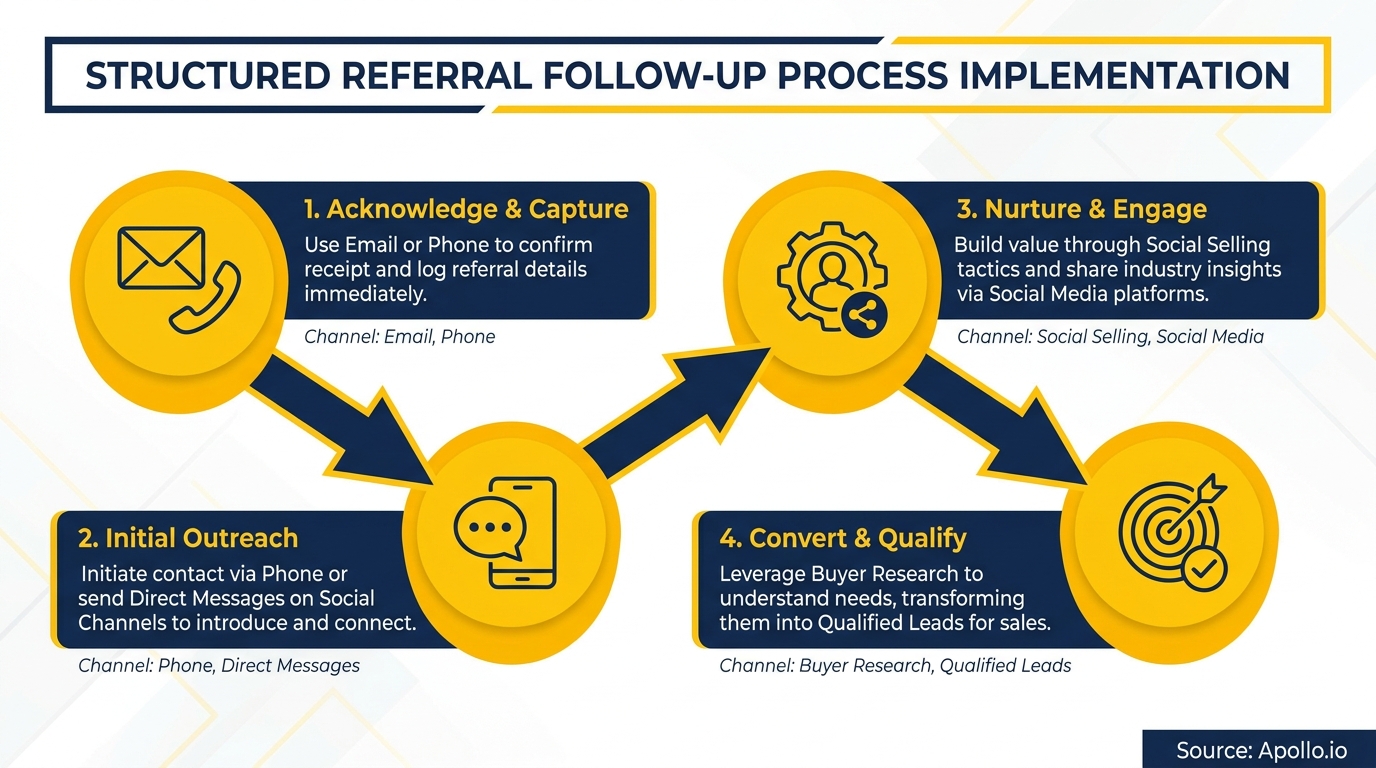
What Is the SLA Playbook for Each Follow-Up Stage?
The referral follow-up SLA defines who acts, when, and with what message at each stage of the process. The Norwest 2025 B2B Benchmark Report identified warm referrals as the top-rated outreach tactic at 65%, ahead of all other methods — yet buyers are deciding earlier and faster than ever. Speed is non-negotiable.
| Stage | Timing | Owner | Action |
|---|---|---|---|
| Referrer Acknowledgment | Same day (within 4 hours) | AE or SDR | Thank referrer, confirm context, set expectations |
| First Prospect Outreach | Within 24 hours | AE | Personalized email citing the referrer, specific trigger, low-friction ask |
| Buyer-Enablement Send | Day 2–3 | AE + Marketing | Send Referral-to-Consensus Kit (ROI proof, case study, stakeholder FAQ) |
| Committee Expansion | Day 4–7 | AE | Multi-thread to 1–2 additional buying-committee personas |
| Referrer Update | Weekly or at key milestones | AE | Brief update to referrer on status; keeps relationship warm |
| Close-Loop Report | On deal close or disqualify | RevOps | Log outcome, referrer reward trigger, second-gen referral flag |
For AEs managing active pipelines, the referrer update step is often skipped — and that is exactly how future referrals get cut off. Treat the referrer as a stakeholder, not just a lead source. Pair this SLA with structured sales meeting best practices to keep every touchpoint purposeful.
Spending too much time manually sequencing referral follow-ups? Automate your multi-stage referral sequences with Apollo's sales engagement platform and keep every touchpoint on schedule.
Turn Funnel Guesswork Into Real Pipeline
Pipeline forecasting a guessing game because marketing leads never convert? Apollo surfaces high-intent prospects at exactly the right moment. Top revenue teams use Apollo to turn funnel gaps into predictable opportunities.
Start Free with Apollo →What Should You Send Referred Prospects? The Referral-to-Consensus Kit
Referred prospects need buyer-enablement content that helps them build an internal business case — not just a calendar link. The 2024 Demand Gen Report B2B Buyer's Survey found 67% of buyers said winning-vendor content made it easier to show ROI internally, and 77% wanted content that spoke directly to their company's situation.
A Referral-to-Consensus Kit should include:
- ROI / Business Case Template: Pre-filled with the prospect's industry benchmarks and the problem the referrer flagged.
- Stakeholder FAQ: Answers to questions from economic buyers, security/IT, and end users — the three most common blockers in committee deals.
- Relevant Case Study: One customer proof point matching the referred prospect's industry, company size, or use case.
- Risk and Implementation Summary: A one-page overview of onboarding, timeline, and integration — reduces perceived switching risk before the first conversation.
- Thought Leadership Asset: A relevant article or data report that demonstrates expertise, not just product features.
This kit serves the buying committee, not just the referred contact. Because Base.ai reports referred customers convert 30% better than those acquired through other channels, the investment in quality enablement content pays back at scale. To understand how content fits your broader funnel, see How to Build a B2B Marketing Funnel That Converts in 2026.
How Do SDRs and AEs Handle Referral Multi-Threading?
SDRs and AEs should use the referral relationship as a trust bridge to reach additional buying-committee members, not just the referred contact. The 6sense 2026 State of the BDR Report found that multi-threading to two additional personas was associated with approximately 11 points higher quota attainment — and structured guidance on which personas to prioritize added another 10 points.
Practical multi-threading steps for referral follow-up:
- Map the buying committee using the trigger event logged at intake (e.g., a security audit triggers IT and Legal involvement).
- Ask the referred contact or the referrer directly: "Who else is typically involved in decisions like this at your company?"
- Send persona-specific content to each stakeholder, not a generic cc'd email.
- Reference the original referral in each outreach: the trust transfers when the relationship is named explicitly.
SDRs often stop at the first referred name. AEs should take the handoff and expand the thread before the first discovery call — not after. Pair this with intent data signals to identify which committee members are actively researching.
How Do You Measure a Referral Follow-Up Process Beyond Lead Volume?
Measuring a referral follow-up process requires tracking conversion quality, speed, and second-generation referral output — not just how many referrals came in. Volume alone tells you nothing about whether the process is working.
Referral Program Measurement Framework
| Metric | What It Measures | Target Benchmark |
|---|---|---|
| Time-to-First-Outreach | SLA compliance and referral urgency | Under 24 hours |
| Referral-to-Meeting Rate | Quality of first outreach and kit | Compare vs. inbound benchmark |
| Referral Close Rate | Full-funnel conversion | Should exceed non-referral close rate |
| Referrer Engagement Rate | Health of referral relationship and future referral likelihood | Track referrers who refer again within 12 months |
| Second-Generation Referrals | Downstream compounding value | Flag and tag in CRM at close |
| Referral Lifetime Value | Long-term revenue impact vs. other channels | Referred customers show 25% higher lifetime value per Talkable |
RevOps should build a referral dashboard that surfaces these metrics monthly. Tracking second-generation referrals specifically reveals whether your process creates compounding value or just processes leads one at a time. For guidance on building the supporting tech infrastructure, see How to Build a Sales Tech Stack That Scales Revenue.
Struggling to track referral pipeline alongside the rest of your deals? Get complete pipeline visibility with Apollo's deal management tools and never lose a referral opportunity in the noise.
How Do You Scale and Automate Referral Follow-Up Without Losing Trust?
Scaling referral follow-up means automating the workflow triggers and content delivery while keeping the actual communication personalized and context-aware. HubSpot's April 2026 Smart Deal Progression release signals the direction: CRM-native agents that analyze deal history, draft follow-ups, and suggest next steps after each interaction.
Referral programs built with AI-ready CRM fields (referral source, relationship strength, trigger event, buying role) are positioned to benefit immediately from these capabilities.
Key automation rules for referral follow-up:
- Automate intake logging: Trigger CRM record creation and field population when a referral tag is applied.
- Automate kit delivery: Send the Referral-to-Consensus Kit automatically 24 hours after first outreach, not manually.
- Automate referrer updates: Milestone-triggered emails to the referrer keep them informed without adding manual tasks to the AE's plate.
- Keep first outreach human: The first email to the referred prospect should be written or personalized by the AE. Automation that sounds generic destroys the trust the referral created.
This balance — automate the workflow, personalize the conversation — is also the core principle behind effective sales automation more broadly.

Build a Referral Follow-Up System That Compounds
A structured referral follow-up process is not a sequence — it is a system with defined ownership, CRM infrastructure, buyer-enablement content, and closed-loop measurement. Teams that implement the intake field map, SLA playbook, and Referral-to-Consensus Kit convert more referrals, generate second-generation referrals, and build the kind of referrer relationships that keep producing pipeline.
The investment is modest. The compounding return is not.
Start by auditing your current referral intake: are you capturing all six context fields? Is your first outreach happening within 24 hours?
Are you updating referrers at each milestone? Fix those three gaps first, then layer in automation and measurement.
Apollo gives B2B GTM teams — from SDRs and AEs to RevOps and revenue leaders — a unified platform to manage referral sequencing, pipeline tracking, and deal management in one workspace. As Cyera put it, "Having everything in one system was a game changer." Schedule a Demo to see how Apollo can operationalize your referral follow-up process from intake to close.
Ramp Reps Faster, Prove ROI Sooner
Struggling to justify your sales tools when ramp time drags and pipeline impact stays invisible? Apollo gets new reps productive fast with guided workflows built to scale. Leading teams report measurable ROI from day one.
Start Free with Apollo →Don't miss these
Sales
Inbound vs Outbound Marketing: Which Strategy Wins?
Sales
What Is a Sales Funnel? The Non-Linear Revenue Framework for 2026
Sales
What Is a Go-to-Market Strategy? The 2026 GTM Playbook
See Apollo in action
We'd love to show how Apollo can help you sell better.
By submitting this form, you will receive information, tips, and promotions from Apollo. To learn more, see our Privacy Statement.
4.7/5 based on 9,690 reviews
