
How to Handle Record Conflicts When a Lead Is Updated in Both Systems (2026 Playbook)
When a lead gets updated simultaneously in your CRM and marketing automation platform (MAP), one system will overwrite the other. Without explicit rules, that silent collision can corrupt lead owner, status, consent, attribution, or qualification fields, and you will never know until a deal falls through or a rep calls a disqualified contact. For teams investing in data-driven prospecting, unresolved sync conflicts are a direct revenue leak.
According to Validity, 37% of CRM users reported losing revenue as a direct consequence of poor data quality. The solution is not faster syncing. It is field-level ownership rules, governance SLAs, and exception queues for high-impact fields.

Apollo Turns Hours of Research Into Minutes
Tired of your reps burning the day on manual lead research instead of closing deals? Apollo delivers verified contacts instantly, so your team spends time selling. Join 600K+ companies building pipeline faster.
Start Free with Apollo →Key Takeaways
- "Last write wins" is the most dangerous default: it silently overwrites high-value fields like lead owner, lifecycle stage, and consent without any audit trail.
- Field-level system-of-record rules (CRM owns owner/stage, MAP owns consent/engagement) prevent the majority of destructive conflicts automatically.
- High-impact fields such as lead status, attribution, and opportunity stage should route to a human exception queue, not auto-resolve.
- RevOps teams that define a formal conflict governance SLA report stronger pipeline visibility and fewer routing errors.
- Unresolved sync conflicts corrupt AI lead scoring, routing, and forecasting models, making data governance an AI-readiness issue in 2026.
Why Does a Lead Updated in Both Systems Cause a Conflict?
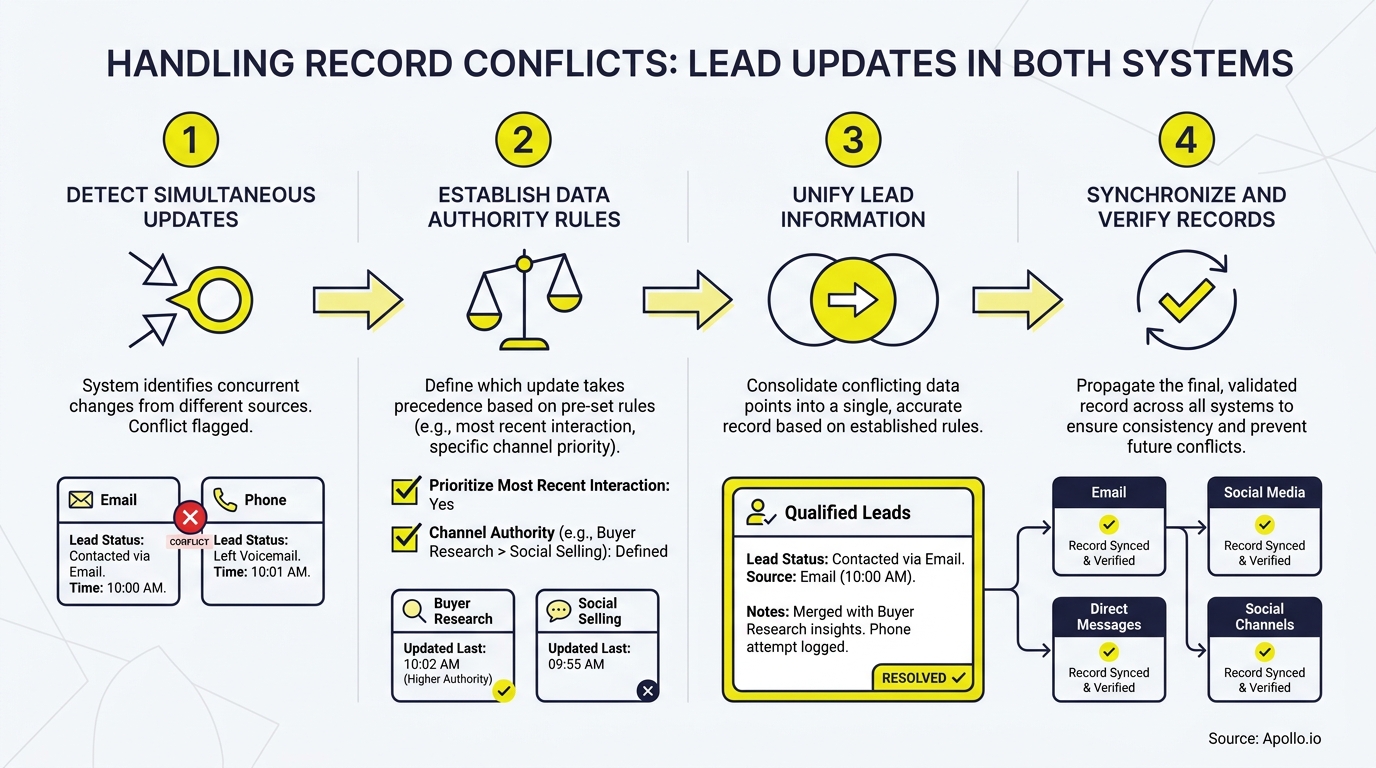
A record conflict occurs when the same lead field is modified in two connected systems before the next sync cycle completes, leaving the integration layer with two competing values and no clear winner. Most CRM-MAP integrations default to timestamp-based resolution: whichever system wrote last wins.
This works for low-stakes fields but destroys data integrity for owner, status, consent, and attribution fields where business rules, not timestamps, should govern outcomes.
Research from Landbase shows poor data quality costs organizations between 15% and 25% of their revenue annually. Bidirectional sync conflicts are one of the primary drivers of that decay. Adobe Marketo's current Salesforce documentation (updated May 2026) still resolves simultaneous lead updates with a hard rule: Marketo wins. That platform-defined precedence applies to every field equally, regardless of which system holds the authoritative value.
What Is a Field-Level Conflict Resolution Matrix?
A field-level conflict resolution matrix assigns each lead field to exactly one system of record, defines the auto-resolution rule, and specifies when a human must review. This replaces blanket "CRM wins" or "MAP wins" policies with granular, business-logic-driven rules.
| Lead Field | System of Record | Auto-Resolution Rule | Human Review Required? |
|---|---|---|---|
| Lead Owner | CRM | CRM value always wins | Yes — if MAP override detected |
| Lifecycle Stage | CRM | CRM value always wins; stage cannot move backward via MAP | Yes — if regression detected |
| Lead Status | CRM | CRM wins; MAP can only set "Contacted" or "Engaged" states | Yes — if "Disqualified" overwritten |
| Consent / Opt-Out | MAP | MAP value always wins; opt-outs propagate immediately | No — auto-sync within 15 minutes |
| Email Engagement Score | MAP | MAP value always wins | No |
| First Touch Attribution | MAP | Locked after first write; CRM cannot overwrite | Yes — if overwrite attempted |
| Job Title / Company | Enrichment Tool | Enrichment wins if CRM field is blank or older than 90 days | No — unless title changes role category |
| Opportunity Stage | CRM | CRM wins; MAP read-only for this field | Yes — always for stage regressions |
HubSpot's May 2026 Salesforce sync documentation reflects this shift, introducing an explicit "resolve sync conflict" rule and an "Always use HubSpot" field-mapping option. This signals a broader industry move away from vague bidirectional sync toward deliberate, field-by-field source-of-truth rules.
Turn Funnel Guesswork Into Pipeline Wins
Pipeline forecasting a guessing game because your leads never convert? Apollo surfaces high-intent prospects that actually become opportunities. Nearly 100K paying customers stopped flying blind and started closing.
Schedule a Demo →How Should RevOps Teams Build a Conflict Governance SLA?
RevOps teams should formalize conflict governance as a written SLA that defines sync frequency, field lock rules, rejection handling, and audit trail requirements. Without this, data ownership remains ambiguous: research by LeadAngel confirms that strong data governance establishes clear policies and processes for data collection, storage, access, and usage, leading to consistent data formats and improved data quality.
A practical conflict governance SLA should cover four areas:
- Sync frequency: Define sync intervals by field category. Consent fields sync within 15 minutes. Owner and stage fields sync hourly with conflict detection enabled.
- Lock rules: Identify fields that are read-only in one direction. First-touch attribution locks after creation. Opportunity stage is CRM-only.
- Exception queue: Route conflict alerts for high-impact fields to a named RevOps owner within one business day. Log every rejected change with timestamp, source system, and field value.
- Audit trail: Maintain a 90-day change history for owner, status, stage, and consent fields. This supports both compliance and AI model retraining when data errors are found.
Salesforce's November 2025 acquisition of Informatica brings governed MDM capabilities directly into the CRM layer, signaling that enterprise teams will increasingly manage conflict rules at the master data level, not just the integration middleware level.

How Do RevOps Leaders Prevent the Most Destructive Conflict Types?
RevOps leaders prevent destructive conflicts by categorizing fields into three risk tiers and applying different resolution logic to each. Not all conflicts carry equal business risk.
- Tier 1 (Critical): Lead owner, lifecycle stage, lead status, consent, attribution. These fields drive routing, compliance, and revenue attribution. Any conflict must trigger an exception alert, never auto-resolve with timestamp logic.
- Tier 2 (Important): Lead score, engagement flags, campaign membership. MAP is typically the system of record. Auto-resolve in MAP's favor, but log changes for 30 days.
- Tier 3 (Low-risk): Phone format, address normalization, social handles. Auto-resolve using enrichment data or most-recently-updated value. No exception queue needed.
For SDRs and BDRs, the most painful conflicts are Tier 1 overrides: a marketing automation workflow re-assigns a lead that a rep already contacted, or resets a "Working" status back to "New." Building a one-way lock on status fields for leads with recent CRM activity prevents this class of error entirely.
Struggling with stale or conflicting lead data slowing down your pipeline? Apollo's data enrichment keeps your CRM fields accurate and conflict-free with verified business contact data.
Why Do Unresolved Conflicts Hurt AI Scoring and Forecasting?
Unresolved sync conflicts corrupt the training data and real-time inputs that AI scoring, routing, and forecasting models depend on. If a lead owner field was overwritten by a MAP sync and the CRM now shows the wrong rep, AI routing sends the next touchpoint to the wrong person.
If lifecycle stage was reset by a conflicting update, the lead score drops and the lead exits a nurture sequence it should still be in.
This is not a theoretical risk. The Salesforce 2026 State of Sales report found 46% of sales professionals using AI agents say data quality issues hurt their sales performance. Meanwhile, Martal reports that 30% of CRM data decays annually, compounding the problem with each unresolved conflict.
For teams using lead scoring software, the input data quality is the ceiling on model accuracy. A conflict resolution framework is not just an admin process: it is an AI-readiness investment.
What Are the Most Common Bidirectional Sync Conflict Scenarios?
The five most common conflict scenarios in CRM-MAP bidirectional sync each require a different resolution approach.
- Simultaneous update: A rep updates lead status in the CRM at the same moment a workflow fires in the MAP. Apply field-level system-of-record rules. CRM wins for status.
- Stale enrichment overwrite: An enrichment tool appends a new job title that contradicts the rep's manually verified value. Lock rep-verified fields against enrichment overwrite for 90 days.
- Opt-out propagation delay: A contact unsubscribes in the MAP but the CRM still shows "Opted In" during the next sync window. Treat consent as a Tier 1 field with sub-15-minute sync.
- Stage regression:A MAP workflow moves a lead back to "MQL" after a rep advanced it to "SQL." Apply a no-regression rule: lifecycle stage can only advance through the CRM, never revert via MAP.
- Duplicate merge conflict: Two records for the same contact exist in different systems and merge logic creates a combined record with values from both, including a wrong owner. Apply survivorship rules that preserve the CRM-owned fields from the primary record.
According to Databar.ai, studies estimate the cost of a single duplicate record at approximately $96 when accounting for identification, review, and merging time. At scale, unresolved conflicts that produce duplicates represent a measurable operational cost beyond the revenue impact.
For teams building prospect nurturing workflows, duplicate and conflict-driven data errors are the leading cause of mis-sequenced outreach and failed SLA handoffs between sales and marketing.

How to Start Fixing Record Conflicts Today
Clean, conflict-free lead data is foundational to every downstream GTM motion: routing, scoring, sequencing, forecasting, and AI-assisted selling. The practical starting point is auditing your current sync configuration to identify fields with no defined system of record, then applying the field-level matrix above.
Feeding your CRM and outreach sequences with continuously verified, enriched data reduces the volume of conflicts at the source. Apollo's data enrichment continuously validates contact and company fields so your CRM starts with accurate data, reducing the frequency and severity of sync conflicts before they occur. Apollo's unified GTM platform also consolidates prospecting, engagement, and enrichment in one workspace, reducing the number of systems writing to the same lead record simultaneously.
Record conflict handling is not a one-time configuration. It is an ongoing RevOps discipline that protects pipeline integrity, compliance, and AI model quality as your GTM stack grows.
Start with Tier 1 fields, assign business owners, build the exception queue, and expand from there.
Try Apollo Free and keep your lead data clean, enriched, and conflict-ready across every system in your stack.
Prove Pipeline ROI With Apollo
Budget approval stuck on unclear metrics? Apollo delivers measurable pipeline impact from day one — no guesswork, no long ramp. Leadium 3x'd their annual revenue. Your CFO wants proof. Apollo gives you the numbers.
Start Free with Apollo →Don't miss these
Sales
Inbound vs Outbound Marketing: Which Strategy Wins?
Sales
What Is a Sales Funnel? The Non-Linear Revenue Framework for 2026
Sales
What Is a Go-to-Market Strategy? The 2026 GTM Playbook
See Apollo in action
We'd love to show how Apollo can help you sell better.
By submitting this form, you will receive information, tips, and promotions from Apollo. To learn more, see our Privacy Statement.
4.7/5 based on 9,690 reviews
