
Handling Objections in Sales: The 2026 Buyer Enablement Playbook
Most sales training treats objections as walls to knock down. In 2026, that mental model is obsolete. Buyers now arrive at conversations pre-educated, AI-assisted, and already skeptical. Winning before the rebuttal means addressing objections before they surface, not scrambling to counter them live. This playbook shows you how.

Research Less, Close More With Apollo
Tired of your reps burning hours hunting down contact info that bounces? Apollo delivers 97% email accuracy across 230M+ verified contacts. Stop losing selling time to dead ends.
Start Free with Apollo →Key Takeaways
- Handling objections in sales now requires buyer enablement assets, not just verbal rebuttals, because most buyers self-educate before talking to a rep.
- The biggest objection in 2026 is internal misalignment, not price. Helping committees reach consensus closes more deals.
- SDRs who persist past the first two objections dramatically outperform those who quit early.
- Objections addressed at mid-stage rather than late-stage accelerate deal velocity significantly.
- AI role-play and conversation intelligence are now standard tools for building objection-handling skills at scale.
What Is Handling Objections in Sales?
Handling objections in sales is the practice of identifying, understanding, and resolving a prospect's concerns so the buying process can move forward. It is not a scripted rebuttal exercise.
Done well, it is a diagnostic process: the rep uncovers the real source of hesitation, validates it, and provides evidence that reduces perceived risk.
Objections fall into four core categories:
- Price/budget: "We can't afford it" or "It's not in the budget."
- Need: "We don't have this problem" or "We're handling it internally."
- Timing: "Now isn't the right time" or "We're revisiting in Q3."
- Authority/alignment: "I need to check with IT/Legal/Finance" or "We can't get consensus."
As noted in Apollo's 2026 objection-handling framework, authority and alignment objections are now the most common late-stage deal killers in B2B.
Why Is Handling Objections in Sales Different in 2026?
Two structural shifts have changed the game. First, a Gartner survey in 2025 found that 61% of B2B buyers prefer a rep-free buying experience. That means most objections now form before a rep is ever contacted. Second, buying decisions involve committees: a separate Gartner report in 2025 found that 74% of B2B buyer teams show unhealthy conflict during decisions, while buyer groups that reached consensus were 2.5x more likely to rate their purchase as high-quality.
The implication: reps are no longer the first line of objection defense. Your content, your website, and your enablement assets are. According to BookYourData, 80% of B2B sales interactions between suppliers and buyers now occur through digital channels.
How Do SDRs Handle Objections Without Losing Momentum?
SDRs face a specific challenge: objections hit early, before trust is established, and most reps give up too soon. Research from GrowLeads confirms that most SDRs abandon conversations after one or two objections, despite the fact that persistence past that point is where deals are actually won.
A practical framework for SDRs:
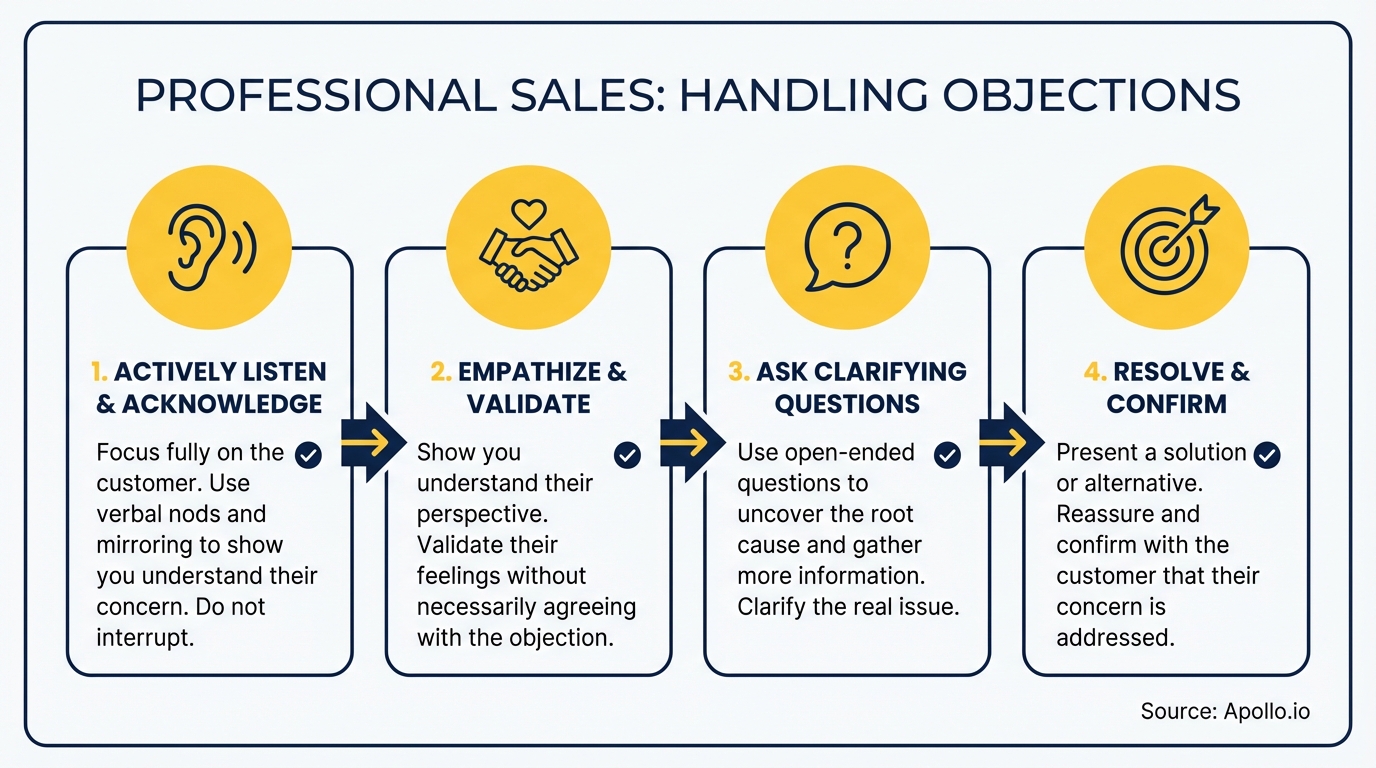
- Acknowledge: Repeat the objection back in your own words. "So the concern is timing, not fit?"
- Isolate: Confirm it's the real objection. "If we could solve the timing issue, would you be open to moving forward?"
- Validate: Normalize the concern with social proof or data.
- Respond: Provide a concise, evidence-backed answer, not a pitch.
- Confirm: Check that the objection is resolved before moving on.
According to Tendril, sales representatives who embrace objections as part of the process close 15-20% more deals than those who avoid them. Reframing objections as buying signals, not rejections, is the foundational mindset shift.
Struggling to track objection patterns across your outreach? Apollo's multi-channel sales engagement platform lets SDRs log objections by sequence step and refine messaging based on what actually converts.
Turn Funnel Gaps Into Pipeline Gold
Pipeline forecasting a guessing game because leads stall before they ever become opportunities? Apollo surfaces in-market buyers with intent signals so your team reaches the right prospects at exactly right moment. Join 600K+ companies building predictable pipeline.
Schedule a Demo →What Are the Most Effective Objection-Handling Techniques for AEs?
For Account Executives managing late-stage deals, objections are less about skepticism and more about risk mitigation. Buyers at this stage have made a tentative decision but need confidence to commit.
The techniques that work best:
| Objection Type | Technique | Asset to Deploy |
|---|---|---|
| Price/ROI | Reframe total cost of inaction | ROI calculator, case study |
| Security/AI risk | Provide security review pack | IT/CISO brief, compliance FAQ |
| Implementation risk | Share phased rollout plan | Implementation timeline, onboarding guide |
| Internal alignment | Facilitate committee consensus | Mutual action plan, executive brief |
| Timing | Anchor to a business event | Urgency trigger, milestone map |
For high-ticket sales and enterprise deals, the internal alignment objection is frequently the deal-stopper. Providing stakeholder-specific briefs (CFO, CIO, Procurement) gives your champion the tools to build consensus without a rep in the room. See how top enterprise reps structure multi-stakeholder deals for a practical approach.

How Does Active Listening Improve Objection Handling?
Active listening is the foundation of effective objection handling. As Klozers notes, active listening is crucial for understanding the prospect's concerns, building trust, and grasping the underlying issues beneath the stated objection. Most reps hear the surface objection and respond to it. Top performers diagnose the root cause first.
Practical active listening habits:
- Pause for 2-3 seconds after the prospect finishes speaking before responding.
- Summarize what you heard before offering any response.
- Ask clarifying questions: "Can you help me understand what's driving that concern?"
- Note the emotional tone, not just the words. Hesitation often signals unstated concerns.
Conversation intelligence tools are now making active listening a measurable, coachable skill. Apollo's AI call assistant automatically surfaces objection moments in recorded calls, so sales leaders can coach reps on specific responses rather than generic technique. Losing deals to objections you never see coming? Track every deal stage and objection signal in Apollo's deal management platform.
How Should RevOps Teams Systematize Objection Handling?
RevOps leaders are increasingly treating objections as a data problem, not a training problem. The goal is to build an institutional objection-handling system: capture objections from calls, classify them by type and stage, update battlecards on a defined cadence, and measure response effectiveness by win rate impact.
A basic objection ops workflow:
- Tag objections in your CRM or conversation intelligence tool by category.
- Review top objections weekly in pipeline reviews. For guidance on using sales analytics to drive revenue, see Apollo's breakdown.
- Update response playbooks and battlecards monthly based on win/loss data.
- Use AI role-play tools to certify reps on updated responses before deploying to live deals.
This "objection ops" approach turns individual rep skill into a repeatable team capability. For sales KPI tracking in 2026, objection resolution rate by stage is an emerging metric worth adding to your dashboard.

Conclusion: Objection Handling Is Now a Team Sport
Handling objections in sales in 2026 requires more than sharp rebuttals. It demands buyer enablement assets, committee alignment tools, conversation intelligence, and a RevOps system that turns every lost deal into better future messaging.
The reps who win are the ones whose teams have already addressed the objection before the call starts.
Apollo gives GTM teams one unified platform to prospect smarter, engage across channels, record and analyze calls, and manage deals, replacing the fragmented stack that slows response times and lets objections fester. As Cyera put it: "Having everything in one system was a game changer."
Get Leads Now and start handling objections with the full context your team needs to close.
Prove Pipeline ROI With Apollo
ROI pressure killing your tool budget approval? Apollo delivers measurable pipeline impact fast — Leadium 3x'd annual revenue and GTM Ops drives 4x more meetings. Start your free trial today.
Start Your Free Trial →Don't miss these
Sales
Inbound vs Outbound Marketing: Which Strategy Wins?
Sales
What Is a Sales Funnel? The Non-Linear Revenue Framework for 2026
Sales
What Is a Go-to-Market Strategy? The 2026 GTM Playbook
See Apollo in action
We'd love to show how Apollo can help you sell better.
By submitting this form, you will receive information, tips, and promotions from Apollo. To learn more, see our Privacy Statement.
4.7/5 based on 9,690 reviews
